
HOW MANY SETTERS PER CLOSER
How Many Setters per Closer? Calculate It From Your Inbound Counts
There is no fixed answer to how many setters per closer an inbound sales floor needs. The number comes from the firm's own application and contact counts, and this guide shows the calculation step by step. It provides no typical or recommended ratio.
Watch a contact get pre-qualified.
This is exactly what your CRM gets back.
Your opt-in form
Soft pull · no impact to their credit
This is not a real soft pull. It's an example of the data points that land in your CRM contact record when a lead fills out your form.
LEADFI DEMO
Watch the demo, then start free or book a call.
GUIDE
Why there is no fixed number of setters per closer on an inbound floor
A ratio copied from another floor ignores the work behind it. Two teams receiving the same number of applications can require different setter coverage because their measured attempts, live-contact time, wrap work and set rates differ.
Application volume sets the starting point
Begin with applications the firm already receives through the client's intake form. Separate days, offers or campaigns when their workloads differ materially, but do not infer an expected route mix from another account.
Contact work drives setter demand
A setter works submitted inbound applications and prepares the next sales conversation. A closer is the senior representative who handles the main high-ticket conversation. Setter demand therefore depends on the firm's recorded attempts, contacts, talk time, wrap time and booking work.
Closer slots are an existing input
Take closer call slots per day from the schedule the firm already maintains. Do not derive slots from a revenue target or re-create the calendar model here. For the calendar split and closer-slot mechanics, see how to route leads to calendars by qualification.
Floor design changes daily coverage
Meetings, breaks, training, administrative work and coverage windows affect productive setter hours. Plan from productive hours by day or time block rather than copying a headcount ratio.
GUIDE
Working out how many setters per closer from your own applications, contacts and closer slots
The calculation has two parts: determine the setter hours required by submitted applications, then compare calculated senior-closer sets with the closer slots already staffed.
Define each route before counting
For this page, financially qualified means the application meets the client's written routing rule for a first conversation with a senior closer. Not financially qualified means the first conversation offered is about the client's lower-ticket offer. The SQL route is the financially qualified route; the NQL route is the not financially qualified route.
Neither label is an approval, eligibility or admission decision, and neither is a judgment of the person. This page describes a routing input, not a credit decision, approval, or eligibility determination. An applicant whose first offered conversation concerns the lower-ticket offer can still ask to discuss the flagship offer and is not refused that conversation.
Keep no-result records separate
Report three groups: the financially qualified route, the not financially qualified route and no result. A record without a readiness result must remain in the no-result group rather than being classified into either other route.
The route comes only from applications submitted to the client's own form with the client's disclosures and the applicant's authorisation. Setters and closers see only the route or readiness band and never the figures behind it.
Every application still receives a staffed first contact within the client's written response standard. The route changes which conversation is offered first and who staffs it, not whether someone is contacted. The client's written routing rule should identify whether a trained setter or another designated representative staffs the lower-ticket conversation.
Gather the daily staffing inputs
Use the firm's own records for:
- Applications per day
- Attempts per application under the firm's written contact policy
- Reached contacts by route, with no result separate
- Contacts per setter hour for each conversation where measured rates differ
- Sets per contact on the financially qualified route
- Administrative and handoff hours
- Productive hours per setter
- Existing closer call slots per day
- Staffed closers per day
- The role assigned by the client's written rule to handle the lower-ticket conversation
The firm sets its contact policy, confirms its workflow choices with counsel and applies the same first-contact standard to every submitted request.
Calculate contact and attempt hours
Live-contact hours by route =
Reached contacts on that route
÷ Contacts per setter hour for that conversation
Add the financially qualified, lower-ticket and no-result contact hours.
Total attempts =
Applications per day × Attempts per application

Non-contact attempts =
Total attempts − Reached contacts

Non-contact attempt hours =
Non-contact attempts ÷ Non-contact attempts per hour
Adjust the second formula if the firm's records define contact events differently.
Calculate sets per setter day
Senior-closer sets per day =
Reached financially qualified contacts × Sets per contact

Sets per setter day =
Senior-closer sets per day ÷ Scheduled setters
This is an operating result from the firm's records, not a quota or benchmark.
Convert workload into setter coverage
Required setter hours =
Live-contact hours
+ Non-contact attempt hours
+ Administrative and handoff hours

Required setter coverage =
Required setter hours ÷ Productive hours per setter
Use the unrounded coverage result for analysis. The firm can then apply its own scheduling rules to partial shifts.
Calculate the setter-to-closer ratio
First compare calculated sets with the existing slot input:
Slot difference =
Closer slots per day − Senior-closer sets per day
Then calculate the staffing ratio:
Setter-to-closer ratio =
Required setter coverage ÷ Staffed closers
The result applies only to the period and records used. It is not a recommended ratio for another floor.
GUIDE
A placeholder setter-to-closer calculation
Every number below is a fictional placeholder, not an average, target, forecast or recommendation. Replace each value with the firm's own records.
Fictional placeholder inputs
| Input | Fictional placeholder only |
|---|---|
| Applications per day | 120 |
| Attempts per application | 2.4 |
| Total reached contacts | 54 |
| Financially qualified contacts | 30 |
| Lower-ticket route contacts | 20 |
| No-result contacts | 4 |
| Financially qualified contacts per setter hour | 7 |
| Lower-ticket contacts per setter hour | 4 |
| No-result contacts per setter hour | 6 |
| Non-contact attempts per hour | 24 |
| Sets per financially qualified contact | 0.40 |
| Administrative and handoff hours | 2 |
| Productive hours per setter | 5.5 |
| Existing closer slots per day | 14 |
| Staffed closers | 2 |
| Lower-ticket conversation owner | Trained setter under the client's written rule |
These fictional route counts do not indicate an expected mix.
Placeholder contact and attempt hours
Financially qualified contact hours = 30 ÷ 7 = 4.29
Lower-ticket contact hours = 20 ÷ 4 = 5.00
No-result contact hours = 4 ÷ 6 = 0.67

Total live-contact hours = 9.96
Total attempts = 120 × 2.4 = 288
Non-contact attempts = 288 − 54 = 234
Non-contact attempt hours = 234 ÷ 24 = 9.75
Placeholder setter coverage and ratio
Required setter hours =
9.96 + 9.75 + 2.00 = 21.71

Required setter coverage =
21.71 ÷ 5.5 = 3.95 fictional setter shifts
The fictional senior-closer set and slot check is:
Senior-closer sets = 30 × 0.40 = 12
Slot difference = 14 − 12 = 2 fictional slots
The fictional ratio is:
3.95 fictional setter shifts ÷ 2 fictional staffed closers
= 1.975 fictional setter shifts per closer
A report could display 1.98 after rounding, but it remains an output from fictional placeholders rather than a staffing rule.
ROUTING
How a route written at submission changes the inputs to the ratio
Financial-readiness qualification can turn one inbound application pool into measurable conversation paths. It supplies an operating input based on the client's written rule; it does not decide whether the person may buy.
Readiness creates a route, not a verdict
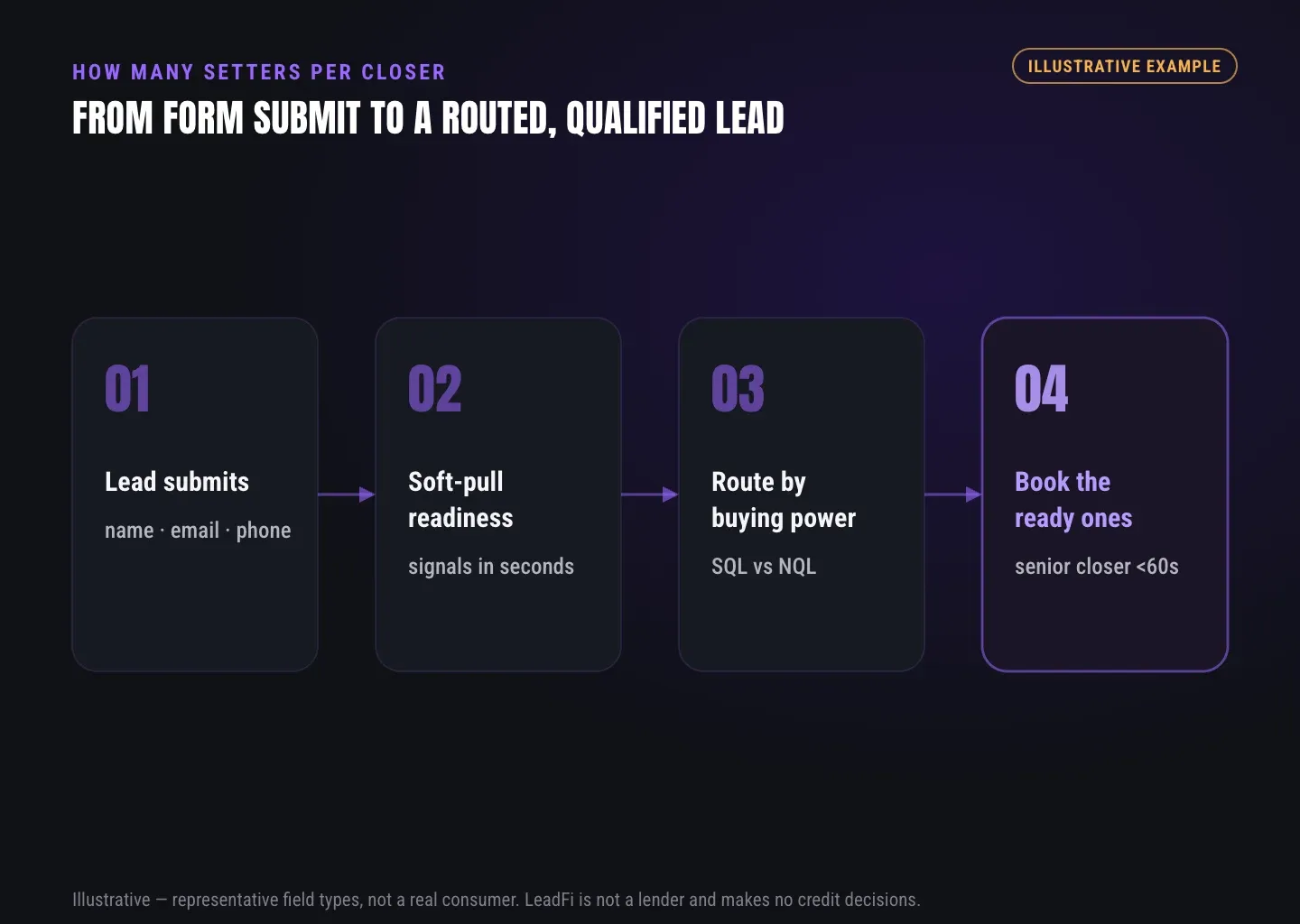
LeadFi is designed to return a readiness band or route after an authorised application. Reps and managers work from that route and do not see, record or quote the underlying figures. Questions about the check follow the client's written disclosure and go to the client's designated contact.
SQL and NQL routes split the workload
Operations can count senior-closer sets, lower-ticket conversations and no-result records separately. CRM records may include the route, assigned team, first staffed contact, conversation offered, set outcome and work time. They should not contain hidden financial figures.
Every application keeps staffed contact
Every submitted application receives a staffed first contact under the client's written response standard. Neither route receives fewer first-contact attempts or a lower contact standard. The route decides only which conversation is offered first and who staffs it.
The client owns the written rule
The client defines the routing rule, offers, prices and payment policy. A setting or closing firm follows those written instructions without changing or overriding them. Payment options follow one written policy applied to every buyer and are not determined by the readiness route.
The CRM receives only the operating route
LeadFi can send the route to the client's existing workflow through an API, webhook, Zapier, Make or supported native connection. The workflow can then apply the client's approved assignment, stage, task or calendar path. A no-result record remains separate and follows the client's written no-result route.
| Staffing input | One blended ratio | Route-based calculation |
|---|---|---|
| Application count | One total | Total plus separate route counts |
| Contact policy | Applied to every application | Applied to every application |
| Attempts per application | One measured input | Same measured input under the written policy |
| Live-contact time | Blended rate | Measured by conversation when useful |
| Senior-closer sets | May be mixed with total bookings | Counted from the financially qualified route |
| Lower-ticket conversations | May be hidden in total contacts | Included as setter-side work |
| No-result records | Can be misclassified | Kept as a separate group |
| Rep visibility | General application status | Route or readiness band only |
| Underlying financial figures | Not needed | Not shown or recorded in rep-facing fields |
| Staffing output | Broad ratio | Setter hours, coverage, sets and ratio |
ROUTING
Comparing one blended ratio with a route-based model
Both models begin with the same submitted inbound applications. A blended model summarizes overall activity, while a route-based model keeps the conversation paths and no-result group visible in the staffing calculation.
The route-based view is intended to clarify setter workload. It does not change the contact standard, dignity or access to a flagship-offer conversation for any applicant.
See which of the leads you already have can actually afford to buy.
GUIDE
Counting setter hours for the lower-ticket conversation
The lower-ticket conversation is part of setter capacity and must be included in the calculation rather than omitted from the workload.
Count the complete conversation
Measure live talk time, wrap work, approved notes and next-step booking. Use the firm's observed time rather than a borrowed duration.
Lower-ticket contact hours =
Reached lower-ticket contacts
÷ Lower-ticket contacts per setter hour
Add separate administrative time only when it is not already included in the measured contact rate.
Keep contact treatment consistent
The lower-ticket route must not receive fewer first-contact attempts or less setter time per application. Conversation lengths can differ naturally, but those differences should be measured after they occur rather than imposed as a lower service standard.
Record operating outcomes only
The CRM can record the conversation offered, contact outcome, handle time, next step and whether the applicant requested a flagship-offer discussion. It should record the route or readiness band only, not underlying financial figures.
Review demand by time block
Daily totals can hide periods when applications arrive faster than staffed capacity. Compare applications, attempts, contacts and setter hours by the firm's chosen time blocks without turning the result into a universal ratio.
GUIDE
Setter and closer staffing examples
These scenarios illustrate how inputs can move. They contain no expected results or recommended ratios.
Contact time rises
If the application count stays constant while live calls take longer, contacts per setter hour decline and required setter hours increase.
Contact outcomes change
If more attempts result in live contact under the same written policy, live-contact hours may rise while non-contact attempt hours fall. Use the firm's measured talk and wrap time to calculate the net effect.
Lower-ticket conversation volume changes
If the client's own authorised application records show more lower-ticket conversations during a reporting period, include that work in setter capacity without changing the first-contact standard.
No-result records increase
Keep no-result records separate, check the workflow and follow the client's written no-result route. Do not relabel them based on assumptions.
Closer slots stay fixed
If setter output changes while the existing closer-slot input remains fixed, compare calculated senior-closer sets with those slots. The difference alone does not prescribe headcount, routing or applicant treatment.
GUIDE
Who should use this staffing model
This model is for teams working applications people submitted to the client's own form with the client's disclosures and their authorisation. It is not for cold outreach, purchased lists, scraped records or prospecting databases.
High-ticket offer teams
Coaching, consulting, course, agency and other high-ticket teams can use the model when their call structure and offers are already defined. The calculation starts with actual inbound volume rather than a revenue target.
Credit-adjacent teams
Credit-adjacent firms can use route and workload counts for staffing, but the route must not become an approval, underwriting, pricing, enrollment or eligibility result. LeadFi does not approve or deny consumers.
Sales agencies and setting firms
An agency should calculate each client account from that account's own records. It should not pool, compare or carry readiness results across clients. The client owns the routing rule and offer paths.
Revenue and sales operations teams
Operations teams can match application times, routes, staffed contacts, attempt counts, conversation types, set outcomes and work time with scheduled capacity. Clean operating records are more useful than an external benchmark.
ROUTING
Capability notes for LeadFi routing
LeadFi is a financial-readiness engine for high-ticket and credit-adjacent businesses. It qualifies existing inbound applications and returns an operating route to the client's stack; it does not generate or buy leads.
Route existing inbound applications
LeadFi can support thin-input, soft-pull financial-readiness workflows where the client's configuration, consent and disclosures allow them. The output used in this staffing model is the readiness band or route, not a consumer approval or denial.
Show representatives only the route
Setters, closers and managers should see only the route or readiness band. They should not view, record, quote or discuss the figures behind it with the applicant.
Connect the existing stack
LeadFi can connect through webhooks, APIs, Zapier, Make or a supported native workflow. The route can update an approved assignment, stage, task or calendar path while the client retains its primary systems and written routing rule.
Set up the workflow before launch
LeadFi can help teams plan privacy and consent language, route states, CRM fields, rep access and other compliance-aware workflow choices before launch. LeadFi does not provide legal advice or guarantee compliance. Clients should review their use case with counsel.
Related reading: a practical guide to measure lead quality, a practical guide to marketing lead qualification, a closer look at optimizing Meta ads for qualified leads.
Key takeaways
The short version
- There is no universal or recommended setter-to-closer ratio.
- Calculate setter coverage from the firm's own inbound workload.
- Keep financially qualified, lower-ticket and no-result records separate.
- Every application receives a staffed first contact under the same standard.
- Setters and closers see the route, never the figures behind it.
Quick answers
Fast answers before you dig in
How many setters per closer should an inbound sales floor have?
There is no fixed or recommended ratio. Divide required setter coverage—calculated from the firm's own contact, attempt and administrative hours—by the number of staffed closers.
What is the setter-to-closer ratio formula?
Setter-to-closer ratio = required setter coverage ÷ staffed closers. Required coverage = total setter workload hours ÷ productive hours per setter.
How does financial-readiness routing affect staffing?
It separates senior-closer, lower-ticket and no-result workloads so each conversation path can be measured. Every application still receives a staffed first contact.
FAQ
Common questions
How many setters per closer should an inbound sales floor have?
What is the basic setter-to-closer ratio formula?
Which counts are needed to calculate how many setters per closer?
What does SQL vs NQL routing mean in this staffing model?
Does financial-readiness routing change who receives contact?
Should setters or closers see the financial figures behind a readiness route?
Does a LeadFi soft-pull workflow approve or deny an applicant?
Sources
References
- CFPB — What is a credit inquiry? (hard vs. soft) (opens in a new tab)Federal regulator confirms a soft inquiry, unlike a hard inquiry, does not affect the consumer's credit score.
- VantageScore — VantageScore 4.0 credit scoring model (opens in a new tab)Official page describing VantageScore 4.0, the tri-bureau, trended-data model used to assess credit risk.
- Experian — What Is a Soft Inquiry? (opens in a new tab)Major credit bureau explains soft inquiries are informational and have no impact on credit scores.
Know who is ready before your next sales call.
A useful setter-to-closer ratio starts with the firm's own authorised inbound records, not a copied benchmark. LeadFi can sit behind the current form, funnel, calendar or CRM and return the financial-readiness route needed for a measurable SQL vs NQL workflow.