
MARKETING LEAD QUALIFICATION
Marketing Lead Qualification: Build a Sales Handoff Around Real Readiness
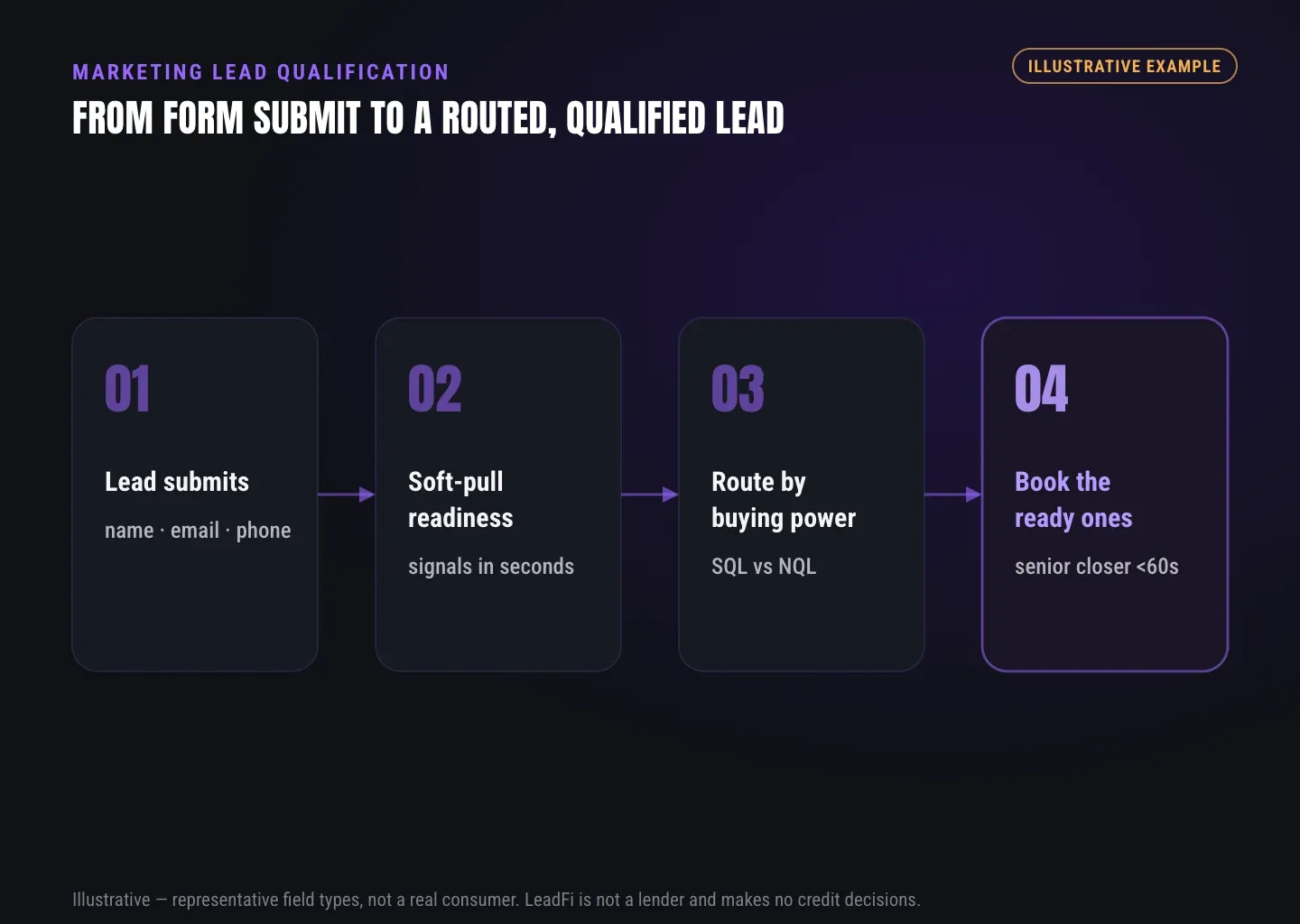
Marketing lead qualification should answer a practical question: what should happen after an existing inbound lead responds? A form fill can show interest, but it rarely tells sales whether to follow up immediately, send the record for review, or use a different path.
Watch a contact get pre-qualified.
This is exactly what your CRM gets back.
Your opt-in form
Soft pull · no impact to their credit
This is not a real soft pull. It's an example of the data points that land in your CRM contact record when a lead fills out your form.
LEADFI DEMO
Watch the demo, then start free or book a call.
GUIDE
Define a marketing qualified lead
A marketing qualified lead, or MQL, is an inbound contact who meets marketing’s chosen rules for the next step. Those rules may cover offer fit, intent, location, source, form answers, and financial readiness. An MQL is not necessarily ready for a closer; the label should begin a defined handoff rather than end qualification.
Tie status to an action. State whether an MQL enters sales review, receives a booking path, or moves into deeper intake. Define the owner, queue, required fields, response path, and timestamp.
Separate fit, intent, and readiness. Fit asks whether the lead matches the offer. Intent reflects actions such as requesting pricing, submitting an application, or booking a call. Financial readiness adds buying-power context. Keep these dimensions visible instead of hiding them inside one unexplained score.
Keep stages distinct. An SQL meets the team’s operating rules for direct sales action. An NQL does not meet the current rules for the primary route but may still fit nurture, a lower-ticket product, an alternate offer, or manual review. These handoff criteria are the team’s own operating choices and do not represent consumer approval or denial.
Store evidence. Useful CRM fields include identity details, campaign source, offer, intent event, fit result, readiness status, route, timestamps, and rule version. Short reason codes such as MQL_HIGH_INTENT, SQL_READY, and NQL_NURTURE make stage changes easier to review.
Example. A consulting firm selling a $7,500 engagement marks a matching strategy-call applicant as an MQL based on fit and intent. LeadFi can then add a configured readiness result. Under the firm’s rules, an SQL can enter a senior closer’s queue while an NQL receives a workshop, nurture sequence, alternate offer, or review.
GUIDE
Align lifecycle stages before a handoff
Marketing, sales, and RevOps need one shared lifecycle map. Otherwise, marketing may count every form fill as an MQL while sales expects a booked call with complete context.
Start with one intake event. Choose a primary event for each funnel, such as an application, demo request, webinar response, or booking request. This reduces duplicate records and competing stage rules.
Use stable MQL criteria. Campaign, offer, location, business type, stated need, and form completion can establish fit and intent. Version the rules whenever they change so reports do not compare unlike groups.
Connect SQL status to action. An SQL should trigger a defined queue, task, calendar, alert, or sales workflow. This turns SQL vs NQL routing into an operating process rather than a dashboard label.
Give NQLs a next step. NQL should mean the lead does not meet the current rules for the primary sales route—not that the record has no value. Nurture, lower-ticket products, alternate pages, other internal teams, and manual review can preserve useful demand.
Control exceptions. Create a review stage for missing data, identity conflicts, duplicates, or cases requiring human judgment. Name an owner and response target rather than burying these records in SQL or NQL totals.
A practical lifecycle can use New, MQL, Qualification Pending, SQL, NQL, and Sales Accepted. Keep meetings, opportunities, customers, nurture, and closed outcomes as later stages rather than forcing every funnel event into the MQL definition.
Example. A coaching company can record webinar source and engagement first, mark applicants as MQLs under its criteria, and use a configured LeadFi readiness result for routing. SQLs can enter the priority sales path, while NQLs receive replay content, a lower-ticket offer, or longer-term nurture.
INTELLIGENCE LAYER
Add readiness context to an intake record
Marketing lead qualification often relies on stated budget, clicks, job title, and form depth. Those inputs can indicate interest without establishing buying power. LeadFi adds financial-readiness context after an inbound lead submits through the team’s existing capture flow.
Establish the match first. LeadFi’s patent-pending identity matching is designed to establish a high-confidence match before soft-pull prescreening and, where applicable, deeper bureau-backed workflows. Many configurations can begin with name, email, and phone. Identity-related information and identity signals, such as current address or age, may also apply depending on the workflow. The purpose is reliable matching and routing—not avoiding required data, consent and disclosures, or review.
Use the soft pull as context. In a configured soft-pull workflow, prescreening can add readiness context without affecting the consumer’s credit score. Teams must align their forms, privacy terms, consent and disclosures, and data flows with the use case. LeadFi supports compliance-aware workflows but does not provide legal advice.
Choose relevant signals. Depending on configuration and availability, readiness signals may include VantageScore 4.0, available credit, income, debt, debt-to-income ratio, current address, age, and optional net-worth-style or asset context. These signals support routing and rep preparation; LeadFi does not approve or deny consumers.
Convert signals into operating rules. Each team decides how readiness works with offer fit, intent, source, capacity, and sales coverage. One funnel might route financially qualified leads to a senior closer, while another uses readiness bands to select between primary, alternate, nurture, and review paths.
Keep CRM output actionable. Useful fields include qualification status, readiness band, route reason, offer path, owner, calendar route, source, processing status, and rule version. Avoid copying unnecessary sensitive values into notes, alerts, or campaign audiences.
LeadFi can return configured outcomes through a webhook, API, Zapier, Make, or supported native workflow. Existing forms, funnels, CRMs, calendars, and sales processes can remain in place.
Agency example. An agency receives applications for a client’s $5,000 service. After submission, LeadFi can add a readiness result, tag SQLs for prompt follow-up, and send NQLs into a separate campaign while preserving source attribution.
Credit-adjacent example. A business receives an inbound paid-search request and checks campaign fit, service area, and form status. With the appropriate configured workflow, consent and disclosures, LeadFi can add financial-readiness context to inform the business’s chosen sales route. The result supports qualification and rep preparation, not consumer approval or denial.
See which of the leads you already have can actually afford to buy.
GUIDE
Review handoff quality without performance promises
Review marketing lead qualification through data coverage, stage accuracy, route completion, response timing, sales acceptance, and outcome feedback. These measures reveal operational gaps without treating one conversion rate as proof that qualification caused an outcome.
Track coverage. Confirm that each record includes required contact details, source, offer mapping, consent status, and qualification result. Fix intake gaps before changing readiness thresholds.
Audit accuracy. Sample records from SQL, NQL, review, unavailable, and no-match groups. Compare each route with the written rules and recorded reason code. This evaluates the workflow—not the value or potential of an individual.
Measure timing. Store timestamps for submission, qualification, assignment, first sales attempt, and route completion. Real-time classification has limited value if priority records remain unassigned.
Separate routing from acceptance. Sales acceptance shows whether a person or queue took ownership. Keep it distinct from the initial qualification result so RevOps can tell the difference between routing quality and staffing capacity.
Return useful outcomes. Marketing feedback can include SQL, NQL, review, no match, sales accepted, meeting held, and later opportunity stages. Where platform policies and the team’s setup allow, appropriately minimized qualified-lead events can feed Meta, Google, TikTok, Hyros, and related systems. Sensitive financial values should not be exposed to advertising platforms, and no platform result is guaranteed.
Monthly review example. If a landing page omits an offer code, affected records may enter manual review. Fixing the field map is more useful than changing a readiness rule that was not responsible for the issue.
Definition dispute example. If marketing treats a guide download as an MQL while sales expects a qualified call request, align the lifecycle definition before adding more scoring inputs.
NQL example. If SQLs enter a closer queue but NQLs disappear, map the non-primary group to nurture, a lower-ticket product, an alternate page, or review. LeadFi can support these routes according to the team’s logic and connected stack.
INTELLIGENCE LAYER
Who benefits from readiness-based qualification
Readiness-based marketing lead qualification is most useful when sales time is expensive and an inbound lead can follow more than one valid path.
High-ticket teams. Coaches, consultants, agencies, course creators, and information-product businesses selling offers around $1,000 to $10,000 or more can use readiness routing to decide which leads reach setters, closers, alternate offers, or nurture. The team retains control of its handoff criteria.
Credit-adjacent teams. Business funding, mortgage, lending, insurance, auto, and real estate teams may need additional financial context during intake. Each workflow requires appropriate data choices, consent and disclosures, and review with counsel. LeadFi remains a qualification and routing layer and does not approve or deny consumers.
RevOps teams. RevOps can connect form events, CRM fields, queues, reason codes, and reports while monitoring duplicate stages, field-map failures, and rule drift. LeadFi can complement the core CRM through fields, tags, stages, webhooks, and triggers.
Demand-generation teams. Keeping SQL, NQL, review, and later outcomes attached to original source data helps marketing compare lead profiles rather than optimizing solely for raw volume. Any campaign-system feedback should use permitted, minimized events and be evaluated against the team’s own data.
Related reading: practical insights on sales lead qualification, a practical guide to buying power data for lead qualification, practical insights on soft credit check without address for lead qualification.
| Handoff area | Weak setup | Aligned setup | LeadFi capability |
|---|---|---|---|
| MQL definition | Any form fill | Written fit and intent rules | Adds configured readiness context after capture |
| SQL definition | Rep decides from limited notes | Defined sales-action rules | Supports SQL, NQL, review, or unavailable routing |
| NQL treatment | Ignored or marked lost | Nurture, alternate offer, or review | Triggers the team’s selected non-primary path |
| CRM record | Contact and source only | Status, reason, time, and rule version | Can write fields, tags, stages, and triggers |
| Calendar path | Every lead sees one calendar | Next step varies by route | Supports routing based on the configured workflow |
| Campaign feedback | Optimizes for raw lead volume | Uses permitted, minimized quality events | Can supply configured qualified-lead signals |
| Attribution | Keeps only the last visible source | Connects source and qualification outcomes | Adds readiness context to reporting |
| Compliance setup | Reviewed after launch | Reviewed with forms and data flow | Supports compliance-aware onboarding |
Key takeaways
The short version
- Tie every MQL status to a specific owner and next action.
- Keep fit, intent, financial readiness, and route reasons distinct.
- Use SQL vs NQL routing as the team’s operating process.
- LeadFi can enrich submitted leads from thin inputs in configured workflows.
- Measure coverage, routing, timing, acceptance, and downstream outcomes.
Quick answers
Fast answers before you dig in
What is marketing lead qualification?
Marketing lead qualification checks whether an existing inbound lead meets the team’s rules for the next lifecycle stage. Effective criteria combine fit, intent, source, required intake data, and—where appropriate—financial readiness.
What is an MQL?
An MQL is an inbound contact who meets marketing’s documented criteria for a defined next action. MQL status should identify an owner, route, required context, and exit rule.
How should teams align an MQL-to-SQL handoff?
Define MQL, SQL, NQL, review, and sales-accepted stages separately. Record the rule, reason, owner, route, timestamp, and rule version for every stage change.
How does financial readiness support marketing lead qualification?
Financial readiness adds buying-power context to submitted inbound records so a team can apply its own SQL, NQL, nurture, alternate-offer, or review rules before sales follow-up.
Can LeadFi work from name, email, and phone?
Many LeadFi workflows can begin with name, email, and phone. Exact inputs depend on identity matching, the configured workflow, consent and disclosures, and applicable product requirements.
What should happen to NQLs?
NQLs should receive a defined non-primary path, such as nurture, a lower-ticket offer, an alternate page, another internal queue, missing-data follow-up, or manual review.
FAQ
Common questions
What is marketing lead qualification?
What should an MQL lifecycle definition include?
How does a marketing qualified lead handoff work?
How does financial readiness fit into marketing lead qualification?
Can LeadFi run a soft pull from name, email, and phone?
Does a LeadFi soft pull affect the consumer’s credit score?
How does SQL vs NQL routing connect to a CRM or calendar?
Sources
References
- CFPB — What is a credit inquiry? (hard vs. soft) (opens in a new tab)Federal regulator confirms a soft inquiry, unlike a hard inquiry, does not affect the consumer's credit score.
- VantageScore — VantageScore 4.0 credit scoring model (opens in a new tab)Official page describing VantageScore 4.0, the tri-bureau, trended-data model used to assess credit risk.
- CFPB — Who can request to see my credit report? (opens in a new tab)Federal regulator explains the FCRA rules governing who may obtain a credit report.
- VantageScore 4.0 (opens in a new tab)Official model information for the named score referenced in the article.
Know who is ready before your next sales call.
LeadFi can sit behind your current form, funnel, calendar, or CRM to enrich existing inbound leads and support financial-readiness-based SQL vs NQL routing before sales follow-up. It also supports compliance-aware setup and does not approve or deny consumers.