
BUYING POWER DATA FOR LEAD QUALIFICATION
Buying Power Data For Leads: Qualify By Real Financial Readiness Before Reps Call
Your closers have a fixed number of hours each week. Every hour spent on a prospect who can't fund a $1,000–$10,000+ offer is an hour stolen from a real buyer. That math only gets worse as ad spend climbs and calendars fill with leads who look interested but aren't ready.
Watch a contact get pre-qualified.
This is exactly what your CRM gets back.
Your opt-in form
Soft pull · no impact to their credit
This is not a real soft pull. It's an example of the data points that land in your CRM contact record when a lead fills out your form.
LEADFI DEMO
Watch the demo, then start free or book a call.
PLATFORM OVERVIEW
What Buying Power Data For Leads Actually Means
Quick answer: Buying power data for leads is financial-readiness context tied to each lead — credit score, available credit, income, and debt-to-income. You use it to route and prep, not to approve or deny. LeadFi surfaces these signals after a lead submits, so sales focuses on prospects who can fund the offer.
Most teams treat "lead data" as a name and an email. But that tells you who showed up, not whether they can buy. Buying power data adds the missing layer: a read on financial readiness before a rep ever dials.
For high-ticket sellers, that gap is costly. In LeadFi's client experience, self-reported application data is often inflated or vague, and a large share of booked calls turn out to be prospects who can't afford a premium offer. So the term matters most when your offer starts around $1,000 and climbs.
Readiness, not a verdict
Readiness means fitness for the next conversation — not a judgment of personal worth. LeadFi classifies and routes; it never approves or denies consumers. Treat the score as context for your team, not a decision about the person.
Built for high-ticket and credit-adjacent teams
This data earns its keep when sales time is costly. For example, it covers coaches, consultants, agencies, course creators, funding, mortgage, lending, real estate, insurance, and auto. If your offer is roughly $1,000–$10,000+, the buying-power read pays for itself in saved rep hours.
Not generic lead scoring
Generic scoring guesses from clicks, opens, and form answers. LeadFi instead reads permissioned financial-readiness signals through soft-pull prescreening. As a result, you route on buying power — not on engagement that may mean nothing.
INTELLIGENCE LAYER
From Name, Email, And Phone To Real-Time Financial-Readiness Insights
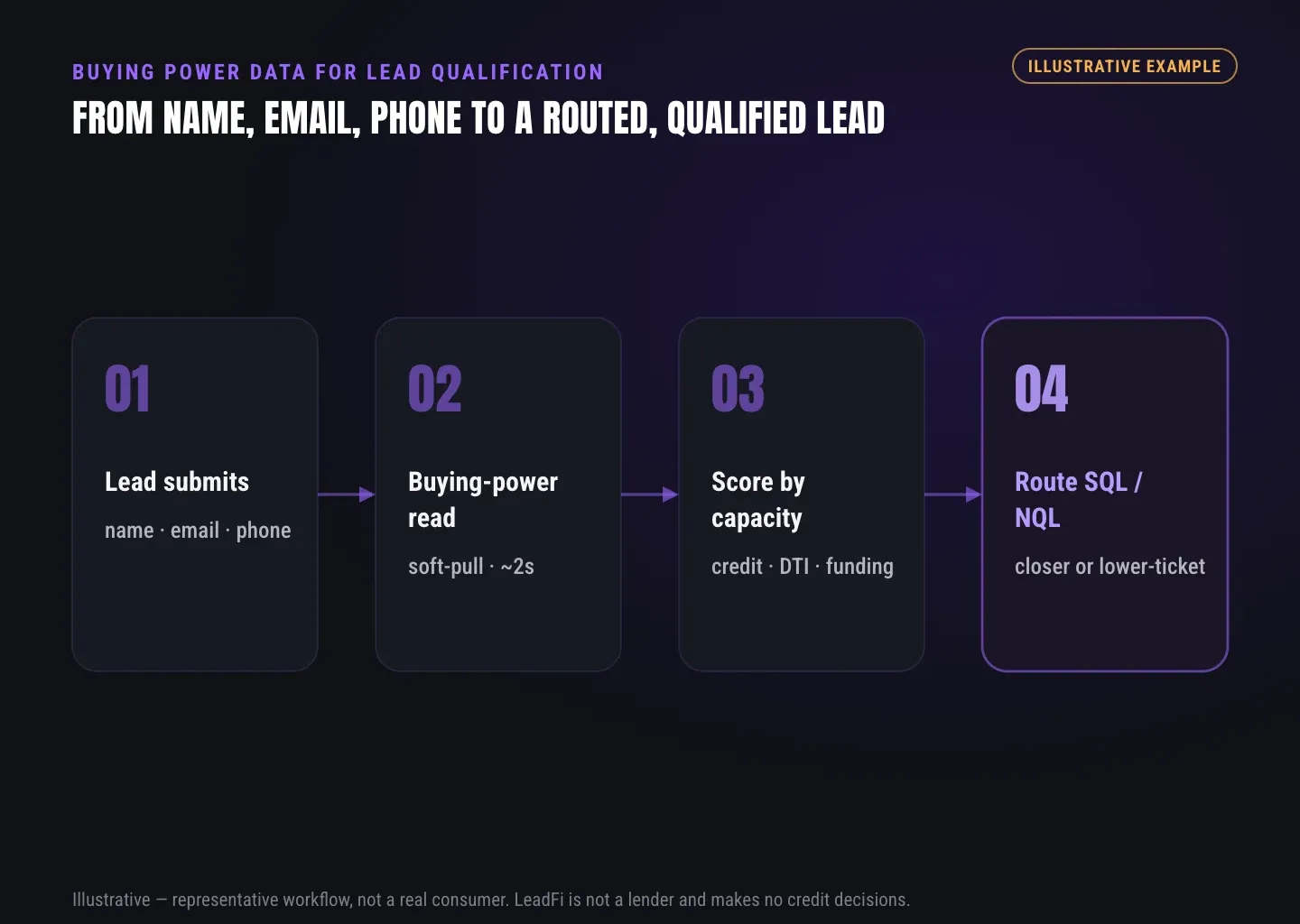
Quick answer: LeadFi can work from just name, email, and phone. Patent-pending identity matching is designed to establish a high-confidence match before soft-pull prescreening runs. That thin-input approach reduces form friction while still returning real readiness context — for many workflows, no SSN or date of birth is collected up front.
Long forms kill conversion. Every extra field — address, date of birth, SSN — costs you submissions and trust. So LeadFi is built to start from the three fields most funnels already capture.
Here's the sequence. First, identity matching confirms a high-confidence match using identity-related information like current address and age. Next, soft-pull prescreening reads the readiness signals. Then, where the workflow supports it, deeper bureau-backed credit-report workflows can follow with proper consent and disclosures.
Thin-input prescreening
Thin input means name, email, and phone — nothing heavy up front. For many paths, you skip asking for address and DOB on the form itself. As a result, your funnel stays light while the match and the soft pull happen behind the page.
High-confidence identity match first
A soft pull is only useful if it's tied to the right person. That's why matching runs before prescreening — to anchor the read to a high-confidence match. The goal is accuracy, set up with the disclosures and consent your workflow requires.
Real numbers, not ranges
The output is meant to be specific rather than a wide guess. For high-ticket routing, more precise readiness signals help separate a real buyer from a maybe. Confirm exactly what your configured workflow returns, and align it with your disclosures.
INTELLIGENCE LAYER
The Signals: VantageScore 4.0, Available Credit, Income, DTI, And Funding Pre-Approval
Quick answer: LeadFi can surface VantageScore 4.0, available credit, income, debt, debt-to-income ratio, funding pre-approval signals, current address, age, and optional net-worth context. These are readiness signals for routing and rep prep — never approvals, denials, or underwriting. Availability depends on consent, disclosures, and your configured workflow.
Each signal answers a practical question your reps already ask on calls. Together they paint a fast picture of whether a prospect can fund the offer. Below are the main ones, framed as routing context.
Credit score and available credit
VantageScore 4.0 gives a clean readiness baseline. Available credit shows room to move now — useful when an offer can be financed on existing cards. For example, a prospect with strong available credit may route straight to a closer.
Income and debt-to-income
Income shows raw capacity; debt-to-income (DTI) shows how much of it is already spoken for. For instance, a 38% DTI reads very differently from one near the ceiling. Together they help separate "can pay today" from "needs a payment path."
Funding pre-approval signals
Some prospects can't pay cash but can finance. Funding pre-approval signals flag who likely has a financing path before the call — these are signals, not a promise of any funding outcome. As a result, your team can pre-position the right offer instead of stalling mid-deal.
Optional asset and net-worth context
Where available, optional signals like retirement, brokerage, or real estate context add depth for premium routing. Use these only when your workflow, consent, and disclosures support them. They inform priority — they do not decide anyone's worth.
ROUTING
Route SQLs To Closers And Monetize NQLs With Low-Ticket Or Alternate Offers
Quick answer: LeadFi splits leads into SQLs (sales-qualified, financially ready) and NQLs (non-qualified). SQLs fast-track to closers and fast calendars for speed-to-lead. NQLs route to low-ticket offers, payment plans, or financing paths instead of getting discarded — so the next step fires while momentum is high.
Surfacing data isn't the win — acting on it is. Most tools stop at showing a score. That's why LeadFi is designed to route on readiness, not just display it.
Routing happens in two places. First, in the CRM, workflow automations send SQLs to a senior closer or fast-track calendar and NQLs to a separate path. Second, on the funnel page, readiness data can return to the page the prospect is sitting on, so the next step adapts in real time.
Speed-to-lead for SQLs
Financially qualified leads deserve your fastest motion. For example, teams using this pattern aim to call SQLs quickly and book them onto a closer calendar right away. Faster contact on real buyers tends to lift show and close rates.
Monetize NQLs instead of dumping them
A non-qualified lead isn't worthless — it's just wrong for the primary offer right now. Instead of dropping it, route the NQL to a low-ticket funnel, a payment plan, or a financing branch. As a result, "rejected" leads become a second revenue path inside the same traffic.
Match the offer to the readiness
One offer for every lead leaves money on the table. Higher-readiness segments can see a premium path; financing-dependent segments can see a payment branch. As a result, more leads land on a path they can actually say yes to.
Cleaner calendars for closers
When NQLs route elsewhere, your closers stop absorbing dead calls. Instead, their calendars fill with prospects who can fund the offer. That focus is where the saved-hours math turns into pipeline.
| Dimension | Self-reported application data | Buying power data (LeadFi) |
|---|---|---|
| Source | What the prospect types in | Permissioned financial-readiness signals |
| Reliability | Often inflated or vague | More precise readiness signals (e.g., VantageScore 4.0, income) |
| When you learn it | On the call | After submit, before the call |
| Routing | Manual, gut-feel | SQL vs NQL, rules-based |
| Form friction | More fields lower conversion | Works from name, email, phone |
| NQL handling | Usually discarded | Low-ticket, payment plan, or financing path |
| Ad feedback | Optimizes for opt-in volume | Can feed qualified-lead signals back (where allowed) |
| Decision authority | Human judgment | Routing only — no approve/deny |
See which of the leads you already have can actually afford to buy.
ATTRIBUTION & FEEDBACK
Feed Buying-Power Signals Back Into Your CRM And Ad Stack
Quick answer: LeadFi writes qualification status, SQL/NQL labels, and permitted financial fields into your CRM via webhook, API, Zapier, Make, or native workflow. It can also feed qualified-lead signals into Meta, Google, TikTok, and Hyros — where platform rules and your setup allow — so platforms learn from real buyers, not cheap opt-ins. No platform performance or ROAS is guaranteed.
Buying-power data should live where your team already works. So LeadFi pushes outcomes into CRM fields, tags, pipeline stages, and workflow triggers. Your reps see readiness on the record; your automations route on it.
The same signal helps marketing. When your pixel trains on financially qualified events instead of raw leads, it can learn to find more buyers. In other words, that's the difference between optimizing for volume and optimizing for quality.
CRM updates that reps actually use
LeadFi can write standard and custom fields, tags, stages, and notifications. SQL/NQL status sits on the record, and workflows trigger from it. As a result, no more digging — the buying-power read is right where the rep already looks.
Integrations via webhook, API, Zapier, Make
LeadFi sits behind your form, funnel, calendar, or CRM and returns signals after submission. For example, it can integrate with GHL, HubSpot, Close, Pipedrive, Keap, and similar stacks. You don't rip anything out — LeadFi adds the readiness layer to what you run.
Smarter ad signals, not just more leads
Send qualified-lead events back to Meta, Google, TikTok, or Hyros where supported and where platform financial-services policies allow. Qualified signals can help train the algorithm toward buyers over time. Configure these audiences with your setup and platform rules in mind — no platform outcome is guaranteed.
Booked calls vs financially qualified leads
A booked call is a vanity number if the prospect can't pay. In contrast, financially qualified booked calls are the metric that maps to revenue. Feeding that signal back helps your campaigns attract the next buyer, not the next tire-kicker.
WORKFLOW DESIGN
Compliance-Aware Setup Before Launch
Quick answer: LeadFi helps teams design a compliance-aware qualification workflow before going live — privacy policy language, consent language, TCPA-aware practices, and FCRA-aware workflow guidance. This is onboarding support, not legal advice. LeadFi does not guarantee compliance and does not approve or deny consumers. Clients should review their use case with counsel.
Compliance-aware setup is part of onboarding — not a blocker to launch. The goal is one consistent story across your form, SMS, and CRM. For example, when you collect financial context, explain why it routes the prospect to the right program.
Keep it simple and honest. LeadFi supports compliance-aware workflows and helps align disclosures and consent with what actually happens on the call. Then your counsel reviews the customer-facing language and confirms consent for your use case.
What LeadFi helps with
LeadFi can help with privacy policy alignment, consent language, TCPA-aware phone and SMS practices, and FCRA-aware workflow design. In short, these are operational guardrails, set up before launch. They make readiness qualification thoughtful, not scary.
What LeadFi does not do
LeadFi does not approve or deny consumers and guarantees nothing about compliance. It does not provide legal advice or replace your counsel. Instead, treat readiness as operational context for the next conversation — never a verdict on a person.
RELATED READING
Related guides
Explore a closer look at coaching program lead qualification, a practical guide to measure lead quality, and a practical guide to solar lead qualification for related context.
Key takeaways
The short version
- Buying power data qualifies leads on real financial readiness — credit, available credit, income, DTI — after the form and before the call.
- LeadFi works from name, email, and phone; patent-pending identity matching anchors a high-confidence match before soft-pull prescreening.
- Leads split into SQLs (fast-tracked to closers) and NQLs (routed to low-ticket, payment plan, or financing) instead of being discarded.
- Qualification status and permitted fields write back to your CRM via webhook, API, Zapier, or Make, and qualified signals can feed ad platforms where allowed.
- LeadFi supports compliance-aware setup but does not approve/deny consumers, guarantee compliance, or provide legal advice — review your use case with counsel.
Quick answers
Fast answers before you dig in
What is buying power data for leads?
Buying power data for leads is financial-readiness context tied to each lead — credit score, available credit, income, and debt-to-income — used to route and prep reps before the call. LeadFi surfaces it from name, email, and phone after a lead submits. It is routing intelligence, not a consumer approval or denial.
How does LeadFi qualify leads without a long form?
LeadFi can work from just name, email, and phone. Patent-pending identity matching establishes a high-confidence match, then soft-pull prescreening reads readiness signals — often without asking for address or DOB on the form, which keeps conversion high.
Does LeadFi approve or deny consumers?
No. LeadFi never approves or denies anyone and guarantees no funding outcome. It classifies and routes leads using permissioned readiness signals so your team decides the next step.
FAQ
Common questions
What is buying power data for leads?
How does LeadFi qualify leads by buying power without a long form?
Is this soft pull lead qualification — does it affect the consumer's credit?
Does LeadFi approve or deny consumers?
What signals can LeadFi return for financial-readiness lead scoring?
How does lead routing based on buying power work in my CRM?
Can buying power data reduce wasted sales calls on high-ticket offers?
What exactly is buying power, and how is it measured for a lead?
Where does buying-power data come from, and is it permissioned?
How is buying-power data different from intent data or firmographic data?
What is the difference between buying power and a credit score?
How accurate or current is the buying-power data LeadFi returns?
How do sales teams actually use buying-power data in their workflow?
Is using buying-power data for lead qualification compliant?
Sources
References
- VantageScore — VantageScore 4.0 credit scoring model (opens in a new tab)Official page on the VantageScore 4.0 predictive model that turns credit-bureau data into a standardized credit-risk signal.
- CFPB — What is a credit inquiry? (hard vs. soft) (opens in a new tab)Federal regulator confirms a soft inquiry does not affect the consumer's credit score.
- CFPB — Who can request to see my credit report? (opens in a new tab)Federal regulator explains the disclosure limits on obtaining and using credit-report data.
Know who is ready before your next sales call.
You already have a form, funnel, calendar, and CRM. LeadFi adds the financial-readiness layer behind them — so SQLs reach closers fast and NQLs still get a path that pays.