
HOW TO MEASURE LEAD QUALITY
How to Measure Lead Quality Beyond Raw Volume
Learning how to measure lead quality requires one shift: stop treating every form fill as equally valuable. A lead can submit a form, book a meeting, and attend a call without fitting the offer or being financially ready for the main sales path.
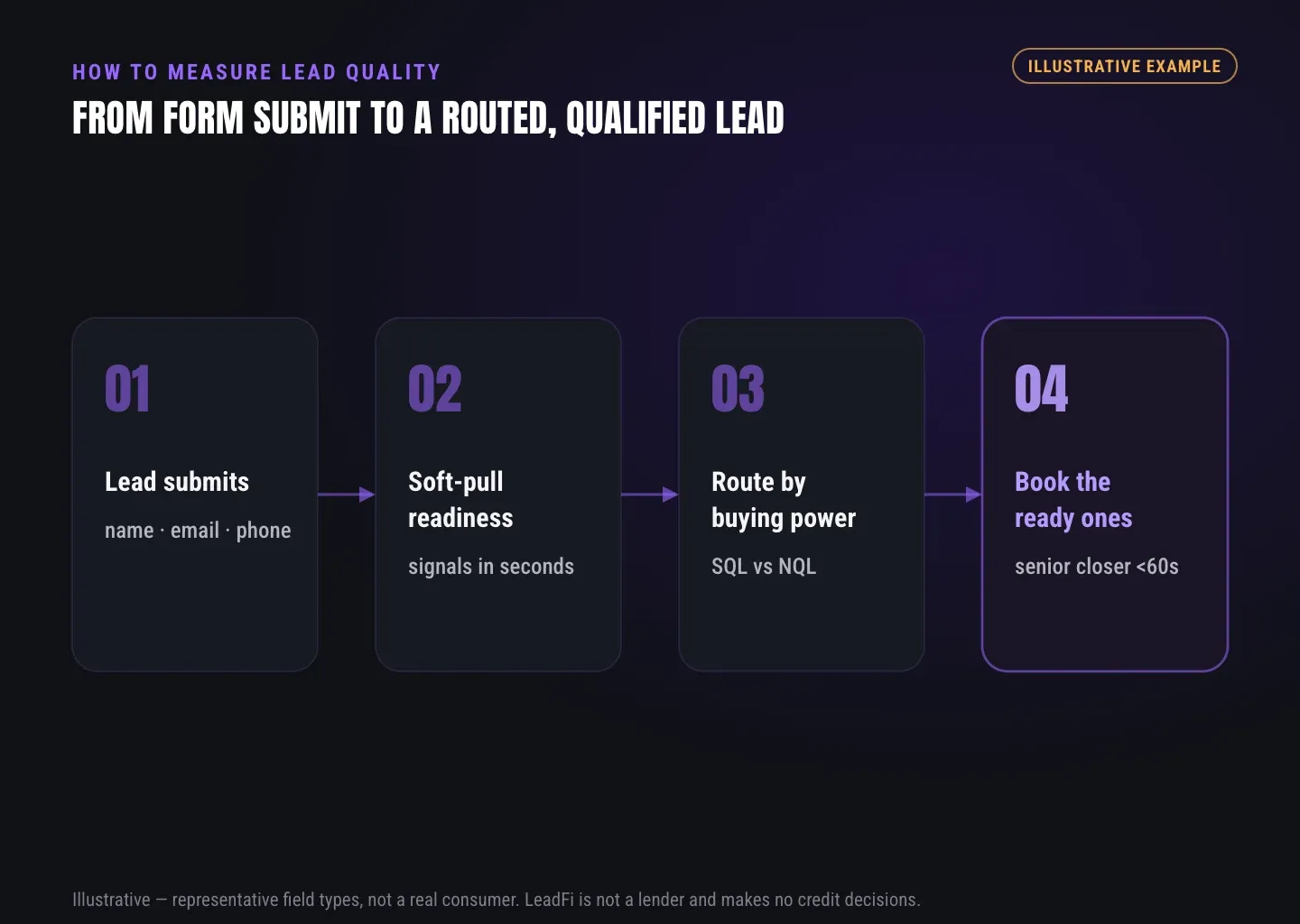
Watch a contact get pre-qualified.
This is exactly what your CRM gets back.
Your opt-in form
Soft pull · no impact to their credit
This is not a real soft pull. It's an example of the data points that land in your CRM contact record when a lead fills out your form.
LEADFI DEMO
Watch the demo, then start free or book a call.
THE PROBLEM
Why lead volume is a poor health metric
Lead volume shows how many people entered a funnel. It does not reveal whether they fit the offer, have a viable buying path, or deserve immediate sales attention. A campaign can lower cost per lead while filling a closer's calendar with poorly routed calls.
Form fills hide buying power
Most forms measure expressed intent through clicks, answers, and contact details. Self-reported information may not provide enough context to assess financial readiness.
LeadFi can work from name, email, and phone in configured thin-input workflows. Its patent-pending identity matching is designed to establish a high-confidence match before soft-pull prescreening and, where applicable, deeper bureau-backed credit-report workflows. Required inputs depend on the setup, consent and disclosures.
Booked calls can overstate demand
A booking confirms that somebody selected a time. It does not establish that the person meets the team's rules for the main sales route. Measure how many bookings become held, qualified conversations with a recorded next step.
Cheap leads can consume expensive hours
A low cost per lead can conceal a high cost per useful sales conversation. Media cost and sales labor therefore belong in the same quality view. For additional workflow context, see practical insights on speed to lead for high ticket offers.
Blended totals hide weak sources
A blended SQL rate can remain stable while one campaign improves and another deteriorates. Break results down by channel, campaign, ad set, form, offer, cohort, and sales team so changes in traffic mix remain visible.
NQL status does not mean worthless
A Non-Qualified Lead is not ready for the main sales path under the current rules. It is an operational status, not a judgment about the person. NQLs may fit nurture, a lower-ticket product, an alternate service, or later requalification.
Financial readiness adds buying-power context
Depending on the configured workflow, financial-readiness signals may include VantageScore 4.0, available credit, income, debt, debt-to-income ratio, funding pre-approval signals, and optional asset context where available. Current address and age should be described as identity-related information or identity signals—not automatically used as financial-readiness routing criteria.
These signals support routing and rep preparation. LeadFi does not approve or deny consumers or promise credit, funding, or sales outcomes.
GUIDE
Four lead quality metrics worth tracking
The best lead-quality metrics form a chain connecting acquisition, qualification, sales work, and pipeline. Define the denominator for each metric before testing and keep it stable during the comparison.
1. SQL rate shows the readiness mix
A Sales-Qualified Lead meets the team's documented rules for the main sales path.
SQL rate = SQLs ÷ eligible processed leads × 100
Report match rate beside SQL rate. Exclude or separately label duplicates, test records, invalid contact data, unmatched records, and out-of-scope submissions so the denominator remains interpretable.
2. Cost per SQL links spend to fit
Cost per SQL shows what the team paid for leads that reached its intended sales route—not merely for form submissions.
Cost per SQL = acquisition spend ÷ SQL count
Use like-for-like costs. Do not include an expense for one campaign while omitting the same expense from another.
3. Qualified pipeline shows value density
Qualified pipeline per 100 processed leads makes sources with different volumes easier to compare.
Qualified pipeline per 100 leads = qualified pipeline value ÷ processed leads × 100
Define what creates an opportunity, how value is assigned, and which next step must be recorded. Pipeline is not collected revenue, so report the two separately.
4. Closer hours reveal sales efficiency
Closer hours per qualified opportunity exposes the labor cost of weak routing.
Closer hours per qualified opportunity = total closer hours ÷ qualified opportunities created
If precise time tracking is unavailable, begin with scheduled call duration plus a consistent allowance for preparation and notes. The purpose is not to shorten every conversation; it is to determine whether the right conversations reach closers.
Build an SQL rate benchmark from your own funnel
A useful SQL rate benchmark is an internal baseline for a defined offer, source, cohort, and qualification rule. Record cohort dates, eligibility criteria, match rate, SQL logic, pipeline definition, sales route, NQL path, and rule version.
Do not publish or rely on an unsupported universal rate. Offers, prices, traffic sources, routing logic, and sales models differ too much. Teach the method, not a number.
GUIDE
Building a sound before-and-after comparison
A useful before-and-after comparison begins with a written test plan—not a dashboard screenshot. Compare similar cohorts under stable definitions so the team can explain what caused a change.
Freeze the success definition
Document what counts as an eligible lead, SQL, qualified opportunity, held call, no-show, NQL progression, and win. Marketing, sales, and RevOps should use the same definitions.
Map the current lead path
Record each step from submission through the webhook, CRM, tags, stages, calendar, alerts, sales tasks, and nurture workflows. Identify where leads wait, disappear, or receive a default route.
Run a shadow period first
In shadow mode, classify leads without changing their buyer journey. Review match quality, field mapping, routing logic, and edge cases before changing live calendars or follow-up.
Compare matched lead groups
Compare cohorts with similar offers, sources, budgets, and sales coverage. Record seasonality, pricing changes, major creative shifts, and staffing changes that could influence the result.
Audit every handoff
Confirm that each eligible lead reached the qualification workflow, matched as expected, received a route, and wrote back to the CRM. An API can succeed while a field-name mismatch prevents the intended CRM action.
Version qualification rules
Give each rule set a version name and activation point. Store that version on the CRM record and begin a new cohort when thresholds, offers, or routes change.
Align consent and disclosures
Financial-readiness workflows should align with the consent and disclosures presented in the funnel, along with privacy language and communication practices. LeadFi supports compliance-aware workflows and can help teams consider privacy policy language, consent language, TCPA-aware practices, and FCRA-aware workflow choices. LeadFi does not provide legal advice, and clients should review their use case with counsel.
Separate identity match quality from lead quality
Matching asks whether submitted information maps to the correct person with high confidence. Qualification applies the team's readiness rules after that step. Report match rate separately so changes in data coverage are not mistaken for changes in lead quality.
Treat soft-pull prescreening as one layer
In an appropriately configured workflow, soft-pull prescreening can provide credit-related readiness signals without affecting the consumer's credit score. The commercial value comes from the resulting action: SQL/NQL routing, rep preparation, CRM workflows, calendar selection, and measured follow-up—not from presenting LeadFi as generic soft-credit-check software.
Teams applying this framework to adjacent funding strategies may also consult a practical guide to credit card stacking lead qualification.
See which of the leads you already have can actually afford to buy.
GUIDE
Turning saved closer hours into pipeline
Saved time is not pipeline by itself. The team must assign reclaimed capacity to a better action and measure what that action creates.
Price the current call load
Estimate call volume, call duration, preparation, notes, and loaded hourly cost.
Monthly call cost = calls × minutes per call ÷ 60 × loaded hourly cost
Use the team's own data. An illustrative calculation is a planning tool, not a market benchmark.
Find avoidable sales work
Review calls that entered the closer route but did not meet the documented criteria when booked. Include repeated follow-up that should have entered nurture earlier, but do not classify every lost deal as avoidable.
Prioritize fast SQL follow-up
SQL routing can trigger a priority queue, task, alert, stage change, assigned rep, or calendar path while momentum is high. LeadFi is designed to support real-time routing based on the customer's configuration and integrated stack.
Give NQLs a defined next step
Route lower-readiness leads to an appropriate nurture sequence, lower-ticket offer, alternate service, educational path, custom page, or later review. Respect buyer fit, consent, and the funnel's stated purpose.
Convert reclaimed capacity into a plan
Assign recovered time to specific work such as fresh SQL outreach, qualified no-show recovery, proposal follow-up, or better call preparation. Measure the qualified conversations and pipeline produced rather than praising time savings alone.
Feed appropriate quality signals upstream
Where platform rules, privacy requirements, contracts, consent and disclosures, and the configured setup allow it, teams may send an appropriate qualified-lead event to Meta, Google, TikTok, Hyros, or other operational systems. Do not send raw credit, income, debt, funding, or readiness details as ad events. No platform performance result is guaranteed.
Keep CRM fields useful
Common action fields include SQL/NQL status, match status, route reason, rule version, source, next step, and timestamp. Limit detailed financial values to people and systems that need them; many users require only an operational status.
LeadFi can integrate through webhooks, API, Zapier, Make, or supported native workflows, depending on the stack.
Report NQL recovery separately
NQL progression rate = NQLs reaching a defined next step ÷ routed NQLs × 100
Choose a consistent progression event, such as a nurture milestone, lower-ticket purchase, alternate application, or later requalification. Report NQL-path value separately from main-path pipeline.
GUIDE
Measure the leads that sales can act on
Lead quality becomes useful when it changes what happens next. A practical measurement system identifies leads that need fast sales attention, directs lower-readiness demand to another path, and reveals which sources create qualified pipeline without relying on raw volume.
LeadFi brings financial-readiness qualification, SQL/NQL routing, CRM actions, and measured signal feedback into one workflow behind the tools a high-ticket team already uses.
Related reading: a practical guide to debt consolidation lead qualification, practical insights on speed to lead for high ticket offers, a practical guide to credit card stacking lead qualification.
| Measurement area | Volume-only view | Lead-quality view | Decision supported |
|---|---|---|---|
| Lead capture | Total submissions | Eligible leads and match rate | Whether the input set is usable |
| Qualification | Form answers | Financial-readiness SQL rate | Who should receive priority sales attention |
| Acquisition | Cost per lead | Cost per SQL | Which sources create sales-ready demand |
| Calendar | Booked calls | SQL booked and held calls | Which calendar routes should remain open |
| Sales labor | Calls completed | Closer hours per qualified opportunity | Where sales capacity creates value |
| Pipeline | Total stated pipeline | Qualified pipeline per 100 processed leads | Which traffic produces meaningful opportunities |
| NQL handling | Leads ignored | NQL progression by alternate path | How lower-readiness demand should progress |
| Campaign learning | Form-submit event | Appropriate operational quality event | What deeper event the team can test |
Key takeaways
The short version
- Measure SQL rate, cost per SQL, pipeline density, and closer hours together.
- Build benchmarks from stable internal cohorts, not unsupported market figures.
- Report identity match rate separately from financial-readiness qualification.
- Prioritize SQL follow-up and give every suitable NQL a defined alternate path.
- Send only appropriate operational events—not raw financial details—to ad platforms.
Quick answers
Fast answers before you dig in
How to measure lead quality
Track SQL rate, cost per SQL, qualified pipeline per 100 processed leads, and closer hours per qualified opportunity. Segment each metric by source, offer, cohort, and rule version.
Why is lead volume not enough?
Volume counts submissions but does not measure buying power, route fit, sales labor, qualified pipeline, or what happens to NQLs.
What is a good SQL rate benchmark?
Use your own stable baseline for a defined offer, source, cohort, and qualification rule. Teach the method, not an unsupported universal percentage.
How should SQLs and NQLs be routed?
Prioritize SQLs for timely sales follow-up and direct NQLs to a suitable nurture, lower-ticket, alternate-offer, educational, or later-review path.
What does LeadFi do?
LeadFi adds permissioned financial-readiness signals after lead capture to support qualification, rep preparation, SQL/NQL routing, CRM workflows, and quality measurement.
FAQ
Common questions
How do you measure lead quality?
What are the most useful lead quality metrics?
What is a good SQL rate benchmark?
How does financial-readiness qualification improve lead-quality measurement?
Does LeadFi soft-pull prescreening determine whether someone is approved?
Can LeadFi work behind an existing CRM or form?
What should happen to Non-Qualified Leads?
Sources
References
- CFPB — What is a credit inquiry? (hard vs. soft) (opens in a new tab)Federal regulator confirms a soft inquiry, unlike a hard inquiry, does not affect the consumer's credit score.
- VantageScore — VantageScore 4.0 credit scoring model (opens in a new tab)Official page describing VantageScore 4.0, the tri-bureau, trended-data model used to assess credit risk.
- CFPB — Who can request to see my credit report? (opens in a new tab)Federal regulator explains the FCRA rules governing who may obtain a credit report.
- VantageScore 4.0 (opens in a new tab)Official information about the VantageScore 4.0 credit-scoring model.
Know who is ready before your next sales call.
Request a LeadFi demo or workflow assessment to explore how thin-input prescreening, SQL/NQL routing, CRM fields, NQL paths, and appropriate signal feedback could fit behind your current form, funnel, calendar, or CRM.