
SPEED TO LEAD FOR HIGH TICKET OFFERS
Speed-to-Lead for High-Ticket Offers: How to Reach Buyers First
Speed-to-lead sounds simple: call fast, close more. For high-ticket offers, it rarely works that cleanly. Your reps chase every new form fill, and most of those calls go nowhere.
Watch a contact get pre-qualified.
This is exactly what your CRM gets back.
Your opt-in form
Soft pull · no impact to their credit
This is not a real soft pull. It's an example of the data points that land in your CRM contact record when a lead fills out your form.
LEADFI DEMO
Watch the demo, then start free or book a call.
GUIDE
Why speed-to-lead breaks down on high-ticket offers
Quick answer: Speed-to-lead breaks on high-ticket offers because raw speed treats every lead as equal. It isn't. A fast call to someone who can't fund an $8,000 offer still burns a closer's hour. The fix is not calling slower — it's calling financially ready leads first, then routing the rest somewhere useful.
Most speed-to-lead advice comes from low-ticket, high-volume sales. There, any human who answers is worth a call. High-ticket sales work differently: your offer costs real money, so buying power decides whether a call is worth booking at all.
That's why "call in under 5 minutes" advice falls apart at scale. You have more leads than closer hours. As a result, when reps dial in submission order, ready buyers wait behind unready ones — so your best prospects go cold while your team works through noise.
Volume outpaces closer capacity
Paid ads can flood a funnel with 100+ opt-ins a day. Meanwhile, your closers can run maybe 8 to 12 real calls each. The math never balances, so someone always waits.
Buying power is invisible at opt-in
A name, email, and phone tell you nothing about funding. Two leads look alike on the form. Yet only one can pay for the offer today.
First-in-line is not best-in-line
Submission time is a weak priority signal. It rewards whoever clicked fastest, not who can buy. For high-ticket offers, that ordering quietly costs you booked revenue.
Wasted calls compound fast
Every call to an unready lead is an hour not spent on a ready one. Across a month, that gap becomes real pipeline. This is why high-ticket lead follow-up needs a smarter priority order than "newest first."
INTELLIGENCE LAYER
Scoring buying power before the first outreach
Quick answer: LeadFi reads permissioned financial-readiness signals from name, email, and phone after a lead submits. Consistent with your disclosures and consent, it uses a soft-pull prescreen — no impact on the person's credit score — to surface signals like VantageScore 4.0, income, available credit, and debt-to-income. Then it tags each lead SQL or NQL for routing. It never approves or denies anyone.
Financial readiness means one thing here: can this person likely fund your offer, and how soon? It's an operational question for routing, not a judgment of the person. LeadFi frames it that way on purpose.
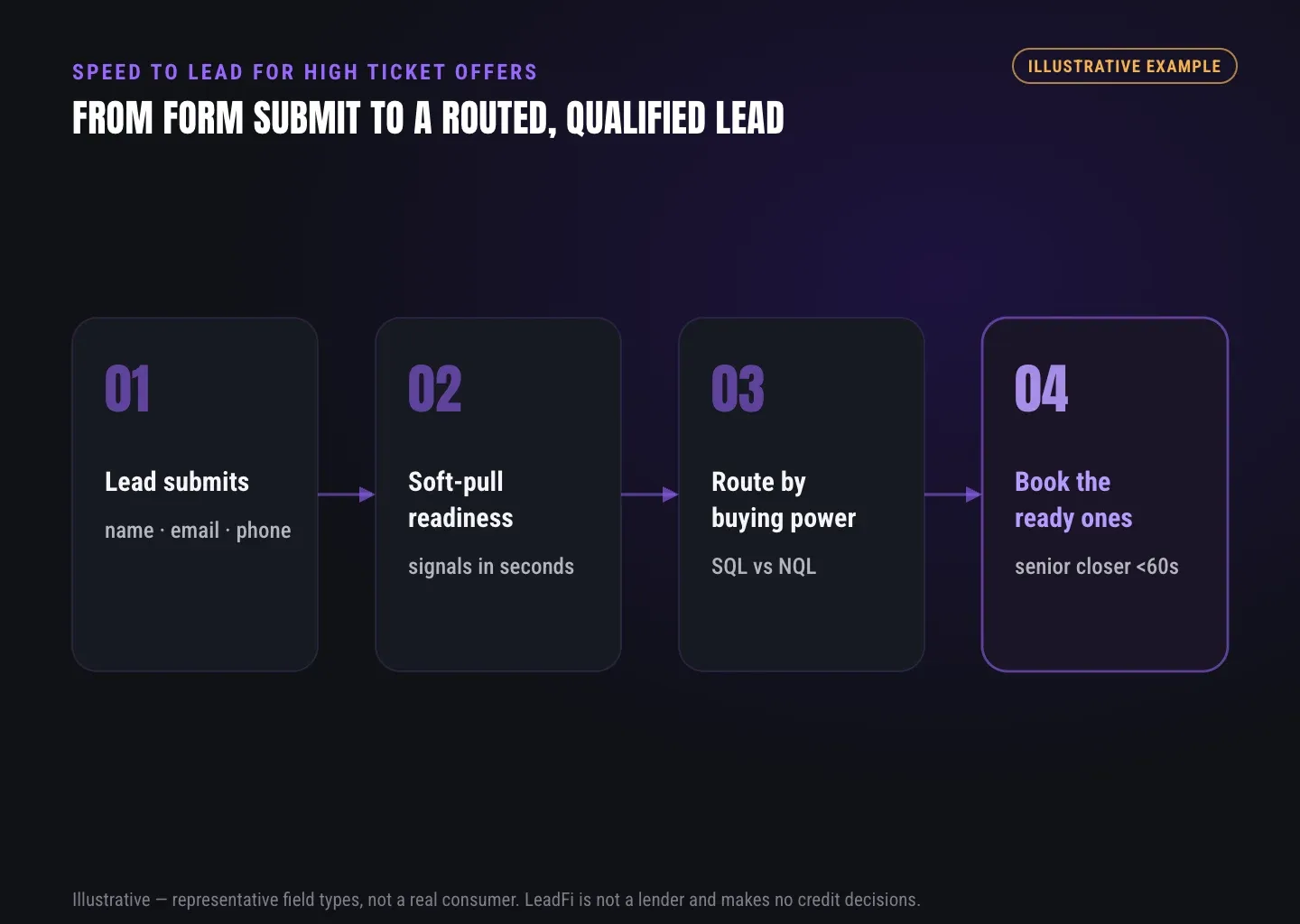
Here's the flow. First, a lead submits your form. Consistent with your disclosures and consent, LeadFi runs identity matching, then a soft-pull prescreen. That soft pull reads readiness signals without touching the consumer's credit score. Finally, LeadFi tags the lead so your team knows who to call first.
The soft pull, in plain terms
A soft-pull prescreen reads readiness signals with no impact on the consumer's credit score. It is not an application and not a decision. Instead, it gives your reps context before the call.
Signals LeadFi can surface
Depending on setup and consent, signals may include VantageScore 4.0, available credit, income, debt, and debt-to-income. Optional net-worth or asset context can apply where available. These are readiness signals for routing — never underwriting.
Thin-input matching from name, email, phone
For many workflows, LeadFi can work from name, email, and phone. Patent-pending identity matching is designed to establish a high-confidence match before any prescreen. For some paths, that means less friction up front and no long form.
Readiness is operational, not moral
Treat the score as a routing input, not a verdict on the person. A lower-readiness lead is not a bad lead — just a different next step. That framing keeps your workflow buyer-respectful and compliance-aware.
ROUTING
Prioritizing financially ready leads for closers
Quick answer: LeadFi splits leads into SQLs and NQLs, then routes each path. SQLs — the financially ready ones — go straight to a closer calendar, a setter, or a priority queue while momentum is high. NQLs route to a low-ticket offer, a payment plan, or a financing path. Your closers spend their hours on the leads most likely to buy.
SQL means Sales-Qualified Lead: here, a lead that clears your financial-readiness rules. NQL means Non-Qualified Lead, one that doesn't clear them yet. Many people first read "SQL" as a database term, so we define it once and keep the labels consistent.
The point is not to discard NQLs. Instead, it's to give each lead the right next step. A ready buyer gets a closer fast. Meanwhile, someone not ready yet gets a path that fits — a smaller first offer, a payment plan, or financing options you already run.
Route SQLs to a closer first
The moment a lead tags as an SQL, LeadFi can trigger a redirect, notify a closer, or drop the lead on a priority calendar. As a result, your best-fit buyers reach a human in minutes, not the next morning.
Send NQLs to a path that fits
NQLs don't vanish. Instead, route them to a low-ticket offer, a payment plan, or a financing path — whatever your funnel supports. This keeps every lead monetizable instead of dead.
Give closers context before the call
LeadFi can write permitted readiness context into your CRM before the call starts. Reps open the record and already know the shape of the talk. As a result, less discovery, more closing.
Program thresholds to your audience
Selling to a younger, thin-credit demographic? Then set different cutoffs. You can run many campaigns, each with its own SQL/NQL line. The rules are yours to tune.
| Factor | Raw speed-to-lead | Readiness-first with LeadFi |
|---|---|---|
| Call priority | Newest lead first | Financially ready lead first |
| Closer time | Spread across all leads | Focused on SQLs |
| NQL handling | Same call, weak results | Low-ticket, payment plan, or financing path |
| Buying power | Invisible at opt-in | Read via soft-pull prescreen |
| Ad signals | Every opt-in counts equally | SQL-quality signals where permitted |
| CRM context | Rep discovers on the call | Readiness context written before the call |
See which of the leads you already have can actually afford to buy.
OUTCOMES
Measuring the impact on conversion
Quick answer: Track speed-to-lead conversion by comparing outcomes on SQL calls versus your old "call everyone" baseline. Watch closer hours per booked deal, show-up rate on SQL calls, and NQL monetization. Where permitted, LeadFi can feed SQL-quality signals back into your CRM and ad platforms — so you optimize for financially qualified demand, not raw volume.
Speed matters, but the metric that matters more is speed to the right lead. So measure both. A faster dial to an SQL should show up in better show rates and a lower cost per real talk.
Booked calls are a fine surface metric. However, financially qualified booked calls are the one that ties to high-ticket revenue. That shift — from volume to quality — is where most teams find their lift.
Metrics worth watching
Track closer hours per booked deal, SQL show-up rate, and NQL revenue from low-ticket or payment-plan paths. Then compare against your pre-LeadFi baseline. The gap tells the story.
Feed signals back into ad platforms
Where the platform and your setup allow, LeadFi can send SQL-quality signals into Meta, Google, TikTok, or Hyros. This helps campaigns learn from financially ready buyers, not every opt-in. There are no ROAS guarantees — this is a signal-quality improvement.
Improve attribution with cleaner inputs
Attribution tools show what happened. In contrast, readiness data can help improve who your campaigns attract next. For that reason, LeadFi complements Hyros and SegMetrics as the financial-readiness signal layer, not a replacement.
Close the loop in your CRM
Qualification status, tags, stages, and workflows live where your team already works. LeadFi writes outcomes back, so the whole funnel reads from one source. As a result, there's no separate dashboard to babysit.
ROUTING
Examples: how the routing plays out
A funding agency. Ads drive 150 opt-ins a week. Before, closers dialed in order and half the calls stalled at the finance step. Now SQLs hit the closer calendar first, while thin-credit leads route to a low-ticket offer with a financing path.
A high-ticket coaching program. The $6,000 offer drew plenty of excited leads who couldn't fund it. LeadFi tags readiness after the application, so setters book only SQLs onto closer calls. As a result, NQLs get a $200 starter offer instead of a dead end.
A mortgage lead shop. Raw name-email-phone leads sold cheap. Connected via API, LeadFi prequalifies each lead with a readiness tag so the shop can prioritize follow-up. This workflow may implicate FCRA reseller and disclosure rules, so review it with counsel before launch.
Key takeaways
The short version
- High-ticket speed-to-lead fails when reps dial in submission order instead of buying-power order.
- LeadFi reads permissioned financial-readiness signals via a soft-pull prescreen that does not affect a consumer's credit score.
- SQLs route to a closer first; NQLs route to low-ticket, payment-plan, or financing paths so no lead is wasted.
- Measure closer hours per booked deal and SQL show-up rate against a 'call everyone' baseline — optimize for quality, not volume.
- LeadFi sits behind your existing form, CRM, funnel, or calendar and does not approve or deny consumers.
Quick answers
Fast answers before you dig in
Why does speed-to-lead break down on high-ticket offers?
Because raw speed treats every lead as equal. A fast call to someone who can't fund an $8,000 offer still burns a closer's hour. The fix is calling financially ready leads first, then routing the rest to a low-ticket offer or a payment plan.
How does LeadFi score buying power before the first call?
After a lead submits, LeadFi runs identity matching and a soft-pull prescreen — no impact on the person's credit score — consistent with your disclosures and consent. It surfaces readiness signals, then tags each lead SQL or NQL. It never approves or denies anyone.
How does SQL vs NQL routing help closers?
SQLs (financially ready leads) go straight to a closer, setter, or priority calendar while momentum is high. NQLs route to a low-ticket offer, a payment plan, or a financing path — so closer hours concentrate on buyers most likely to fund the offer.
FAQ
Common questions
What is speed-to-lead for high-ticket offers?
Does the soft pull affect a lead's credit score?
How does SQL vs NQL routing improve conversion?
Do I need to collect an address and date of birth up front?
Will LeadFi replace my CRM, calendar, or funnel?
How does this help high-ticket lead follow-up specifically?
Is this a compliant way to qualify leads?
Sources
References
- CFPB — What is a credit inquiry? (hard vs. soft) (opens in a new tab)Federal regulator confirms a soft inquiry, unlike a hard inquiry, does not affect the consumer's credit score.
- VantageScore — VantageScore 4.0 credit scoring model (opens in a new tab)Official page describing VantageScore 4.0, the tri-bureau, trended-data model used to assess credit risk.
- Experian — Hard Inquiry vs. Soft Inquiry (opens in a new tab)Major credit bureau contrasts hard and soft inquiries and confirms soft inquiries do not affect a credit score.
Know who is ready before your next sales call.
You don't have to rip out anything. First, LeadFi reads financial readiness after the form.