
CREDIT CARD STACKING LEAD QUALIFICATION
Qualifying Credit-Card Stacking Clients by Approval Readiness
Credit card stacking lead qualification comes down to one question: does the person on the form have the credit profile to get funded? Most funding and coaching teams learn the answer too late — on the call, or after the strategy session.
Watch a contact get pre-qualified.
This is exactly what your CRM gets back.
Your opt-in form
Soft pull · no impact to their credit
This is not a real soft pull. It's an example of the data points that land in your CRM contact record when a lead fills out your form.
LEADFI DEMO
Watch the demo, then start free or book a call.
INTELLIGENCE LAYER
Why stacking outcomes depend on approval readiness
Credit card stacking is a credit-driven strategy, so the outcome tracks the profile, not the pitch. For example, a lead with a strong score and low debt has very different odds than one with maxed cards and a thin file. Both may want funding equally, yet only one is ready today.
That gap is where sales time gets lost. Reps take a call, build rapport, explain the strategy, then hit the underwriting reality — and the lead was never close. This is why reading readiness up front matters more here than in almost any other high-ticket vertical.
Approval odds track the credit profile
Approval odds for 0% business credit card stacking come from the numbers, not the enthusiasm. Score, use, and open credit lines drive how many cards clear and at what limits. As a result, if you read those signals early, you know who is actually close.
Debt-to-income shapes stack size
Debt-to-income ratio (DTI) is one of the clearest readiness signals for stacking. A low DTI usually means more room to stack. A high one, however, narrows the path fast. LeadFi can surface DTI as a routing signal, not as a decision about the person.
Tradeline data adds context, not verdicts
Tradeline data — open accounts, limits, payment history — helps explain a lead's readiness beyond a single score. For example, a clean payment record gives your team context for the conversation. LeadFi frames tradeline signals for routing and rep prep, never as an approval or a promise.
Self-reported forms miss the truth
Most teams ask on the form: income, credit range, funds on hand. But people round up, guess, or stretch. As a result, "qualified" leads on paper collapse on the call. Reading permissioned signals after submit closes that gap.
INTELLIGENCE LAYER
Reading readiness before the strategy call
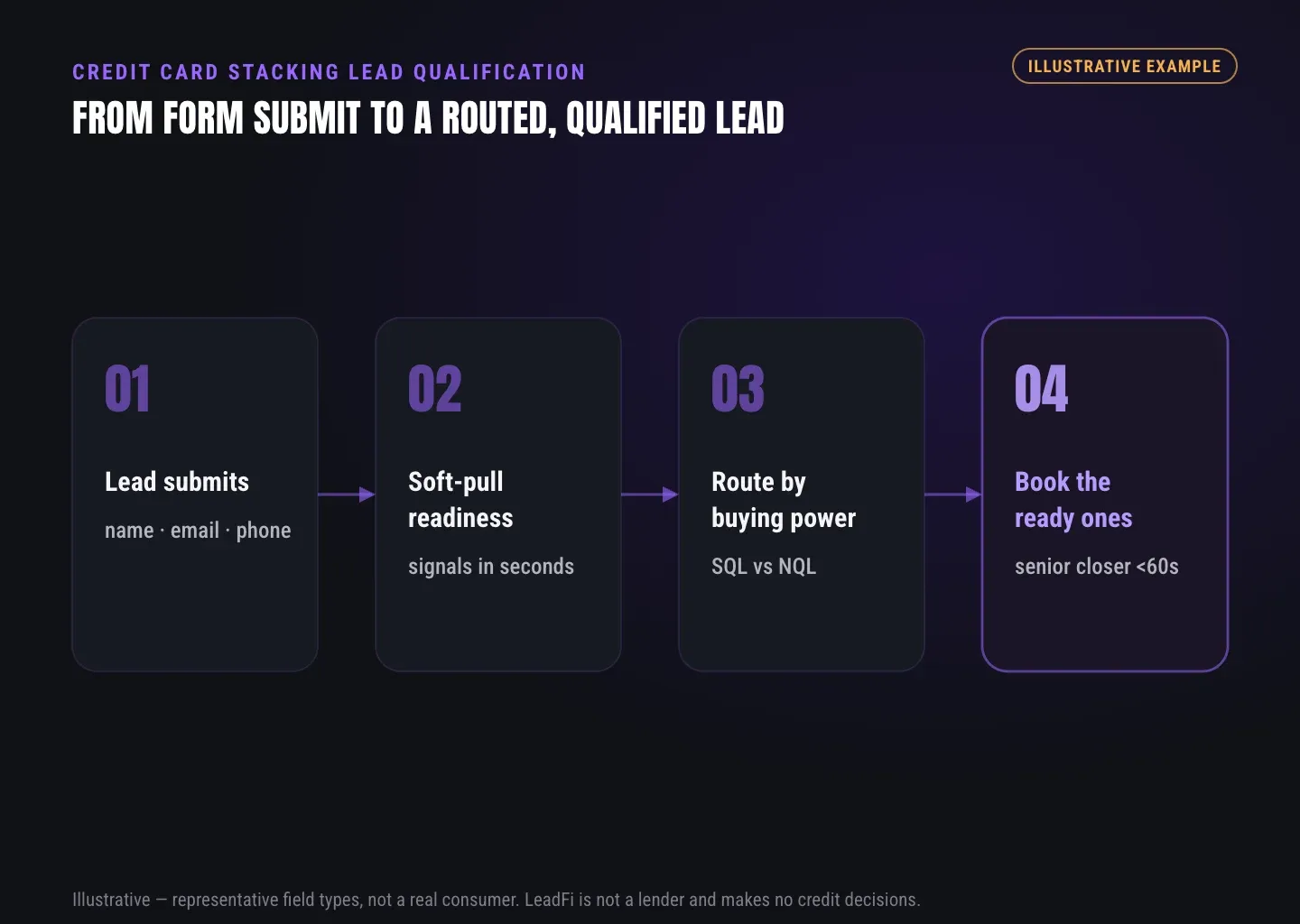
The point of reading readiness early is simple: put your best closer time where the odds are best. When a lead lands, LeadFi enriches it after submission and scores it on ability to pay. So your reps open the strategy call already knowing where the lead stands.
This is soft-pull prescreening — a soft pull designed to read readiness with no impact on the consumer's credit score. It is built for financial-readiness qualification, not underwriting. In other words, it tells you who to call first, not who gets funded.
Thin-input match from name, email, phone
LeadFi can work from name, email, and phone to start a permissioned readiness workflow. Its patent-pending identity matching is designed to confirm a high-confidence match before any soft-pull prescreening. For many stacking funnels, that means less friction on the form.
Readiness signals for rep prep
The soft pull can surface signals like VantageScore 4.0, open credit, income, debt, and DTI where consent and disclosures support it. Your reps read these as prep, not as a score card on the person. Above all, treat readiness as operational, not moral.
SQL vs NQL routing, defined
An SQL is a sales-qualified lead — one whose readiness fits your stacking program. An NQL is a non-qualified lead, at least for now. LeadFi splits SQLs from NQLs after submit, so the right next step happens while momentum is high.
Speed-to-lead on the strongest fits
Once a lead reads as an SQL, speed matters. Teams using this pattern often aim to reach financially qualified leads quickly. As a result, show rates and close rates tend to climb, though results vary by offer and team.
OUTCOMES
Setting client expectations without promising outcomes
Credit-adjacent offers carry real expectation risk. Promise approvals and you set up refunds, complaints, and worse. The safe move is to talk about readiness and odds, not certainty. That way, you protect both the client and your program.
Readiness tells you a lead looks like a strong fit today. However, it does not say the cards will clear. Keep that line clear on the page, on the call, and in your automations. Then you carry one story from form to follow-up.
Frame readiness as fit, not approval
Tell clients what readiness means: they look like a good fit for the strategy right now. That is honest and still motivating. It never crosses into "you're approved," which no one but a lender can say.
Keep one consistent story across the stack
Your form disclosures, SMS consent, and CRM notes should all say the same thing. When the story lines up, prospects trust the process more. In addition, LeadFi helps teams align that language as part of a compliance-aware setup — this is not legal advice.
Route lower-readiness leads with dignity
An NQL today is not a lost lead forever. For example, you can route lower-readiness leads to a low-ticket offer, a payment plan, or a credit-building path. That respects the person and keeps the lead monetizable.
Compliance-aware setup as onboarding help
Before launch, LeadFi can help you set up a compliance-aware workflow — consent language, privacy-policy alignment, and TCPA-aware practices. It is a value-add during onboarding, not a blocker. Still, LeadFi does not guarantee compliance and does not provide legal advice; review your use case with counsel.
See which of the leads you already have can actually afford to buy.
GUIDE
Fitting qualification into the intake flow
You do not rip anything out. The lead submits where it already submits. Then LeadFi enriches, scores, and hands the outcome back to the tools your team already lives in.
For example, an SQL can go straight to a closer's calendar with readiness context attached. Meanwhile, an NQL can drop into a low-ticket offer or a credit-building path. From there, qualified-lead signals can feed back into ad and ops stacks where the platform permits it. So your ads can learn from real buying power, not just opt-ins.
Capture stays where it is
Your form, funnel, or booking app keeps capturing leads. LeadFi receives the submission and works after it: first the lead comes in, then readiness gets read, then routing fires.
Outcomes write back to your CRM
LeadFi can push qualification status into CRM fields, tags, pipeline stages, and workflows. So your reps see readiness right where they already work. No new tab, no separate lookup.
Route SQLs and NQLs automatically
SQLs can book a closer call instantly. NQLs, meanwhile, can redirect in real time to a low-ticket offer under $3,000, a payment plan, or a credit-building path. As a result, closers get cleaner calendars and every lead still has a path. Routing rules are yours to define.
Feed ad platforms real buying power
Where each platform allows it and your setup supports it, you can send SQL-quality signals back into ad and ops workflows. Over time, this can train delivery toward financially qualified buyers. LeadFi makes no ROAS or platform-performance guarantee.
| Factor | Self-reported intake form | LeadFi readiness layer |
|---|---|---|
| Source of qualification | What the lead types | Permissioned soft-pull signals |
| Credit-score accuracy | Guessed or rounded | VantageScore 4.0 where supported |
| DTI / open credit | Rarely captured honestly | Read as routing signals |
| When you learn fit | On the call, or later | After submit, before the call |
| SQL vs NQL routing | Manual, if at all | Automatic, rule-based |
| Address / DOB up front | Often required | Often not required for certain paths |
| Consumer approval | Neither approves | Neither approves |
Key takeaways
The short version
- 0% business credit card stacking is approved on credit profile, so qualification should read score, open credit, and DTI — not self-reported form answers.
- LeadFi uses thin-input matching from name, email, and phone plus soft-pull prescreening to read readiness with no impact on the consumer's credit score.
- SQL vs NQL routing sends strong-fit leads to closers fast and moves lower-readiness leads to low-ticket, payment-plan, or credit-building paths.
- Frame readiness as fit, not approval — LeadFi does not approve or deny consumers and does not guarantee funding.
- LeadFi sits behind your existing form, funnel, calendar, or CRM and writes qualification outcomes back via webhook, API, Zapier, or Make.
Quick answers
Fast answers before you dig in
Why do stacking outcomes depend on approval readiness?
Stacking outcomes depend on approval readiness because 0% business credit card offers are approved on credit profile, not intent. A lead's score, open credit, and DTI shape how much funding they can stack. LeadFi reads these readiness signals after submission, so your team spends closer time on leads who fit. It never approves or denies anyone.
How does LeadFi read readiness before the strategy call?
LeadFi reads financial-readiness signals from name, email, and phone after a lead submits — often without needing address and date of birth up front for certain workflows. Signals can include VantageScore 4.0, open credit, income, debt, and DTI, always subject to consent and disclosures. Your team sees a readiness view for routing and prep, not a consumer approval.
Can readiness guarantee a funding outcome?
No. A strong soft-pull profile signals better odds, but final funding depends on the lender, the timing, and the full application. LeadFi helps you route and prepare — it does not approve, deny, or promise funding. Frame every conversation around fit and next steps, not guaranteed results.
How does LeadFi fit into an existing intake flow?
LeadFi sits behind your existing intake — ClickFunnels, Typeform, GoHighLevel, HubSpot, a custom form, or a booking app. It receives the lead via webhook, API, Zapier, or Make, reads readiness, and writes the outcome back into your CRM as fields, tags, stages, and routing. Your stack stays; the qualification layer gets added.
FAQ
Common questions
What is credit card stacking lead qualification?
Can LeadFi tell me a lead's approval odds for card stacking?
Do you need an address to read financial readiness?
Does the soft pull affect the lead's credit score?
What is tradeline data used for here?
How does SQL vs NQL routing work for a stacking funnel?
Is LeadFi compliant, and does it replace my lawyer?
Sources
References
- CFPB — What is a credit inquiry? (hard vs. soft) (opens in a new tab)Federal regulator confirms a soft inquiry, unlike a hard inquiry, does not affect the consumer's credit score.
- VantageScore — VantageScore 4.0 credit scoring model (opens in a new tab)Official page describing VantageScore 4.0, the tri-bureau, trended-data model used to assess credit risk.
- CFPB — Who can request to see my credit report? (opens in a new tab)Federal regulator explains the FCRA rules governing who may obtain a credit report.
Know who is ready before your next sales call.
You keep your forms, your funnel, your calendar, and your CRM. LeadFi adds the readiness layer that tells your team who to call first — and where every other lead should go next.