
DEBT CONSOLIDATION LEAD QUALIFICATION
Debt Consolidation Lead Qualification Before the Sales Call
Debt consolidation lead qualification should determine whether a lead matches the provider’s target file before a rep spends time on the call. Long forms often fall short because debt, income, and credit details remain self-reported.
Watch a contact get pre-qualified.
This is exactly what your CRM gets back.
Your opt-in form
Soft pull · no impact to their credit
This is not a real soft pull. It's an example of the data points that land in your CRM contact record when a lead fills out your form.
LEADFI DEMO
Watch the demo, then start free or book a call.
GUIDE
Lead intake costs rise when every answer is self-reported
Most debt consolidation forms ask leads to estimate unsecured debt, income, monthly payments, and credit range. These questions provide context, but they do not confirm program fit. Some leads do not know their exact balances, while others select the answer they believe will unlock a call.
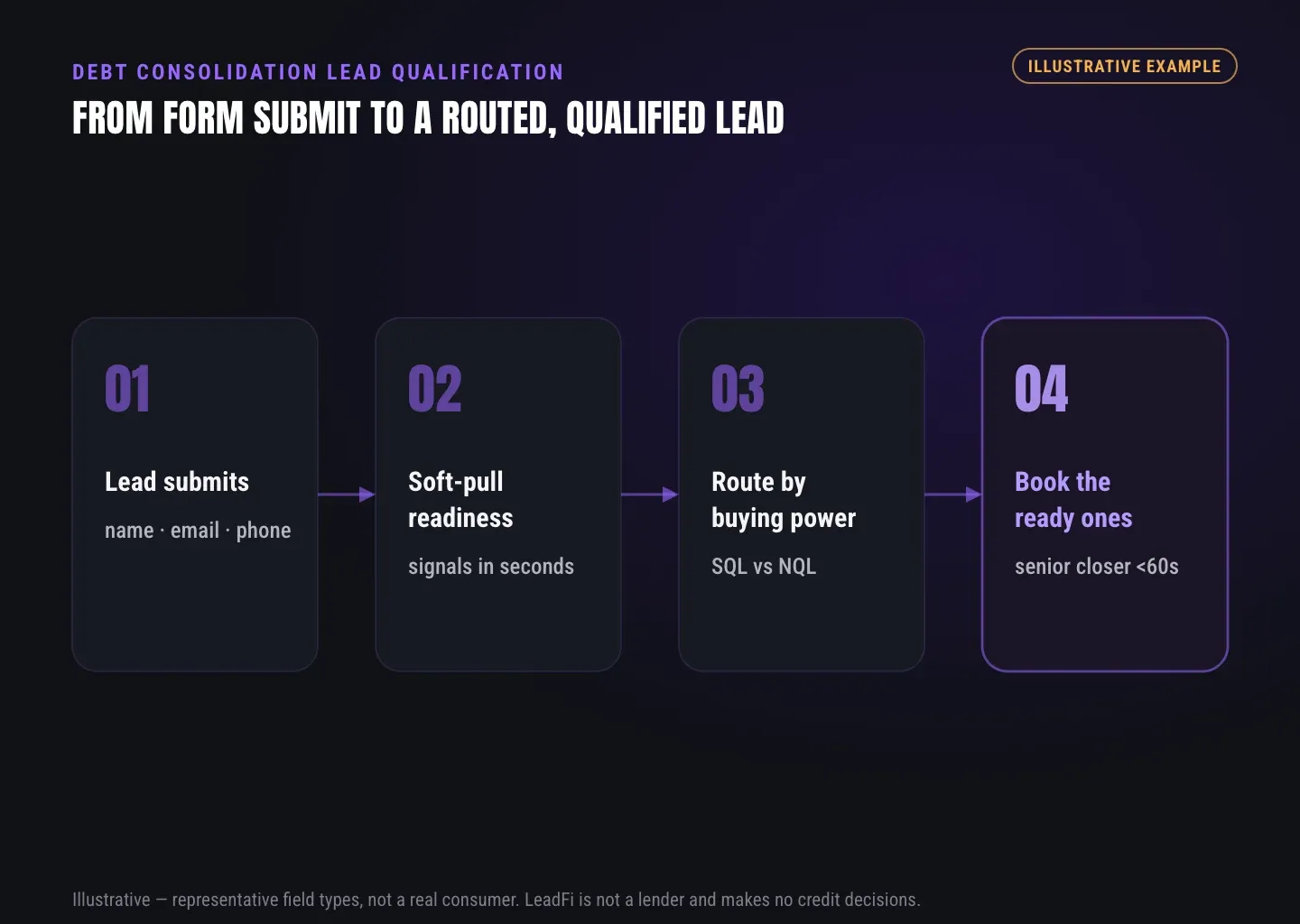
LeadFi sits behind the existing intake flow. For many workflows, it can start with name, email, and phone. Patented identity matching is designed to establish a high-confidence match before soft-pull prescreening and, where applicable, deeper bureau-backed workflows. Results can then return to the CRM as financial-readiness signals for sales teams.
Self-reported debt can hide the real file
A lead may select “$30,000 to $50,000” without knowing how much represents unsecured debt or obligations within the provider’s scope. Debt amount qualification works better when form responses are considered alongside available financial signals and later confirmed by a trained rep.
Long forms add friction without certainty
Adding fields can reduce completion while leaving the underlying data self-reported. Subject to appropriate consent and disclosures, a thin-input workflow can often begin with name, email, and phone after submission. This keeps the form short while adding relevant context behind it.
Calendar volume can mask low call quality
Booked-call volume does not show whether leads match the target debt and credit profile. A financial-readiness layer can classify leads before assignment so the calendar reflects program fit rather than raw demand alone.
Manual checks delay the first useful call
Without pre-call context, reps may spend the opening minutes collecting balances, payment details, and credit information. Earlier qualification lets the rep begin with a clearer route while still confirming details and applying human judgment.
Bad form data weakens ad learning
When every submission sends the same conversion event, media teams optimize around lead volume rather than workable files. Where platform rules, consent, and the setup allow, LeadFi can return qualified-lead events to Meta, Google, TikTok, Hyros, and operations systems. These signals do not guarantee advertising performance.
Example: The misleading debt range
A lead selects a target debt band, but only a small portion of the balance may fit the provider’s criteria. Readiness-based routing can flag the record for review or referral before a senior closer spends a full call discovering the mismatch.
Example: The short form with a better back end
A landing page collects name, email, phone, and a few plain-language answers. LeadFi receives the submission through an API or webhook, applies the client’s rules, and returns a sales, review, nurture, or referral route to the CRM.
INTELLIGENCE LAYER
Financial signals separate workable files from dead ends
Debt consolidation lead qualification should not depend on one score or balance. Fit varies by service model, accepted debt types, target amounts, location, and the provider’s reviewed program rules.
LeadFi returns permissioned readiness signals and applies client-set routing logic. The business remains responsible for its criteria, consumer conversations, and final actions. The most useful result is a next step—not a simplistic “good” or “bad” label.
Debt amount shows problem size
Debt-related signals can help place a lead into a target band, below-range path, or review queue. The rep still needs to confirm debt type, ownership, status, and whether it falls within the provider’s scope.
Debt-to-income shows monthly pressure
Debt-to-income ratio provides context about the share of income associated with debt obligations. It can inform routing and rep preparation, but it should not be treated as a moral judgment or a standalone service decision.
Income adds payment context
Income ranges can help teams understand a lead’s broader financial picture. Access should be limited by role: many reps need a route and reason code rather than every underlying value.
Credit context changes debt-fit logic
In some high-ticket funnels, stronger credit may correlate with buying power. Debt consolidation can require a different model: higher debt and a lower score may align more closely with a provider’s target file. LeadFi therefore supports configurable qualification rather than assuming a higher score is always better. VantageScore explains that its scoring models assess credit risk, but the score remains only one part of a broader workflow (VantageScore).
Available credit may shape the next path
Available credit or a funding pre-approval signal may provide routing context when available. Neither represents a promised option, final funding decision, or guaranteed outcome. LeadFi does not approve or deny consumers.
Identity signals improve match confidence
LeadFi can work from name, email, and phone in many configured workflows. Identity-related information, such as current address or age, may be returned where available to support matching and rep context. Protected characteristics should not be used as eligibility criteria without a lawful, counsel-reviewed basis. Thin inputs do not remove consent and disclosure obligations.
Who financial-readiness qualification fits
The workflow may fit debt consolidation providers, call centers, agencies, lead sellers, and multi-brand operators with enough volume to make sales time costly. It works best when the team has defined criteria, a CRM owner, and useful paths for SQLs, NQLs, and uncertain files.
Comparison: intake methods for debt leads
Forms, manual review, soft-pull prequalification tools, and a financial-readiness engine serve different roles. The strongest workflow typically combines concise intake, permissioned financial context, automated routing, and human confirmation.
ROUTING
Lead routing separates consolidation-fit files from referrals
A qualification result should change what happens next. SQL vs NQL lead routing can update a CRM field, assign an owner, trigger an alert, select a calendar, redirect the lead, or start a nurture workflow.
An SQL is a lead that matches the client’s direct sales route. An NQL does not currently match that route and may instead enter review, education, nurture, or referral. These are workflow labels—not decisions about a consumer’s worth or eligibility.
SQL routing protects speed-to-lead
Once LeadFi returns the configured SQL status, the CRM can send the record to a priority queue and notify the appropriate setter or closer. Reps can receive a status and approved reason code without unnecessary access to every raw financial field.
Review routing catches edge cases
A lead may fit the target debt band but lack sufficient debt-type detail, or the identity match may require another step. A manual-review lane avoids forcing uncertain files into either the SQL or NQL path.
NQL routing preserves future value
An NQL may benefit from education, a lower-cost offer, future follow-up, or another reviewed path. A consent-aligned nurture sequence can keep the primary sales queue focused without making the initial classification final.
Referral routing matches another service
If a lead has a genuine need outside the provider’s scope, a defined referral workflow may be more useful than repeated sales calls. The business should document the trigger, consumer experience, partner handoff, and data shared between systems.
CRM routing turns data into work
LeadFi can write results into CRM fields, tags, stages, lists, and automation triggers through webhook, API, Zapier, Make, or a supported native workflow. Example fields include qualification_status, route_reason, match_status, and next_action.
Ad signals improve lead-quality feedback
A raw lead event records a submission; an SQL-quality event records that the lead matched a configured financial-readiness route. Where allowed by platform rules and the client’s setup, that signal can support campaign analysis in Meta, Google, TikTok, Hyros, and CRM reporting. Creative, bids, volume, data quality, and platform restrictions still affect outcomes.
Example: SQL to priority call queue
A paid lead submits a short form. LeadFi establishes an identity match and returns a debt-fit SQL under the client’s rules. The CRM assigns the lead to a priority queue and alerts the rep with an approved route reason.
Example: NQL to education track
A lead falls below the main route’s current debt threshold. The CRM applies an NQL tag and begins a consent-aligned education sequence instead of displaying a senior closer’s calendar.
Example: Unclear file to manual review
A lead has a relevant debt signal but an incomplete identity match. Operations receives a review task and requests additional information through the approved flow before assigning the next route.
| Qualification method | Data source | Main strength | Main limit | Best role |
|---|---|---|---|---|
| Short intake form | Lead answers | Low front-end friction | Limited, self-reported detail | Initial capture |
| Long intake form | Lead answers | More stated context | More friction; answers may remain estimates | Pre-call discovery |
| Manual rep review | Calls and documents | Human context | Slow and expensive at scale | Confirmation and conversation |
| Basic lead scoring | Form and behavioral data | Simple CRM prioritization | May confuse intent with financial fit | Early marketing priority |
| Soft-pull prescreening | Permissioned credit signals | Adds credit-backed context without score impact where configured | Requires accurate disclosures and reviewed rules | Pre-call qualification |
| Financial-readiness engine | Identity, financial, form, and CRM signals | Supports SQL/NQL classification and next actions | Quality depends on configuration and client-set rules | End-to-end routing |
See which of the leads you already have can actually afford to buy.
WORKFLOW DESIGN
Compliance-aware qualification keeps every step aligned
Financial-readiness data should be described consistently across the form, privacy policy, CRM, call script, follow-up, and partner handoffs. LeadFi supports compliance-aware workflows and can help teams plan privacy language, consent language, TCPA-aware practices, and FCRA-aware workflow choices. LeadFi does not provide legal advice or guarantee compliance.
Consent language should match the data use
Consent and disclosures should explain the actual qualification and contact workflow in clear language. If calls or SMS messages are part of the path, the form and downstream process should align with those channels and the client’s reviewed requirements.
Soft pulls need accurate explanations
Where configured, a soft pull adds credit-backed context without affecting the consumer’s credit score. It is an input for prescreening, routing, and rep preparation—not a full review, enrollment decision, approval, or promised outcome. The Consumer Financial Protection Bureau distinguishes soft inquiries from hard inquiries and explains their treatment in credit reporting (CFPB).
Thin inputs do not remove obligations
A workflow may begin with name, email, and phone and may not require address and date of birth on the first form. That reduced input does not remove the need for appropriate consent and disclosures, privacy controls, accurate consumer messaging, or a reviewed data flow.
CRM access should follow job needs
Closers may need a qualification status and call context, while media buyers may need only an event and source information. Define role-based access, retention, security, and deletion practices for sensitive identity and financial data.
Consumer messaging should protect dignity
Debt and credit information describe a financial situation, not a person’s value. Consumer-facing copy and sales scripts should explain the next step without shaming, pressuring, or presenting a route as a final judgment.
Launch checks should cover every handoff
Test SQL, NQL, manual-review, failed-match, duplicate, and error paths before sending paid traffic. Confirm CRM tags, owners, alerts, redirects, nurture steps, and any data sent to advertising platforms or partners.
Launch checklist for debt teams
- Criteria: Define target debt bands, debt types, profile rules, and review cases.
- Inputs: Document form fields and identity signals used.
- Language: Align the form, privacy policy, consent, disclosures, and scripts.
- Outputs: Name CRM fields, stages, route reasons, and next actions.
- SQL path: Set the owner, alert, calendar, and response target.
- NQL path: Choose education, nurture, referral, or later review.
- Exceptions: Plan for no match, thin data, duplicates, and errors.
- Ad events: Review which qualification signals may be sent and where.
- Access: Restrict sensitive fields to roles that need them.
- Testing: Run representative records through every route before launch.
Compliance-aware setup should be part of onboarding rather than a late-stage blocker. Clients should review their specific use case with counsel.
Key takeaways
The short version
- Combine debt, income, DTI, credit, and identity context.
- Use client-set rules instead of generic high-score logic.
- Send SQLs to fast follow-up and NQLs to alternate paths.
- Thin-input prescreening can begin with name, email, and phone.
- Align consent, CRM access, routing, and ad feedback before launch.
Quick answers
Fast answers before you dig in
How can debt consolidation teams qualify leads before a sales call?
Compare permissioned debt, income, DTI, credit, and identity signals with client-set program rules, then route each lead to sales, review, nurture, education, or referral.
Does a high credit score always indicate a qualified debt consolidation lead?
No. Debt consolidation qualification uses the provider’s target debt and credit profile. A lower score and substantial eligible debt may fit some programs better than a conventionally strong credit file.
What does SQL vs NQL mean for debt consolidation leads?
An SQL matches the current direct-sales route. An NQL does not currently match that route and can enter a review, education, nurture, alternate-offer, or referral workflow.
Can LeadFi qualify a lead from name, email, and phone?
LeadFi can work from name, email, and phone in many configured workflows. Its identity matching is designed to establish a high-confidence match before applicable soft-pull or deeper bureau-backed steps.
FAQ
Common questions
What is debt consolidation lead qualification?
How does debt amount qualification work?
Can soft-pull prequalification help with debt consolidation lead qualification?
Can LeadFi pre-screen leads from name, email, and phone?
What is SQL vs NQL routing for debt consolidation?
Does LeadFi approve or deny debt consolidation leads?
Can qualified lead signals improve debt consolidation ad campaigns?
Sources
References
- CFPB — What is a credit inquiry? (hard vs. soft) (opens in a new tab)Federal regulator confirms a soft inquiry, unlike a hard inquiry, does not affect the consumer's credit score.
- VantageScore — VantageScore 4.0 credit scoring model (opens in a new tab)Official page describing VantageScore 4.0, the tri-bureau, trended-data model used to assess credit risk.
- CFPB — Who can request to see my credit report? (opens in a new tab)Federal regulator explains the FCRA rules governing who may obtain a credit report.
- Consumer Financial Protection Bureau: What is a credit inquiry? (opens in a new tab)General explanation of hard and soft credit inquiries and their treatment in credit reporting.
- VantageScore: Why VantageScore (opens in a new tab)Background on VantageScore credit scoring and the role of a score as a credit-risk signal.
- Federal Trade Commission: Coping with Debt (opens in a new tab)Consumer-facing context about debt services, debt relief claims, and evaluating provider representations.
Know who is ready before your next sales call.
A debt consolidation funnel should not wait until the sales call to discover the basic shape of a file. LeadFi can sit behind your form, funnel, calendar, or CRM, add permissioned financial-readiness context, and return an SQL, NQL, or review route to your existing stack.