
SOLAR LEAD QUALIFICATION
Solar Lead Qualification by Financial Readiness
Most solar teams don't have a lead volume problem. They have a readiness problem. Reps drive out for site visits, run the shade analysis, size the system — then the deal dies at financing.
Watch a contact get pre-qualified.
This is exactly what your CRM gets back.
Your opt-in form
Soft pull · no impact to their credit
This is not a real soft pull. It's an example of the data points that land in your CRM contact record when a lead fills out your form.
LEADFI DEMO
Watch the demo, then start free or book a call.
WORKFLOW DESIGN
Why solar appointments stall at the financing step
Think about the usual solar funnel. First, a homeowner fills out a form. Next, a setter books the visit. Then a rep spends two or three hours on a proposal. Only at the loan step does anyone learn the buyer can't clear the lender's bar.
That's late, and it's costly. The cost isn't one lost deal — it's the site visits, proposals, and follow-ups spent on homeowners who were never finance-ready. Meanwhile, finance-ready buyers wait in the same queue as everyone else.
The self-reported form problem
Most solar forms ask about income or home ownership. The trouble is simple: people guess, round up, or skip the hard questions. As a result, self-reported answers rarely match what a lender sees.
Site-visit hours are the real cost
A solar site visit is costly labor — travel, roof measurement, and a custom proposal. Spend that on a homeowner who can't finance, and the hour is gone. That's why readiness-based routing protects those hours for the buyers most likely to close.
Financing readiness decides the deal
Whether a homeowner can afford a solar system depends on financing readiness — credit, income, and debt load. When that's unknown until the loan step, the whole funnel runs on hope. Read it early, and hope turns into a routing rule.
Speed-to-lead still matters
A finance-ready homeowner who waits a day may book with the next installer. But when you qualify solar leads in near real time, finance-ready buyers reach a rep in minutes — not the next morning.
INTELLIGENCE LAYER
Reading readiness before the site visit
Financial readiness means one thing here: can this homeowner realistically finance a solar system now? That's an operational question, not a moral one. The goal is to route the next step, not to judge anyone.
LeadFi runs a soft-pull prescreening workflow that reads readiness signals after the form submits — no impact on the consumer's credit score. It never approves or denies anyone. Instead, it tells your team who looks finance-ready, so a rep can prepare.
Thin-input identity match
LeadFi can start from name, email, and phone. Patent-pending identity matching is designed to establish a high-confidence match before the soft pull runs. As a result, many solar workflows don't need a full address and date of birth on the form up front.
Readiness signals for solar
Depending on consent and configuration, the soft pull can surface signals such as VantageScore 4.0, available credit, income, debt, and debt-to-income. For solar, income and DTI often matter most because they track closely to what a solar lender weighs. Treat every signal as a readiness input, not a decision.
Financing benchmarks as routing rules
You set the thresholds that fit your lenders and your market. Financing readiness signals like income, score, and DTI become routing inputs — you decide the cutoffs, and you tune them over time. The score is a routing input, not a guarantee, and LeadFi does not approve or deny consumers.
No credit-score impact
The soft pull is a prescreen, not a hard inquiry, so it does not affect the homeowner's credit score the way a hard inquiry can. Still, confirm the exact path for your workflow with your team and counsel. LeadFi supports compliance-aware workflows and does not provide legal advice.
ROUTING
Routing finance-ready homeowners vs financing paths
Two labels drive the whole flow. An SQL is a lead that looks finance-ready by your rules; an NQL is a lead that doesn't clear those rules yet. Both matter — they just deserve different next steps.
For SQLs, speed wins: route them to a closer calendar or a rep alert so outreach happens while interest is high. For NQLs, the point isn't rejection. Instead, it's a smarter path that still respects the homeowner.
SQL routing to reps and calendars
When a lead qualifies, send it to the right place fast — a closer's calendar, a setter, or an instant rep alert. As a result, your best homeowners book while the ad is still fresh in their mind. Clean calendars also mean reps spend visit time on buyers who can move.
NQL routing to financing paths
A homeowner who isn't finance-ready today still has real options. For example, you can route NQLs to a financing partner, a BNPL-style path, or a credit-building offer. That way, you keep the relationship warm instead of losing it at the loan step.
Low-ticket offers and payment plans
Some homeowners need time or a smaller first step. For those, a lower-cost entry offer with a follow-up sequence keeps them engaged. Then, when readiness improves, they can re-enter the SQL path.
Write outcomes back to your CRM
LeadFi writes the SQL/NQL status and readiness tags into your CRM — as fields, tags, or pipeline stages. So your team sees who's ready without leaving the tools they already use, and routing logic can trigger from those same fields.
| What you compare | Self-reported form only | LeadFi readiness routing |
|---|---|---|
| When you learn buying power | At the loan step | Right after form submit |
| Data source | Homeowner's typed answers | Permissioned soft-pull signals |
| Credit-score impact | N/A | No impact (soft pull) |
| Lead split | Manual or none | SQL vs NQL, automatic |
| NQL handling | Often dropped | Financing, payment plan, or low-ticket path |
| Rep time | Spent before qualifying | Spent on finance-ready homeowners |
| CRM write-back | Manual notes | Fields, tags, stages, routing |
LeadFi does not approve or deny consumers. The readiness read is a routing input for your team — the homeowner's financing outcome still rests with your lenders.
See which of the leads you already have can actually afford to buy.
GUIDE
What you set up: form fields, disclosures, CRM write-back
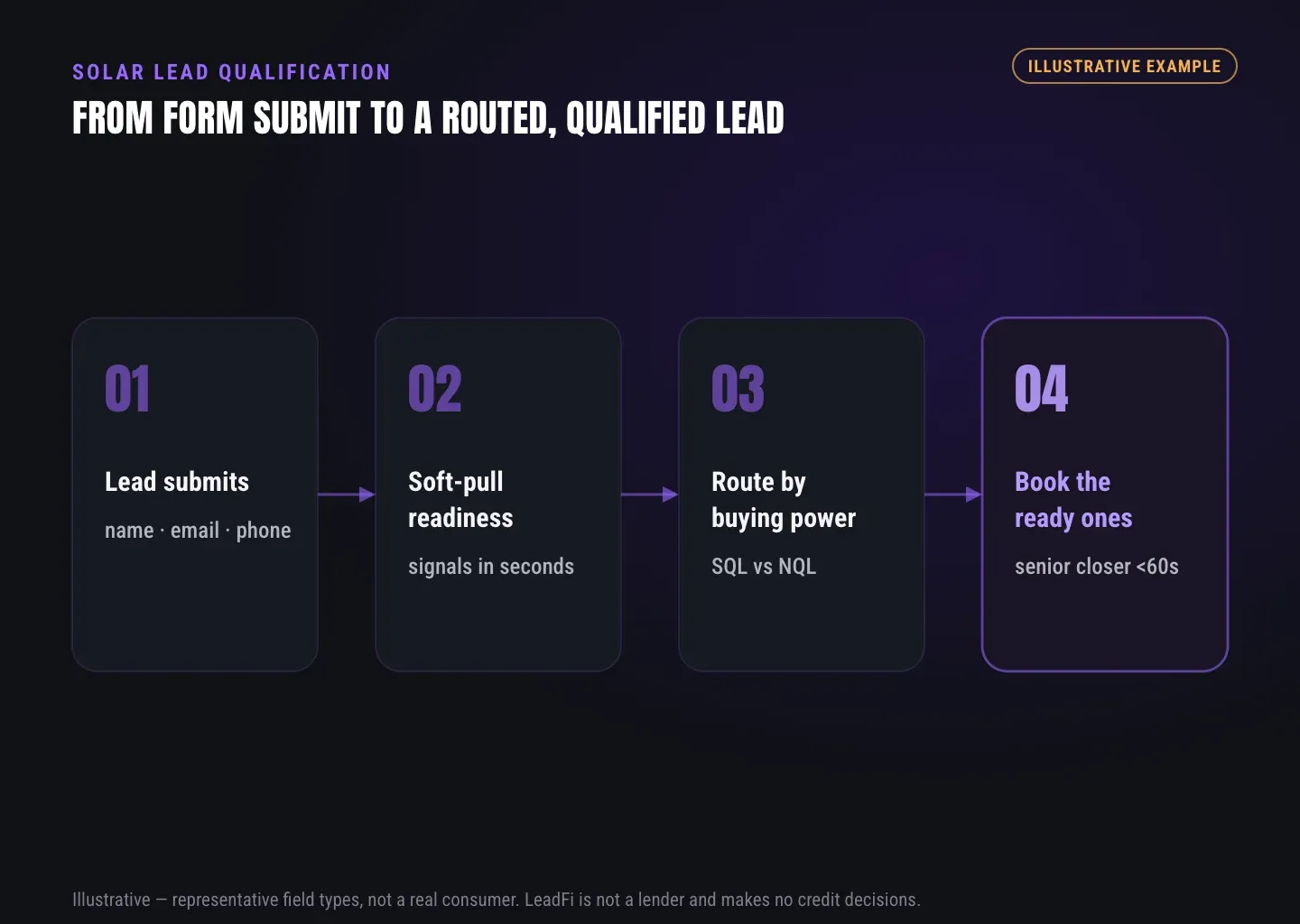
You don't rebuild your funnel. LeadFi sits behind the form, funnel, calendar, or CRM you already run. The homeowner submits as usual, and LeadFi enriches the lead after the submit, then returns readiness plus routing.
The launch checklist is light. First, confirm form fields and consent language. Next, wire the integration. Then map the CRM write-back and routing rules. Finally, test with a few leads before you turn it live.
Form fields and identity inputs
For many solar paths, name, email, and phone are enough to start the identity match. That often means you can drop heavier fields — like full address and DOB — from the form itself. Fewer form fields usually lifts completion, and the readiness read still happens after submit.
Consent and disclosure language
Your form, SMS, and CRM notes should tell one consistent story about why you collect financial context and what happens next. For soft-pull prescreening involving consumer credit data, clear consent and disclosure are essential. LeadFi helps teams align consent and disclosure language as part of setup — this is workflow help, and clients should review their use case with counsel.
CRM and ad-signal write-back
LeadFi can push readiness and SQL/NQL status into your CRM fields, tags, and stages. It can also feed qualified-lead signals back into Meta, Google, TikTok, or Hyros — where the platform permits and your setup allows. As a result, your ads can learn from finance-ready buyers, not just cheap opt-ins. No platform performance is guaranteed.
Compliance-aware setup as onboarding
Compliance-aware setup is a value-add during onboarding. Before launch, LeadFi can help you shape a workflow that fits your disclosures and data practices. LeadFi supports compliance-aware workflows and does not approve or deny consumers.
WHO IT'S FOR
Who this is for
Solar is a high-ticket, local business — the ticket is large and a site visit costs real time. This section is written for installers, solar sales floors, and the agencies that run their lead gen.
- Solar installers spending rep hours on site visits before knowing buying power.
- Solar sales teams with full calendars but soft close rates at the finance step.
- Lead-gen agencies tired of being blamed for "broke leads" — deliver prequalified solar leads instead.
- Media buyers who want ad platforms to optimize for finance-ready homeowners, not cheap form fills.
If you sell high-ticket solar and run ads or organic lead gen, readiness routing fits. But if you only sell a low-cost add-on with no larger offer behind it, it probably won't pay off.
Key takeaways
The short version
- Solar deals die at financing because buying power stays hidden until the loan step — readiness qualification moves that check to right after the form submits.
- LeadFi reads permissioned signals (VantageScore 4.0, income, available credit, debt, DTI) from name, email, and phone via soft-pull prescreening — no credit-score impact and no approve/deny.
- Finance-ready homeowners (SQLs) route to a rep or calendar fast; lower-readiness leads (NQLs) get a financing partner, a low-ticket offer, or a payment plan.
- Thin-input identity matching often removes the need for full address and DOB on the form, which usually lifts completion.
- LeadFi sits behind your existing form, CRM, funnel, or calendar and writes SQL/NQL status back via webhook, API, Zapier, Make, or native integration.
Quick answers
Fast answers before you dig in
Why do solar appointments stall at the financing step?
Solar deals stall because buying power stays hidden until the loan application. Reps invest a full site visit before anyone checks credit, income, or debt-to-income. Readiness-based qualification moves that check to right after the form — so you learn who can finance before you spend the drive time.
How does LeadFi read solar financing readiness?
LeadFi reads financial-readiness signals from name, email, and phone using a soft-pull prescreening workflow — no impact on the homeowner's credit score. It surfaces signals like VantageScore 4.0, income, available credit, debt, and debt-to-income as readiness for routing and rep prep, not a consumer approval or denial.
How are finance-ready solar leads routed vs everyone else?
LeadFi splits every lead into SQL (finance-ready) or NQL (not yet ready) right after submit. SQLs go straight to a rep or booking calendar for fast follow-up. NQLs get a fitting path — a financing partner, a credit-building program, or a low-ticket offer — so no lead is simply thrown away.
What does it take to set up solar lead qualification?
Setup is short. You keep your existing form, add the consent and disclosure language your workflow needs, connect LeadFi by webhook, API, Zapier, Make, or native integration, and map where SQL/NQL outcomes write back. LeadFi helps design a compliance-aware workflow before launch as onboarding help — not legal advice.
FAQ
Common questions
What is solar lead qualification by financial readiness?
Does the soft pull hurt the homeowner's credit score?
Can you qualify solar leads without a full address on the form?
What happens to leads that aren't finance-ready (NQLs)?
What signals does LeadFi read for solar financing readiness?
Does LeadFi guarantee compliance or approve buyers?
Sources
References
- CFPB — What is a credit inquiry? (hard vs. soft) (opens in a new tab)Federal regulator confirms a soft inquiry, unlike a hard inquiry, does not affect the consumer's credit score.
- VantageScore — VantageScore 4.0 credit scoring model (opens in a new tab)Official page describing VantageScore 4.0, the tri-bureau, trended-data model used to assess credit risk.
- CFPB — Who can request to see my credit report? (opens in a new tab)Federal regulator explains the FCRA rules governing who may obtain a credit report.
Know who is ready before your next sales call.
You keep your form, funnel, calendar, and CRM. LeadFi adds the financial-readiness layer behind them — so finance-ready homeowners reach a rep fast, and everyone else gets a path that fits.