
COACHING PROGRAM LEAD QUALIFICATION
Lead Qualification for Coaching and Info-Product Programs
Most coaching programs sell between $2,000 and $15,000. At that price, a discovery call carries real cost — closer time, setter time, and follow-up all add up.
Watch a contact get pre-qualified.
This is exactly what your CRM gets back.
Your opt-in form
Soft pull · no impact to their credit
This is not a real soft pull. It's an example of the data points that land in your CRM contact record when a lead fills out your form.
LEADFI DEMO
Watch the demo, then start free or book a call.
GUIDE
Where a coaching floor loses closer hours
Quick answer: Coaching floors lose hours to booked calls that were never going to buy. Volume looks healthy, yet a chunk of every discovery block goes to people who can't fund a $5K–$10K offer right now. Readiness qualification finds that gap before the call, so closers spend time on leads who can actually move forward.
Your ad account fills the calendar, and that part often works fine. The leak shows up later, when a closer spends 40 minutes on someone who loves the pitch but can't pay. As a result, your cost per real conversation climbs while the dashboard still shows "calls booked."
Most tools stop at surfacing leads. That's why the buying-power question rarely gets answered before someone sits on a call. Below are the four spots where a high-ticket floor bleeds time.
Calls that never had buying power
A lead can be motivated, coachable, and still unable to fund the program today. However, a closer often won't learn this until the payment plan comes up at minute 35. Those minutes are gone — and multiplied across a week, they're a full sales day.
Setters chasing low-readiness replies
Setters work the inbound queue by speed and interest, not by capacity to pay. So the fastest replier gets the first slot, even when a slower, more ready lead sits in the same list. In practice, readiness signals help you rank the queue by fit, not just by who answered first.
One offer for every readiness level
When every lead gets pushed to the same high-ticket call, you force a single path onto a mixed crowd. As a result, that buries ready buyers and sends unready ones to a call they'll never close. A lower-ticket or financing path would serve both sides better.
Ad spend optimizing for the wrong lead
Meta and Google optimize toward whatever event you feed them. For example, if that event is "form submit," they'll find you more submitters — not more buyers. That's why the pixel keeps learning the wrong audience while your true buyer stays under-served.
INTELLIGENCE LAYER
Reading buying power before the discovery call
Quick answer: LeadFi reads buying power from a soft-pull prescreen after the lead submits, using permissioned financial-readiness signals like VantageScore 4.0, income, available credit, and debt-to-income. The soft pull is designed to leave no impact on the consumer's credit score. It informs routing and rep prep, never a consumer approval or denial.
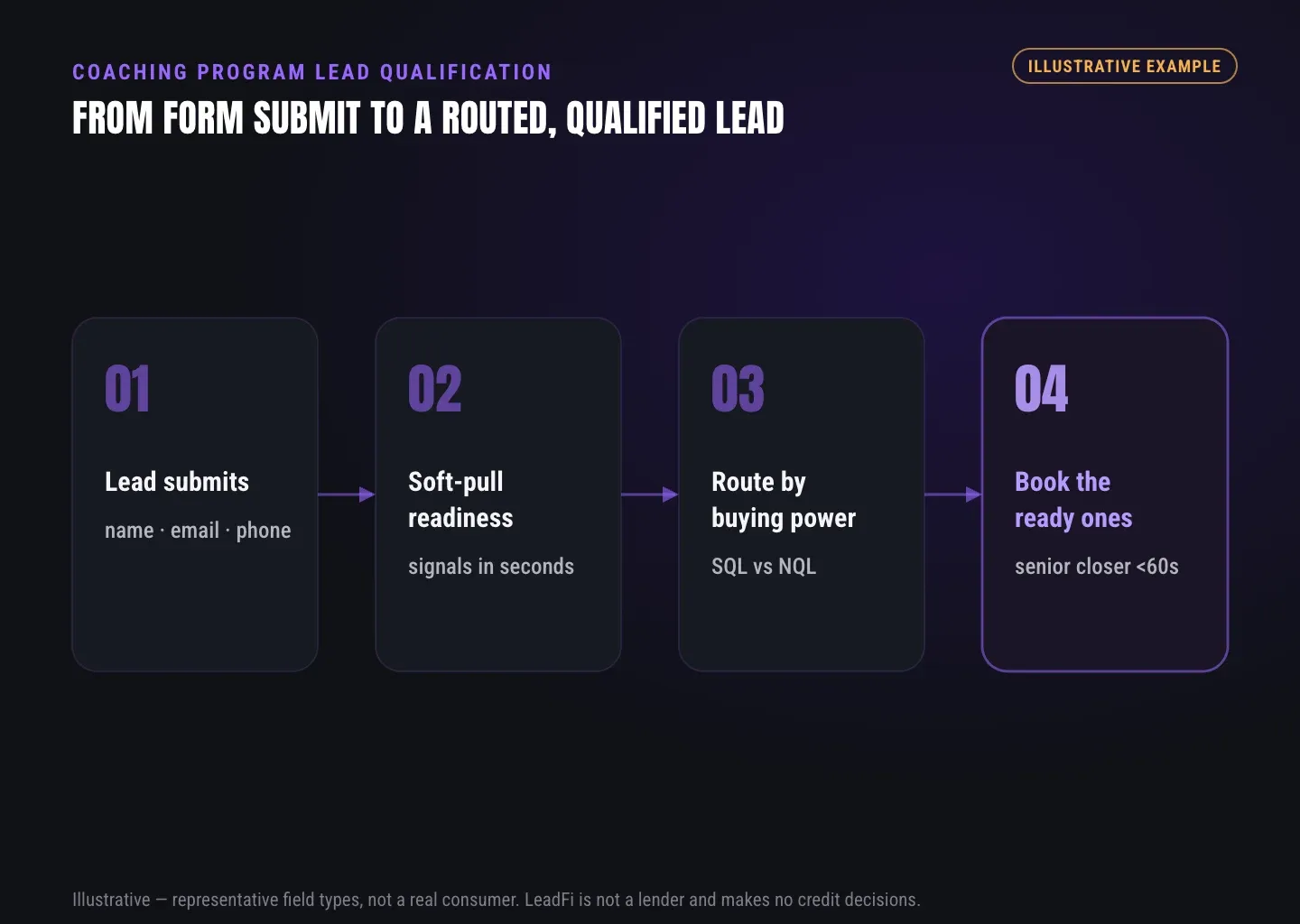
Here's the sequence. First, a lead submits your form or application. Then LeadFi runs identity matching from name, email, and phone to reach a high-confidence match. Next, where your consent and disclosures support it, a soft pull reads readiness signals. Finally, LeadFi returns an SQL or NQL tag plus context your reps can use.
The soft pull is a prescreen — not a full credit decision, and not underwriting. It reads readiness signals with no impact on the consumer's credit score. Above all, it never approves or denies anyone; it just tells your team who's ready and what to say.
Identity match from name, email, phone
LeadFi can work from name, email, and phone. Patent-pending identity matching is designed to confirm a high-confidence match before any prescreen runs. As a result, you often skip asking for address and date of birth up front — less form friction, cleaner data.
Soft-pull prescreen, no credit-score impact
A soft pull reads financial-readiness signals and is designed for no impact on the consumer's credit score. It runs after submit, so it never slows your form or scares the lead. Think of it as operational readiness, not a judgment of anyone's worth.
Readiness signals your closers can use
Signals may include VantageScore 4.0, income, available credit, debt, debt-to-income, and funding pre-approval signals — where consent and disclosures support them. That said, reps don't need raw numbers to prep well. A clean readiness tag tells them which offer and which tone to lead with.
Debt-to-income as a fit signal
Debt-to-income (DTI) compares monthly debt to monthly income. For a high-ticket offer with a payment plan, DTI hints at whether a monthly commitment is realistic right now. LeadFi uses it as one readiness input for routing — not as an approval or a promise about financing.
ROUTING
Routing: who gets the closer, who gets a lower-ticket offer
Quick answer: SQL/NQL routing sends financially ready leads (SQLs) straight to a closer calendar, and routes lower-readiness leads (NQLs) to a low-ticket offer, a payment plan, or a financing path. You set the rules. LeadFi applies them in near real time after submit, so momentum stays high and no ready buyer waits overnight.
Two labels do the heavy lifting here. An SQL is a sales-qualified lead — ready enough for a closer now. An NQL is a non-qualified lead — not unqualified forever, just not ready for the top-ticket call today. Routing decides what happens to each the moment the tag lands.
Speed matters most for SQLs, so route them to a closer fast while interest is fresh. Meanwhile, NQLs don't get dumped — they enter a path built to keep them warm and monetized.
SQLs to the closer, fast
When a lead clears your readiness rules, LeadFi can trigger a redirect to a closer calendar, tag the CRM record, and notify the rep. As a result, your best-fit leads reach a human in minutes, not the next morning. That's speed-to-lead working for the people most likely to buy.
NQLs to a low-ticket offer or a payment plan
A lower-readiness lead is still a lead. For example, you can route them to a low-ticket offer, a payment plan, a self-paced course, a community tier, or a financing path — whatever fits your ladder. This is how you monetize demand that isn't ready for the $8K call yet.
Rules you control by campaign
You set the thresholds, and you can tune them per campaign. For example, a younger, thinner-credit audience might need different cutoffs than a seasoned-professional funnel. LeadFi applies whichever rule set you configure — it doesn't decide your business logic for you.
Rep context before the call opens
Beyond the SQL/NQL tag, LeadFi can write readiness context into the CRM record. So the closer opens the call already knowing which offer and payment structure fit. That prep turns a cold-open pitch into a relevant conversation.
| Layer | What it does well | What it doesn't do | How LeadFi fits |
|---|---|---|---|
| Form / funnel builder | Captures the lead, structures questions | Read buying power after submit | LeadFi enriches the lead once it lands |
| Calendar / booking tool | Schedules the call | Decide who should get which call | LeadFi routes SQLs vs NQLs into the right calendar |
| CRM | Stores records, runs automations | Score financial readiness | LeadFi writes SQL/NQL tags, fields, and stages back in |
| Attribution / ad tool | Tracks journeys and channels | Grade leads by financial fit | LeadFi feeds readiness signals for optimization, where permitted |
| LeadFi | Financial-readiness qualification + SQL/NQL routing | Approve or deny consumers; guarantee outcomes | Sits behind the whole stack |
See which of the leads you already have can actually afford to buy.
GUIDE
What you set up: form fields, calendar rules, CRM tags
Quick answer: Setup has three parts — keep your form light (name, email, phone are often enough), add calendar rules so SQLs and NQLs reach different next steps, and map CRM fields, tags, and stages so qualification status lives where your team works. LeadFi connects via webhook, API, Zapier, Make, or native workflow, behind the stack you already run.
You don't rebuild anything. LeadFi sits behind your current form, funnel, calendar, and CRM. In practice, it receives the lead after capture, enriches it, and writes outcomes back where your team already looks.
Compliance-aware setup is part of onboarding — a value-add, not a blocker. In addition, LeadFi helps align your form disclosures, consent language, and CRM notes so prospects hear one consistent story. LeadFi does not provide legal advice; your counsel reviews customer-facing language.
Form fields: keep it light
Because identity matching runs on name, email, and phone, you can often drop address and DOB from the form. As a result, fewer fields usually means higher completion. Cleaner input also means a stronger match before the prescreen runs.
Calendar rules: split the paths
Set your booking flow so SQLs land on a closer calendar and NQLs hit a low-ticket or payment-plan page. LeadFi decides who gets which path; your calendar tool still handles the scheduling. The two work together — no rip-and-replace.
CRM tags, fields, and stages
LeadFi can write SQL/NQL status, readiness tags, and pipeline stages into your CRM via webhook, API, Zapier, Make, or native workflow. So qualification lives in the record your reps already open. Tags and stages then drive your existing automations.
Ad signal loop, where permitted
You can feed financially qualified lead signals back into Meta, Google, TikTok, Hyros, and your ops stack — where the platform and your setup permit it. This is how you teach the pixel to chase buyers, not just submitters. Still, no platform guarantees apply, and correct setup matters.
Key takeaways
The short version
- High-ticket coaching floors lose closer hours to booked calls that never had buying power, not to low lead volume.
- LeadFi reads buying power from a soft-pull prescreen after submit using signals like VantageScore 4.0, income, available credit, and DTI — designed for no credit-score impact.
- Identity matching runs on name, email, and phone, so you can often drop address and DOB from the form and lift completion.
- SQL/NQL routing sends ready leads to a closer fast and routes lower-readiness leads to a low-ticket offer, a payment plan, or a financing path.
- LeadFi classifies and routes by readiness — it does not approve or deny consumers, does not provide legal advice, and defers customer-facing language to your counsel.
Quick answers
Fast answers before you dig in
What is lead qualification for coaching programs?
It's scoring booked leads on whether they can actually fund your $2K–$15K offer, then routing each one accordingly. LeadFi reads permissioned financial-readiness signals after submit and splits SQLs from NQLs — it classifies and routes, never approving or denying anyone.
Does the soft-pull prescreen hurt a lead's credit score?
No. The soft-pull prescreen is designed to leave no impact on the consumer's credit score. It reads readiness signals for routing and rep prep only — it is not underwriting and not a consumer approval or denial.
How does SQL vs NQL routing work for coaching calls?
SQLs (financially ready leads) route to a closer calendar fast with CRM tags and a rep notification. NQLs route to a low-ticket offer, a payment plan, or a financing path. You set thresholds per campaign; LeadFi applies them in near real time after submit.
FAQ
Common questions
What is lead qualification for coaching programs, and how is LeadFi different?
How do I qualify coaching leads without adding form fields?
Does the soft pull hurt a lead's credit score?
How does SQL vs NQL routing work for high-ticket coaching sales calls?
What do I actually set up to start?
Can LeadFi improve my ad targeting for financial-readiness qualification?
Is this compliant, and does LeadFi handle the legal side?
Sources
References
- CFPB — What is a credit inquiry? (hard vs. soft) (opens in a new tab)Federal regulator confirms a soft inquiry, unlike a hard inquiry, does not affect the consumer's credit score.
- VantageScore — VantageScore 4.0 credit scoring model (opens in a new tab)Official page describing VantageScore 4.0, the tri-bureau, trended-data model used to assess credit risk.
- Experian — What Is a Soft Inquiry? (opens in a new tab)Major credit bureau explains soft inquiries are informational and have no impact on credit scores.
Know who is ready before your next sales call.
Coaching floors don't fail on lead volume — they lose hours on calls that were never going to close. In practice, a readiness layer helps you spend closer time where the buying power is, and gives lower-readiness leads a path that still monetizes.