
SALES LEAD QUALIFICATION
Sales Lead Qualification: Criteria to Set Before the First Call
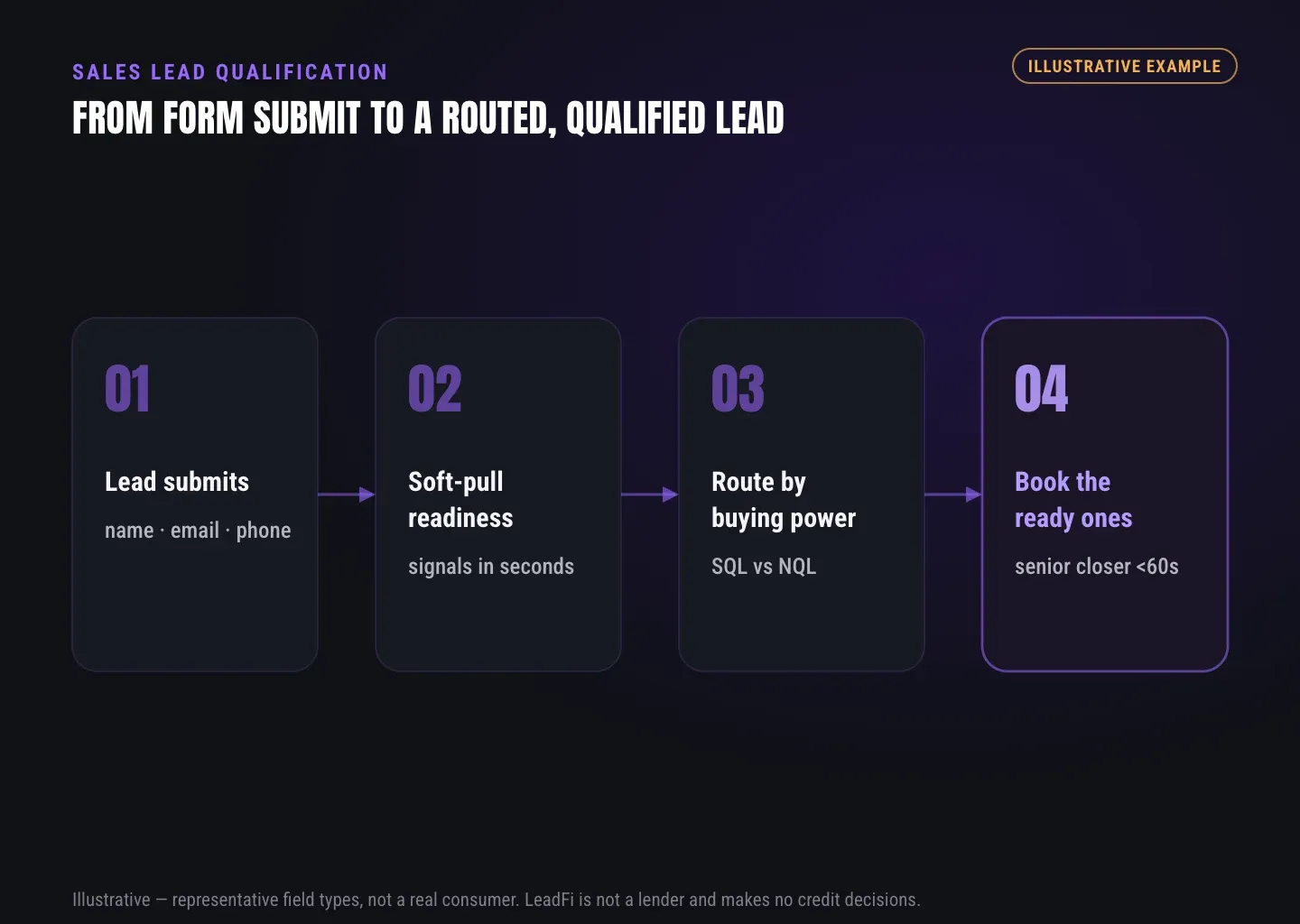
Sales lead qualification should answer a practical question: What happens after an inbound lead submits a form? For high-ticket teams, stated interest alone may not justify scarce closer time.
Watch a contact get pre-qualified.
This is exactly what your CRM gets back.
Your opt-in form
Soft pull · no impact to their credit
This is not a real soft pull. It's an example of the data points that land in your CRM contact record when a lead fills out your form.
LEADFI DEMO
Watch the demo, then start free or book a call.
GUIDE
Sales-ready standards for lead qualification
Sales lead qualification works best when every inbound lead faces clear, repeatable rules. Define required gates, ranking signals, status owners, and the action triggered by each result. Store those fields in the CRM so routing does not depend on memory.
SQL definitions in plain terms
A Sales-Qualified Lead meets the team's stated criteria for a primary sales path. The SQL label should trigger a specific action, such as a priority queue, standard closer calendar, or faster response target.
NQL definitions without blame
A Non-Qualified Lead does not currently meet the rules for the main path. NQL should describe a workflow status, not a person's worth. Useful next steps include nurture, a lower-ticket product, an alternate service, a request for missing information, or later follow-up.
Qualification gates versus scoring signals
A gate is a required condition, such as offer fit, service area, or valid contact information. A scoring signal ranks leads after they pass the necessary gates. Keeping the two separate prevents one attractive signal from overriding poor fit.
A practical high-ticket rubric can assess:
- Offer fit: The lead has a problem the offer addresses.
- Market fit: The business type, location, or size fits the service.
- Stakeholder access: The lead can participate in the buying choice.
- Intent: The lead requested a call, review, or clear next step.
- Timing: The stated window fits the sales process.
- Contact quality: The submitted name, email, and phone support follow-up.
- Financial readiness: Buying-power context supports the intended sales path.
- Intake completion: Required application steps are complete.
Your team decides which criteria are gates, ranking factors, or discovery questions. Those choices may differ across coaching, agency, real estate, insurance, mortgage, funding, and other high-ticket sales motions.
Status ownership and next actions
Give every status one owner and one next action. A useful status set might include priority SQL, standard SQL, manual review, NQL—nurture, NQL—alternate offer, and unmatched.
Qualification reviews on a set schedule
Do not rewrite the rubric after every difficult call. Review repeat patterns by offer, source, route, and rule version. Make changes when the evidence points to a stable operating problem, such as weak fit questions or missing intake data.
Closer intake standards
A closer should receive concise context rather than an unexplained score. Useful CRM fields include qualification status, reason code, offer path, lead source, intent summary, readiness band, next action, response target, record owner, and rule version. Clearly label whether each field came from the form, a setter, LeadFi, or a CRM event.
INTELLIGENCE LAYER
Financial readiness before the first sales call
Financial readiness adds buying-power context to sales lead qualification before follow-up. Depending on configuration, consent and disclosures, signals can include VantageScore 4.0, available credit, income, debt, debt-to-income ratio, and optional asset or net-worth-style context. These signals inform routing and rep preparation.
Readiness added after lead capture
LeadFi works behind forms, funnels, calendars, and CRMs. After an existing inbound lead submits, the platform can enrich the record and return a readiness classification while the sales team still has momentum.
Thin-input identity matching
LeadFi can work from name, email, and phone in many workflows. Its patent-pending identity matching is designed to establish a high-confidence match before soft-pull prescreening and, where applicable, deeper bureau-backed workflows.
Current address and age may be used as identity-related information where relevant and available. Age-related data should be limited to necessary identity functions rather than used as a sales-ranking criterion. Exact inputs and returned fields depend on the configured workflow.
Financial signals read together
A single signal rarely explains full sales readiness. Available credit can provide capacity context, while income, debt, and debt-to-income ratio add different dimensions. VantageScore 4.0 may be included where supported. Optional liquid asset, retirement, brokerage, real estate, or net-worth-style context may also be available.
Most reps do not need an unrestricted raw-data view. A team-defined readiness band, reason code, and recommended next action can provide useful context while limiting unnecessary exposure.
Buyer dignity in qualification
A readiness label is an operating status, not a judgment about a person. Reps should receive only the information needed to conduct a relevant, respectful conversation. Lower readiness can lead to education, nurture, a lower-ticket offer, or a later check-in rather than an unexplained dead end.
Team-owned sales decisions
Your business defines offer-fit criteria, readiness bands, routes, and follow-up rules. LeadFi supplies financial-readiness signals and helps apply those rules. A financially ready lead may still have weak fit or intent, while a lower-readiness lead may fit another offer.
A simple two-axis model can evaluate sales fit separately from financial readiness. This prevents buying power from becoming the entire qualification standard.
Address friction in lead intake
Some workflows can begin with name, email, and phone without requesting an address or date of birth on the first form. This creates an option for shorter intake, although exact identity requirements depend on the setup. It does not remove consent and disclosures obligations.
LeadFi supports compliance-aware setup before launch, including help with privacy and consent language, TCPA-aware practices, and FCRA-aware workflow guidance. LeadFi does not provide legal advice, and clients should review their use case with counsel.
ROUTING
Closer queue priorities and routing rules
Appointment-priority rules turn qualification results into a clear work order. Every route should specify an owner, response target, queue, reason code, and fallback action.
Closer time protection
Start with available closer capacity and the minimum intake standard for a useful first call. The goal is not to fill every calendar slot blindly; it is to direct limited sales time toward leads that meet the team's stated fit and readiness criteria.
Readiness and fit routing
Useful tiers include:
- Priority SQL: Strong fit, clear intent, near-term timing, and strong readiness.
- Standard SQL: Good fit and intent with a normal follow-up window.
- Review lead: Missing, mixed, or unmatched information requiring human review.
- NQL path: A lead who does not currently meet the main-offer rules.
Put a readable reason code beside the tier. “Priority SQL—strong fit, near-term timing, readiness matched” gives a rep more context than an unexplained numeric score.
Speed-to-lead rules
A priority label matters only if it changes the workflow. Assign each queue a team-owned response target, backup owner, and overflow path. LeadFi supports faster routing for financially qualified leads, but actual response time remains an operational choice.
Manual-review lanes
Missing or conflicting data should trigger review rather than a guessed classification. A review lane can request one missing intake detail, send the lead to a setter, or resolve a field-mapping issue before the main sales path continues.
NQL next steps
NQL routing can preserve demand by matching the next step to the reason:
- Timing NQL: Scheduled nurture or later follow-up.
- Offer-level NQL: Lower-ticket or entry product.
- Fit NQL: Another relevant service where one exists.
- Incomplete NQL: Request for missing intake information.
- Readiness NQL: Education, nurture, or a later assessment.
- Unmatched lead: Manual review instead of an assumed status.
CRM and funnel connections
LeadFi can connect through webhook, API, Zapier, Make, or supported native workflows. Results can update CRM fields, tags, stages, owners, lists, alerts, calendars, landing pages, and automation triggers.
Where platform rules and configuration allow, teams can also send financially qualified lead events into Meta, Google, TikTok, Hyros, and related operations stacks. Media buyers generally need a useful quality event rather than raw personal financial values. These feedback signals can support campaign analysis without promising platform performance.
| Sales fit | Financial readiness | Suggested sales route |
|---|---|---|
| High | High | Priority closer queue |
| High | Medium or unclear | Standard closer queue or setter review |
| High | Lower | Nurture, lower-ticket path, or later follow-up |
| Low | High | Alternate offer only when genuine fit exists |
| Low | Low | Long-term nurture or respectful closeout |
| Unclear | Any band | Manual review or request missing information |
See which of the leads you already have can actually afford to buy.
INTEGRATIONS
Rep feedback for qualification calibration
Rep feedback helps sales lead qualification stay connected to real conversations. Use structured reason codes and comparable records rather than relying on isolated opinions.
Accepted and rejected handoff tracking
Ask closers whether each handoff met the defined intake standard. If it did not, capture a specific reason such as poor offer fit, inaccurate timing, missing stakeholder context, incomplete intake, or an unsuitable route.
Route and outcome comparisons
Review accepted handoffs, rejected handoffs, route changes, held calls, stage movement, and follow-up timing. One lost sale does not prove that qualification was wrong; qualification determines a suitable sales path, not a guaranteed outcome.
Segment-based rule tuning
Compare like with like. Webinar leads may have different intent from direct demo requests, and separate offers may require different gates. Keep financial readiness distinct from offer fit so teams can correct the actual problem.
Versioned qualification changes
Store the rule version applied to each lead. Without versioning, RevOps may compare records created under different definitions and draw the wrong conclusion.
Weekly qualification calibration
A focused weekly review can cover inbound volume, identity-match status, SQL and NQL counts, manual reviews, accepted handoffs, rejected handoffs, response time, route changes, source, offer, and rule version. Also check whether the sales team met its own response targets before blaming the rubric.
Marketing can receive aggregated SQL-quality events, readiness bands, or route outcomes where the setup allows. Sales may receive more context for call preparation, while leadership can trace source, qualification status, handoff, route, and outcome.
A 30-day qualification cycle
- Week 1—Define: Set statuses, gates, signals, owners, routes, and reason codes.
- Week 2—Connect: Map forms, LeadFi results, CRM fields, calendars, and alerts.
- Week 3—Observe: Check matching, routing, response timing, and rep feedback.
- Week 4—Calibrate: Review stable patterns by source, offer, and rule version before changing the rubric.
The strongest system is not the one with the most fields. It is the one that gives each inbound lead a clear, useful, and trackable next step.
Related reading: a closer look at prequalifying leads before the sales call, practical insights on soft credit check without address for lead qualification, a practical guide to pre-screen leads by financial readiness.
Key takeaways
The short version
- Separate qualification gates from lead-ranking signals.
- Evaluate offer fit and financial readiness independently.
- Give every SQL, NQL, review, and unmatched status a next action.
- Use name, email, and phone for eligible thin-input workflows.
- Feed route outcomes into CRM and campaign-quality workflows.
Quick answers
Fast answers before you dig in
What is sales lead qualification?
Sales lead qualification applies team-owned criteria such as offer fit, intent, timing, stakeholder access, contact quality, and financial readiness to determine the next sales follow-up path for an inbound lead.
Which criteria should be set before the first sales call?
Define hard gates, ranking signals, and discovery questions for offer fit, market fit, intent, timing, contact quality, stakeholder access, intake completion, and financial readiness.
How does LeadFi support financial-readiness qualification?
LeadFi enriches existing inbound leads after submission and returns buying-power-aware signals that teams can use for SQL/NQL routing, queue priority, rep preparation, nurture, or alternate offers.
Can sales lead qualification start from thin inputs?
Many LeadFi workflows can start from name, email, and phone. Patent-pending identity matching is designed to establish a high-confidence match before applicable soft-pull prescreening.
What should happen to NQLs?
Route NQLs according to the reason: nurture, lower-ticket products, alternate services, requests for missing data, manual review, education, or later follow-up.
FAQ
Common questions
What is sales lead qualification?
Which sales lead qualification criteria matter most?
How does financial readiness improve sales lead qualification?
Can LeadFi support a soft credit check without an address?
Does a LeadFi soft pull affect a credit score?
What is SQL/NQL routing?
How should closer feedback change sales lead qualification?
Sources
References
- CFPB — What is a credit inquiry? (hard vs. soft) (opens in a new tab)Federal regulator confirms a soft inquiry, unlike a hard inquiry, does not affect the consumer's credit score.
- VantageScore — VantageScore 4.0 credit scoring model (opens in a new tab)Official page describing VantageScore 4.0, the tri-bureau, trended-data model used to assess credit risk.
- CFPB — Who can request to see my credit report? (opens in a new tab)Federal regulator explains the FCRA rules governing who may obtain a credit report.
- VantageScore 4.0 (opens in a new tab)Official background on the named score model referenced as a possible financial-readiness signal.
Know who is ready before your next sales call.
LeadFi works behind the forms, funnels, calendars, CRMs, and automations your team already uses. Request a guided demo or workflow assessment to see how thin-input financial-readiness qualification, SQL/NQL routing, and rep-ready context could fit your high-ticket sales motion.