
SOFT CREDIT CHECK WITHOUT ADDRESS FOR LEAD QUALIFICATION
Soft Credit Check Without Address for Lead Qualification
A soft credit check without address sounds like a workaround, but for businesses that need to understand buying power before the first call, the real value isn't skipping a data field. It's gaining financial-readiness signals early enough to prioritize sales-qualified leads (SQLs), route non-qualified leads (NQLs) to low-ticket or alternate paths, and feed better conversion signals back into your CRM and paid-media workflows.
- Soft pull — no impact to their credit
- From name, email, phone — no address or SSN
- Sits behind your form, funnel, and CRM
Watch a contact get pre-qualified.
This is exactly what your CRM gets back.
Your opt-in form
Soft pull · no impact to their credit
This is not a real soft pull. It's an example of the data points that land in your CRM contact record when a lead fills out your form.
LEADFI DEMO
Watch how it works, then start free or book a call.
THE PROBLEM
Why Buying-Power-Aware Qualification Beats Chasing Raw Lead Volume
Bottom line: Buying-power-aware qualification routes sales calls to leads with demonstrated financial readiness. You reduce wasted rep hours, improve speed-to-lead for SQLs, and create alternate monetization paths for NQLs. Volume without readiness equals burned ad spend and demoralized closers.
Most marketing teams optimize for cost-per-lead or form-fill rates. When a high-ticket offer requires a $5,000 upfront payment or financing approval, raw lead volume becomes a vanity metric.
If half your inbound leads lack the income, available credit, or debt-to-income ratio to realistically close, your sales team spends half its time on calls that were never going to convert—no matter how polished the pitch.
What Financial-Readiness Qualification Enables
LeadFi turns that dynamic around. By running soft-pull prescreening and financial-readiness qualification before the call gets assigned, teams can:
- Prioritize financially qualified leads for immediate speed-to-lead follow-up
- Route lower-readiness leads to low-ticket offers, payment plans, or alternate financing paths
- Feed qualified-lead signals back into Meta, Google, TikTok, Hyros, and CRM workflows so ad algorithms and rep dashboards learn which lead profiles actually close
- Reduce wasted sales calls and improve rep morale by putting closers in front of prospects who can say yes
Real-World Financial Qualification Workflows
High-ticket coaching clients use LeadFi to spot leads with $10,000+ available credit before booking a strategy call. Business-funding agencies use it to see debt-to-income ratio and income signals so they know whether to route a lead to a traditional term loan, a merchant cash advance, or a six-month credit-building path.
Mortgage brokers use it to identify pre-approval-ready leads versus tire-kickers who need credit repair first. The unifying theme: optimize for lead quality and buying power, not just lead volume.
PLATFORM OVERVIEW
Beyond "Without An Address": What Thin-Input Prescreening Really Unlocks
Note: the scenarios below are hypothetical illustrations, not customer results. Figures are examples only and are not a promise of results; actual results vary.
Bottom line: "Soft credit check without address" often means generating financial-readiness signals from name, email, and phone—thin-input prescreening that supports SQL vs NQL routing and rep preparation without requiring a full application form upfront. The value isn't skipping compliance; it's unlocking actionable intelligence early in the funnel.
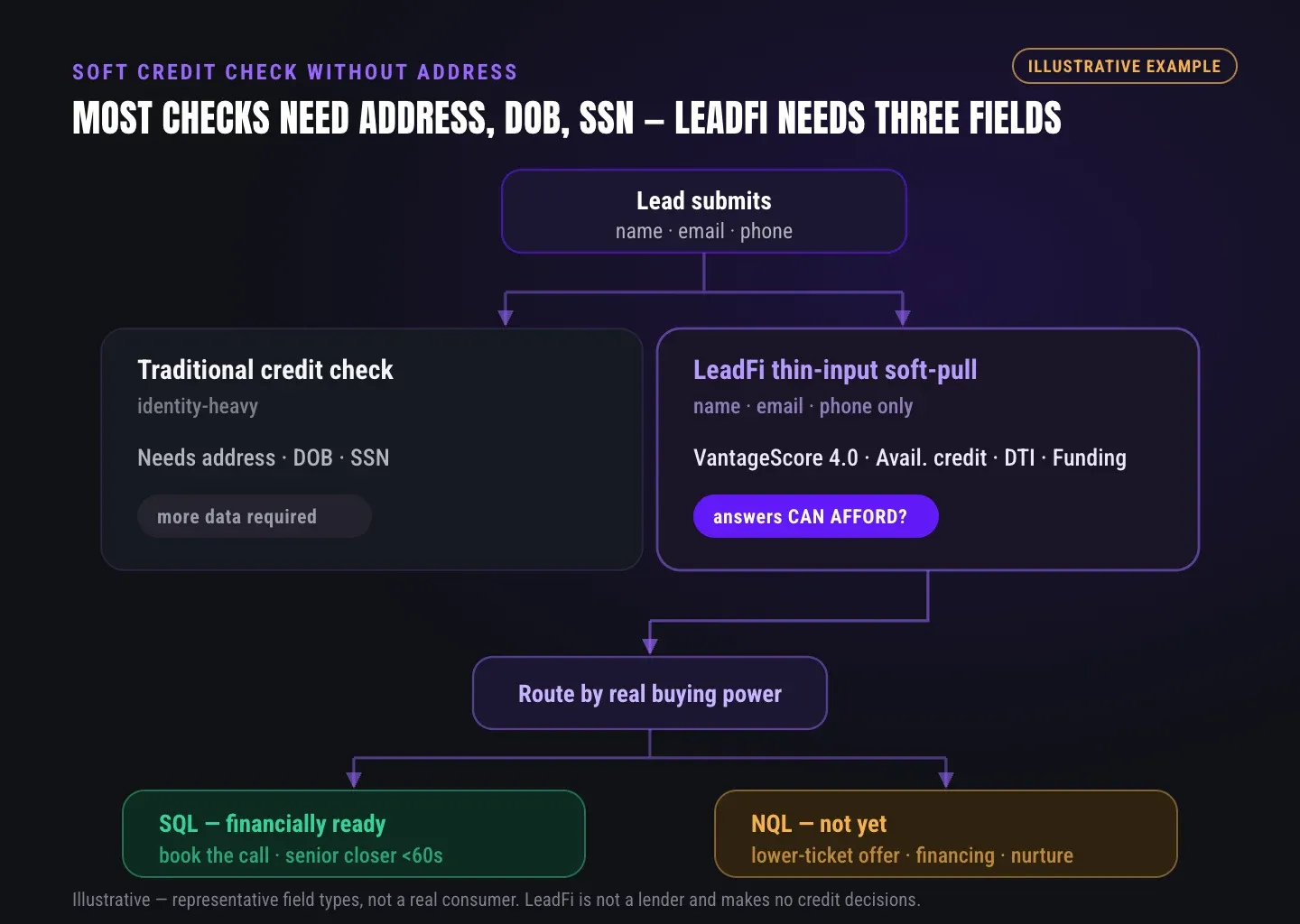
The phrase "soft credit check without address" sounds like a trick to avoid data collection. The real opportunity is thin-input prescreening: using the lead data you already capture—name, email, phone—to generate real-time financial insights that help teams route and prioritize before asking for a full application.
LeadFi surfaces VantageScore 4.0, available credit, income, debt, debt-to-income ratio, funding pre-approval, age, address (when available), and optional net-worth-style context as readiness signals for routing and rep prep—not as underwriting decisions or consumer approvals.
Traditional vs Financial-Readiness Workflows
The side-by-side workflow comparison lives in the Comparison section below.
LeadFi is designed for soft-pull prescreening and financial-readiness qualification. It helps teams prioritize, route, and follow up with leads more effectively.
Compliance-First Approach to Thin-Input Qualification
The platform does not skip consent, ignore disclosures, or run checks on anyone without proper workflow setup. LeadFi helps clients set up a compliance-aware qualification workflow before launch, ensuring privacy policy language, consent language, TCPA-aware practices, and FCRA-aware workflow guidance are in place. That's not legal advice, but onboarding support that removes friction and confusion.
Hypothetical example: A business-coaching company runs Facebook ads for a $7,500 program. Leads land on a quiz that asks name, email, phone, and one qualifying question. LeadFi receives those inputs via webhook, runs a soft-pull prescreen, and returns a readiness score plus available credit.
High-readiness leads (VantageScore 4.0 660+, $8,000+ available credit) get routed to the sales director within five minutes. Medium-readiness leads get a calendar link for a group call and a low-ticket offer. Low-readiness leads receive a $497 low-ticket course and a six-month credit-building path.
Illustrative result: Sales calls drop 40%. Close rate on calls made jumps 60%.
| Traditional flow | LeadFi thin-input flow |
|---|---|
| Lead fills form → Sales calls blind → Discovers halfway through call that lead can't afford offer → Wasted 30 minutes | Lead fills form → LeadFi runs soft-pull prescreening → SQL routed to closer; NQL routed to a low-ticket offer or alternate path → Rep preps with readiness context |
| No financial context until deep in conversation | Rep sees VantageScore 4.0, available credit, income, DTI before dialing |
| All leads treated the same priority | Speed-to-lead for SQLs; automated low-ticket path for NQLs |
| CRM and ads learn slowly which leads convert | Qualified-lead signals fed back via webhook to CRM and ad platforms |
INTELLIGENCE LAYER
Financial-Readiness Signals Teams Can Act On Before The Call
Bottom line: LeadFi surfaces VantageScore 4.0, available credit, income, debt, debt-to-income ratio, funding pre-approval, age, address, and optional asset context. These signals help reps prioritize SQLs, prepare context for conversations, and route NQLs to a low-ticket offer or alternate paths—not approve or deny consumers.
When a rep dials a lead, context is leverage.
Illustrative example: knowing that a prospect has a 720 VantageScore 4.0, $15,000 in available credit, verified income over $80,000, and a 28% debt-to-income ratio means the conversation can skip "Can you afford this?" and jump straight to "Which payment option works best for you?"
Knowing that a lead has a 580 score, maxed-out credit lines, and a 55% DTI means the rep can pivot to a low-ticket offer, a payment plan, or a financing partner—before wasting 30 minutes on a pitch that can't close.
Key Financial-Readiness Data Points
LeadFi helps teams generate these financial-readiness signals from name, email, and phone:
Credit and Capacity Signals
- VantageScore 4.0: A soft-pull credit score that reflects creditworthiness without impacting the consumer's score. Helps teams understand likelihood of financing approval or ability to pay upfront
- Available credit: Total revolving credit limits minus current balances. High available credit often correlates with buying power for high-ticket purchases
- Funding pre-approval: Indicators that a lead may qualify for business funding, personal loans, or other financing products. Useful for teams selling via financing partners
Income and Obligation Signals
- Income: Verified or modeled income estimates. Critical for debt-to-income calculations and affordability assessments
- Debt: Total outstanding obligations. Combined with income, this drives DTI ratio
- Debt-to-income ratio (DTI): Monthly debt payments divided by monthly income. Lenders and high-ticket closers use DTI to gauge financial capacity
Context and Net-Worth Signals
- Age and address: Demographic and location context that can inform offer matching and compliance workflows
- Optional net-worth signals: Liquid assets, retirement accounts, brokerage accounts, real estate equity. Useful for ultra-high-ticket offers or wealth-management scenarios where net worth matters more than credit score
How Teams Use Financial-Readiness Data
These signals are readiness data for routing and rep preparation—not underwriting decisions or consumer approvals. LeadFi does not approve or deny consumers. It helps businesses understand financial readiness and lead quality so teams can act smarter, faster, and more profitably.
Hypothetical example: A solar-financing agency captures name, email, and phone via a roofing calculator. LeadFi prescreens each lead.
Leads with 680+ VantageScore, $20,000+ available credit, and sub-40% DTI get routed to a senior loan officer with same-day callback SLA. Leads with 620–680 score and moderate DTI get a calendar link for a group financing webinar. Leads below 620 get a "start here" credit-repair partner offer and enter a 90-day credit-building follow-up.
Illustrative result: The agency's close rate on senior-officer calls doubles. Overall funnel profitability improves 50% because NQLs now generate alternate revenue instead of burning rep time.
ROUTING & SIGNALS
SQL Vs NQL: Prioritize Financially Qualified Leads And Route The Rest
Bottom line: SQLs are financially qualified leads with the buying power to close now. NQLs are leads who need a low-ticket offer, a payment plan, or a longer timeline. Routing both intelligently—speed-to-lead for SQLs, low-ticket monetization for NQLs—reduces wasted sales calls and improves funnel economics.
Not every lead is created equal. Treating them all the same is expensive.
Speed-to-lead matters most for sales-qualified leads (SQLs)—prospects who have the financial readiness and intent to close in the near term. For non-qualified leads (NQLs)—prospects who lack immediate buying power but may convert later or via alternate offers—speed-to-lead is less critical than smart routing to the right next step.
SQL Routing (Financially Qualified Leads)
- Profile: VantageScore 4.0 above threshold (e.g., 660+), available credit sufficient for offer price, income and DTI within acceptable range, funding pre-approval indicators present
- Action: Route to top closer within minutes. Surface readiness signals in CRM so rep can tailor pitch. Track conversion to feed signal back into ad platforms
- Outcome: Higher close rates, better rep utilization, faster revenue recognition
NQL Routing (Financially Unqualified or Not-Yet-Ready Leads)
- Profile: VantageScore 4.0 below threshold, insufficient available credit, high DTI, or missing income verification
- Action: Route to a low-ticket offer, a payment plan, a financing-partner pathway, or a credit-repair affiliate. Do not assign to senior closers
- Outcome: Monetize leads who would otherwise be discarded. Build pipeline for future upsell. Reduce wasted sales calls
Why Smart Routing Captures More Value
This isn't about rejecting leads—it's about matching them to the right next step.
A lead with a 590 VantageScore and maxed-out credit cards won't close on a $10,000 coaching package today, but they might buy a $297 course, join a credit-building program, or convert in six months after improving their finances. By routing them appropriately, you capture value and preserve rep capacity for high-probability closes.
Hypothetical example: A high-ticket consulting agency runs Google Ads for a $15,000 done-for-you service. Leads submit name, email, phone, and business revenue. LeadFi prescreens and returns a readiness score.
SQLs (score 75+, $20,000+ available credit, income verified) get a Calendly link for the founder's calendar and a five-minute callback from an SDR. NQLs (score 40–74) get a $997 low-ticket DIY course and a twelve-month follow-up campaign. Low-readiness leads (score <40) get a free lead-magnet and affiliate link for business credit-building.
Illustrative result: Founder's close rate hits 45% because every call on the calendar is financially qualified. NQL monetization adds $50,000/month in DIY course revenue that previously didn't exist.
See which of the leads you already have can actually afford to buy.
ATTRIBUTION & FEEDBACK
From CRM To Ads: Webhooks, APIs, Zapier, Make, And Platform Signals
Bottom line: LeadFi integrates with CRMs via webhook, API, Zapier, Make, or native workflow. It feeds qualified-lead signals back into Meta, Google, TikTok, Hyros, and ops stacks so ad algorithms and sales systems learn which lead profiles convert—creating a closed-loop optimization engine.
Financial-readiness qualification is only valuable if it connects to the systems your team already uses. LeadFi is designed to plug into CRMs, marketing automation platforms, and paid-media workflows so qualification signals flow automatically—no manual export-import gymnastics, no "check this other dashboard" friction.
CRM and Ops Integrations
- Webhook: LeadFi sends qualification results (score, available credit, income, DTI, SQL/NQL designation) to your CRM in real time as JSON payload. Your CRM workflow routes the lead, tags it, assigns it to the right rep, and surfaces readiness signals in the contact record
- API: Bi-directional API for custom integrations. Query LeadFi for readiness on demand. Push results into proprietary systems
- Zapier and Make: No-code connectors for HubSpot, Salesforce, Pipedrive, ActiveCampaign, GoHighLevel, and hundreds of other platforms. Configure triggers ("When LeadFi scores a lead as SQL…") and actions ("…create task for senior closer and send Slack notification")
- Native workflow: For platforms with direct integration support, LeadFi appears as a native action in the workflow builder
Paid-Media Signal Feedback
Once you know which leads are financially qualified and which close, feeding that signal back to ad platforms supercharges optimization:
- Meta (Facebook/Instagram): Send "qualified lead" and "closed deal" conversions via Conversions API. Meta's algorithm learns to find more lookalike leads with similar financial profiles
- Google Ads: Push "qualified lead" conversion events. Enhanced conversions and smart bidding optimize toward leads who can actually afford your offer
- TikTok Ads: Fire "qualified lead" and "purchase" events. TikTok's algorithm shifts spend toward creative and audiences that generate buying-power-ready leads
- Hyros and attribution platforms: Feed qualification and close data so attribution models account for lead quality, not just lead quantity
How Closed-Loop Feedback Compounds Results
This closed-loop feedback is how marketing and sales compound each other. Without it, ad platforms optimize for form fills that may never convert. With it, they optimize for financially qualified form fills—leads who can say yes.
Hypothetical example: A business-funding agency runs Meta lead ads. Every lead flows into LeadFi via webhook.
SQLs (income $75k+, DTI <45%, funding pre-approval positive) trigger a "qualified_lead" conversion event back to Meta via Conversions API and get assigned to a senior loan officer in the CRM. NQLs trigger a "nurture_lead" event and get a Zapier action that adds them to a Mailchimp sequence and creates a low-priority task in Pipedrive.
Illustrative result: After 60 days, Meta's algorithm has shifted 70% of spend toward audiences and creative that produce SQLs. Cost-per-qualified-lead drops 40%. Close rate on funded deals improves 35% because reps only call financially ready prospects.
WORKFLOW DESIGN
Compliance-Aware Setup Before Launch — Help, Not A Blocker
Bottom line: Clients do not need perfect compliance documentation before working with LeadFi. LeadFi helps teams set up privacy policy language, consent language, TCPA-aware practices, and FCRA-aware workflow guidance before launch—onboarding support that removes confusion and ensures readiness (not legal advice).
One of the most common objections to financial-readiness qualification is: "We don't know if our compliance setup is ready for soft credit pulls."
The good news: you don't need everything perfect on day one, and LeadFi is built to help you get it right before you flip the switch.
What LeadFi's Compliance-Aware Onboarding Includes
LeadFi helps clients set up a compliance-aware qualification workflow before launch. This includes:
Privacy Policy and Consent Language
LeadFi provides sample language (not legal advice) that explains how the business will use consumer information, obtain consent for soft credit inquiries, and comply with privacy regulations. Clients adapt this language to their own policies with guidance from their counsel, but LeadFi removes the "where do I even start?" paralysis.
TCPA-Aware Practices
For businesses that call or text leads, LeadFi helps structure consent flows so leads affirmatively agree to contact. Sample checkbox language, opt-in confirmations, and disclosure templates are part of the onboarding process.
FCRA-Aware Workflow Guidance
LeadFi is designed for soft-pull prescreening and financial-readiness qualification—consent-based uses under FCRA when structured correctly. LeadFi walks clients through consent requirements, disclosure obligations, and adverse-action considerations (when applicable). This is guidance, not legal advice, but it ensures teams understand the framework before launch.
Onboarding Review
Before going live, LeadFi's onboarding team reviews your lead flow, consent mechanism, CRM routing logic, and disclosure setup. If gaps exist, they flag them and provide resources (sample templates, links to regulatory guidance, recommended next steps with counsel). The goal: launch with confidence, not fear.
Why This Approach Accelerates Time-to-Value
This compliance-aware setup is a value-add, not a blocker. It shortens time-to-launch, reduces legal risk, and ensures the financial-readiness engine operates within appropriate guardrails. LeadFi does not guarantee compliance or replace legal counsel, but it provides the scaffolding so teams can move fast without moving recklessly.
Hypothetical example: A mortgage brokerage wants to prescreen leads for loan readiness but worries about FCRA compliance.
During onboarding, LeadFi provides sample consent language for the brokerage's landing page, explains disclosure framing for prescreening, and reviews the brokerage's CRM workflow to ensure adverse-action logic is documented (if applicable). The brokerage's attorney reviews and approves the setup.
Illustrative result: Two weeks later, the brokerage launches. Every lead consents to a soft inquiry via checkbox. Qualified leads get routed to loan officers with prescreen context. Unqualified leads receive alternate financing-partner offers. No compliance surprises, no wasted dev cycles, no launch delays.
RELATED READING
Related guides
Key takeaways
The short version
- The bottleneck on high-ticket funnels is usually lead quality, not lead volume — a large share of inbound can't afford the offer.
- Thin-input prescreening surfaces financial-readiness signals from just name, email, and phone — no address or SSN required from the lead.
- Signals let reps prioritize SQLs, route NQLs to lower-ticket or financing paths, and prep context before the first call.
- LeadFi qualifies and routes the leads you already have — it is not a lead source and not a lender, and it makes no approve/deny decisions.
- It sits behind your existing forms, funnels, and CRM and feeds qualified events back to your CRM and paid-media workflows.
Quick answers
Fast answers before you dig in
What does "soft credit check without address" mean for lead qualification?
"Soft credit check without address" refers to thin-input prescreening: generating financial-readiness signals (VantageScore 4.0, available credit, income, DTI) from minimal inputs like name, email, and phone—without requiring a full application form upfront. LeadFi uses this approach to help teams route SQLs to closers and NQLs to a low-ticket offer or alternate paths before the first sales call, unlocking actionable buying-power intelligence early in the funnel.
Can LeadFi run credit checks without consumer permission?
No. LeadFi helps clients set up a compliance-aware qualification workflow that includes obtaining proper consent for soft credit inquiries and ensuring consent under FCRA. Leads must affirmatively consent before any soft-pull prescreening occurs. LeadFi provides sample templates and onboarding guidance but does not guarantee compliance or provide legal advice—clients work with their own counsel to finalize consent language.
How does LeadFi reduce wasted sales calls?
LeadFi surfaces financial-readiness signals (VantageScore 4.0, available credit, income, debt-to-income ratio) before a lead reaches your sales team. By routing financially qualified leads (SQLs) to closers and financially unqualified leads (NQLs) to low-ticket offers or alternate paths, LeadFi ensures reps spend time with prospects who have demonstrated buying power. High-ticket teams use LeadFi so reps know which leads have demonstrated buying power before the call.
Does LeadFi approve or deny consumers?
No. LeadFi does not approve or deny consumers. It helps businesses understand financial readiness and lead quality so teams can prioritize, route, and follow up with leads more effectively. The signals LeadFi surfaces are for routing and rep preparation—not underwriting decisions. Final approval or denial decisions are made by lenders, underwriters, or the business's own credit policies—not by LeadFi.
FAQ
Common questions
What does "soft credit check without address" actually mean for lead qualification?
Can LeadFi run credit checks on leads without their permission?
How does LeadFi help reduce wasted sales calls?
What integrations does LeadFi support?
Does LeadFi approve or deny consumers?
What financial signals can LeadFi provide from just name, email, and phone?
How do I know if my business is ready to use financial-readiness qualification?
What's the difference between a soft pull and a hard pull for credit qualification?
Sources
References
- CFPB — Who can request to see my credit report? (opens in a new tab)Federal regulator explains the FCRA disclosure rules governing who may obtain a credit report.
- CFPB — What is a credit inquiry? (hard vs. soft) (opens in a new tab)Federal regulator confirms a soft inquiry does not affect credit scores and is only visible to the consumer.
- Experian — What Is a Soft Inquiry? (opens in a new tab)Major credit bureau describes when a soft inquiry occurs and why it carries no scoring impact.
Know who is ready before your next sales call.
Get an API key and run your next 20 pre-qualifications free — or book a 5-minute walkthrough. LeadFi qualifies and routes the leads you already have. Not a lead source. Not a lender.