
OPTIMIZE META ADS FOR QUALIFIED LEADS
Optimizing Meta Ads for Qualified Leads, Not Form Fills
Most Meta ad accounts chase form fills. The pixel counts a lead the moment someone types an email, and the algorithm goes looking for more people just like them. That sounds fine — until your closers burn hours on people who cannot afford the offer.
Watch a contact get pre-qualified.
This is exactly what your CRM gets back.
Your opt-in form
Soft pull · no impact to their credit
This is not a real soft pull. It's an example of the data points that land in your CRM contact record when a lead fills out your form.
LEADFI DEMO
Watch the demo, then start free or book a call.
GUIDE
Why optimizing for form fills buys the wrong leads
Quick answer: When you optimize for form fills, Meta learns to find people who fill out forms — not people who buy. For high-ticket offers, that often means cheaper leads with lower buying power. The fix is to feed Meta a signal that reflects financial readiness, not just an opt-in.
Meta's algorithm is good at its job. Give it a "Lead" event, and it hunts for lookalikes of everyone who triggered that event. The problem is the event itself: a form fill only proves someone had a working thumb and a spare 20 seconds.
For a $3,000+ offer, that gap matters. Two leads can look identical on the form. Yet one has the income, credit, and available funds to say yes, while the other cannot afford a payment plan. Your ad account cannot tell them apart, so it treats both as wins and asks for more of each.
Pixel rewards the wrong behavior
Your pixel fires on submission, not on buying power. As a result, Meta optimizes toward whoever opts in most cheaply. Over weeks, the algorithm drifts your audience toward low-intent, low-readiness traffic.
Cheap leads quietly raise your real CPA
A lower cost per lead looks great in the dashboard. However, if fewer of those leads can buy, your true cost per acquisition climbs. You paid less per opt-in and more per closed deal.
Self-reported forms invite fibbing
Many teams add income or budget questions to filter leads. In practice, people round up, guess, or stretch the truth. LeadFi does not ask — it reads financial-readiness signals with consent and disclosures instead.
Closers pay the tax
Every unready lead still gets a call, a follow-up, and calendar space. So sales capacity leaks into talks that were never going to close. Cleaner input at the ad level protects your closers' hours.
ATTRIBUTION & FEEDBACK
Sending a qualified-lead signal instead
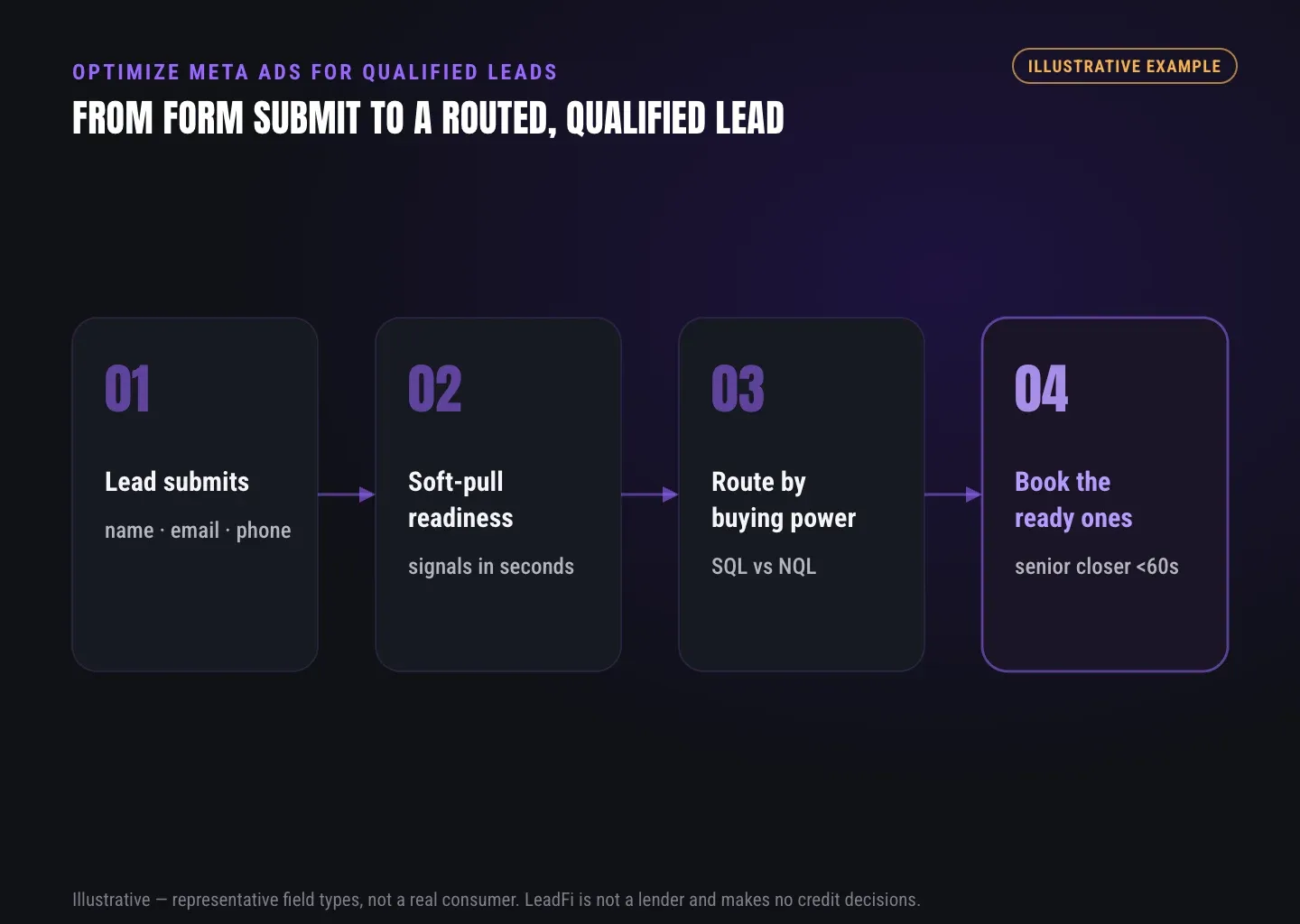
Quick answer: Instead of firing a generic "Lead" event on every form fill, you fire a qualified-lead event only when a lead clears your financial-readiness rules. LeadFi reads signals from name, email, and phone, scores each lead SQL or NQL by ability to pay, then sends that event back to Meta through the Conversions API — so the algorithm learns from real buying power.
The mechanic is simple to describe. First, a lead submits your form as usual. LeadFi sits behind that form and runs soft-pull prescreening — a soft pull that reads financial-readiness signals with no impact on the consumer's credit score. Then it labels the lead.
That label is the signal you send back. A sales-qualified lead (SQL) clears your readiness rules; a non-qualified lead (NQL) does not. First LeadFi scores the lead, then it can pass the SQL event to Meta via the Conversions API. This is how conversion API qualified leads flow into the account: real buyer signals, not opt-in noise.
Soft-pull prescreening reads readiness
A soft pull reads signals like VantageScore 4.0, income, available credit, debt, and debt-to-income (DTI). It never approves or denies anyone — it only scores readiness for routing. Patent-pending identity matching is designed to confirm a high-confidence match before any prescreening runs.
SQL vs NQL, defined once
An SQL clears your buying-power rules; an NQL falls below them. You set the thresholds — for example, a minimum income or a DTI ceiling. From there, every lead lands in one bucket or the other.
Conversions API carries the event
LeadFi can send the SQL event to Meta through the Conversions API (CAPI), not just the browser pixel. As a result, the algorithm trains on your qualified event instead of the raw form fill. Meta then looks for more people who resemble your actual buyers.
You still respect consent and disclosures
Readiness signals only work inside a compliance-aware setup. Your form disclosures, SMS consent, and CRM notes should tell one consistent story. LeadFi helps you align that language before launch — onboarding help, not legal advice.
GUIDE
What changes in the ad account
Quick answer: You keep the same campaigns, but you swap the optimization event. Instead of optimizing for every form fill, you optimize toward the qualified-lead event LeadFi sends. You also route SQLs and NQLs to different next steps, so no traffic is wasted while Meta relearns your audience.
Nothing about your creative or targeting has to be torn down. The change sits upstream and downstream of the form. Upstream, you decide what counts as qualified; downstream, you decide where each lead goes.
Meta needs volume to learn a new event, so plan for a learning window. During that time, keep monetizing every lead — SQLs to sales, NQLs to a low-ticket or payment path. That way nothing is thrown away while the algorithm adjusts.
Swap the optimization event
Point the campaign at the qualified-lead event, not the generic "Lead." Meta then optimizes toward buying power over time. As a result, spend shifts away from cheap opt-ins and toward people who resemble buyers.
Route SQLs straight to sales
Send financially ready leads to a closer calendar fast, because speed-to-lead matters most for hot buyers. Some teams call SQLs within 60 seconds of the classification. That white-glove speed can support higher show and close rates.
Route NQLs to a path that still pays
An NQL is not garbage — it is a different offer. Route lower-readiness leads to a low-ticket funnel, a payment plan, or a financing path. This is how you monetize all your traffic, not only the top tier.
Write the outcome back to your stack
LeadFi can push qualification status into your CRM as fields, tags, and pipeline stages via webhook, API, Zapier, or Make. As a result, your reps see readiness context before they dial. The signal lives where your team already works.
Feed financing paths where they fit
For offers over $10,000, some teams route qualified buyers toward financing help. Income and DTI can help inform options like a payment plan or BNPL. LeadFi surfaces readiness signals; it does not promise any funding outcome.
See which of the leads you already have can actually afford to buy.
OUTCOMES
Reading the result without over-claiming
Quick answer: Judge the change by downstream quality, not front-end cost per lead. Watch SQL rate, cost per SQL, show rate, close rate, and cost per closed deal over a few weeks. LeadFi is built to improve the signal quality feeding Meta — it does not guarantee ROAS, approvals, or any platform outcome.
The trap here is measuring the wrong number. If you only watch cost per lead, a qualified-lead strategy can look worse at first: fewer, pricier leads. But those leads are the ones your closers want.
So track the metrics that reflect money. For example, cost per SQL tells you what a ready buyer costs. Show rate and close rate tell you if the routing is working. Cost per closed deal is the number that actually pays your team.
Watch cost per SQL, not cost per lead
Cost per lead measures opt-ins; cost per SQL measures buying power. Meta ad lead quality shows up in the second number, not the first. Give the account a few weeks before you judge the shift.
Give the algorithm a learning window
New optimization events need conversion volume to stabilize. Therefore, expect noisy numbers early and a clearer picture later. Judge the change on a rolling window, not a single day.
No guarantees — only better inputs
LeadFi feeds cleaner signals into Meta where your setup permits. Still, no tool controls Meta's auction, your creative, or your close rate. Better inputs help; they are not a promise of ROAS.
WHO IT'S FOR
Who this is for
This approach fits high-ticket teams that run paid social. For example, if you sell offers around $1,000–$10,000+ and generate leads through ads, the fit is strong.
- Coaches, consultants, and course creators paying for opt-ins that don't convert.
- Agencies and sales agencies blamed by clients for "broke leads."
- Funding, lending, mortgage, and real estate teams that need buying power before a call.
- Insurance and capital-raising teams that care about asset or net-worth context.
The one poor fit: a low-ticket-only offer with no upsell to a higher-ticket product. If there is no path above roughly $3,000, readiness-based optimization has less to work with.
| Dimension | Optimize for form fills | Optimize for qualified leads (LeadFi) |
|---|---|---|
| Event sent to Meta | Generic "Lead" on submit | SQL / qualified-lead event via Conversions API |
| What the algorithm learns | Who opts in cheaply | Who resembles a financially ready buyer |
| Front-end cost per lead | Often lower | Often higher |
| Cost per closed deal | Often higher | Often lower (goal, not guaranteed) |
| Lead signal source | Self-reported form answers | Soft-pull readiness signals with consent and disclosures |
| NQL handling | Same call queue as everyone | Routed to low-ticket, payment plan, or financing |
| Closer time | Spread across ready and unready | Focused on ready buyers first |
Key takeaways
The short version
- Form-fill optimization trains Meta to find cheap opt-ins, not buyers — for high-ticket offers that raises your real cost per closed deal.
- LeadFi runs soft-pull prescreening behind your form to score each lead SQL or NQL using signals like VantageScore 4.0, income, and DTI.
- Send the qualified-lead (SQL) event to Meta via the Conversions API so the algorithm optimizes for financial readiness, not raw submissions.
- Route SQLs to sales fast for speed-to-lead and route NQLs to low-ticket, payment-plan, or financing paths so no traffic is wasted.
- Judge success by cost per SQL and cost per closed deal over a few weeks — LeadFi improves inputs but does not guarantee ROAS or approvals.
Quick answers
Fast answers before you dig in
How do I optimize Meta ads for qualified leads instead of form fills?
Stop optimizing for the generic "Lead" event. Add a financial-readiness layer behind your form that scores each lead SQL or NQL by ability to pay, then send the qualified-lead event to Meta via the Conversions API so the algorithm optimizes toward people who resemble financially ready buyers.
What are conversion API qualified leads?
They are qualified-lead events sent to Meta server-side through the Conversions API (CAPI), rather than only a browser pixel firing on submit. LeadFi can send an SQL event via CAPI so the algorithm trains on real buying-power signals instead of raw form fills.
Does a soft pull hurt the lead's credit score?
No. A soft pull reads financial-readiness signals with no impact on the consumer's credit score. LeadFi uses soft-pull prescreening to score and route leads — it never approves or denies anyone.
FAQ
Common questions
How do I optimize Meta ads for qualified leads instead of form fills?
What are conversion API qualified leads?
Does a soft pull hurt the lead's credit score?
What is the difference between an SQL and an NQL here?
Will this raise my cost per lead?
Does LeadFi replace my CRM or ad platform?
Is this compliant?
Sources
References
- CFPB — What is a credit inquiry? (hard vs. soft) (opens in a new tab)Federal regulator confirms a soft inquiry, unlike a hard inquiry, does not affect the consumer's credit score.
- VantageScore — VantageScore 4.0 credit scoring model (opens in a new tab)Official page describing VantageScore 4.0, the tri-bureau, trended-data model used to assess credit risk.
- Experian — What Is a Soft Inquiry? (opens in a new tab)Major credit bureau explains soft inquiries are informational and have no impact on credit scores.
Know who is ready before your next sales call.
If Meta is optimizing for opt-ins today, the leads you cannot afford to call are quietly training your algorithm. A readiness layer changes the input, and the input is what Meta learns from.