
DEBT SETTLEMENT CLIENT ATTRITION
Debt Settlement Client Attrition: Intake Routing and Process Review
Debt settlement client attrition can follow changes in a client’s disclosed budget, expectations, or circumstances. Intake cannot predict an individual cancellation, but it can assign the appropriate first conversation and give operations teams a consistent route for later process review.
Watch a contact get pre-qualified.
This is exactly what your CRM gets back.
Your opt-in form
Soft pull · no impact to their credit
This is not a real soft pull. It's an example of the data points that land in your CRM contact record when a lead fills out your form.
LEADFI DEMO
Watch the demo, then start free or book a call.
GUIDE
Debt settlement attrition: Why clients may leave after enrollment
A client’s circumstances may change after intake. Housing costs, medical expenses, family needs, work hours, or other facts can affect the budget the client reports. Teams should use updated client disclosures rather than infer monthly capacity from the original readiness route.
A missed deposit is a neutral service event, not proof that intake made a poor decision or that the client is unreliable. It should trigger the company’s normal client-care process—not a new soft pull, a refreshed route, or a personal cancellation-risk label.
Expectations can also drift when intake, enrollment, and client care use inconsistent language. A written handoff can record the assigned route, whether the budget review occurred, and who owns the next action. Raw financial values should not appear in staff notes or scripts.
Cancellation reasons should reflect what the client chooses to state and remain separate from the intake route. A relationship between those fields does not establish cause, and the original route must not guide cancellation or save conversations.
Records that do not return a readiness result belong in a distinct no result group. A failed match, incomplete payload, or technical issue must not be treated as a not-financially-qualified result. The company’s written manual-review path should govern the next step.
ROUTING
Intake routes: What they tell the budget conversation
The intake route tells the team which conversation, owner, or review should come first. It does not determine what the client can afford each month. This page describes a routing input, not a credit decision, approval, or eligibility determination.
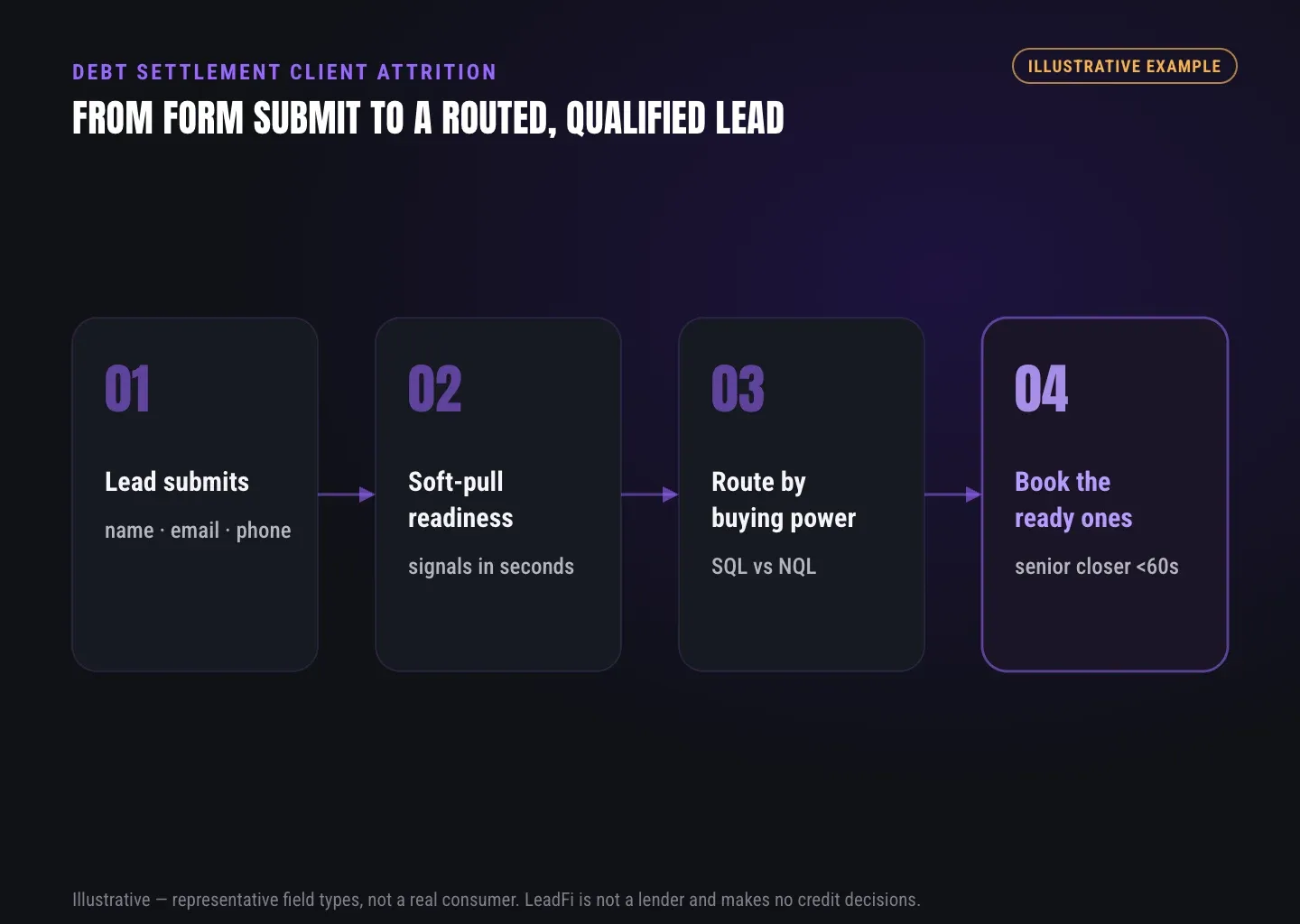
LeadFi can work from the name, email, and phone submitted through an existing inbound form. Identity-related information and identity signals, such as current address or age where applicable, may support patent-pending identity matching designed to establish a high-confidence match before an applicable soft-pull workflow. The configuration must align with the company’s consent and disclosures.
LeadFi then returns a readiness band or route. In this debt settlement workflow, configured SQL and NQL labels represent only the company’s two written review paths: the standard first conversation and the fuller budget review. They do not enroll, reject, or characterize the person as a good or poor client.
The budget comes solely from the income, expenses, timing, and other information the client discloses during the company’s budget process. A readiness band is not a budget analysis or measure of monthly capacity.
Payment options, deposit terms, discounts, and any third-party payment arrangements must follow one written policy applied consistently. The route must not change a client’s monthly deposit, program length, fees, or settlement approach. Staff should never encourage a client to borrow, open new credit, or use a credit card to cover a funding gap.
For example, one authorized intake submission may receive the standard first-conversation route, while another receives the fuller budget review route. The second file receives a different review sequence—not worse terms. Enrollment and deposits still follow the same written policies and each client’s disclosed budget.
| Workflow area | Basic tracking | Route-aware tracking |
|---|---|---|
| Intake record | Enrollment record only | Original route, route date, and rule version |
| Readiness output | Missing or mixed into notes | Standard conversation, fuller budget review, or no result |
| Budget source | May be unclear | Client’s own disclosed budget |
| Staff view | Free-text notes may expose excess data | Readiness band or route only |
| Missed deposit | Event with little context | Neutral service event kept separate from route |
| Cancellation reason | Broad cancellation label | Client-stated reason stored separately |
| Data after enrollment | May invite ad hoc checks | No readiness refresh for this workflow |
| Process review | Focuses on the client outcome | Checks whether assigned reviews and care occurred |
| CRM automation | Generic tasks | Tasks based on the route fixed at intake |
| Reporting | May merge missing results with another route | No-result records remain a separate group |
ROUTING
Missed deposits: Compare service events with the intake route
Operations teams may compare later service events with the original route already stored at intake. This should be an aggregate review of company records, not a reason to refresh readiness data after enrollment.
A practical CRM field such as intake_review_route can contain standard_conversation, fuller_budget_review, or no_result. Teams may also save the route date and rule version. They should not save the underlying score, income, debt, debt-to-income ratio, or available-credit values for staff use.
Missed deposits and client-stated cancellation reasons belong in separate fields with neutral labels. Reports can ask whether the assigned review, handoff, and scheduled client-care tasks occurred. They should not rank clients by supposed cancellation risk or claim that a route caused an outcome.
Use the same reporting window for every route and show record counts beside percentages. The purpose is to evaluate process delivery, not create an industry benchmark or estimate future cancellation.
Related operational reading includes a closer look at credit restoration client retention and practical insights on final expense persistency early lapses. These comparisons can help teams think about handoffs and early service without treating different industries as interchangeable.
ROUTING
Route-aware tracking vs basic tracking
Route-aware tracking preserves the original intake instruction while keeping later service facts separate. It gives operators context for process review without exposing raw financial data or turning readiness into a cancellation score.
Suppose a team reviews an internal group of enrolled files. The report separates the standard route, fuller-review route, and no-result group, then checks whether each assigned review and early-care task occurred. If some fuller-review files lack a recorded handoff, the team can correct the CRM owner and task rules for future inbound submissions. It should not rescore enrolled clients or contact them because of the report.
GUIDE
Early client care after a fuller budget review
A fuller budget review route can create a planned handoff and early-care schedule. That plan is assigned from the route fixed at intake—not from later monitoring or a cancellation-risk score.
Each task should have a defined service purpose, such as confirming contact details, identifying the next owner, or answering program-process questions. Tasks should not be framed as efforts to pressure a client to remain enrolled.
Setters, closers, managers, and client-care staff should see only the route needed for their work. They should not see or quote the underlying VantageScore 4.0 value, income, debt, debt-to-income ratio, or available credit. The client’s own disclosures remain the source for every budget conversation.
The company should not rerun or refresh readiness data on enrolled clients to predict cancellation. If a client requests cancellation, staff should follow the written process without delay, discouragement, or route-based save tactics.
If a file follows the operator’s documented referral path, the team can use the process described in debt consolidation lead qualification, with the consumer’s consent before sharing contact details.
See which of the leads you already have can actually afford to buy.
WORKFLOW DESIGN
LeadFi’s role in the intake and CRM workflow
LeadFi is a financial-readiness engine for existing inbound submissions. It is not a debt relief provider, budget analysis, lender, or enrollment system. It does not generate the lead, approve or deny consumers, set deposits, or predict cancellation.
For many configured workflows, LeadFi can begin with name, email, and phone. The benefit is buying-power-aware routing with fewer initial inputs—not avoiding consent and disclosures. Depending on the authorized configuration, signals behind the route may include VantageScore 4.0, income, debt, debt-to-income ratio, and available credit. People using this workflow see the resulting readiness band or route only.
A focused CRM model can store the route, route date, rule version, review owner, review status, assigned care plan, neutral service events, and client-stated cancellation reason. Teams designing intake fields may also find practical insights on bank statement analysis useful when separating client-provided budget information from routing outputs.
LeadFi can connect through a webhook, API, Zapier, Make, or a supported native workflow. A fuller-review route can assign the appropriate queue and task, while a no-result route can create a manual-review task.
Debt-related or financial-distress routes should not be used to target, exclude, or build advertising audiences. Keep this workflow within intake and service operations unless counsel approves another use.
Before launch, map the form language, consent and disclosures, routing rule, CRM fields, access controls, and failure handling. LeadFi supports compliance-aware workflows and can assist with privacy-oriented language, TCPA-aware practices, and FCRA-aware workflow guidance. LeadFi does not provide legal advice, and clients should review their use case with counsel.
WHO IT'S FOR
Workflow fit for debt settlement teams
This model fits debt settlement operators that receive inbound applications, use a written enrollment process, and need consistent handoffs among intake, operations, and client-care teams. It is not intended for scoring existing clients or deciding who may enroll.
Intake leaders can use a written routing rule to assign the same next step consistently. RevOps teams can maintain narrow route fields, keep no-result records separate, and verify that tasks reach the correct owner. Client-care teams receive the approved task and schedule without access to the financial values behind the route.
A narrow purpose also makes the workflow easier to review: the route controls the first conversation, owner, or review, and nothing more. Enrollment, monthly deposits, service decisions, and cancellation remain outside the route.
INTELLIGENCE LAYER
Implementation plan for readiness-based routing
Start by defining the standard first conversation, the fuller budget review, and the no-result manual-review path. The rule should describe workflow actions rather than personal traits and should state that enrollment and deposits follow written policy and the client’s disclosed budget.
Next, map the field, owner, task, alert, and access level for each route. Integration failures should create a no-result task rather than defaulting the record into either financial route.
Test that the intake form, privacy language, CRM workflow, and contact process consistently describe the actual data use. Confirm that staff views and reports contain only the route—not raw score, income, debt, debt-to-income ratio, or available-credit figures.
After launch, verify that route fields arrive, tasks fire, and owners complete the assigned work. Aggregate reviews should ask whether the planned review and care process occurred, without refreshing readiness data or assigning cancellation-risk scores to enrolled clients.
Related reading: a closer look at credit restoration client retention, practical insights on final expense persistency early lapses, practical insights on bank statement analysis.
Key takeaways
The short version
- Intake routes conversations; it does not predict cancellation.
- The client’s disclosed budget governs enrollment and deposits.
- Keep no-result records separate from both financial routes.
- Store the readiness route, not underlying financial values.
- Never refresh readiness data to score enrolled clients.
Quick answers
Fast answers before you dig in
What can intake flag about debt settlement client attrition?
Intake can flag which file needs the standard first conversation, a fuller budget review, or manual review because no result was returned. It cannot predict cancellation or determine enrollment, deposits, or affordability.
How should financially qualified and not financially qualified be defined here?
Financially qualified means the file meets the company’s written rule for its first conversation or review. Not financially qualified means the file goes to the fuller budget review. Neither is an affordability or enrollment decision.
Should debt settlement teams refresh readiness data after enrollment?
No, not for this workflow. Teams should retain the route assigned at intake and review neutral service events separately without rerunning or refreshing readiness data.
What should staff see in the CRM?
Staff should see the readiness band or route, route date, rule version, assigned owner, and task status—not the underlying score, income, debt, debt-to-income ratio, or available-credit values.
FAQ
Common questions
What is debt settlement client attrition?
Can intake predict debt settlement client cancellations?
Can financial-readiness routing prevent debt settlement client attrition?
Does LeadFi decide who can enroll in debt settlement?
Should a team run another soft pull after enrollment?
What should the CRM store for debt settlement client attrition reviews?
Can LeadFi work from name, email, and phone?
Sources
References
- CFPB — What is a credit inquiry? (hard vs. soft) (opens in a new tab)Federal regulator confirms a soft inquiry, unlike a hard inquiry, does not affect the consumer's credit score.
- VantageScore — VantageScore 4.0 credit scoring model (opens in a new tab)Official page describing VantageScore 4.0, the tri-bureau, trended-data model used to assess credit risk.
- CFPB — Who can request to see my credit report? (opens in a new tab)Federal regulator explains the FCRA rules governing who may obtain a credit report.
- Consumer Financial Protection Bureau consumer resources (opens in a new tab)General consumer financial-information resource; not a substitute for legal advice.
Know who is ready before your next sales call.
LeadFi can sit behind your existing inbound form and return a simple readiness route to your CRM. Your team keeps control of its written enrollment, budget, deposit, client-care, and cancellation policies.