
FINAL EXPENSE PERSISTENCY EARLY LAPSES
Final Expense Persistency: How to Trace Early Lapses
Final expense persistency shows how much issued business stays in force over time, but one blended rate rarely explains why early lapses happen. A stronger review separates issue-month cohorts and then examines sale fit, payment setup, and post-sale service.
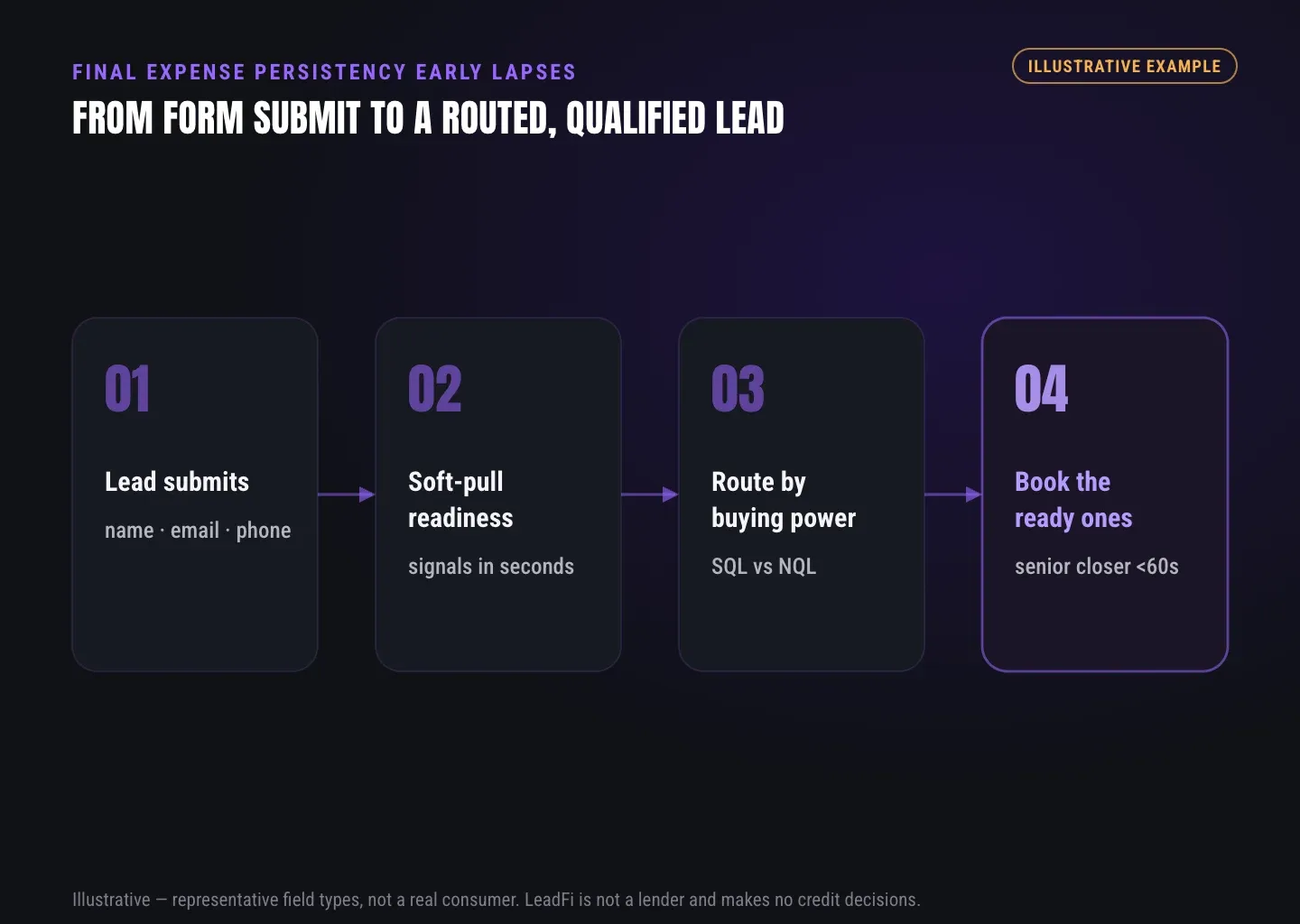
Watch a contact get pre-qualified.
This is exactly what your CRM gets back.
Your opt-in form
Soft pull · no impact to their credit
This is not a real soft pull. It's an example of the data points that land in your CRM contact record when a lead fills out your form.
LEADFI DEMO
Watch the demo, then start free or book a call.
GUIDE
Blended 13-month persistency rates can hide the cause
A blended final expense persistency rate provides a top-line view, but it can hide opposing trends across issue months, billing arrangements, agents, and service histories. Confirm the report’s exact numerator, denominator, observation date, and treatment of pending, withdrawn, not-taken, replaced, and never-drafted records before comparing results.
Cohort timing reveals the break point
Group policies by calendar issue month and follow each cohort through consistent duration points, such as months 1, 2, 3, 6, and 13. Compare cohorts only at equal maturity. This shows whether a break starts near issue, follows the first draft, or appears after a service handoff.
Review both rates and policy counts. A large stable cohort can mask a sharp change in a smaller billing or service group, while tiny cells can move substantially when one policy changes status. Any minimum-cell rule should be documented as an internal reporting choice.
Denominators and status dates must stay consistent
Use one defined starting population, such as issued-and-placed policies, and one status source for each observation date. Do not mix a carrier status captured in one month with a CRM status captured later. Preserve the source files and report rules so later changes can be explained.
Persistency is not one event
A policy may miss its first draft, recover, and later lapse. Another may remain in force despite payment timing issues. State whether the report measures in-force status, paid-to-date status, successful drafts, or another contract-defined measure.
This analysis is for diagnosing process causes, not ranking agents or evaluating lead vendors. Findings may change the sale conversation, billing setup, or service touchpoints, but never which requesters are quoted or served.
Signal and data checklist
Build one row per issued policy with only the fields needed to test a process cause:
- Internal policy or application key
- Issue month, status date, and duration month
- Stable internal agent ID
- Billing method and scheduled draft-date bucket
- First-draft result
- Welcome-call, delivery, and billing-confirmation timestamps
- Existing readiness band and result status: SQL, NQL, or no result
- Current policy status and first known lapse month
- Verified, client-stated, other, or unknown reason code
Do not include or display a buyer’s VantageScore 4.0 value, income, debt, or available-credit figures. Store and report only the readiness band or route.
GUIDE
Issue-month cohorts should compare agents and billing setup
The core analysis should compare agents, billing arrangements, and service events within the same issue month. Each cut should answer a specific process question rather than create an agent leaderboard.
Start with one policy-level row
Deduplicate carrier and CRM records with a stable policy key. Keep application attempts outside the issued-policy population unless the report explicitly defines otherwise. Normalize agent names to stable internal IDs so spelling differences do not create false groups.
Separate billing setup from payment outcomes
Billing method describes how premiums should be collected; payment outcome records what happened. Keep bank draft, scheduled date, first-draft result, and returned-payment status in separate fields. Bucket draft dates consistently while retaining exact dates in the controlled source table.
Record welcome calls, delivery checks, and billing confirmations as separate timestamped events. One broad service flag can conceal the step where a handoff failed.
Keep unknowns and no-result records visible
Do not force missing billing data, lapse reasons, or service events into known groups. Use explicit unknown categories. Policies without an existing readiness band belong in a separate “no result” group, not in NQL. A missing result does not establish anything about the client’s financial fit.
Keep the analysis within the agency. Do not share readiness-derived cuts, cohorts, or reports with carriers, IMOs, uplines, or other outside parties.
Example: a month-end draft cluster
Suppose one issue-month cohort has more month-2 lapses. The agent cut shows no clear pattern, but the billing cut shows that many affected policies had late-month draft dates and returned first drafts.
The appropriate response is to review draft-date confirmation and route failed drafts through the agency’s standard service process. It is not to change who receives a quote, reduce service for a route, penalize an agent, or infer that the readiness band caused the lapses.
INTELLIGENCE LAYER
Intake readiness bands add context without deciding outcomes
A readiness band may be included only when the agency already holds it from the original quote form, submitted with consent and disclosures and the lead’s authorization for the configured workflow. Do not check or re-check open deals, past leads, clients, policyholders, or the in-force book to fill reporting gaps.
LeadFi can work from name, email, and phone in configured intake workflows. Its patent-pending identity matching is designed to establish a high-confidence match before a soft pull where applicable to the authorized workflow. Staff conducting this analysis use only the resulting readiness band or route.
This page describes a routing input, not a credit decision, approval, or eligibility determination.
Define SQL and NQL as conversation routes
An SQL is someone able to afford the offer being sold—here, the premium level the desk usually writes. An NQL is someone not financially fit to buy that offer. For an NQL, the agent begins with the client’s stated budget, and the client may choose a product that fits their financial capability through the needs-and-budget conversation.
Every requester receives a quote conversation and the same written service standards. A band must not be used to ignore, delay, deprioritize, or refuse a requester.
The readiness band is not an insurance decision
Carriers underwrite, rate and issue policies. The readiness band is a routing input for the agent’s own workflow, not underwriting, rating, a credit-based insurance score, or an insurability decision.
The band must not choose, cap, or recommend a face amount, premium, policy type, rider, or carrier. Those decisions follow the needs-and-budget conversation and the carrier’s process. It also must not determine payment plans, deposit terms, discounts, or third-party financing. Payment options should follow one written policy applied to every buyer.
Use historical bands only
Use only the band the agency already holds from the authorized intake submission. The report should contain SQL, NQL, or no result—not underlying score, income, debt, or available-credit figures. Do not quote those figures to the buyer or place them in CRM notes.
Do not use a readiness band for lapse-save, conservation, re-draft, or other outreach to existing policyholders. The historical band is limited to group-level review of the original intake and subsequent process.
Compare bands only at group level
A group cut may show that affordability and early lapses appear together qualitatively. It does not prove why an individual policy lapsed or predict what a particular policy will do. Billing records, service events, carrier status, and recorded client contact remain necessary to investigate a pattern.
See which of the leads you already have can actually afford to buy.
GUIDE
Sale fit, payment setup, and service data explain the cuts
Read cohort cuts in order: confirm the issue month and maturity window, split by payment setup and service events, and then use the existing readiness band as context rather than a verdict. Most actionable findings concern sale fit, payment setup, service, or a combination of those factors.
Sale fit starts with the client’s stated budget
A sale-fit question may arise when the chosen premium did not remain workable within the client’s stated budget. The band alone cannot establish that cause. Review whether the needs-and-budget conversation was documented and whether the client chose the policy.
The process response is a clearer budget-first conversation—not using the band to select coverage, a premium, a policy type, a rider, or a carrier.
Payment and service causes need event data
Returned first drafts, changed bank details, draft-date confusion, missed welcome calls, unconfirmed delivery, and unresolved billing tasks require event records and timestamps. Apply confirmation and service processes consistently to every issued client, regardless of route.
Many lapse causes sit outside readiness
Many early lapses have causes a readiness band cannot see, including death inside a graded or guaranteed-issue waiting period, billing-date and bank-draft problems, and service gaps after the sale. Carrier status rules and client decisions can also contribute.
Any relationship between affordability and lapses must remain qualitative. A readiness band cannot predict whether a policy will lapse, be approved by a carrier, create a chargeback, or remain in force.
Match each supported cause to a narrow fix
If returned first drafts drive a cluster, review payment confirmation and standard follow-up. If missed service tasks drive it, repair the handoff. If the cause remains unclear, preserve an unknown category rather than assigning affordability or service through guesswork.
Make one documented process change at a time and record the first affected issue month. Keep conclusions neutral, such as “billing pattern under review” or “service gap supported by event data.” Findings should improve the conversation, billing setup, or service workflow—not determine who is served.
Related reading: practical insights on qualifying high ticket leads before the call, a practical guide to scoring leads by ability to pay, practical insights on bank statement analysis.
| Cohort pattern | What it may suggest | What to check next | Safe operational response |
|---|---|---|---|
| Lapses before the first successful draft | Payment setup problem | Draft status, date, bank details, and carrier file timing | Tighten confirmation and standard follow-up |
| Lapses in one draft-date bucket | Timing friction | Client-selected date, first-draft timing, and returned items | Clarify date selection for every client |
| Lapses after missed welcome calls | Service gap | Call timestamp, delivery status, and open tasks | Apply one service checklist to every client |
| NQL group differs before billing cuts | Possible sale-fit question | Stated budget, documented conversation, and premium choice | Strengthen the budget-first conversation |
| SQL and NQL differ within one billing group | Mixed payment and sale-fit factors | First-draft results within each band | Fix billing first, then observe later cohorts |
| One agent differs in one issue month | Process variation | Script use, setup fields, and service handoff | Coach the process without ranking or penalizing the agent |
| No-result group differs from known bands | Intake data or workflow issue | Submission timing, match result, and missing fields | Keep no result separate and review the intake workflow |
| All groups move together | Shared calendar or service factor | Carrier file timing, holidays, bank dates, and staffing | Review the common process before subgroup explanations |
Key takeaways
The short version
- Compare issue-month cohorts at equal maturity.
- Diagnose sale fit, payment setup, and service separately.
- Use only authorized readiness bands already held at intake.
- Keep no-result policies separate from NQL records.
- Never use a band to restrict quotes or choose policies.
Quick answers
Fast answers before you dig in
How should an agency trace early final expense lapses?
Group issued policies by issue month and equal duration, then compare billing setup, first-draft outcomes, service events, and verified lapse reasons. An existing readiness band may add group-level context but cannot establish an individual cause.
Can financial readiness predict final expense persistency?
No. A readiness band cannot predict whether a specific policy will lapse. It may be used as an existing group column while billing, service, carrier, and client records are used to investigate possible causes.
How should NQL quote requests be handled?
Every requester receives a quote conversation. The NQL route begins with the client’s stated budget, after which the client may choose a product that fits their financial capability through the needs-and-budget conversation.
What should happen when a policy has no readiness band?
Report it in a separate no-result group. Do not classify it as NQL, infer financial fit, or run a new check against the policyholder to fill the gap.
FAQ
Common questions
What is final expense persistency?
How is a 13-month final expense persistency rate calculated?
Why can a blended final expense persistency rate be misleading?
Can a financial-readiness band predict final expense persistency?
What do SQL and NQL mean in this final expense workflow?
Should an agency run a new soft pull on existing policyholders?
Can a readiness band determine the policy, premium, or carrier?
Sources
References
- CFPB — What is a credit inquiry? (hard vs. soft) (opens in a new tab)Federal regulator confirms a soft inquiry, unlike a hard inquiry, does not affect the consumer's credit score.
- VantageScore — VantageScore 4.0 credit scoring model (opens in a new tab)Official page describing VantageScore 4.0, the tri-bureau, trended-data model used to assess credit risk.
- CFPB — Who can request to see my credit report? (opens in a new tab)Federal regulator explains the FCRA rules governing who may obtain a credit report.
Know who is ready before your next sales call.
LeadFi can sit behind an authorized final expense quote form and write an internal SQL, NQL, or no-result route into a CRM through an API, webhook, Zapier, Make, or supported native workflow. The later cohort report can use that route without exposing raw financial values.