
HOW TO QUALIFY HIGH TICKET LEADS BEFORE THE CALL
How to Qualify High-Ticket Leads Before the Sales Call
Your closers have a fixed number of hours each week. On a $1,000–$10,000+ offer, every call with someone who can't fund the buy burns money you already spent to get the lead.
Watch a contact get pre-qualified.
This is exactly what your CRM gets back.
Your opt-in form
Soft pull · no impact to their credit
This is not a real soft pull. It's an example of the data points that land in your CRM contact record when a lead fills out your form.
LEADFI DEMO
Watch the demo, then start free or book a call.
PLATFORM OVERVIEW
What "qualified" means for a $1,000–$10,000+ offer
Quick answer: A qualified high-ticket lead has real buying power and intent — not just a filled-out form. For offers over $1,000, "qualified" means the person can plausibly fund the buy. LeadFi calls this a Sales-Qualified Lead (SQL) and routes it to a closer. Lower-readiness leads become Non-Qualified Leads (NQLs) and take a different path.
Most funnels treat every opt-in the same. As a result, a closer spends 30 minutes with someone who loves the offer but can't cover it today. The interest was real; the buying power wasn't. That gap is where high-ticket teams quietly lose money.
Fixing it starts with a clear meaning of "ready." For a $5,000 coaching program, readiness might mean open credit or income above a line you set. For a funding offer, it might mean a VantageScore 4.0 band plus a healthy debt-to-income ratio. The point is simple: "qualified" should map to your offer, not a generic score.
SQL vs NQL, defined once
An SQL is a lead your rules mark ready for a closer right now. An NQL isn't ready yet — but may become ready after a smaller first offer, a payment plan, or financing. LeadFi labels each lead so your team knows the next step without guessing.
Buying power beats form volume
More opt-ins don't help if half can't buy. That's why LeadFi optimizes for SQL quality, not raw lead count. You still collect every lead. However, you route them by readiness instead of treating them as equal.
Interest is not the same as readiness
Someone can watch your whole VSL and still lack the funds today. In other words, intent and buying power are two different signals. LeadFi reads readiness after the form. As a result, your closers spend time where money and motivation overlap.
"Qualified" is operational, not a verdict
Readiness describes what should happen next — not a judgment of anyone's worth. A low-readiness lead isn't a bad person; they're a better fit for a different path today. Keep that framing in your copy, your scripts, and your CRM notes.
INTELLIGENCE LAYER
Using permissioned soft-pull readiness signals
Quick answer: A soft-pull reads financial-readiness signals with consent and disclosures — no impact on the consumer's credit score. LeadFi can work from name, email, and phone to establish a high-confidence identity match, then surface readiness signals for routing and rep prep. It does not underwrite, approve, or deny anyone.
Here's the core idea. After a lead submits your form, LeadFi runs a permissioned soft-pull prescreening step behind the scenes. The soft pull reads readiness — it never makes a consumer credit decision. As a result, your team gets a readiness picture while the consumer's score stays untouched.
Patent-pending identity matching is designed to confirm who the lead is before any soft-pull prescreening runs. That match uses identity-related information such as current address and age. Because of that, you can often cut upfront form friction and still get a confident match from thin inputs.
The signals depend on your setup, consent, and disclosures. For example, they may include VantageScore 4.0, open credit, income, debt, debt-to-income ratio, funding pre-approval signals, address, and age. Optional net-worth-style context can round out the picture where available. Every signal feeds routing and rep prep — not a consumer approval.
What the soft pull reads
The soft pull surfaces readiness signals like open credit, income, and debt-to-income. These help you decide who reaches a closer first. They are not an underwriting decision and never approve or deny a person.
Identity match comes first
LeadFi is designed to establish a high-confidence match before prescreening runs. Name, email, and phone can be enough to start. That's why certain paths don't need a full address and date of birth up front.
No credit-score impact
A soft pull for prescreening does not lower the consumer's credit score. Still, confirm the exact path with product and counsel for your workflow. Keep the "no credit impact" line only where it's accurate for that path.
Signals feed reps, not verdicts
Never show a rep a raw credit or DTI number to judge a person. Instead, surface a readiness tag — "route to closer" or "route to low ticket." As a result, the workflow stays operational and the buyer's dignity intact.
GUIDE
Splitting ready-now from low-ticket
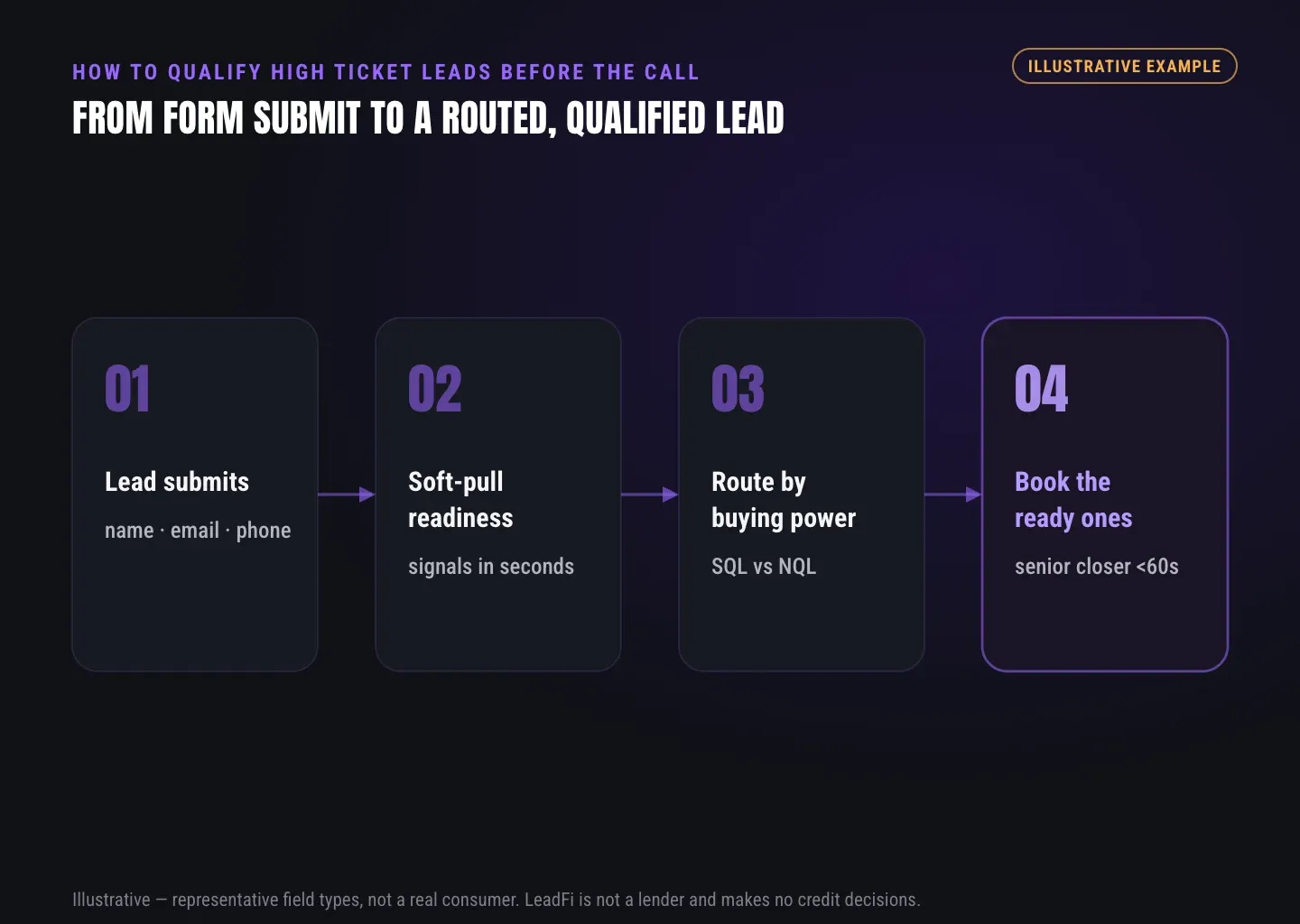
Quick answer: LeadFi splits ready-now SQLs from low-ticket-path NQLs the moment a lead submits. SQLs can route straight to a closer calendar with fast speed-to-lead. NQLs route to a low-ticket offer, a payment plan, or a financing path — so no lead is wasted and your closers stay focused on buyers who can act now.
This is where SQL/NQL routing earns its keep. Once a lead is classified, LeadFi acts on your rules across the stack. For example, an SQL can trigger a closer notification, a thank-you redirect to a booking page, and a pipeline-stage update — all while the lead is still warm.
Speed-to-lead matters most for ready buyers. When an SQL reaches a closer in minutes instead of the next morning, momentum stays high. Meanwhile, an NQL doesn't get dropped: it flows into a low-ticket offer, a payment plan, or a financing option that fits today's readiness.
Consider the routing choices you can set up:
- SQL → closer calendar with an instant rep notification
- NQL → low-ticket offer to build readiness over time
- NQL → financing or BNPL path where that offer fits
- NQL → low-ticket offer to monetize interest now
- Any lead → CRM fields, tags, stages, and workflow triggers
Route SQLs to a closer fast
An SQL should hit a closer while intent is fresh. For instance, LeadFi can fire a webhook, update the CRM stage, and redirect the lead to a booking page. As a result, your best-fit buyers book before the moment cools.
Monetize NQLs instead of dropping them
A lower-readiness lead still cost you money to get. So route NQLs to a low-ticket offer, a payment plan, or financing. In practice, you recover value from leads a "book a call" funnel would waste.
Write outcomes back to your CRM
LeadFi can push qualification status into standard or custom fields, tags, and pipeline stages. As a result, your reps see the readiness tag where they already work. There's no new dashboard to babysit.
Feed signals back to your ad platforms
Where permitted and correctly set up, LeadFi can send SQL-quality signals into Meta, Google, TikTok, Hyros, and your CRM. This helps campaigns learn from financially qualified demand, not just raw opt-ins. LeadFi makes no platform performance or ROAS guarantee.
See which of the leads you already have can actually afford to buy.
WORKFLOW DESIGN
Compliance-aware setup
Quick answer: LeadFi helps teams stand up a compliance-aware qualification workflow before launch — as onboarding help, not legal advice. That covers privacy-policy language, consent alignment, TCPA-aware practices, and FCRA-aware workflow guidance. LeadFi does not guarantee compliance, does not provide legal advice, and does not approve or deny consumers. Your team should review your use case with counsel.
Adding financial questions to a funnel is a workflow decision, not a legal trick. Because of that, LeadFi treats setup as a value-add before you go live — not a blocker. The aim is one consistent story across your form, your SMS, and your CRM notes.
Keep the framing plain and respectful. When you collect readiness data, explain why it helps route the prospect to the right program. In other words, treat qualification as readiness for the next talk — not a verdict on anyone's worth.
Align your disclosures early
Your form disclosure, SMS consent, and CRM notes should tell one story. LeadFi helps teams align that language during onboarding. Then your counsel reviews the customer-facing wording and data practices.
Consent and disclosures stay
Permissioned readiness workflows depend on consent and disclosures. LeadFi never minimizes that. There is no "no consent needed" path — that framing is wrong and unsafe.
LeadFi does not decide for consumers
LeadFi classifies and routes leads for your business. However, it does not approve, deny, or underwrite any consumer. The readiness tag guides your team's next step; the decision stays with you and your process.
| Approach | What it tells you | Who reaches a closer | NQL handling | Speed-to-lead |
|---|---|---|---|---|
| Form questions only | Self-reported answers | Anyone who books | Usually dropped | Depends on manual review |
| Booked-call volume | That a call happened | Everyone who booked | No built-in path | Fast, but unfiltered |
| LeadFi readiness routing | Permissioned readiness signals | SQLs by your rules | Low-ticket, payment plan, financing | Fast for SQLs, automated |
The table simplifies real setups; your rules, stack, and setup shape the exact behavior.
Key takeaways
The short version
- "Qualified" for a high-ticket offer means real buying power plus intent — not just a filled-out form.
- LeadFi confirms a high-confidence identity match from name, email, and phone before any permissioned soft-pull prescreen runs.
- SQLs route to a closer fast for strong speed-to-lead; NQLs route to a low-ticket offer, a payment plan, or financing instead of being dropped.
- Readiness signals feed routing and rep prep as a tag — they are never an underwriting decision and never approve or deny consumers.
- Compliance-aware setup is onboarding help, not legal advice; consent and disclosures always apply and clients should review with counsel.
Quick answers
Fast answers before you dig in
What does it mean to qualify a high-ticket lead?
A qualified high-ticket lead has both intent and real buying power — the plausible ability to fund a $1,000–$10,000+ offer. LeadFi tags these ready-now leads as SQLs for a closer and routes lower-readiness NQLs to a low-ticket, payment-plan, or financing path.
How does a soft-pull prescreen qualify leads before the call?
After a lead submits, LeadFi confirms a high-confidence identity match, then runs a permissioned soft-pull prescreen that reads readiness signals for routing and rep prep. It never lowers the consumer's credit score and never approves or denies anyone.
FAQ
Common questions
How do I qualify high-ticket leads before the sales call?
Can I qualify leads before the call without asking for an address up front?
Does a soft-pull hurt the consumer's credit score?
What's the difference between an SQL and an NQL?
Does LeadFi replace my CRM, funnel, or calendar?
Can LeadFi help my ad campaigns find better buyers?
Does LeadFi approve or deny my leads?
Sources
References
- CFPB — What is a credit inquiry? (hard vs. soft) (opens in a new tab)Federal regulator confirms a soft inquiry, unlike a hard inquiry, does not affect the consumer's credit score.
- VantageScore — VantageScore 4.0 credit scoring model (opens in a new tab)Official page describing VantageScore 4.0, the tri-bureau, trended-data model used to assess credit risk.
- CFPB — Who can request to see my credit report? (opens in a new tab)Federal regulator explains the FCRA disclosure rules governing who may obtain a credit report.
Know who is ready before your next sales call.
Pre-qualifying high-ticket leads by readiness is straightforward once the routing runs after the form. LeadFi supports compliance-aware setup during onboarding, complements the tools you already use, and never approves or denies consumers.