
SCORE LEADS BY ABILITY TO PAY
Score Leads by Ability to Pay, Not Just Engagement
Clicks, page views, replies, and booked calls show interest. They do not show whether a lead is financially ready for a $3,000, $5,000, or $10,000 offer. High-ticket teams need to score leads by ability to pay alongside engagement.
Watch a contact get pre-qualified.
This is exactly what your CRM gets back.
Your opt-in form
Soft pull · no impact to their credit
This is not a real soft pull. It's an example of the data points that land in your CRM contact record when a lead fills out your form.
LEADFI DEMO
Watch the demo, then start free or book a call.
GUIDE
Behavioral scoring has limits in high-ticket sales
Engagement measures attention, not buying power
Behavioral models assign points to actions such as pricing-page visits, email clicks, webinar attendance, replies, and bookings. These events help rank interest, but they do not establish financial readiness for the next step.
A highly engaged prospect may lack a workable payment path. A financially ready referral may submit one form and expect an immediate response. Treating engagement as buying power can therefore fill closer calendars without improving call quality.
Form answers rely on self-reporting
Applications often ask leads to select income, savings, credit, or budget ranges. Those answers can guide a conversation, but respondents may estimate, misunderstand a range, or choose the answer they believe will unlock a calendar.
A financial-readiness layer adds separate context after submission. Teams evaluating that workflow can start with a closer look at pre-screen leads by financial readiness.
Intent scores can reward noise
A lead can accumulate a high score simply by creating many tracked events. Meanwhile, a serious buyer with fewer digital touches may remain below the sales threshold. Behavioral scoring is useful for measuring interest, but it is incomplete as the only measure of high-ticket fit.
Lead source can create the same distortion. Retargeting campaigns generate more trackable interactions than many referrals, even when the referral has stronger financial fit.
Booked calls are not equal
A calendar event confirms that a person selected a time. It does not confirm fit for the offer, the availability of a suitable payment path, or the need for a senior closer. Adding readiness context before final routing can distinguish priority SQLs from leads better suited to review or nurture.
Sales feedback arrives too late
Without earlier qualification, a closer may discover weak fit during the call—after the business has paid for acquisition, reminders, follow-up, and sales time. Earlier SQL/NQL classification gives sales and marketing a faster quality signal.
For paid-social implementation ideas, see a closer look at optimizing Meta ads for qualified leads. Platform outcomes are not guaranteed, and any feedback event must fit the approved setup and platform rules.
INTELLIGENCE LAYER
Financial readiness adds buying-power context
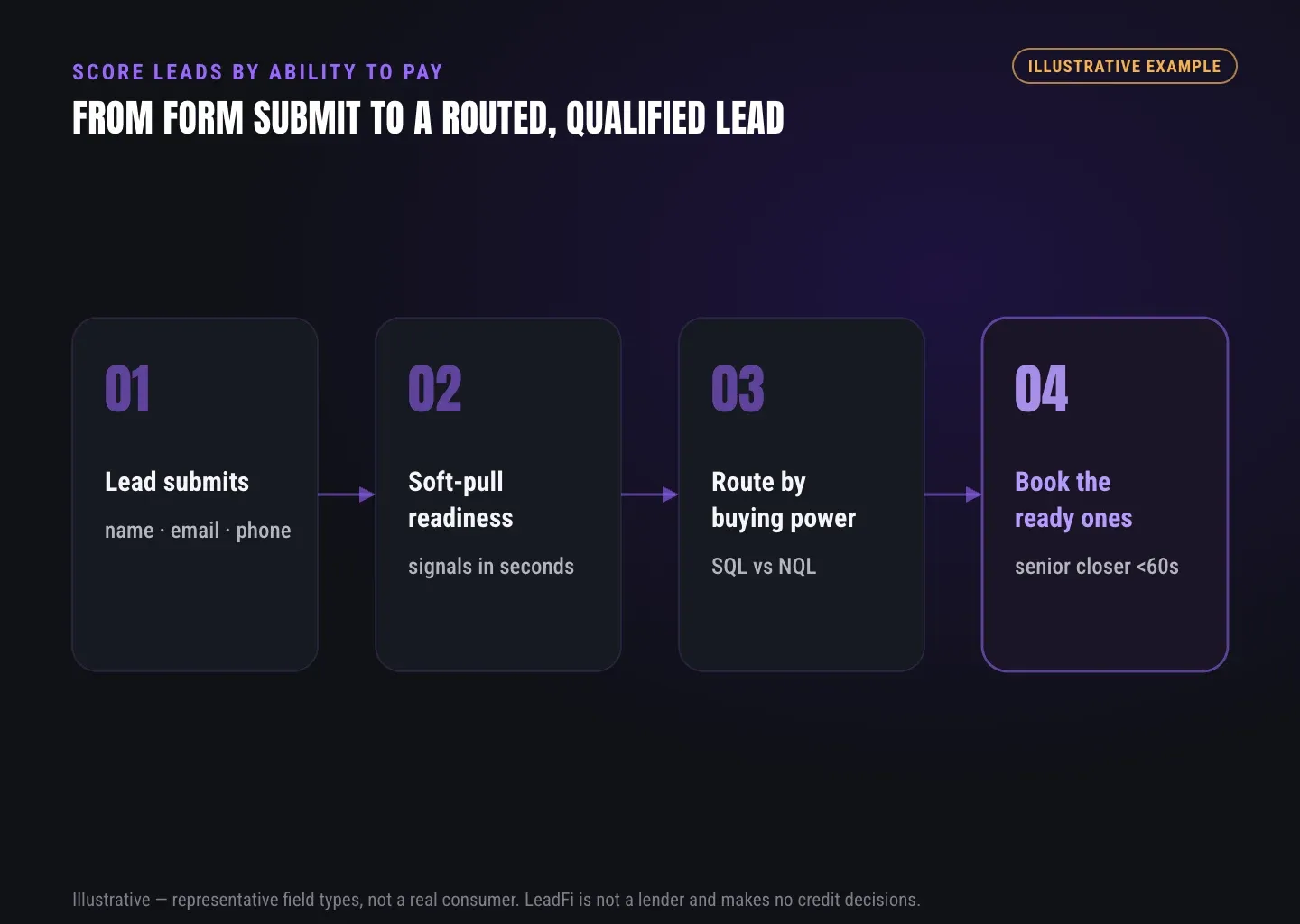
To score leads by ability to pay, add financial-readiness context after capture and before final routing. LeadFi sits behind forms, funnels, calendars, and CRMs rather than requiring teams to replace those systems.
Thin inputs reduce early form friction
LeadFi can work from name, email, and phone for many configured workflows. Its patent-pending identity matching is designed to establish a high-confidence match before soft-pull prescreening and, where applicable, deeper bureau-backed credit-report workflows.
Some implementations may not require address and date of birth at the first step. Exact inputs depend on the use case, available data, identity confidence, consent and disclosures, and workflow configuration. Uncertain or incomplete matches should enter a defined review or normal-processing path rather than automatically receiving a negative result.
Soft-pull prescreening adds credit context
A configured soft-pull prescreening path is intended to add relevant credit context without affecting the consumer's credit score. The information supports financial-readiness qualification, routing, and representative preparation—not a LeadFi approval or denial decision.
A soft pull is only one component of the financial-readiness engine. The commercial value comes from turning relevant signals into an appropriate next action while maintaining required consent and disclosures.
Multiple signals create better readiness bands
Depending on configuration and available data, readiness context may include:
- VantageScore 4.0: Credit context where supported by the workflow.
- Available credit: Capacity context that may differ among people with similar scores.
- Income: One input for understanding broad financial capacity.
- Debt and DTI: Debt load and debt-to-income context used with other signals.
- Funding pre-approval signals: An input for routing, not an offer or guarantee of funding.
- Identity-related information: Current address, age, or related identity signals where relevant to matching and the configured workflow; age should not be used as a general sales-scoring shortcut.
- Optional asset context: Liquid asset, retirement, brokerage, real-estate, or net-worth-style signals where supported.
No single field should act as a universal judgment. Teams should use only the minimum information needed for the defined workflow and restrict sensitive data to appropriate roles.
Readiness bands drive action
A raw number has limited value unless it changes what happens next. LeadFi can map configured signals into readiness bands or SQL/NQL results under the client's documented rules. The CRM can then select a calendar, alert a closer, create a review task, start nurture, or present a lower-ticket or alternate offer.
Teams that already use enrichment tools may also benefit from a closer look at a financial readiness layer for Clearbit enrichment.
High-ticket teams that benefit most
Financial-readiness qualification is most relevant when sales time is expensive or the offer creates a substantial price hurdle. Examples include coaching, consulting, course creators, agencies, business funding, mortgage and lending, real estate, insurance, and auto-finance teams.
Credit-adjacent and other regulated use cases require additional review. Clients should validate their workflow, data use, routing rules, consent and disclosures, and consumer-facing communications with counsel.
GUIDE
Behavioral and financial scores work together
Behavioral and financial lead scoring answer different questions. Behavioral data asks how interested a lead appears. Financial-readiness data adds context about fit for the financial step associated with the offer.
Use a two-axis qualification model
A practical model creates four broad segments:
- High intent and high readiness: Prioritize for speed-to-lead and an appropriate sales representative.
- High intent and lower readiness: Route to review, nurture, financing information, or a lower-ticket path.
- Low intent and high readiness: Use personal nurture, proof assets, setter outreach, or an event invitation.
- Low intent and lower readiness: Use education, a lower-cost entry point, or a later follow-up path.
Lower readiness should mean that the lead does not fit the primary path under the current rules. It is not a judgment about the person's worth and should not produce demeaning consumer-facing language.
Combined scores guide handoffs
The model should return an action rather than another number for representatives to interpret. Possible actions include priority closer routing, setter review, standard follow-up, a custom page, segmented nurture, an alternate offer, or manual review.
Stored reason codes should be limited to what each role needs. Representatives generally need a clear route and useful preparation—not unrestricted access to every underlying financial field.
CRM events close the loop
LeadFi can return results to CRM fields, tags, lists, stages, and workflow triggers through a webhook, API, Zapier, Make, or a supported native workflow. This allows representatives to work in the systems they already use.
SQL and NQL routing in the stack
An SQL is a Sales-Qualified Lead that meets the business's configured readiness rules for the primary path. An NQL is a Non-Qualified Lead for that path at that time.
A typical workflow can:
- Capture the lead through a form, application, or booking flow.
- Establish an identity match and run the configured readiness workflow.
- Write an SQL, NQL, review, or no-match status to the CRM.
- Notify the right representative or start the corresponding automation.
- Route NQLs to nurture, low-ticket, financing-information, or alternate-offer paths where appropriate.
LeadFi does not approve or deny consumers. In regulated or credit-adjacent contexts, clients must evaluate whether routing or offer changes create additional obligations.
Qualified-lead signals support campaign learning
When the setup and platform rules allow it, LeadFi can help feed qualified-lead events into Meta, Google, TikTok, Hyros, and related operations workflows. This lets media teams compare cost per SQL with cost per raw lead.
A campaign with fewer forms may produce a higher SQL rate than a high-volume campaign. No acquisition-cost, campaign-learning, or return outcome is assured, and sensitive financial fields should not be transmitted as advertising attributes.
See which of the leads you already have can actually afford to buy.
ROUTING
Thresholds turn scores into routing rules
There is no universal credit score, income level, available-credit amount, or DTI cutoff for every LeadFi client. Thresholds should reflect the offer, payment options, sales cost, audience, applicable requirements, and the action associated with each band.
Start with the next action
Define the route before choosing a threshold. Decide whether the result controls priority follow-up, setter review, standard nurture, financing information, a lower-ticket offer, or manual review. Each band should have a named owner and measurable next step.
Use bands instead of one cutoff
Bands such as Priority SQL, Standard SQL, Review, and NQL provide more routing flexibility than one hard cutoff. A $3,000 installment offer may require different weighting from a $10,000 offer with a different payment structure.
Teams should avoid copying another company's thresholds. They should also test rules for unfair or unintended outcomes, especially in lending, insurance, housing, auto finance, and other regulated contexts.
Plan for missing or uncertain data
A missing value is not automatically a negative signal. Define no-match, partial-data, conflicting-data, and manual-review states. These safeguards help reduce misrouting and limit the consequences of identity or data errors.
A sample action framework is:
- Offer fit: Define the financial demand created by the primary path.
- Signal mix: Select the minimum relevant readiness inputs.
- Routing action: Map each band to an operational next step.
- Review process: Assign an owner and a fixed review cadence.
Monitor routing quality
Useful measures include cost per SQL, SQL rate, no-match rate, override rate, response time, qualified-call rate, show rate, path conversion, and sales-cycle length. Review results by campaign and source because blended averages can hide high-volume channels that produce few ready leads.
Document each threshold change with its reason and expected effect. A controlled review process produces more reliable learning than frequent ad hoc edits.
Support a compliance-aware launch
LeadFi supports compliance-aware workflows and can help teams consider privacy-policy language, consent and disclosures, data minimization, role-based access, FCRA-aware workflow guidance, and TCPA-aware practices before launch.
LeadFi does not provide legal advice or guarantee compliance. Clients should review their specific use case with counsel, particularly when bureau-backed data affects credit, insurance, housing, or another regulated consumer path.
Related reading: a closer look at pre-screen leads by financial readiness, a closer look at optimizing Meta ads for qualified leads, a closer look at a financial readiness layer for Clearbit enrichment.
| Scoring approach | Main question | Common inputs | Best use | Main limit | Typical action |
|---|---|---|---|---|---|
| Behavioral scoring | Is the lead interested? | Clicks, views, replies, bookings, source | Intent tracking and nurture priority | Does not establish financial readiness | Raise follow-up priority |
| Financial lead scoring | Is the lead financially ready for the next step? | Credit context, available credit, income, debt, and DTI | Buying-power-aware qualification | May not show urgency or product interest | Assign a readiness band or SQL/NQL status |
| Combined scoring | Is the lead interested and financially ready? | Behavioral and permissioned readiness signals | High-ticket routing and sales focus | Requires clear rules, safeguards, and handoffs | Select a closer, review, nurture, page, or offer path |
Key takeaways
The short version
- Engagement shows interest, not financial readiness.
- LeadFi can begin with name, email, and phone.
- Readiness signals support SQL versus NQL routing.
- NQLs can enter nurture or alternate-offer paths.
- Thresholds should map to actions and undergo review.
Quick answers
Fast answers before you dig in
How do you score leads by ability to pay?
Combine behavioral intent with permissioned financial-readiness signals, then map the result to a defined sales action. LeadFi can return an SQL, NQL, review, or no-match status to the CRM after submission.
What is the difference between behavioral scoring and financial lead scoring?
Behavioral scoring measures actions such as clicks, replies, and bookings. Financial lead scoring adds buying-power context such as available credit, income, debt, DTI, or VantageScore 4.0 where supported.
Can LeadFi qualify leads from thin inputs?
LeadFi can work from name, email, and phone for many configured workflows. Its patent-pending identity matching is designed to establish a high-confidence match before relevant prescreening steps.
What happens to an NQL?
An NQL can enter nurture, manual review, financing-information, low-ticket, or alternate-offer paths instead of automatically consuming primary closer capacity.
Can readiness results improve paid-media optimization?
LeadFi can help send permitted qualified-lead events to Meta, Google, TikTok, Hyros, and related workflows when supported. Platform performance is not guaranteed.
FAQ
Common questions
How do you score leads by ability to pay?
Is financial lead scoring an alternative to behavioral lead scoring?
What data can LeadFi use to score leads by ability to pay?
Does a LeadFi soft pull affect the consumer's credit score?
Can LeadFi score leads without asking for an address?
How does SQL/NQL routing work?
Can financial-readiness signals improve ad optimization?
Sources
References
- CFPB — What is a credit inquiry? (hard vs. soft) (opens in a new tab)Federal regulator confirms a soft inquiry, unlike a hard inquiry, does not affect the consumer's credit score.
- VantageScore — VantageScore 4.0 credit scoring model (opens in a new tab)Official page describing VantageScore 4.0, the tri-bureau, trended-data model used to assess credit risk.
- CFPB — Who can request to see my credit report? (opens in a new tab)Federal regulator explains the FCRA rules governing who may obtain a credit report.
- VantageScore 4.0 (opens in a new tab)Background on the VantageScore 4.0 credit-scoring model referenced as a potential workflow signal.
- Consumer Financial Protection Bureau: Debt-to-income ratio (opens in a new tab)General explanation of debt-to-income ratio.
Know who is ready before your next sales call.
LeadFi complements your existing forms, funnels, calendars, CRM, and ad stack. See how thin-input qualification can prioritize financially ready SQLs, route NQLs to more suitable paths, and give sales representatives useful context before follow-up.