
FINANCIAL READINESS LAYER FOR CLEARBIT ENRICHMENT
A Financial-Readiness Layer for Clearbit-Style Enrichment
Clearbit by HubSpot turns a work email into a clean company-and-contact record: industry, role, seniority, hierarchy, and account-level intent from anonymous traffic. Its public copy says "Score & route instantly," and it does that at capture.
Watch a contact get pre-qualified.
This is exactly what your CRM gets back.
Your opt-in form
Soft pull · no impact to their credit
This is not a real soft pull. It's an example of the data points that land in your CRM contact record when a lead fills out your form.
LEADFI DEMO
Watch the demo, then start free or book a call.
INTELLIGENCE LAYER
Quick answer: what does LeadFi add to Clearbit-style enrichment?
Quick answer: LeadFi is a financial-readiness engine for high-ticket teams. It works from name, email, and phone to support permissioned readiness signals — VantageScore 4.0, income, available credit, debt, and debt-to-income (DTI). Then it tags each lead a Qualified Lead (SQL) or Non-Qualified Lead (NQL) and routes it. Clearbit enriches company data at capture; LeadFi adds a readiness signal after capture. They answer different questions, so they often pair well.
GUIDE
Who this pairing is for
This page is for teams selling offers of about $1,000–$10,000 and up, to a consumer or solo buyer. If your lead is a person paying out of pocket, company depth alone won't tell you about their financial readiness. That's the gap a readiness layer fills.
High-ticket coaching and consulting
Coaches and consultants burn closer time on prospects who love the pitch but aren't financially ready for a $5,000 program. LeadFi reads readiness after the form submits. As a result, SQLs reach a calendar fast and NQLs go to a low-ticket offer or a payment plan.
Business funding, lending, and mortgage
Funding and lending teams already live in credit-adjacent workflows. In practice, LeadFi surfaces income, DTI, and funding pre-approval signals as routing inputs — never as an approval or denial of the consumer.
Agencies routing client leads
Agencies running paid traffic need SQL quality, not just volume. For example, feeding financially qualified signals back into ad platforms — where each platform's policies and your setup permit it — can shift optimization toward buyers, not opt-ins.
Not the right fit for pure B2B SaaS
Here's the honest caveat: if you sell B2B SaaS and your buyer is a company budget, Clearbit's firmographic depth is likely what you want. In that case, LeadFi may not be the right tool. Overclaiming the overlap helps nobody.
PLATFORM OVERVIEW
What Clearbit is known for
Clearbit by HubSpot is widely known for turning messy public web data into clean, machine-usable fields — and for that job, it works well. Its own product copy describes B2B company and contact data drawn from "public data from the web, our proprietary data, and the power of LLMs." That cleanup discipline is real, and it solves genuinely ugly problems.
A few strengths are worth naming plainly. First, its industry taxonomy is unusually granular: 6-digit NAICS, GICS, and SIC codes, plus parent/subsidiary hierarchies that serve routing. Second, it turns freeform job titles into clean roles and seniorities. Third, its IP intelligence de-anonymizes website traffic into account-level intent.
One buying note, stated as availability: as of mid-2026, Clearbit is closed to new standalone subscriptions, and HubSpot's Breeze Intelligence is the go-forward path (which needs a paid HubSpot subscription). If you're already inside HubSpot, that native path is a real advantage. Much of the live 2026 search for a "clearbit alternative lead qualification" tool comes from readers who simply can't buy it standalone anymore.
Clearbit's public positioning
Clearbit positions itself as B2B company-and-contact-data enrichment, and its public product copy describes it as exactly that. Their pages cover enrichment, fit scoring, instant routing, and IP-based intent. We attribute scope to their words, not ours.
Where the two products sit in a stack
Clearbit enriches from an email at capture; LeadFi adds a readiness signal after capture. So a team already running enrichment-on-capture already has the plumbing for a readiness routing step — added with opt-in and consent.
INTELLIGENCE LAYER
What a financial-readiness layer adds
A financial-readiness layer reads permissioned signals about one buyer — credit score, income, available credit, debt, and DTI — and turns them into a routing decision. Company data alone does not reveal financial readiness for a $10,000 offer; that's a different question about a different subject. LeadFi is built to help answer it and act on it after the lead submits.
Firmographic enrichment tells you who a lead is at work. However, buying power is a separate axis about the person paying. For a $5,000 consumer offer, the useful question is readiness — and that sits outside the core scope of company-level data.
LeadFi works from name, email, and phone. First, patent-pending identity matching is designed to establish a high-confidence match on identity-related information — such as current address and age — before any soft-pull prescreening. The soft pull then reads readiness signals as prescreening for routing. It never approves or denies anyone.
Buying-power signals, not estimates
LeadFi can surface readiness signals where consent and disclosures support them: VantageScore 4.0, available credit, income, debt, and DTI. These are routing inputs and rep prep — not underwriting or a promise of funding.
SQL vs NQL routing
LeadFi labels each lead a Qualified Lead (SQL) or Non-Qualified Lead (NQL). SQLs can book a closer calendar right away. NQLs route to a low-ticket offer under $3,000, a payment plan, or a financing path, so no traffic is wasted.
Thin-input match without an address up front
Traditional soft-pull workflows usually ask for address and date of birth before they run. LeadFi can often start from name, email, and phone, then match the rest of the identity-related information — which cuts form friction for many paths. Confirm the exact path with your setup.
Signals feed CRM and ad platforms
Readiness outcomes write back to CRM fields, tags, stages, and workflows. Where each platform's policies permit and the setup is correct, SQL-quality signals can also inform Meta, Google, TikTok, and Hyros workflows. As a result, ads can optimize toward buyers, not cheap opt-ins. No platform performance is guaranteed.
See which of the leads you already have can actually afford to buy.
GUIDE
How the stack fits together
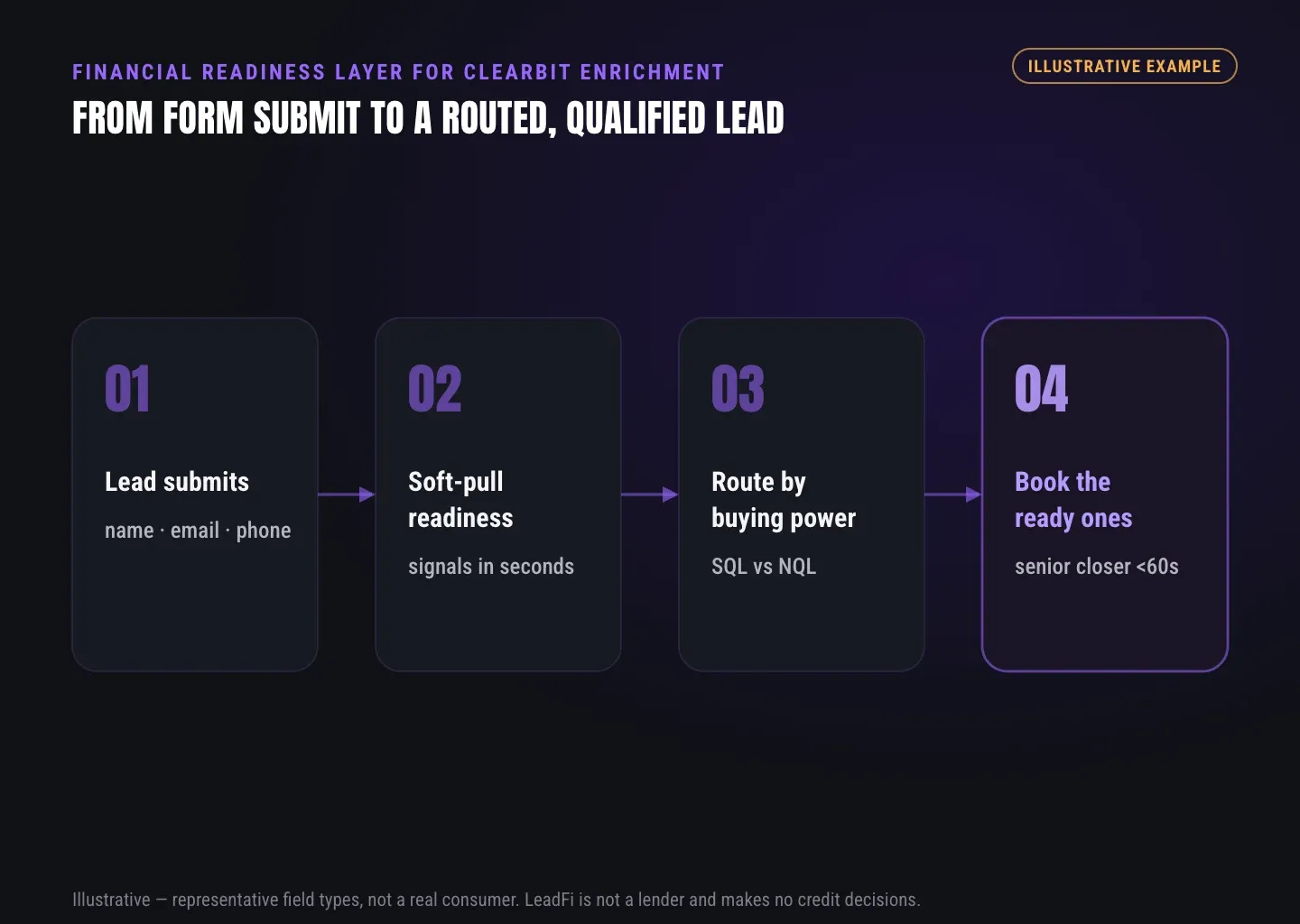
LeadFi sits behind your capture surface. First, a form, funnel, calendar, or application creates a lead event. Next, a webhook, API, Zapier, Make, or native workflow hands the identity payload to LeadFi. Then LeadFi enriches and classifies, and acts — CRM updates, redirects, calendar selection, or signal feedback. Clearbit can enrich the same record with company context at capture, so the two signals live side by side.
You don't rip anything out. Instead, LeadFi adds one step after the lead submits and returns a decision the rest of your stack can act on.
Capture stays where it is
Keep your ClickFunnels page, Typeform, Jotform, GoHighLevel form, HubSpot form, or custom application. LeadFi gets the submission after capture — it is not a replacement for your form or funnel strategy.
Enrich and classify after submit
Once the payload lands, LeadFi applies your readiness rules. Next, it tags the lead SQL or NQL and attaches the permitted context your reps need before the call.
Act in real time
Then the outcome triggers the next step: a thank-you redirect to a calendar, a low-ticket offer, a financing page, or a closer notification with permitted financial context. You define the rules; LeadFi routes to them.
Feed the loop back
Finally, qualified-lead signals can flow back into ad and attribution workflows where each platform's policies and your setup allow it. As a result, campaigns can learn from real buyers over time, not just opt-in counts. No platform performance is guaranteed.
GUIDE
Short scenarios
Consider a coaching funnel selling a $6,000 program. A lead submits a Typeform application. In practice, LeadFi reads readiness, tags them SQL, and redirects them to a closer's calendar within seconds. A second lead comes back NQL. Instead of a call, they get a $997 low-ticket offer.
Now take a funding agency. A prospect fills a GoHighLevel form. LeadFi surfaces income, DTI, and a funding pre-approval signal, then notifies a setter with permitted context. As a result, the setter opens the call already knowing which financing path fits, so there's no cold discovery on readiness.
WORKFLOW DESIGN
Compliance-aware setup
LeadFi helps teams stand up a compliance-aware qualification workflow before launch, as onboarding help. For example, that includes privacy-policy language, consent language that matches your calls and automations, and FCRA-aware and TCPA-aware workflow guidance. This is a value-add, not a blocker — and it is not legal advice.
Treat qualification as operational readiness for the next conversation, not a judgment of a person's worth. So align your form disclosures, SMS consent, and CRM notes, and every prospect hears one consistent story.
To be direct about the limits: LeadFi does not approve or deny consumers, does not guarantee compliance, and does not provide legal advice. Clients should review their use case with counsel before go-live.
| Question | Clearbit (enrichment) | LeadFi (financial-readiness layer) |
|---|---|---|
| Core question answered | Who is this lead and are they our ICP? | Is this buyer financially ready for the offer? |
| Primary data | Company + contact firmographics, intent | Permissioned readiness signals (VantageScore 4.0, income, DTI) |
| When it runs | At capture | After capture |
| Inputs | Work email | Name, email, phone |
| Output | Fit score, clean fields, routing | SQL/NQL tag + routing decision |
| Best buyer | B2B / company budget | Consumer high-ticket ($1,000–$10,000+) |
Key takeaways
The short version
- LeadFi does not replace Clearbit — it adds a financial-readiness layer after capture while Clearbit enriches company and contact data at capture.
- LeadFi works from name, email, and phone to support permissioned readiness signals like VantageScore 4.0, income, available credit, debt, and DTI.
- Each lead is tagged a Qualified Lead (SQL) or Non-Qualified Lead (NQL); SQLs reach a closer calendar fast, NQLs route to a low-ticket offer, a payment plan, or financing.
- Best fit is high-ticket consumer sellers ($1,000–$10,000+); pure B2B SaaS teams are usually better served by Clearbit or Breeze Intelligence.
- LeadFi supports compliance-aware setup as onboarding help but does not approve or deny consumers, guarantee compliance, or provide legal advice.
Quick answers
Fast answers before you dig in
What does LeadFi add to Clearbit-style enrichment?
LeadFi is a financial-readiness engine for high-ticket teams. It works from name, email, and phone to support permissioned readiness signals — VantageScore 4.0, income, available credit, debt, and DTI — then tags each lead SQL or NQL and routes it. Clearbit enriches company data at capture; LeadFi adds a readiness signal after capture.
Does the soft pull affect a lead's credit?
LeadFi supports soft-pull prescreening, which reads financial-readiness signals for routing rather than as a credit decision. It is prescreening for routing and never an approval or denial of the consumer. Confirm inquiry type and disclosures with your setup and counsel.
FAQ
Common questions
Is LeadFi a Clearbit alternative for lead qualification?
Does LeadFi replace Clearbit?
What does "enrichment plus buying power" mean here?
What financial data can LeadFi surface?
Does the soft pull hurt a lead's credit?
How does LeadFi handle SQL vs NQL routing?
Can LeadFi feed signals into my ads and CRM?
Sources
References
- CFPB — What is a credit inquiry? (hard vs. soft) (opens in a new tab)Federal regulator confirms a soft inquiry, unlike a hard inquiry, does not affect the consumer's credit score.
- VantageScore — VantageScore 4.0 credit scoring model (opens in a new tab)Official page describing VantageScore 4.0, the tri-bureau, trended-data model used to assess credit risk.
- Experian — Hard Inquiry vs. Soft Inquiry (opens in a new tab)Major credit bureau contrasts hard and soft inquiries and confirms soft inquiries do not affect a credit score.
Know who is ready before your next sales call.
Book a demo to see how LeadFi can sit behind your current form, CRM, funnel, or calendar workflow and route leads based on financial readiness. LeadFi does not approve or deny consumers and guarantees no specific outcome.