
BANK STATEMENT ANALYSIS
Bank Statement Analysis as a Financial-Readiness Signal
Bank statement analysis reviews account activity to add cash-flow context to a lead record. It can reveal deposit timing, recurring outflows, balance trends, and volatility, but it represents only part of a person’s financial picture.
Watch a contact get pre-qualified.
This is exactly what your CRM gets back.
Your opt-in form
Soft pull · no impact to their credit
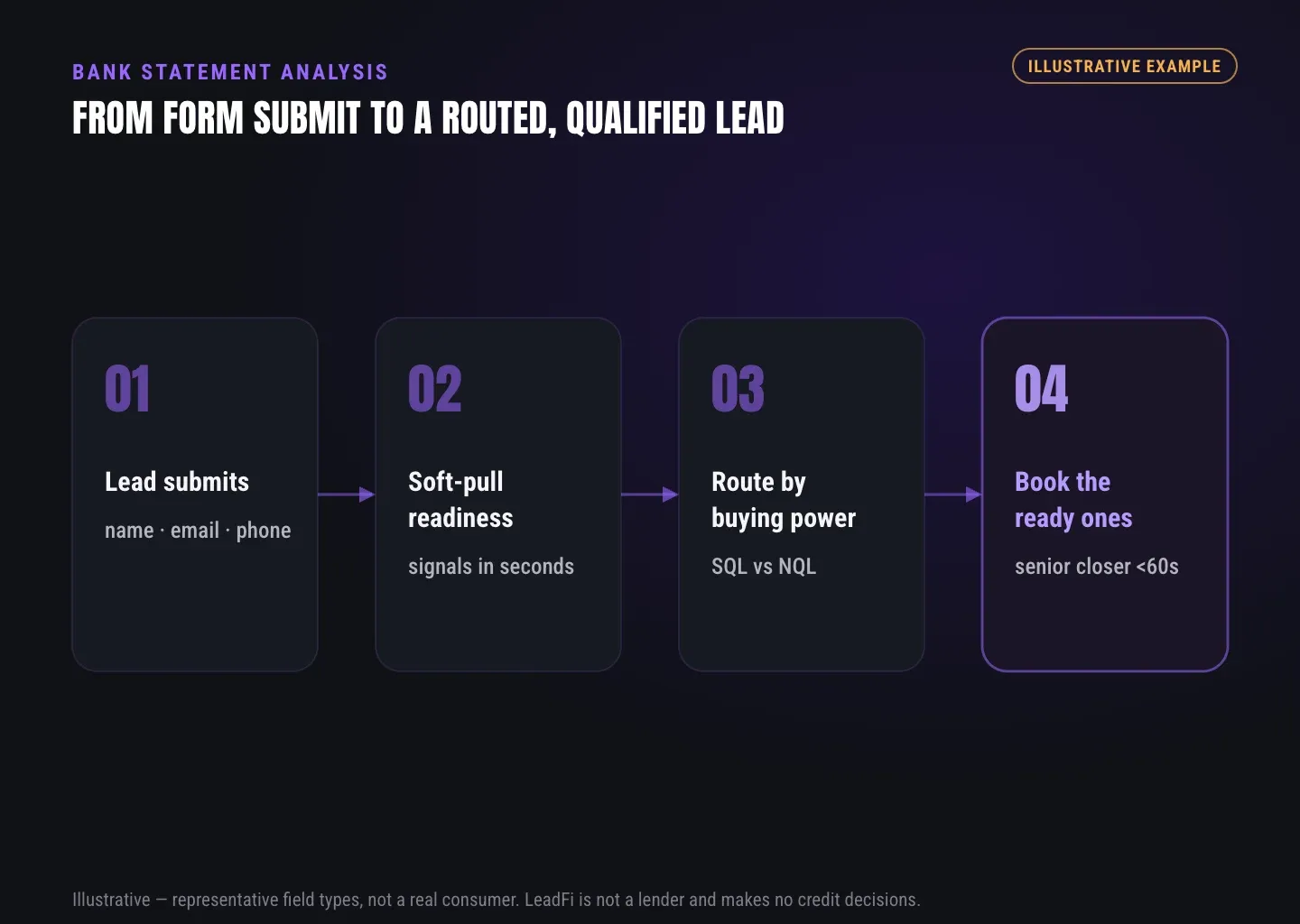
This is not a real soft pull. It's an example of the data points that land in your CRM contact record when a lead fills out your form.
LEADFI DEMO
Watch the demo, then start free or book a call.
GUIDE
Bank statement analysis describes cash movement
Bank statement analysis reviews deposits, withdrawals, balances, and recurring transactions over a chosen period. The team selects that period according to its offer and whether the lead’s cash flow is steady, variable, or seasonal.
Deposit history shows timing patterns
Deposit history can show whether money arrives weekly, twice monthly, monthly, or irregularly. That pattern may help a rep prepare, but frequency alone does not establish that every deposit is income or that the pattern will continue.
Balance trends show short-term liquidity
Daily or monthly balances show how much cash remains after inflows and expenses. A steady buffer and repeated near-zero balances provide different context, although a one-time transfer can distort a short review window.
Recurring outflows add expense context
Statements may show housing costs, debt payments, payroll, subscriptions, and transfers. These outflows help explain why gross deposits and usable cash differ. Ambiguous transaction labels may still require a narrow follow-up question.
Volatility and account coverage limit the picture
A consultant might receive two large client payments in one month and none in the next. One checking account might also omit business, joint, savings, or brokerage activity. Teams should treat partial coverage as partial context rather than a complete financial profile.
Statement intake creates funnel friction
Requesting a bank connection or document upload introduces sensitive data and another completion step. The request should have a clear sales purpose, secure handling, limited access, and suitable consent and disclosures.
In many supported workflows, LeadFi can begin with name, email, and phone. Its patent-pending identity matching is designed to establish a high-confidence match before soft-pull prescreening and, where applicable, deeper bureau-backed workflows. The configuration still needs appropriate consent and disclosures.
INTELLIGENCE LAYER
Cash-flow context is one part of financial readiness
Cash-flow review describes money moving through selected accounts. Financial readiness can also include income, debt, debt-to-income ratio, available credit, VantageScore 4.0, age, address, and optional asset or net-worth-style context when available and supported by the workflow.
LeadFi is a financial-readiness qualification and routing platform, not generic bank statement analysis software. It qualifies a client’s existing inbound leads by readiness before the sales call.
Income and deposits are not identical
Income refers to relevant earnings or receipts. Deposits can also include transfers, refunds, gifts, or returned funds. Teams should avoid treating raw deposit totals as verified income.
Debt and DTI change the usable picture
Two leads can have similar deposits but different recurring debt obligations. When supported, permissioned income, debt, and DTI signals can give the team additional context for its qualification criteria and sales follow-up.
Available credit and score data provide separate context
Available credit is limited readiness context; it is not cash and does not establish whether borrowing is suitable. Where supported, VantageScore 4.0 adds a distinct bureau-backed signal, while a statement can show recent cash movement that score data does not capture.
Optional asset context may matter
Some workflows may use available liquid-asset, retirement, brokerage, real-estate, or net-worth-style context. These signals differ from checking-account activity and should be included only when they change routing or rep preparation.
SQL and NQL labels drive sales action
SQL means Sales-Qualified Lead: someone who is financially fit to buy your offer. NQL means Non-Qualified Lead: someone who is not financially fit to buy your offer.
These are internal sales-operating outcomes. The client owns the qualification criteria, thresholds, routing rules, and follow-up choices. SQLs may enter priority follow-up, while NQLs may enter nurture, a lower-ticket path, an alternate offer, or a custom page.
GUIDE
Statement data remains a team-owned operating choice
The business decides whether statement data belongs in its workflow. It also owns the review period, transaction rules, readiness bands, exception handling, and sales follow-up.
Start with a clear collection purpose
A statement request should answer a defined sales question, such as whether variable cash flow should appear in rep preparation or whether a narrow group needs additional review. Collecting more data without changing an action adds friction without operational value.
Match intake timing to the funnel
Statement intake can occur before booking, after initial qualification, or later in the sales process. A thin-input workflow can keep the first step to name, email, and phone, with deeper intake reserved for paths where it serves a defined purpose.
Keep collection and access narrow
Bank statements can expose account details, merchants, and personal spending. Teams should minimize the data collected, limit access by role, set retention practices, and provide reps with a concise readiness summary instead of unrestricted transaction detail.
Turn CRM fields into explicit next steps
Useful CRM fields might include SQL/NQL status, readiness band, statement-request status, review status, and next action. LeadFi can return outcomes through a webhook, API, Zapier, Make, or a supported native workflow. Automations can then update stages, assign tasks, select pages, or alert the appropriate sales role.
Complete compliance-aware setup before launch
Teams should align the use case, privacy language, consent and disclosures, data handling, and call or messaging practices before launch. LeadFi supports compliance-aware workflows and can help teams plan privacy and consent language, TCPA-aware practices, and FCRA-aware workflow choices. LeadFi does not provide legal advice, and clients should review their use case with counsel.
See which of the leads you already have can actually afford to buy.
INTELLIGENCE LAYER
Readiness inputs should earn their place
Every readiness input should change routing, rep preparation, or workflow measurement. A signal that arrives after the sales call, duplicates another field, or remains unused in the CRM may not justify its cost and friction.
Action value comes before data volume
Start with the available actions: priority follow-up, a closer calendar, nurture, a lower-ticket offer, an alternate service, or a custom page. Map each requested input to one of those actions.
Freshness and coverage affect usefulness
Recent statement data may help with current cash-flow context, while a longer period may reveal seasonal patterns. Neither is complete when important accounts are missing. The workflow should represent gaps explicitly instead of inferring a result.
Rep use and routing should be observable
Teams can monitor whether a signal changes SQL/NQL route mix, review completion, CRM tasks, or time to first sales action. These operational measures show whether the workflow is functioning as designed; they are not promises of revenue or conversion results.
A concise field such as “stable,” “variable,” or “review needed” may be more useful to a rep than a raw transaction export. Team feedback can determine which context belongs in the record.
Qualified-lead signals can support campaign learning
Where allowed by platform rules and the client’s configuration, LeadFi can send financially qualified lead signals into Meta, Google, TikTok, Hyros, CRM, and operations workflows. This gives teams another way to assess lead quality by source, without promising campaign or platform performance.
The approach fits costly high-ticket sales motions
Readiness-based routing is most relevant when sales calls are expensive and buying power varies across inbound leads. That includes coaching, consulting, courses, agencies, business funding, mortgage and lending, real estate, insurance, and auto-loan teams.
LeadFi sits behind existing forms, funnels, calendars, and CRMs. It helps teams prioritize financially qualified leads for speed-to-lead while giving NQLs a useful nurture, low-ticket, or alternate path.
Related reading: practical insights on marketing lead qualification, practical insights on financial readiness signals in your crm, a practical guide to ai lead qualification.
| Input | What it can add | Main limitation | Typical team action |
|---|---|---|---|
| Bank statement analysis | Deposit patterns, balances, recurring outflows, and volatility | Intake friction and incomplete account coverage | Add cash-flow context or request a focused follow-up |
| Self-reported answers | Stated income, budget, goals, and timing | May be incomplete or inconsistent | Support discovery and offer matching |
| Soft-pull readiness signals | Permissioned financial context through a supported thin-input path | Requires suitable configuration, consent and disclosures | Apply team-defined SQL/NQL rules |
| Income and DTI signals | Income context and recurring debt load | Does not show every bank transaction | Set team-owned readiness bands |
| Available credit | Limited context about unused revolving capacity | Is not cash and does not establish suitability to borrow | Inform rep preparation or routing criteria |
| Optional asset context | Longer-term financial depth where available | May not show near-term cash timing | Support selected high-ticket workflows |
| CRM engagement data | Source, activity, calls, notes, and pipeline status | Measures behavior rather than financial fit | Combine intent and readiness for follow-up |
Key takeaways
The short version
- Bank statements add cash-flow context, not a complete financial picture.
- Deposits should not automatically be treated as income.
- LeadFi qualifies existing inbound leads before the sales call.
- Teams own SQL/NQL criteria, routing, and sales follow-up.
- Thin-input workflows can keep statement review optional or targeted.
Quick answers
Fast answers before you dig in
What does bank statement analysis show?
It shows selected account deposits, withdrawals, recurring outflows, balance trends, and cash-flow volatility over a defined period. Its usefulness depends on transaction labeling, review length, and account coverage.
Can bank statement analysis qualify a high-ticket lead?
It can support team-owned high-ticket lead qualification, but it should not stand alone. Teams can combine cash-flow context with broader permissioned readiness signals and explicit SQL/NQL routing rules.
How does LeadFi use financial-readiness signals?
LeadFi qualifies a client’s existing inbound leads by readiness before the sales call, returns SQL/NQL outcomes to connected systems, and supports team-defined routing and sales follow-up.
Can thin-input prescreening reduce statement intake?
In supported workflows, LeadFi can start with name, email, and phone and use permissioned soft-pull prescreening. A statement request can remain a later or exception-based step when the team determines it adds value.
FAQ
Common questions
What is bank statement analysis?
Can bank statement analysis qualify a high-ticket lead?
How does deposit history differ from income?
Does LeadFi perform bank statement analysis?
Can LeadFi run soft-pull prescreening without collecting an address first?
How should SQL/NQL routing work after bank statement analysis?
How should sensitive statement data appear in the CRM?
Sources
References
- CFPB — What is a credit inquiry? (hard vs. soft) (opens in a new tab)Federal regulator confirms a soft inquiry, unlike a hard inquiry, does not affect the consumer's credit score.
- VantageScore — VantageScore 4.0 credit scoring model (opens in a new tab)Official page describing VantageScore 4.0, the tri-bureau, trended-data model used to assess credit risk.
- CFPB — Who can request to see my credit report? (opens in a new tab)Federal regulator explains the FCRA rules governing who may obtain a credit report.
- VantageScore 4.0 (opens in a new tab)Official background on the score model referenced as a possible readiness signal in supported workflows.
Know who is ready before your next sales call.
Bank statement analysis can add useful cash-flow context when it changes a clear sales action. LeadFi helps high-ticket teams qualify existing inbound leads before the sales call, route SQLs and NQLs, and return useful outcomes to the CRM and supported marketing workflows they already use.