
AI LEAD QUALIFICATION
AI Lead Qualification: A Practical Guide for High-Ticket Sales Teams
AI lead qualification uses software to organize inbound lead data, apply team-owned criteria, and recommend the next sales action. AI can summarize applications, flag missing information, support prospect research, and prepare rep notes.
Watch a contact get pre-qualified.
This is exactly what your CRM gets back.
Your opt-in form
Soft pull · no impact to their credit
This is not a real soft pull. It's an example of the data points that land in your CRM contact record when a lead fills out your form.
LEADFI DEMO
Watch the demo, then start free or book a call.
GUIDE
Identify where AI can assist a review
AI works best when it has a narrow, documented role. It can summarize approved research, clean up long form answers, flag missing fields, compare submitted information with written criteria, and draft a concise rep brief.
A team should first map the event that starts qualification, such as a form submission, booking, or new CRM record. It should then define the required output:
- SQL recommendation: Prioritize the lead for timely sales follow-up.
- NQL recommendation: Consider nurture, a lower-ticket product, or an alternate offer.
- Review status: Ask a named person to resolve missing, conflicting, or uncertain information.
- Rep brief: Summarize the lead's stated need, timing, source, and relevant context.
- CRM action: Recommend a field, stage, tag, task, or queue update.
Keep research and routing separate. Research organizes context; routing applies team-owned business rules. Storing inputs, reason codes, and the recommended path in separate CRM fields makes the process easier to review.
A sensible first use case is drafting notes or detecting incomplete records without changing a live route. Once the team trusts the inputs and understands failure points, it can test narrow route recommendations while sending uncertain cases to human review.
For example, a high-ticket coaching company could use AI to turn an application into a five-line brief. LeadFi could add financial-readiness context after submission. The CRM could present a recommended SQL, NQL, or review path, with a person checking the recommendation before a consequential workflow change.
GUIDE
Keep people accountable for the criteria
Human-in-the-loop qualification means people define the criteria, review specified cases, and own the resulting sales workflow. AI assists with organization and consistency; it should not invent hidden standards or independently control financially sensitive routing.
Every criterion needs a business owner and a clear reason. Sales might own offer-fit definitions, while RevOps manages fields, integrations, and route logic. Core changes should require review rather than allowing any user to alter a threshold.
Write rules so a new manager can explain them. Instead of relying on an opaque score, keep dimensions separate:
- Offer fit: Does the stated need match the product or service?
- Timing: Does the lead want to act within the target period?
- Financial readiness: Is there relevant buying-power context for the sales path?
- Data confidence: Are the identity match and required inputs sufficiently clear?
- Review status: Must a person inspect the record before the route changes?
Create specific review triggers for missing data, conflicting answers, uncertain identity matching, records near an internal threshold, new campaign sources, or weak AI research. Assign each review queue an owner and response expectation.
Teams should also log overrides and rule changes. A lightweight governance register can record the rule name, business reason, data source, owner, route effect, known limits, and test history. Frequent overrides may indicate unclear criteria, weak data, or a workflow that needs revision.
INTELLIGENCE LAYER
Use financial readiness as contextual information
Financial-readiness qualification adds buying-power context to an existing inbound lead before sales follow-up. Depending on the configured workflow, consent and disclosures, and data availability, signals may include VantageScore 4.0, available credit, income, debt, debt-to-income ratio, current address, age, or optional asset and net-worth-style context.
These signals should inform rep preparation and team-owned routing criteria. They should not act as a standalone judgment about a person, and defined edge cases should remain subject to human review.
Identity matching and thin-input prescreening
LeadFi can work from name, email, and phone in many supported workflows. Its patent-pending identity matching is designed to establish a high-confidence match before soft-pull prescreening and, where applicable, deeper bureau-backed workflows. Identity-related information, such as a current address or age, may be relevant in some configurations.
The value is not avoiding a particular field. It is reducing friction while giving high-ticket teams useful financial-readiness context for qualification and follow-up.
Routing and rep preparation
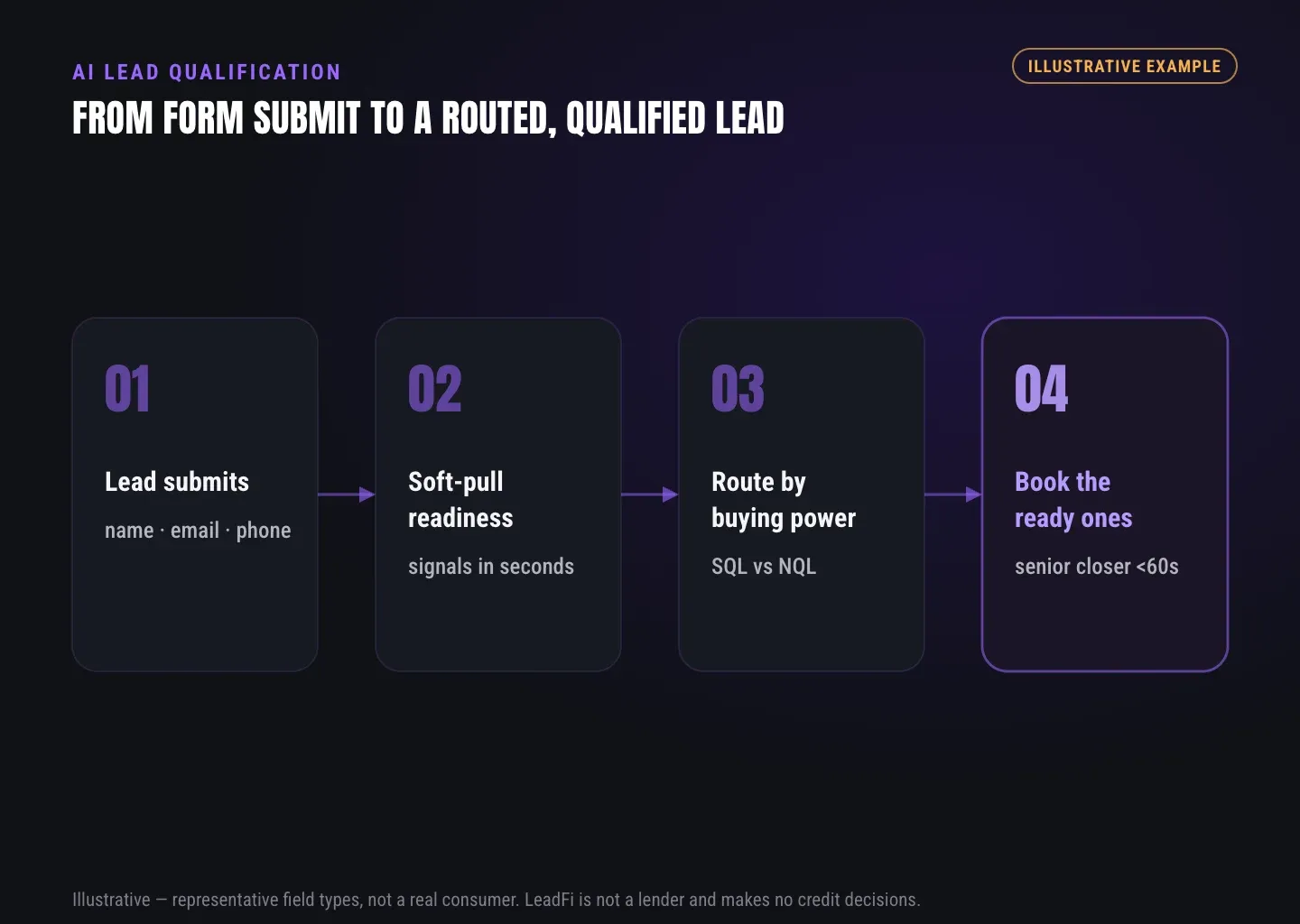
LeadFi sits behind existing forms, funnels, calendars, and CRMs. After capture, it can return readiness context and a route recommendation through a webhook, API, Zapier, Make, or supported native workflow.
A financially ready, strong-fit lead may be recommended for an SQL queue and faster follow-up. A lower-readiness lead may be recommended for nurture, a lower-ticket product, an alternate offer, or later review. A person should review recommendations before consequential routing changes when the team's policy requires it.
Role-based access can limit unnecessary data exposure. A closer may only need a route, readiness tier, and short explanation, while authorized operations staff may need the match state, source, and reason code.
Where platform rules and the configured setup allow, qualified-lead signals can also flow to Meta, Google, TikTok, Hyros, and related operations systems. These feedback events give teams another way to assess lead quality by source; they do not guarantee media or sales performance.
Compliance-aware setup should occur before launch. LeadFi can support privacy and consent language, TCPA-aware practices, and FCRA-aware workflow guidance. LeadFi does not provide legal advice, and clients should review their use case with counsel.
See which of the leads you already have can actually afford to buy.
GUIDE
Evaluate AI assistance without performance promises
Evaluate AI lead qualification through process quality rather than unsupported revenue or conversion claims. Establish a baseline, use a balanced sample of clear and difficult records, and apply the same written criteria throughout the test.
Useful measures include:
- Reviewer agreement: Whether trained reviewers and the AI-assisted process recommend the same path.
- Material errors: Suggestions that would send a lead to an unsuitable main sales path.
- Review rate: How often a person must resolve uncertainty.
- Override rate: How often reviewers change the suggested action.
- Data coverage: Whether required fields and configured signals are available.
- Route completion: Whether the intended CRM or funnel action runs correctly.
- Time to ownership: How quickly the appropriate rep or queue receives the record.
- Reason-code coverage: Whether each recommendation includes an understandable explanation.
Segment results by source, offer, form, campaign, and route. A workflow that performs consistently on detailed applications may be less useful for short social forms.
Watch for automation bias as well. A polished summary can still contain an incorrect statement or weak recommendation. Show supporting reasons, make overrides easy, and train reviewers with examples where AI output should be questioned.
A controlled rollout can begin with AI-generated notes, continue with route recommendations for clear cases, and retain a human-review queue for everything else. Change one major rule or workflow component at a time so the team can understand and reverse the effect.
Related reading: a practical guide to sales lead qualification, a practical guide to marketing lead qualification, a practical guide to what is lead qualification.
| Approach | Main inputs | Human role | Financial-readiness depth | Typical output | Main limitation |
|---|---|---|---|---|---|
| Manual review | Form answers and CRM history | Reviews every record | Usually limited to reported data | Assignment or nurture choice | Can be slow and inconsistent at volume |
| Rules-only scoring | Fixed fields and thresholds | Defines rules and checks exceptions | Limited unless readiness data is connected | Score, stage, tag, or queue | Rigid rules may miss context |
| Generic AI scoring | Forms, activity, CRM text, and approved research | Reviews suggestions and maintains criteria | Usually relies on available sales data | Summary, score, or recommended route | May infer buying power from weak proxies |
| AI plus LeadFi readiness | AI-organized sales context and permissioned readiness signals | Owns criteria and reviews defined cases | May include VantageScore 4.0, income, debt, DTI, or available credit | SQL, NQL, review, rep brief, or CRM recommendation | Requires clear access, workflow, and governance choices |
| LeadFi configured routing | Inbound submission, team rules, and readiness signals | Defines thresholds and owns the workflow | Designed for financial-readiness qualification | CRM field, tag, alert, calendar, nurture, or alternate path | Complements rather than replaces human judgment and the sales stack |
Key takeaways
The short version
- AI should organize team-owned qualification criteria, not replace human review.
- LeadFi adds financial-readiness context after an inbound lead is captured.
- SQL, NQL, and review routes should include clear reasons and accountable owners.
- Thin-input workflows can begin with name, email, and phone where supported.
- Evaluate process quality, data coverage, overrides, and route completion.
Quick answers
Fast answers before you dig in
What is AI lead qualification?
AI lead qualification uses software to organize inbound lead data, apply team-owned criteria, and recommend a sales action. People should own the rules, review exceptions, and make the final routing judgment.
How can AI assist lead review?
AI can summarize applications, flag missing or conflicting data, apply written criteria, and draft rep notes. It should not create hidden standards or independently control financially sensitive routes.
How does financial readiness improve qualification?
Financial readiness adds buying-power context that clicks, bookings, and self-reported answers may not provide. Teams can use it for rep preparation and human-reviewed SQL, NQL, nurture, or alternate-offer recommendations.
How should a team evaluate AI lead qualification?
Track reviewer agreement, overrides, data coverage, reason codes, route completion, and rep use. Test one meaningful change at a time and review results by lead source, offer, form, and route.
FAQ
Common questions
What is AI lead qualification?
How does AI lead qualification differ from lead scoring?
What is human-in-the-loop lead qualification?
Can AI lead qualification use financial-readiness data?
Does LeadFi require an address for every workflow?
How does LeadFi support SQL vs NQL routing?
What governance does AI lead qualification require?
Sources
References
- CFPB — What is a credit inquiry? (hard vs. soft) (opens in a new tab)Federal regulator confirms a soft inquiry, unlike a hard inquiry, does not affect the consumer's credit score.
- VantageScore — VantageScore 4.0 credit scoring model (opens in a new tab)Official page describing VantageScore 4.0, the tri-bureau, trended-data model used to assess credit risk.
- CFPB — Who can request to see my credit report? (opens in a new tab)Federal regulator explains the FCRA rules governing who may obtain a credit report.
Know who is ready before your next sales call.
See how LeadFi can sit behind your current form, funnel, calendar, or CRM and add financial-readiness context for existing inbound leads before sales follow-up.