
WHAT IS LEAD QUALIFICATION
What Is Lead Qualification? Definitions and Core Criteria
What is lead qualification? It is the process of evaluating an existing inbound lead against defined criteria so a team can choose the appropriate sales follow-up. Common criteria include need, buyer fit, intent, timing, authority, and financial readiness.
Watch a contact get pre-qualified.
This is exactly what your CRM gets back.
Your opt-in form
Soft pull · no impact to their credit
This is not a real soft pull. It's an example of the data points that land in your CRM contact record when a lead fills out your form.
LEADFI DEMO
Watch the demo, then start free or book a call.
GUIDE
Define lead qualification in a sales context
Lead qualification is a structured review of whether an inbound lead fits a particular sales process. Instead of relying on a rep’s first impression, the team applies agreed criteria and connects each result to a next step.
Qualification starts after lead capture
A lead enters through a form, application, funnel, calendar, or CRM. Qualification then evaluates information such as the lead’s need, role, location, timing, intent, and fit for the offer.
LeadFi works behind these capture tools. For many configured workflows, it can begin with name, email, and phone, then use identity-related information and identity signals where applicable.
Evaluation turns data into action
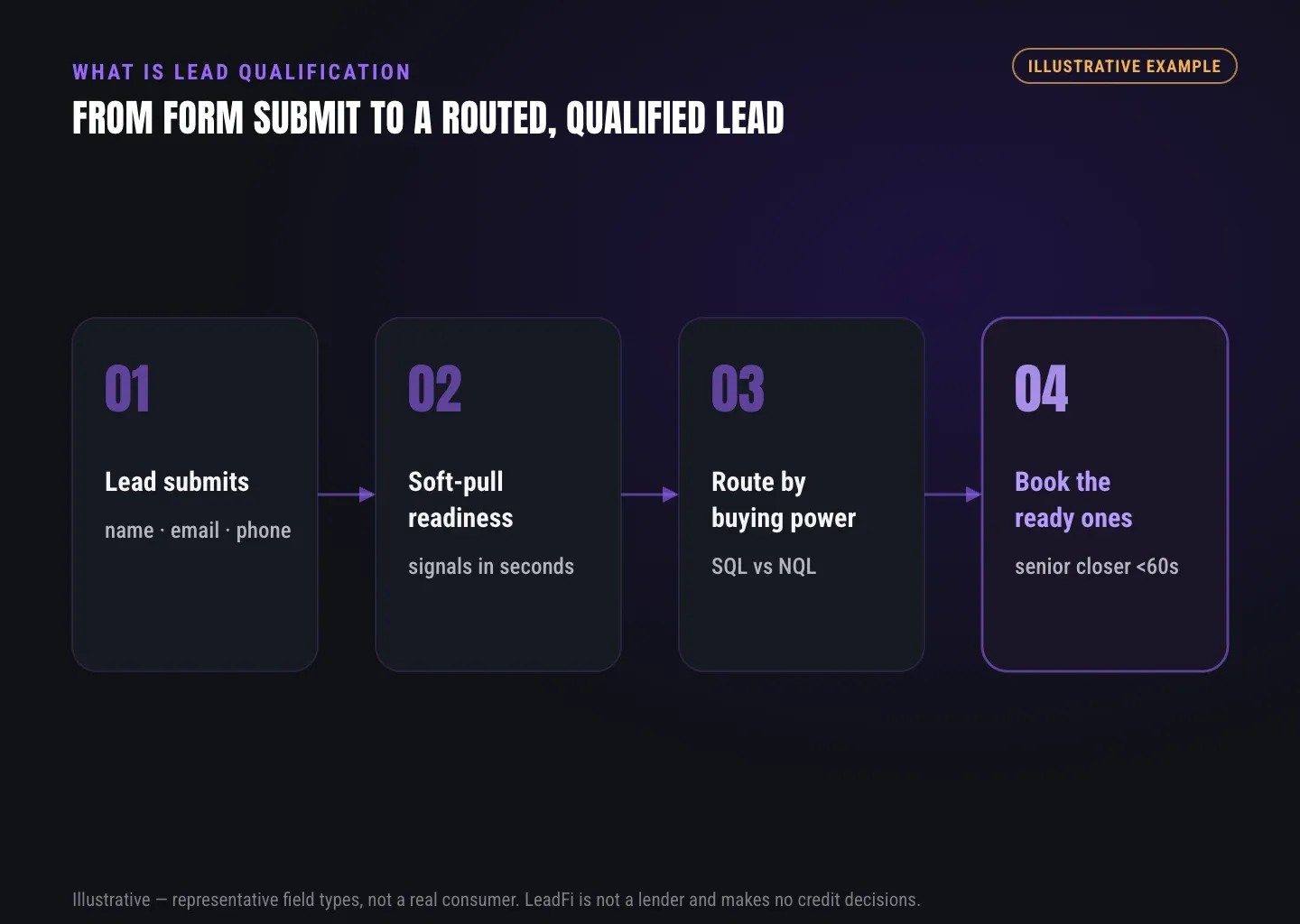
A qualification result is useful only when it changes follow-up. An SQL might trigger priority outreach, while an NQL might enter education, nurture, or later review. Reason codes can explain why the route was selected.
Qualification helps organize sales activity. It does not approve, decline, or offer credit to a consumer.
Criteria should match the offer
A $1,000 course, a $7,500 consulting engagement, and a mortgage-adjacent service should not share one generic qualification model. Rules should reflect the audience, price, sales cycle, customer need, and available follow-up paths.
Scores can rank leads across several inputs, while rules can trigger direct actions. A business might score role, urgency, and fit, then apply a separate readiness rule before prioritizing sales follow-up.
LeadFi adds readiness after submission
LeadFi is a financial-readiness engine rather than generic soft-check plumbing. Its patent-pending identity matching is designed to establish a high-confidence match before configured soft-pull prescreening and, where applicable, deeper bureau-backed workflows.
Depending on the setup, consent and disclosures, LeadFi may return readiness signals, an SQL or NQL status, reason codes, and approved context for CRM routing. Exact inputs and outputs depend on the workflow.
ROUTING
Explain MQLs, SQLs, and NQLs
MQL, SQL, and NQL are internal lead-stage definitions. Each label should identify who owns the lead and what happens next.
MQL means marketing sees interest
A marketing-qualified lead has shown enough interest for additional review or nurture. Signals might include a webinar registration, repeat engagement, a content download, or a partially completed application.
An MQL is not automatically ready for direct sales contact. Marketing may still need to collect information, enrich the record, or build intent.
SQL means direct sales follow-up fits
A sales-qualified lead meets the business’s rules for active sales follow-up. Those rules may combine offer fit, need, intent, timing, authority, and financial readiness.
An SQL can trigger a setter task, closer queue, priority call, calendar route, or CRM stage. It remains an internal sales status—not a consumer credit outcome.
NQL means another follow-up path fits better
A non-qualified lead does not meet the current rules for the primary sales route. The reason could be timing, location, use case, missing information, offer fit, or readiness.
NQL does not mean the person lacks value. The team can use respectful education, nurture, later review, or another separately designed path. Businesses may also develop low-ticket or alternate offers under reviewed business rules rather than treating readiness as a consumer approval decision.
Lifecycle stages need clear owners
Every stage should have an owner, response target, reason code, and exit rule. Because readiness and timing can change, teams should also define when an NQL may be reviewed again.
| Stage | Core meaning | Common signals | Typical next step |
|---|---|---|---|
| MQL | Marketing sees enough interest for further review | Content engagement, webinar registration, repeat visits, partial application | Nurture, enrichment, or qualification |
| SQL | The lead meets defined rules for active sales follow-up | Offer fit, intent, timing, required data, financial readiness | Setter, closer, priority call, or sales calendar |
| NQL | The lead does not meet the current primary sales-route rules | Early timing, fit gap, missing data, or lower current readiness | Education, nurture, later review, or another governed path |
INTELLIGENCE LAYER
Place financial readiness alongside buyer-fit inputs
Financial readiness adds buying-power context to lead qualification. It should complement—not replace—need, fit, intent, timing, authority, and human judgment.
Fit, intent, and timing answer different questions
Fit asks whether the lead has a problem the offer can address. Intent asks whether the person is actively exploring a solution. Timing asks whether that need falls inside the business’s normal sales window.
Strong intent does not establish buying power. Likewise, financial readiness alone does not establish need or offer fit. A useful model considers the inputs together.
Financial readiness adds buying-power context
Depending on the configured workflow, consent and disclosures, readiness signals may include income, available credit, debt, debt-to-income ratio, VantageScore 4.0, funding pre-approval signals, age, current address, or optional net-worth-style context.
These are readiness signals for routing and rep preparation. LeadFi does not use them to approve or deny consumers.
Identity matching supports thin-input workflows
LeadFi can work from name, email, and phone in many thin-input workflows. Its patent-pending identity matching uses identity-related information and identity signals to support matching before applicable soft-pull prescreening.
Some configurations may not require address and date of birth at the top of the form. That does not remove consent and disclosures or other workflow obligations. Required fields vary by use case, data path, and reviewed setup.
Readiness rules should fit the business
Financial-readiness qualification is most relevant when sales time is expensive and the offer is high-ticket. Potential users include coaches, consultants, agencies, course creators, business-funding teams, mortgage and lending businesses, real estate companies, insurers, and auto-related teams.
Each business needs its own qualification thresholds, CRM fields, rep views, follow-up rules, and compliance-aware setup.
See which of the leads you already have can actually afford to buy.
GUIDE
Separate follow-up from credit decisions
Lead qualification determines how a business organizes sales follow-up. It does not determine whether a consumer receives credit, and LeadFi does not approve or deny consumers.
Follow-up is an operating choice
A business may prioritize one lead for prompt outreach and place another into nurture. That is an internal operating decision tied to the business’s sales process.
Teams should use neutral labels such as “priority follow-up,” “education path,” or “later review.” A readiness result describes suitability for a defined next step at that time—not a person’s worth or a credit decision.
CRM actions make qualification useful
LeadFi can return status and approved context through a webhook, API, Zapier, Make, or supported native workflow. The result can update CRM fields, tags, stages, alerts, tasks, and nurture triggers.
The CRM remains the system of record. LeadFi adds financial-readiness intelligence after capture so reps can see the status, reason codes, and appropriate next action without reviewing every lead from scratch.
Routing should preserve buyer dignity
An SQL can move into a priority sales queue or calendar. An NQL can receive education, nurture, a later check-in, or another clearly defined experience. Every path should provide a useful and respectful next step.
Where supported and allowed, teams can also send financially qualified lead signals to Meta, Google, TikTok, Hyros, or analytics systems. These feedback loops can help teams optimize around lead quality rather than form volume, but they do not guarantee platform or campaign performance.
Compliance-aware setup begins before launch
Form language, privacy terms, consent language, CRM fields, phone follow-up, and downstream events should align before launch. LeadFi supports privacy- and consent-oriented workflow choices, TCPA-aware practices, and FCRA-aware workflow guidance.
LeadFi does not provide legal advice or guarantee compliance. Clients should review their use case with counsel.
GUIDE
Prospect-review basics for a working system
A practical qualification model should be simple enough to operate daily and specific enough to explain why each lead followed a particular route.
Define the offer and minimum useful inputs
Document the offer, typical price, target customer, sales cycle, and primary follow-up path. If the business sells several offers, define qualification rules for each sales motion rather than applying one broad score.
Collect only information that changes a decision. LeadFi can add consent-based financial-readiness signals after submission, reducing reliance on long forms or self-reported budget answers in supported workflows.
Set SQL and NQL rules
Write each rule in plain language before automating it. An SQL might require valid offer fit, active timing, sufficient information, and a configured readiness result. NQL reason codes might cover timing, fit, missing data, or readiness.
The purpose is consistent follow-up—not automated approval, denial, or credit access.
Map every result to a next step
Connect SQLs to prompt outreach, the appropriate rep, or a suitable calendar. Connect NQLs to nurture, education, later review, or another separately governed path. A label without an action will not improve the operating workflow.
Review quality after the handoff
Track SQL volume, SQL rate, response time, contact rate, booked calls by status, and rep feedback. Review false positives, unclear reason codes, and leads that repeatedly change stages.
Where platform rules and the configured setup allow, feed qualified-lead events back into acquisition systems. Use the resulting data to compare qualified demand across sources without promising a specific performance lift.
Related reading: practical insights on marketing lead qualification, practical insights on sales lead qualification, a practical guide to pre-screen leads by financial readiness.
Key takeaways
The short version
- Lead qualification connects defined criteria to a sales next step.
- High-ticket teams should assess buyer fit and financial readiness.
- MQL, SQL, and NQL labels need owners, reasons, and routes.
- LeadFi can support thin-input qualification after inbound capture.
- Qualification organizes follow-up; it does not decide consumer credit.
Quick answers
Fast answers before you dig in
What is lead qualification?
Lead qualification is the structured evaluation of an inbound lead against need, fit, intent, timing, authority, and readiness criteria so a team can select the appropriate sales follow-up.
What is financial-readiness lead qualification?
Financial-readiness qualification adds buying-power context to existing inbound leads for routing and rep preparation. It does not approve, decline, or offer credit to consumers.
What do MQL, SQL, and NQL mean?
An MQL has shown marketing interest, an SQL meets the rules for active sales follow-up, and an NQL fits a different current follow-up path.
How does LeadFi support lead qualification?
LeadFi enriches submitted leads with configured financial-readiness signals, returns SQL or NQL status, and activates CRM, calendar, nurture, and reporting workflows.
FAQ
Common questions
What is lead qualification in simple terms?
What criteria are used for lead qualification?
What is the difference between an MQL, SQL, and NQL?
How does financial-readiness lead qualification work?
Can LeadFi qualify leads from name, email, and phone?
How does SQL vs NQL routing connect with a CRM?
Does lead qualification approve or decline consumers?
Sources
References
- CFPB — What is a credit inquiry? (hard vs. soft) (opens in a new tab)Federal regulator confirms a soft inquiry, unlike a hard inquiry, does not affect the consumer's credit score.
- VantageScore — VantageScore 4.0 credit scoring model (opens in a new tab)Official page describing VantageScore 4.0, the tri-bureau, trended-data model used to assess credit risk.
- Experian — What Is a Soft Inquiry? (opens in a new tab)Major credit bureau explains soft inquiries are informational and have no impact on credit scores.
Know who is ready before your next sales call.
See how LeadFi can sit behind your current form, funnel, calendar, or CRM to qualify existing inbound leads by financial readiness and support SQL vs NQL routing. Book a soft demo or request a workflow assessment.