
CREDIT RESTORATION CLIENT RETENTION
Credit Restoration Client Retention Starts at Intake
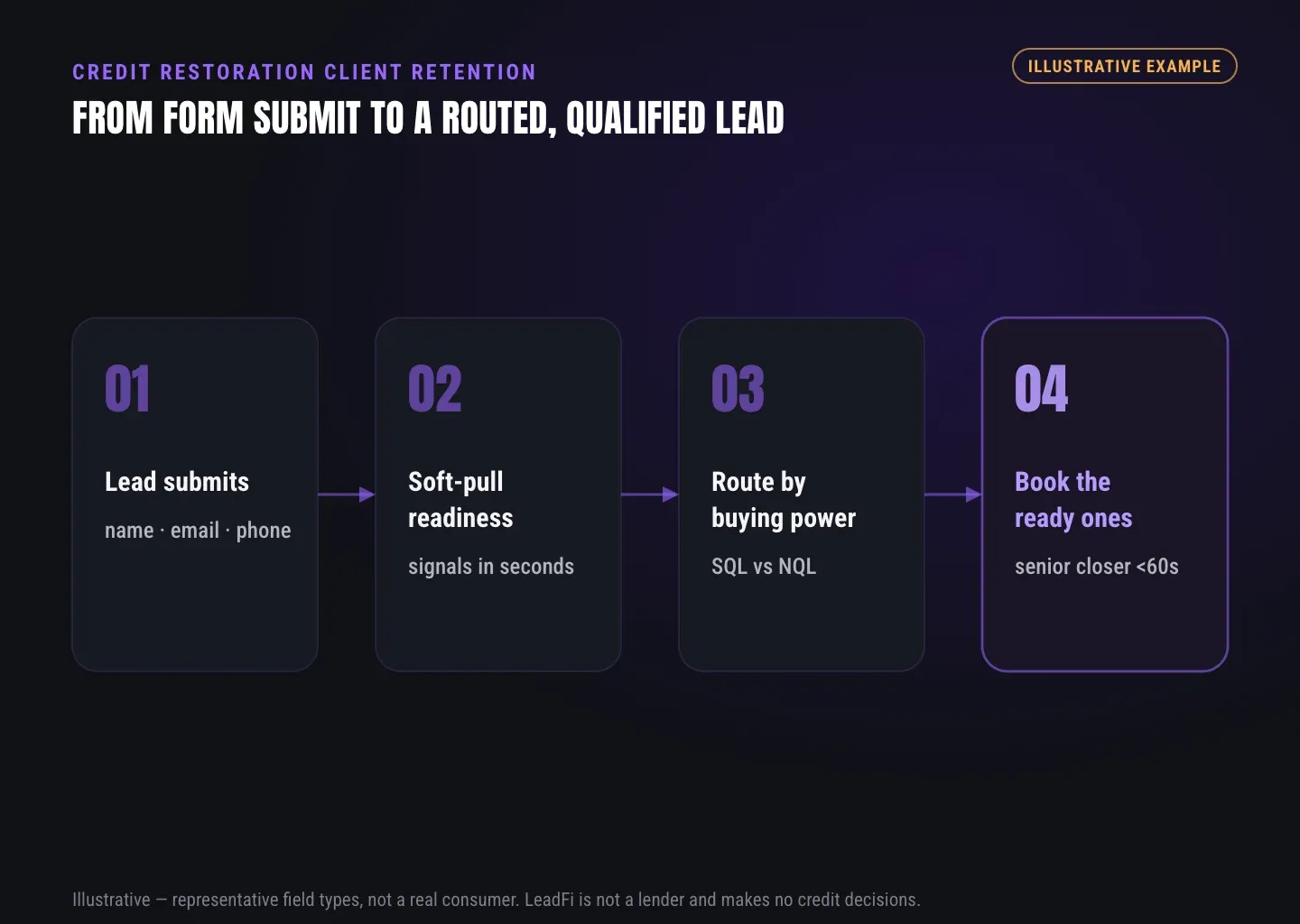
Credit restoration client retention is usually measured after enrollment, but useful cohort context can begin at intake. LeadFi adds a financial-readiness route behind an existing form, funnel, calendar, or CRM so a firm can carry the original route into group reporting.
Watch a contact get pre-qualified.
This is exactly what your CRM gets back.
Your opt-in form
Soft pull · no impact to their credit
This is not a real soft pull. It's an example of the data points that land in your CRM contact record when a lead fills out your form.
LEADFI DEMO
Watch the demo, then start free or book a call.
GUIDE
Cancellations can look the same in a monthly service
A cancellation report can compress different client stories into one status. One client may cite cost, while another may leave because of service fit, communication, timing, changed plans, or another recorded reason.
The intake readiness band adds cohort context, but it cannot identify why someone left. Some clients cancel for reasons unrelated to cost, and the readiness band cannot tell those exits apart from affordability exits on its own; the firm's own cancellation notes do that.
Cost pressure is only one possible reason
A lower readiness band should not be treated as the cause of a cancellation. It is an intake attribute that can be compared with the reason recorded by the firm. Correlation in a cohort report does not establish cause or predict what a named client will do.
Readiness describes capacity, not credit health
The firm defines financial fit against the service it sells and the threshold it sets for that offer. The band describes capacity to take on that offer at intake—not credit health, service eligibility, or the likely result of dispute rounds.
Cancellation notes explain the exit
Keep the intake route and stated cancellation reason in separate CRM fields. A short, consistent reason list can support service analysis without rewriting the client's stated explanation.
No result is its own reporting group
A record without a readiness result belongs in a separate no result group. It must not be counted as an NQL because a missing result does not establish financial fit or lack of fit.
One policy applies after enrollment
Once a client enrolls, the firm should apply one written policy to service, payment options, pauses, discounts, fee waivers, retention offers, and cancellation handling. The intake band should not change that treatment.
This page describes a routing input, not a credit decision, approval, or eligibility determination.
Cancellation records gain context from two fields
Cancellation notes describe the stated reason for leaving, while the original intake route supports group comparisons. Used together, they can inform offer and service-path reviews without ranking individual clients or changing their treatment.
INTELLIGENCE LAYER
Intake readiness bands belong on enrolled-client records
A retention report should use only the readiness result the business already holds from its own intake form, collected with its consent and disclosures and the lead's authorization. If the person enrolls, the original route can follow the record into cohort reporting.
Do not run a new check after enrollment for this analysis. Do not apply the workflow to open deals, past leads, or existing customers merely to create a report. The firm's intake and reporting choices should be confirmed with its counsel.
CRM records need one intake band
A CRM can store a single field such as Intake Readiness Route, with SQL, NQL, or no result as controlled values. The value should stay fixed after enrollment so later reports reflect what was known at intake.
Underlying figures should stay out of view
Setters, closers, service staff, and managers need only the readiness band or route. The workflow should not display, quote, or record the personal financial figures behind that result.
CRM handoffs should map the result
LeadFi can pass the route through a webhook, API, Zapier, Make, or a supported native workflow. Teams should test field mapping, route logic, consent and disclosures, access controls, and no-result handling before launch.
For related implementation context, see a closer look at soft credit check without address for lead qualification and a practical guide to iso broker crm readiness band.
Intake timestamps preserve the source
An intake timestamp distinguishes the original readiness route from later account activity. Enrollment, service start, account status, cancellation date, and stated reason should remain separate fields.
Unmatched records remain separate from NQLs
A no-result record means the workflow did not return a readiness band. An NQL means the returned route was below the firm's threshold for the offer. Keeping those states separate prevents missing results from distorting NQL reporting.
Retention reports should use the intake result
Retention reporting should use the fixed intake route, not a later financial check. The purpose is to compare original cohorts—not to monitor an enrolled client's finances or predict cancellation.
INTELLIGENCE LAYER
Monthly retention reports should compare readiness cohorts
Monthly reports can compare account status and stated cancellation reasons across original intake routes. They cannot prove that readiness caused an outcome or predict how long a named client will remain enrolled.
Cohort months need one fixed rule
Define a cohort using one event, such as enrollment month, and apply that rule consistently. Mixing intake, payment, and service-start months makes comparisons difficult to interpret.
Counts should come before percentages
Show the number of clients in each cohort before calculating shares. A small group can move sharply after one cancellation, so leaders need the underlying count to judge a pattern.
Time windows should stay consistent
Compare every cohort at the same checkpoints and use the same account-status and cancellation-reason definitions throughout the reporting period.
No-result groups need a separate line
Report no-result records independently. An increase may indicate an intake, identity-matching, field-mapping, or handoff issue, but it does not mean those clients were NQLs.
Stated reasons give readiness bands context
Place the original route beside the firm's cancellation-reason groups. The route supplies intake context; the notes record why clients said they left. Neither field should overwrite the other.
Person-level predictions do not belong in cohort reports
Group patterns should not become forecasts about individual clients. They also should not determine retention offers, pauses, discounts, fee waivers, or cancellation handling.
Sample size and missing notes affect the view
Show cohort size and the count of cancellations without a stated reason. Small groups and missing notes limit how confidently leaders can interpret a pattern.
Comparable services produce clearer findings
Filter reports by the service sold, enrollment period, and standard service path when practical. This creates more comparable groups while leaving the original readiness route unchanged.
For broader intake measurement principles, review a closer look at marketing lead qualification.
Monthly reports need only a few fields
A focused report can use:
- Cohort month: The month the client enrolled.
- Service path: The offer selected under the firm's standard policy.
- Intake route: SQL, NQL, or no result.
- Client count: Number enrolled in the cohort.
- Active count: Number active on the review date.
- Cancellation count: Number with a recorded cancellation.
- Cancellation reason: The firm's own reason group.
- Missing-note count: Cancellations without a stated reason.
These fields support cohort review without exposing personal financial figures or turning the report into a person-level prediction.
See which of the leads you already have can actually afford to buy.
GUIDE
New enquirers need a service path they can sustain
Credit restoration client retention begins with a clear intake path, but a readiness route must not become different treatment after enrollment. LeadFi qualifies existing inbound enquiries; it does not generate or buy leads, approve or deny consumers, or predict service outcomes.
Main-offer thresholds define financial fit
The operator sets the threshold for the specific service it sells. An SQL is financially fit to buy that offer. The label is not a judgment about the person's credit file and says nothing about the likely result of the service.
NQL paths should fit financial capability
An NQL is not financially fit to buy the main offer. The route can present a lower-ticket offer or product that fits the buyer's financial capability, and the enquirer remains free to choose among options offered under the firm's standard policy.
Payment policy should remain separate
The route should not determine payment plans, installment terms, deposits, discounts, or third-party financing. Those options should follow one written policy applied to every buyer. The firm should confirm its workflow with counsel.
SQL routing can start while interest is current
An SQL route can send an existing inbound enquiry to the main calendar or sales queue while updating a CRM field, tag, stage, or automation. LeadFi supports speed-to-lead workflows but does not guarantee response, sales, or retention outcomes.
NQL routing should provide a useful next step
An NQL route should not be a dead end or a refusal of service. It can direct the enquirer to a lower-ticket offer or product suited to the buyer's financial capability without stating that the person cannot afford the main service.
Marketing teams can use route quality signals
Where the setup supports it, route-level events can feed Meta, Google, TikTok, Hyros, CRM workflows, or operations systems. These signals can help teams optimize around lead quality rather than form volume, without any platform-performance guarantee.
Forms, CRMs, and calendars should align
The intake form collects the submission under the firm's consent and disclosures. LeadFi returns the route, the CRM stores only that route, and the funnel or calendar presents the configured next step.
Compliance-aware launches start before go-live
LeadFi helps teams plan privacy and consent language, TCPA-aware practices, and FCRA-aware workflows. LeadFi supports compliance-aware workflows but does not provide legal advice or guarantee compliance. Clients should review their use case with counsel.
Soft pulls support the workflow, not the pitch
Soft-pull qualification can support the readiness route when configured with the firm's consent and disclosures. The commercial value is buying-power-aware SQL/NQL routing, clean CRM handoffs, lower-ticket NQL paths, cohort reporting, and route-level marketing feedback—not generic credit-check plumbing.
Workflow fit depends on the firm's sales model
This model is designed for firms that already capture inbound enquiries, sell a defined main service, and have a lower-ticket path that can fit a different level of financial capability. It is especially relevant when consultation time is expensive and the team needs a consistent intake route.
LeadFi capabilities support intake and reporting
LeadFi sits behind the firm's existing form, funnel, calendar, and CRM. It can classify existing inbound enquiries by financial readiness, route SQLs and NQLs, preserve no-result records as a separate group, pass route-level events through supported integrations, and carry the original route into cohort reports.
Related reading: a closer look at soft credit check without address for lead qualification, a practical guide to iso broker crm readiness band, a closer look at marketing lead qualification.
| Reporting view | What it shows | What it does not show | Best use |
|---|---|---|---|
| Cancellation status only | Whether an account is active or canceled | Why the client left or the intake route | Basic account counts |
| Cancellation reason only | The reason recorded by the firm | The readiness route at intake | Service and experience review |
| Reason plus intake route | The stated reason and original cohort | Proof that readiness caused the exit | Cohort and service-path review |
| No-result cohort | Records without a readiness result | Whether those clients were SQLs or NQLs | Intake and workflow review |
Key takeaways
The short version
- Define SQL and NQL against the firm's specific offer threshold.
- Store only the intake readiness route, not underlying figures.
- Keep no-result records separate from NQL cohorts.
- Use cancellation notes to explain stated exit reasons.
- Apply one written policy to every enrolled client.
Quick answers
Fast answers before you dig in
How does intake support credit restoration client retention?
The original intake route gives firms a stable cohort field to compare with later account status and stated cancellation reasons. It adds context but does not predict or explain an individual cancellation.
What do SQL and NQL mean for a credit restoration firm?
An SQL is financially fit to buy the firm's specific offer at its set threshold. An NQL is not financially fit to buy that offer and can be routed to a lower-ticket option fitting the buyer's financial capability.
Should firms run another check after enrollment for retention reporting?
No. This workflow uses only the readiness route already created from the firm's intake form with its consent and disclosures and the lead's authorization.
Can a readiness band identify why a client canceled?
No. The readiness band provides intake context, while the firm's own cancellation notes record the stated reason. Some clients leave for reasons unrelated to cost.
FAQ
Common questions
What is credit restoration client retention?
Can financial-readiness qualification predict cancellations?
How can a readiness band support credit restoration client retention?
What causes credit restoration client cancellations?
What do SQL and NQL mean in this workflow?
Should a firm rerun a soft pull after enrollment?
Does LeadFi approve or deny credit restoration clients?
Sources
References
- CFPB — What is a credit inquiry? (hard vs. soft) (opens in a new tab)Federal regulator confirms a soft inquiry, unlike a hard inquiry, does not affect the consumer's credit score.
- VantageScore — VantageScore 4.0 credit scoring model (opens in a new tab)Official page describing VantageScore 4.0, the tri-bureau, trended-data model used to assess credit risk.
- Experian — What Is a Soft Inquiry? (opens in a new tab)Major credit bureau explains soft inquiries are informational and have no impact on credit scores.
Know who is ready before your next sales call.
See how LeadFi can place an SQL, NQL, or no-result route behind your existing form, funnel, calendar, or CRM—and carry that route into clean cohort reporting. Request a soft demo or workflow assessment for your credit restoration intake.