
SOFT CREDIT PULL VS DATA ENRICHMENT
Soft Credit Pull vs Data Enrichment: What’s the Difference?
The key difference in soft credit pull vs data enrichment is the question each process answers. Standard enrichment adds identity, contact, company, or behavioral context.
Watch a contact get pre-qualified.
This is exactly what your CRM gets back.
Your opt-in form
Soft pull · no impact to their credit
This is not a real soft pull. It's an example of the data points that land in your CRM contact record when a lead fills out your form.
LEADFI DEMO
Watch the demo, then start free or book a call.
INTELLIGENCE LAYER
Standard enrichment adds contact and company data
Standard data enrichment starts with a limited lead or account record and adds available fields. Those fields may include a work email, phone number, role, location, company size, industry, revenue band, or software stack.
Contact and identity data complete the record
Contact enrichment can fill missing channels and support record matching. Identity-related information and identity signals, such as current address or age where available, may also help establish that submitted details correspond to the correct person.
Field definitions, freshness, match confidence, sources, and allowed uses vary. Teams should review those details before making enriched fields part of sales rules.
Firmographic and technographic data describe account fit
Firmographic data helps answer whether a company matches an ideal customer profile. Technographic data can indicate which tools appear within an account’s stack. These signals are useful for territory assignment, account scoring, outreach, and rep preparation.
They answer a different question from personal financial readiness. A company may fit by industry and size while its owner needs a different offer or payment path.
Intent and self-reported data add context
Intent data can indicate research activity, repeat site visits, webinar engagement, or pricing-page behavior. Forms may also collect stated budget, income, available capital, or purchase timing.
These fields can show interest and stated circumstances, but they should not automatically be treated as verified buying power. They work best as inputs within a broader qualification model.
Enrichment improves rep preparation
Enrichment can give a rep useful context about the lead’s company, role, source, campaign, and stated goal. It is especially valuable for B2B account scoring and account-based sales.
When personal buying power changes sales priority or the next offer, the team may need a separate financial-readiness layer.
INTELLIGENCE LAYER
Soft pulls can add financial-readiness signals
A soft-pull workflow can return supported credit-related and financial signals through a configured process. Its treatment differs from a hard-application inquiry, but teams should confirm the actual product configuration and consumer-facing wording before launch.
Depending on availability and setup, LeadFi workflows may surface signals such as VantageScore 4.0, available credit, income, debt, debt-to-income ratio, funding pre-approval signals, current address, and age. Optional liquid asset, retirement, brokerage, real-estate, or net-worth-style context may be available for supported uses.
LeadFi does not approve or deny consumers. These signals are framed as inputs for routing and rep preparation rather than promises of affordability, funding, approval, or sales outcomes.
Multiple signals provide better readiness context
A score alone offers limited context. Two leads with similar scores may have different income, debt, available credit, or other relevant circumstances. A readiness model can consider several supported signals alongside source, offer type, and stated intent.
Available credit is also not proof that a purchase is affordable or suitable. It should be handled as one routing input within a reviewed workflow.
Identity matching supports thin-input workflows
LeadFi can work from name, email, and phone for many workflows. Its patent-pending identity matching is designed to establish a high-confidence match before soft-pull prescreening and, where applicable, deeper bureau-backed credit-report workflows.
Identity-related information and identity signals may support the match. Certain implementations can therefore avoid requesting address and date of birth at the first form step, although additional information may still be required by the use case or integration.
For implementation details, see a closer look at soft credit pull software for lead generation and a closer look at soft pull prequalification tools.
Readiness models connect signals to actions
A useful model maps each result to a defined action. An SQL might receive faster follow-up, a priority CRM stage, or an appropriate calendar. An NQL might enter nurture, receive a lower-ticket offer, or follow another reviewed path.
The labels support workflow segmentation; they are not judgments of personal worth or consumer approval decisions.
Financial signals require reviewed handling
Soft-pull and sensitive-data workflows require suitable consent and disclosures, privacy practices, access controls, and use-case review. LeadFi supports compliance-aware workflows and onboarding guidance, but it does not provide legal advice or guarantee compliance. Clients should review their use case with counsel.
INTELLIGENCE LAYER
Enrichment vs credit signals: When you need each
Choose standard enrichment when the primary gap involves contact, identity, account, company, or behavioral context. Consider a configured soft-pull workflow when supported financial-readiness signals will change lead priority, rep preparation, routing, or the next offer.
Many high-ticket businesses need both layers. Enrichment helps establish who the lead is and whether the account fits. Financial-readiness qualification can then help determine what should happen next.
Use enrichment for identity and account gaps
B2B enrichment is often the core need for SaaS, enterprise services, and account-based teams. Company size, industry, region, role, and technology can drive account fit without introducing personal financial data.
Use readiness signals when the next step changes
Financial-readiness qualification may be relevant when sales calls are expensive, personal buying power matters to the offer, or lower-readiness leads can receive a useful alternate path. This can apply to certain coaching, consulting, course, agency, funding, mortgage, insurance, real-estate, and auto-related workflows after appropriate review.
Combine both for mixed qualification models
An owner-led business may need to fit the company profile while the individual also needs an appropriate sales or payment route. A mixed model can combine company fit, identity confidence, stated intent, and supported financial signals without treating any one field as definitive.
For another comparison of interest and capacity signals, read a closer look at buying power data vs intent data.
Compare the roles in your sales stack
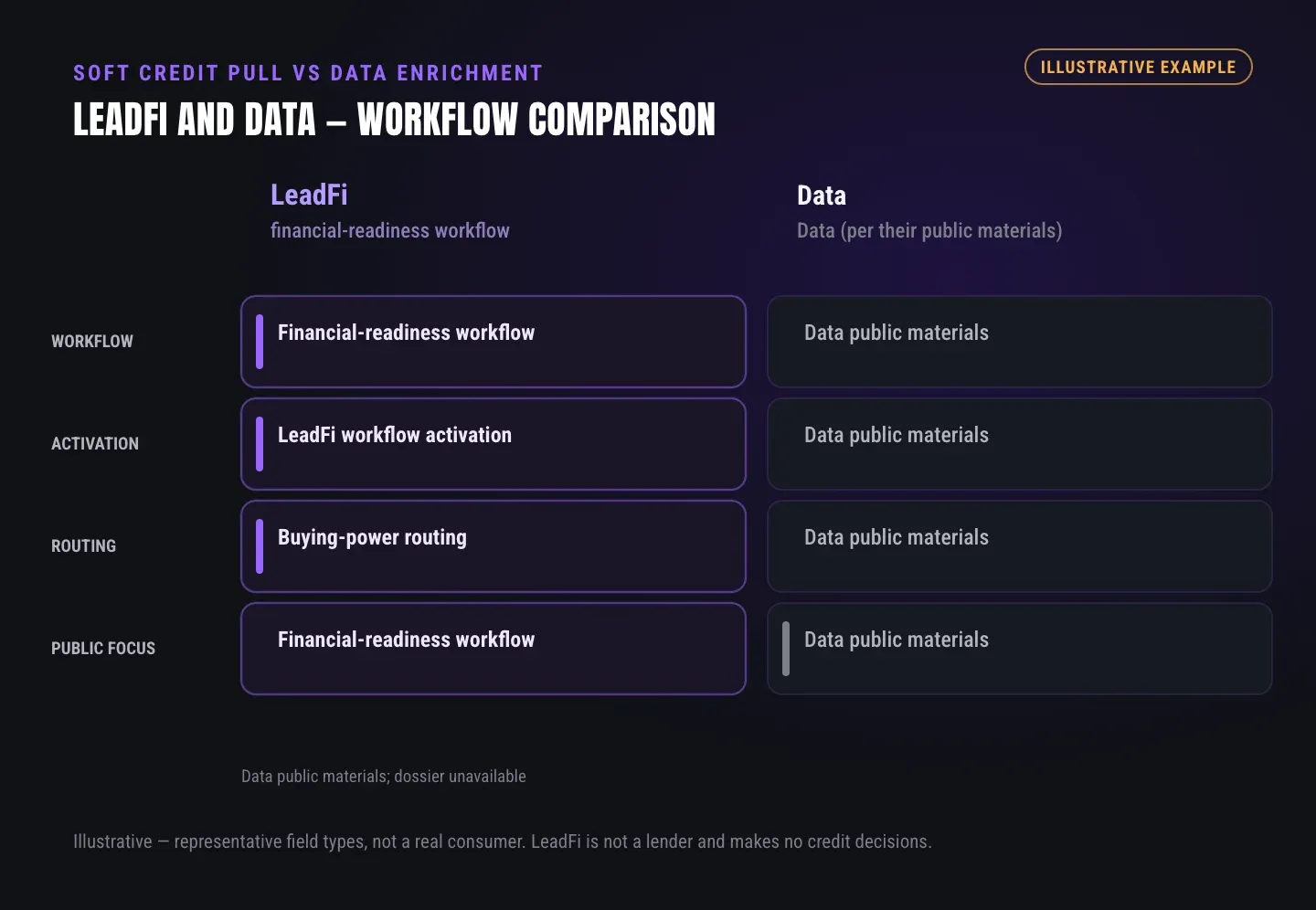
The practical distinction is record context versus readiness-based action. Actual fields, matching behavior, inquiry treatment, and downstream options depend on the provider and configured workflow.
See which of the leads you already have can actually afford to buy.
INTELLIGENCE LAYER
LeadFi turns readiness signals into sales actions
LeadFi is a financial-readiness engine for high-ticket businesses—not merely a data-add or generic soft-check utility. It sits behind forms, funnels, calendars, and CRMs to qualify, route, monetize, and optimize leads using configured buying-power signals.
SQL routing supports speed-to-lead
When a lead meets the client’s reviewed SQL rules, LeadFi can update a CRM field, set a stage or tag, trigger an alert, or direct the lead toward an appropriate calendar or page. This helps sales teams prioritize financially qualified leads while interest is fresh.
NQL routing keeps value in the funnel
An NQL does not need to become a dead end. The lead can enter nurture, see a lower-ticket offer, receive education, or follow another suitable route. Readiness can change, so the classification need not be permanent.
CRM and automation integrations operationalize the result
LeadFi can connect with CRMs and workflow tools through webhook, API, Zapier, Make, or supported native integrations. Results can populate fields, tags, stages, alerts, owner assignments, redirects, and follow-up sequences while reps remain in their existing system.
Quality signals can improve campaign analysis
Where platform rules and the client’s setup allow, financially qualified lead events can feed into Meta, Google, TikTok, Hyros, and related operations or reporting stacks. Teams can then compare lead sources by SQL quality alongside cost per lead, booking rate, show rate, and close rate.
These feedback signals support testing and analysis; they do not guarantee platform performance or campaign results.
Compliance-aware setup happens before launch
LeadFi helps teams plan privacy policy language, consent language, TCPA-aware practices, and FCRA-aware workflow choices before launch. LeadFi does not provide legal advice, replace counsel, approve or deny consumers, or remove consent and disclosures obligations.
Related reading: a closer look at soft credit pull software for lead generation, a closer look at buying power data vs intent data, a closer look at soft pull prequalification tools.
| Comparison point | Standard data enrichment | Soft credit pull | LeadFi readiness workflow |
|---|---|---|---|
| Main question | Who is this lead or company? | Which supported credit-related signals are available? | What reviewed next step fits the readiness result? |
| Common inputs | Email, phone, domain, or company name | Matched identity data within the configured flow | Name, email, and phone for many workflows |
| Common outputs | Contact, role, company, industry, location, or behavior | Supported score, credit, debt, or related fields | Readiness signals, SQL/NQL status, and routing actions |
| Primary use | Record completion and account fit | Financial context for a defined workflow | Qualification, rep preparation, routing, and feedback |
| Financial depth | Varies by provider and dataset | Varies by product and configuration | May combine score, available credit, income, debt, and DTI |
| Identity role | Adds or verifies available record details | Relies on configured identity matching | Uses patent-pending matching before applicable prescreening |
| Credit-score treatment | Determined by the source and workflow | Structured as a soft-inquiry workflow rather than a hard-application inquiry | Uses configured soft-pull signals where applicable |
| CRM action | Writes enriched fields to the record | Returns configured credit-related fields or results | Can set fields, tags, stages, alerts, and workflows |
| Routing role | Supplies data to separate rules | Supplies inputs to client-defined rules | Supports SQL and NQL routing paths |
| Ad feedback | Supports available audience or account events | Depends on provider, platform, and setup | Can send allowed readiness events where supported |
| Consumer decision | Depends on the client’s application of the data | Depends on the client’s reviewed workflow | LeadFi does not approve or deny consumers |
| Setup focus | Sources, definitions, freshness, and match rate | Identity, data configuration, consent and disclosures | Data, routing, integrations, and compliance-aware onboarding |
Key takeaways
The short version
- Enrichment adds identity and account context; soft pulls add supported readiness signals.
- LeadFi can begin with name, email, and phone in many workflows.
- Patent-pending identity matching supports high-confidence matching before applicable prescreening.
- SQLs can receive priority follow-up while NQLs enter nurture or alternate paths.
- LeadFi supports compliance-aware setup but does not approve or deny consumers.
Quick answers
Fast answers before you dig in
What is the difference between a soft credit pull vs data enrichment?
Data enrichment adds identity, contact, company, or behavioral fields. A configured soft credit pull can add supported credit-related and financial-readiness signals. Enrichment improves record context; readiness signals can inform SQL/NQL routing and rep preparation.
When should a high-ticket team use both?
Use both when company or identity fit matters and buying-power readiness changes sales priority, calendar access, nurture, or the next offer. Each field should connect to a defined business action.
Can LeadFi start with thin inputs?
LeadFi can work from name, email, and phone for many workflows. Patent-pending identity matching is designed to establish a high-confidence match before applicable soft-pull prescreening, subject to setup, consent and disclosures, and use-case requirements.
What happens after LeadFi qualifies a lead?
LeadFi can return an SQL or NQL status, update CRM fields, trigger alerts or workflows, select a reviewed calendar or offer path, and provide allowed quality signals to marketing systems.
FAQ
Common questions
What is the main difference between a soft credit pull vs data enrichment?
Is B2B data enrichment the same as credit-based lead scoring?
Does a soft credit pull affect a consumer’s credit score?
Can LeadFi support soft-pull prescreening from name, email, and phone?
How does LeadFi handle SQL vs NQL routing?
Can LeadFi send readiness signals to a CRM or ad platform?
Sources
References
- CFPB — What is a credit inquiry? (hard vs. soft) (opens in a new tab)Federal regulator confirms a soft inquiry, unlike a hard inquiry, does not affect the consumer's credit score.
- VantageScore — VantageScore 4.0 credit scoring model (opens in a new tab)Official page describing VantageScore 4.0, the tri-bureau, trended-data model used to assess credit risk.
- CFPB — Who can request to see my credit report? (opens in a new tab)Federal regulator explains the FCRA rules governing who may obtain a credit report.
- Consumer Financial Protection Bureau: What is a credit inquiry? (opens in a new tab)General background on credit inquiries and the distinction between inquiry types.
- VantageScore (opens in a new tab)Official information about VantageScore credit-scoring models.
Know who is ready before your next sales call.
Standard enrichment can improve the record. LeadFi adds a financial-readiness layer that can connect supported buying-power signals with SQL/NQL routing, CRM actions, rep alerts, alternate offers, and marketing feedback.