
BUYING POWER DATA VS INTENT DATA
Buying-Power Data vs Intent Data: What Each Tells You
The difference between buying power data vs intent data begins with the question each answers. Intent data identifies behavior that may signal interest. Buying-power data surfaces financial-readiness signals that can help determine an appropriate post-capture route.
Watch a contact get pre-qualified.
This is exactly what your CRM gets back.
Your opt-in form
Soft pull · no impact to their credit
This is not a real soft pull. It's an example of the data points that land in your CRM contact record when a lead fills out your form.
LEADFI DEMO
Watch the demo, then start free or book a call.
GUIDE
What intent data shows
Intent data captures actions that may point to research or demand. Common signals include page views, video watch time, email clicks, searches, webinar attendance, downloads, and form completion.
Engagement shows active attention
A pricing-page visit or completed application can prompt timely outreach. These actions indicate attention, but financial position remains a separate qualification dimension.
Topic interest shows the current need
Content activity can reveal what a lead wants to solve. A mortgage prospect researching refinancing may need a different message from someone reading first-time buyer material.
Recency shows when interest peaked
Recent behavior often deserves more weight than older activity. A form submission today may trigger a sales task, while a guide downloaded months ago may remain in nurture.
Frequency shows depth of research
Repeated visits can suggest a more active buying process, although frequency needs context. Research, support needs, job seeking, and other behavior can create similar activity patterns.
Fit data sharpens the intent score
Teams often combine intent with stated or firmographic fit, including industry, role, company size, location, use case, and budget range. This helps prioritize leads that match the offer and show recent activity.
Source data shows where demand began
Campaign, keyword, page, and event data connect engagement to its source. Sales and media teams can use that context to adjust messages and follow-up timing.
Concise answer: Intent data helps show who may be interested, what they are researching, and when engagement increased. It is useful for timing and message selection, while financial readiness requires a separate signal set.
Example: Intent triggers fast follow-up
A prospect visits a consulting firm's pricing page twice, watches most of a webinar, and submits an application for a $7,500 program. The CRM raises the intent score and creates a rapid follow-up task.
Example: Weak intent enters nurture
Another prospect downloads one guide and takes no further action. The CRM records the topic and starts a short educational sequence rather than routing the lead directly to a closer.
GUIDE
What buying-power data shows
Buying-power data provides a financial-readiness view after a known lead submits. With the appropriate setup, consent and disclosures, teams can use selected signals to classify leads, prepare reps, and trigger predefined routes.
Available credit shows payment context
Available credit may provide context for a credit-based payment conversation. It works best within a broader readiness profile rather than as a standalone rule.
Income shows one part of capacity
Income can help frame affordability for recurring or high-ticket costs. Debt, available credit, and other obligations provide additional context.
Debt shows existing obligations
Debt signals can indicate existing financial commitments. They should support a respectful operational route, such as a different offer or nurture period, rather than a judgment about the person.
DTI shows income-to-debt balance
Debt-to-income ratio compares debt obligations with income. Two leads with similar income may have different DTI profiles and therefore enter different routes under the business's reviewed rules.
Credit signals add readiness context
VantageScore 4.0 may be available when the configuration, consent and disclosures support its use. It can contribute to financial-readiness qualification and routing but should not be treated as the full picture.
Asset context supports select offers
Depending on availability and the use case, optional context may include liquid assets, retirement accounts, brokerage holdings, real estate, or net-worth-style signals. Data selection should be limited to what the workflow actually needs.
Concise answer: Buying-power data may include credit, available credit, income, debt, DTI, funding pre-approval signals, and optional asset context. Businesses can map these signals to sales, nurture, alternate-offer, or follow-up routes.
Buying power is not purchase intent
A lead may appear financially ready without actively researching an offer. An engaged lead may also need additional education, time, or a different path. Readiness and intent therefore represent complementary dimensions.
Buying power is not an approval decision
Financial-readiness data supports classification, routing, and rep preparation. LeadFi does not approve or deny consumers; the client controls its sales process and subsequent consumer decisions.
GUIDE
Buying-power data vs intent data compared
A practical comparison focuses on the business question each data type answers. Intent supports demand timing and message relevance. Buying power supports readiness-based qualification and post-capture routing.
Neither data type is a complete picture by itself. High-ticket teams can retain separate intent, fit, and readiness fields instead of compressing every signal into one opaque score.
Quick answer: Intent data helps identify signs of active interest. Buying-power data helps select an appropriate route based on financial-readiness signals. Their value comes from assigning each data type a defined operational role.
GUIDE
Why teams layer both
Layering both data types helps a team answer two linked questions: Does this lead appear interested, and which next step fits the current readiness profile?
For related workflow design, see practical insights on sql vs nql lead routing by financial readiness, practical insights on buying power data for lead qualification, and practical insights on a financial readiness layer for Clearbit enrichment.
Intent sets sales timing
Recent form submissions, pricing visits, or webinar activity can trigger prompt outreach while attention is elevated.
Readiness selects the next path
Readiness rules can direct a lead to a closer, setter, main calendar, custom page, nurture sequence, lower-ticket product, or alternate offer. Intent can then shape the message within that route.
CRM fields keep the logic visible
Teams can store source, intent score, SQL/NQL status, readiness tier, owner, and route in separate CRM fields. Those fields can drive stages, tasks, tags, alerts, and follow-up workflows.
SQL/NQL routing protects sales time
In this context, SQL means Sales-Qualified Lead for the primary sales path. NQL means Non-Qualified Lead for that path under the business's current rules. These labels determine workflow treatment; they are not judgments of personal worth.
NQL paths preserve future value
An NQL can enter nurture, receive a lower-ticket option, explore another offer, or receive a later follow-up. New engagement or changed circumstances may lead to a different route over time.
Ad loops add a lead-quality signal
Where platform policies and the approved setup allow, SQL-quality or readiness events can feed Meta, Google, TikTok, Hyros, analytics, and operations workflows. Performance varies with event design, data volume, match quality, campaign configuration, and sales execution.
Concise answer: Intent can trigger timely outreach, while readiness can determine the rep, calendar, stage, offer, or nurture path. CRM and approved advertising workflows can carry those results into later actions.
Layering avoids one-score thinking
High intent with stronger readiness may trigger priority outreach. High intent with a developing readiness profile may call for education or an alternate offer. Lower intent with stronger readiness may remain in targeted nurture until demand increases.
GUIDE
Is buying-power data an intent data alternative?
Buying-power data can serve as an intent data alternative when the operational need is readiness-based qualification rather than behavioral demand discovery. The concepts are not interchangeable, however, because each describes a different part of the buying journey.
Use intent for demand discovery
Intent works across the top and middle of the funnel. It helps marketing and sales identify active topics, audiences, accounts, and moments for outreach or retargeting.
Use readiness for post-capture action
Financial readiness becomes relevant after a known lead submits identity and contact details. It can help classify the record and trigger the next approved workflow step.
Use both for high-ticket routing
High-ticket teams often have expensive sales calls, multiple offers, payment conversations, or long buying cycles. Keeping intent and readiness distinct lets the team use behavior for timing and financial context for routing.
Quick answer: Buying-power data may replace an intent score only when the actual job is financial-readiness qualification. When demand discovery and post-capture routing both matter, using both data types is usually the clearer model.
See which of the leads you already have can actually afford to buy.
GUIDE
Where LeadFi fits
LeadFi is a financial-readiness engine for high-ticket and credit-adjacent businesses. It sits behind forms, funnels, calendars, and CRMs to enrich submitted leads and return actionable routing results.
LeadFi is not positioned as generic soft-credit-check plumbing. Its role is to help teams qualify, route, monetize, and optimize leads using buying-power signals alongside their existing intent, source, and fit data.
Thin inputs reduce form friction
LeadFi can work from name, email, and phone for many workflows. Patent-pending identity matching is designed to establish a high-confidence match before soft-pull prescreening and, where applicable, deeper bureau-backed credit-report workflows.
Some configurations may not require address and date of birth at the initial step. The central benefit is financial-readiness qualification and routing, not merely removing fields.
Permissioned signals inform readiness
Depending on the configuration, consent and disclosures, signals may include VantageScore 4.0, available credit, income, debt, DTI, funding pre-approval signals, current address, age, and optional asset or net-worth-style context.
These are readiness inputs for routing and rep preparation. LeadFi does not approve or deny consumers.
SQL status drives speed-to-lead
An SQL result can create a priority task, assign an owner, send an alert, update a stage, or open an appropriate calendar path. This helps reps focus quickly when both engagement and the configured readiness rules indicate a priority route.
NQL status starts another journey
An NQL can enter nurture, a lower-ticket offer, a custom page, or a later follow-up. The lead remains in a relevant journey without sending every submission to the same calendar.
CRM outcomes remain actionable
LeadFi can connect through webhook, API, Zapier, Make, or a supported native workflow. Results can update CRM fields, tags, stages, redirects, assignments, tasks, and alerts.
Ad signals reflect lead quality
Where allowed and configured appropriately, financially qualified lead signals can return to Meta, Google, TikTok, Hyros, or related analytics systems. These events provide another input for reporting and campaign testing without promising platform outcomes.
Concise answer: LeadFi adds financial-readiness qualification after lead submission and returns SQL/NQL status, selected signals, and routing outputs to the existing sales and marketing stack.
GUIDE
LeadFi capability flow
A LeadFi implementation starts with the business action the team wants to improve, such as closer priority, calendar quality, NQL monetization, or qualified-lead measurement.
Capture the lead event
A form, application, landing page, booking flow, or CRM action captures name, email, phone, source, campaign, and relevant stated answers. The customer-facing language should align with the planned workflow.
Match the submitted identity
LeadFi's patent-pending identity matching uses identity signals to support a high-confidence match. Identity-related information may include current address or age when available.
The configured workflow can then proceed to soft-pull prescreening. An applicable LeadFi soft pull is designed not to affect the consumer's credit score, subject to the actual configuration and required consent and disclosures.
Classify financial readiness
LeadFi applies the client's configured rules to available signals. Outputs may include SQL/NQL status, a readiness tier, selected rep context, and CRM fields. Rules can vary by offer or campaign.
Route the next action
The result can update a stage, assign a rep, send an alert, select a calendar, trigger a redirect, or start a nurture or alternate-offer workflow.
Return quality signals
Where the setup and platform rules allow, a readiness or SQL-quality event can return to analytics or advertising systems. Teams can then compare submitted-lead volume with qualified-lead volume by source and campaign.
GUIDE
Who buying-power qualification is for
Buying-power qualification is most relevant when sales calls are costly, offers have multiple paths, or the team needs more financial context after capture. Typical offer values range from roughly $1,000 to $10,000 or more, although sales complexity matters as much as price.
Coaches and course teams
Intent can show which prospects watched, clicked, or applied. Readiness can help route submitted leads to a closer, education, community, nurture, or a lower-ticket path.
Agencies and sales firms
Agencies can combine source and campaign data with an SQL/NQL or buyer-fit tag. Role-based access can keep detailed financial fields limited to users who need them.
Funding and lending teams
Credit-adjacent teams may use credit, income, debt, DTI, and funding pre-approval signals where the configuration supports them. LeadFi provides qualification and routing inputs rather than making later consumer decisions.
Mortgage and real estate teams
Intent may reflect listing views, calculator use, or form activity. Readiness can help inform rep assignment, follow-up pace, or an education path within a reviewed workflow.
Insurance and auto teams
Selected readiness or asset context can prepare a representative for the next conversation. The signal set should match the specific offer and approved operational need.
High-ticket local businesses
Dental, elective care, roofing, solar, and similar businesses can pair service interest with readiness-based routes. The workflow should remain respectful and connected to the service the lead requested.
WORKFLOW DESIGN
Compliance-aware setup before launch
Buying-power workflows should begin with a defined use case, a limited signal set, clear routing rules, and a documented view of who can access each result.
LeadFi supports compliance-aware workflows and can help teams consider privacy policy language, consent language, TCPA-aware practices, and FCRA-aware workflow choices. LeadFi does not provide legal advice, and clients should review their use case with counsel.
Consent matches the actual workflow
Customer-facing forms, privacy language, CRM notes, and follow-up should describe a consistent process. Consent and disclosures remain part of the implementation.
Access matches the team's need
Not every user needs every financial field. A setter may need only SQL/NQL status and a route, while selected rep context can be limited to authorized roles.
Routing treats readiness with dignity
Financial readiness is an operational classification, not a moral grade. Leads outside the primary route should receive a useful next step without shaming or demeaning language.
Review happens before traffic starts
Before launch, teams should test payloads, field mapping, access controls, CRM stages, redirects, messages, retention choices, and the resulting buyer experience. Counsel can review the specific use case and customer-facing language.
Related reading: practical insights on sql vs nql lead routing by financial readiness, practical insights on buying power data for lead qualification, practical insights on a financial readiness layer for Clearbit enrichment.
| Comparison point | Intent data | Buying-power data |
|---|---|---|
| Core question | Who may be interested now? | Which next step fits the readiness profile? |
| Common signals | Visits, clicks, searches, downloads, forms, and webinar activity | Available credit, income, debt, DTI, credit signals, and optional asset context |
| Primary use | Timing, topic selection, and engagement scoring | Qualification, routing, offer paths, and rep preparation |
| Typical source | Website, email, CRM, ads, events, and external activity | A configured financial-readiness workflow with consent and disclosures |
| CRM action | Raise a score, create a task, or start a sequence | Set SQL/NQL status, update a stage, or trigger a route |
| Sales action | Follow up while attention is elevated | Select a rep, calendar, nurture flow, or alternate offer |
| Interpretation | Treat behavior as a sign of possible demand | Treat readiness as an operational routing input |
| LeadFi role | Accepts intent and source fields from the existing stack | Adds readiness signals and routing results after submission |
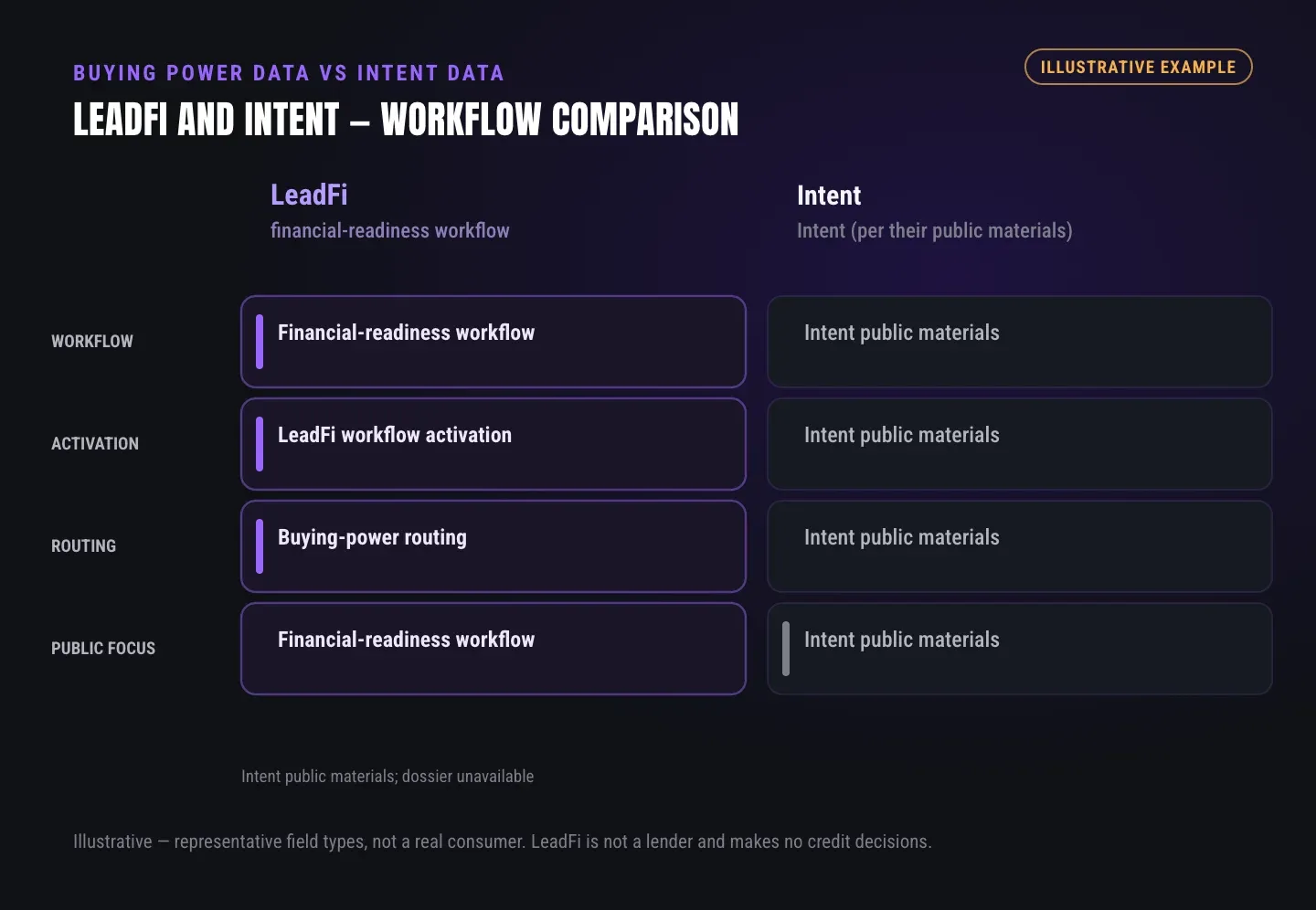
Key takeaways
The short version
- Intent data signals interest, timing, topics, and engagement.
- Buying-power data adds financial-readiness context after capture.
- SQL/NQL rules can trigger distinct sales, nurture, or offer paths.
- LeadFi can start with name, email, and phone in many workflows.
- Consent, disclosures, access controls, and legal review still apply.
Quick answers
Fast answers before you dig in
What is the difference between buying power data vs intent data?
Intent data reflects behavior that may indicate interest. Buying-power data reflects financial-readiness signals that can inform qualification, routing, and rep preparation after capture.
Is buying-power data an intent data alternative?
It can be an alternative when the job is readiness-based qualification rather than demand discovery. High-ticket teams often use both because they answer different questions.
How do buying-power and intent data support SQL vs NQL routing?
Intent can determine follow-up timing and message relevance, while configured readiness rules can assign SQL/NQL status and trigger a sales, nurture, alternate-offer, or later follow-up route.
What inputs can LeadFi use for financial-readiness qualification?
LeadFi can work from name, email, and phone for many thin-input workflows. Available outputs depend on the configuration, identity match, consent and disclosures, and applicable data availability.
Does LeadFi approve or deny consumers?
No. LeadFi provides financial-readiness signals and workflow results for qualification, routing, and rep preparation. The client controls its sales process and later consumer decisions.
FAQ
Common questions
What is the main difference between buying power data vs intent data?
Is buying-power data an intent data alternative?
What does financial readiness vs intent mean?
How does buying-power data support SQL vs NQL routing?
Can LeadFi use name, email, and phone?
Does a LeadFi soft pull affect a credit score?
How can buying-power and intent signals reach a CRM or ad platform?
Sources
References
- CFPB — What is a credit inquiry? (hard vs. soft) (opens in a new tab)Federal regulator confirms a soft inquiry, unlike a hard inquiry, does not affect the consumer's credit score.
- VantageScore — VantageScore 4.0 credit scoring model (opens in a new tab)Official page describing VantageScore 4.0, the tri-bureau, trended-data model used to assess credit risk.
- Experian — What Is a Soft Inquiry? (opens in a new tab)Major credit bureau explains soft inquiries are informational and have no impact on credit scores.
Know who is ready before your next sales call.
Intent data can help identify active demand. Buying-power data can help determine how submitted leads move through a high-ticket funnel.