
SHOW PRICE BEFORE SALES CALL
Should You Show Pricing on Your Website or Save It for the Sales Call?
Should you show pricing on your website? For a high-ticket offer, the answer depends on what the price must accomplish before the sales call. A visible price sets expectations and supports self-selection.
Watch a contact get pre-qualified.
This is exactly what your CRM gets back.
Your opt-in form
Soft pull · no impact to their credit
This is not a real soft pull. It's an example of the data points that land in your CRM contact record when a lead fills out your form.
LEADFI DEMO
Watch the demo, then start free or book a call.
GUIDE
What a visible price filters and what it scares off
Quick answer: Show the price when the offer is standardized, its value is understandable before a conversation, and most buyers receive the same package. Consider hiding or partially showing it when legitimate scope differences shape the final fee.
Price clarity sets a firm expectation
An exact price answers a visitor’s immediate question: “Is this offer in my range?” It can reduce surprises when the buyer reaches the sales call. The tradeoff is that a number shown too early may become the visitor’s main frame before the page establishes scope and value.
Price filters intent, not buying power
Continuing after seeing the price is a behavioral signal. It does not establish that the visitor has the financial capacity to purchase. A visitor may expect financing, misunderstand the commitment, or submit despite uncertainty.
Visible pricing should therefore be treated as expectation-setting—not as financial-readiness qualification.
Price works best for a fixed offer
Exact pricing commonly fits cohorts, courses, standardized services, and packages with consistent deliverables. If every buyer receives substantially the same offer, hiding the fee can introduce unnecessary friction.
Custom consulting, agency work, and complex implementations may need discovery before a precise fee is meaningful. The page should still communicate that the purchase is consequential rather than presenting it like a casual transaction.
Partial pricing offers a middle ground
A starting price, typical range, or minimum commitment can establish scale without suggesting that every engagement has identical scope. Any published figure should match the actual pricing policy.
Do not personalize prices based on a financial-readiness result. Pricing policy and lead-routing logic should remain separate.
GUIDE
What a hidden price pushes onto the sales call
Quick answer: Hidden pricing can support legitimate discovery and custom scoping, but it moves expectation-setting later. Without effective routing, closers may spend significant time on calls where the buyer expected a very different level of investment.
Hidden pricing preserves room for discovery
A variable engagement may depend on service depth, channels, implementation needs, team structure, or other scope factors. A call can establish those facts before the business quotes a fee.
That rationale is strongest when discovery materially changes the proposed work. Hiding a standardized price solely to increase bookings can create avoidable friction.
Expectation gaps become a sales burden
When no price appears, visitors bring their own assumptions. The sales team must then explain both the value and the scale of the purchase. More bookings do not necessarily create a stronger sales queue if expectations are widely misaligned.
The page can reduce that gap by clearly describing the buyer profile, scope, level of support, and significance of the commitment—even if it omits the exact number.
Hidden pricing requires stronger routing
Forms can collect role, goals, timing, and business context, but those answers are self-reported. A high-ticket team may also need permissioned financial-readiness signals to determine call priority after an existing inbound lead submits.
Routing should organize follow-up and rep preparation. It should not alter the price shown to an individual or serve as a reason to withhold the advertised offer.
Visible, hidden, and partial pricing compared
The right approach follows the structure of the offer. None of the three approaches establishes buying power by itself.
INTELLIGENCE LAYER
Where a readiness read fills the gap a hidden price leaves
Quick answer: Financial-readiness qualification helps a business organize follow-up after an existing inbound lead submits. It complements visible or hidden pricing; it does not set the fee or replace the pricing decision.
Thin-input qualification adds a second signal
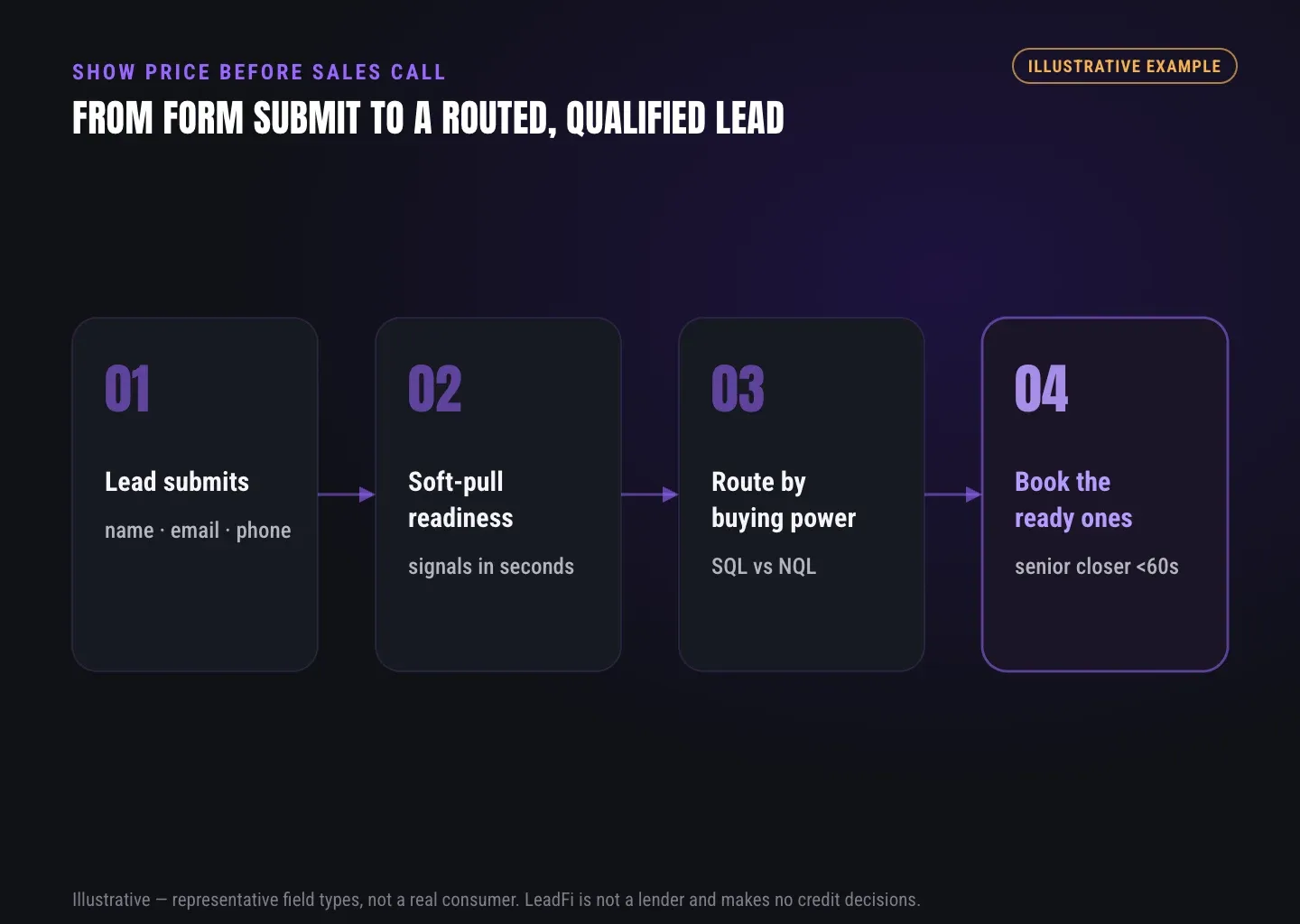
LeadFi sits behind existing forms, funnels, calendars, and CRMs. In supported configurations, it can begin with name, email, and phone. The individual must first receive appropriate disclosure and provide authorization before personal financial information is accessed.
Patent-pending identity matching is designed to establish a high-confidence match before a configured soft-pull or deeper bureau-backed workflow. Depending on the authorized setup, routing inputs can include VantageScore 4.0, available credit, income, debt, debt-to-income ratio, age, address, and optional asset context.
These are financial-readiness and rep-preparation signals. This page describes a routing input, not a credit decision, approval, or eligibility determination.
SQL and NQL labels support routing
SQL (Sales-Qualified Lead) means someone who is financially fit to buy your offer. NQL (Non-Qualified Lead) means someone who is not financially fit to buy your offer.
An SQL label can support faster sales follow-up. An NQL label can support a neutral nurture path until another prospect-initiated action occurs. Teams should define these workflows with appropriate counsel and avoid using readiness results to personalize prices.
For a structured routing model, review LeadFi’s Lead Routing Decision Framework (SQL/NQL by financial readiness).
CRM integrations make the result actionable
LeadFi can return configured signals to CRM fields, tags, pipeline stages, alerts, and workflows through a webhook, API, Zapier, Make, or a supported native integration. Where platform policies and the team’s setup allow, permitted quality events can also inform Meta, Google, TikTok, Hyros, and operational reporting. No advertising or sales outcome is guaranteed.
Compliance-aware setup comes before launch
Thin-input workflows do not remove consent and disclosures, privacy, access-control, or communication obligations. LeadFi supports compliance-aware setup, including privacy and consent language, TCPA-aware practices, and FCRA-aware workflow guidance.
LeadFi does not provide legal advice or guarantee compliance. Clients should review their intended use with counsel.
See which of the leads you already have can actually afford to buy.
OUTCOMES
Testing price visibility without muddying the result
Quick answer: Compare a page that shows the price with one that saves it for the call while holding the offer, traffic mix, application, routing rules, and sales process as steady as practical.
Test one pricing variable
Version A can show the exact fee while Version B withholds it until the call. Alternatively, test a genuine price range against no published range. Do not simultaneously redesign the page, change the offer, shorten the form, and rewrite the sales process.
This keeps the experiment on one decision: whether the price appears before the call.
Preserve the same routing rules
Use the same financial-readiness criteria, CRM fields, and follow-up logic for both versions. Otherwise, the experiment tests pricing and routing at the same time.
The price itself must also remain governed by the same policy. Do not show different prices to different visitors based on a readiness result.
Measure qualified outcomes
Track page-to-form rate, form-to-book rate, SQL/NQL mix, held calls, progression through your existing sales stages, and sales time consumed. Break results out by traffic source so a campaign mix change is not mistaken for a pricing effect.
Avoid assuming that either visible or hidden pricing caused a better outcome without sufficient decision volume. LeadFi does not promise a show-rate, conversion, advertising, or revenue improvement.
Record the final pricing rule
Document whether the page will display an exact price, range, minimum, or no public figure. Record the page version, routing map, CRM fields, and sales handoff so later funnel edits do not unintentionally change the rule.
Related reading: a practical guide to lead scoring software that scores leads by real buying power, a closer look at soft credit pull software for lead generation, a practical guide to reducing sales call no shows.
| Price approach | What appears before the call | Best fit | Main tradeoff | Routing requirement |
|---|---|---|---|---|
| Visible | Exact fee | Standardized offer with consistent scope | Buyers may evaluate cost before understanding value | Use fit and permissioned readiness inputs without changing the price |
| Hidden | No fee | Legitimately variable or diagnostic engagement | Expectation mismatches appear later | Qualify and prioritize follow-up before consuming substantial sales time |
| Partial | Starting price, range, or minimum | Variable scope with a useful investment frame | Visitors may mistake the minimum for the typical fee | Preserve clear scope and pricing explanations |
| Tiered | Several published packages | Distinct, standardized service levels | Too many options can obscure the core choice | Route by stated needs and keep published prices consistent |
Key takeaways
The short version
- Show exact pricing when the offer and scope are standardized.
- Hidden pricing shifts expectation-setting and qualification onto the sales process.
- Price visibility indicates intent, not financial readiness.
- Keep readiness-based routing separate from pricing policy.
- Test only whether price appears before the call and hold routing steady.
Quick answers
Fast answers before you dig in
Should you show pricing on your website?
Show pricing when the offer is standardized and the fee needs little explanation. Hide or partially show it when legitimate scope differences require discovery, then evaluate the full sales path rather than bookings alone.
Does showing a high-ticket price prove buying power?
No. It shows that a visitor saw the fee and continued. Permissioned financial-readiness qualification provides a separate routing signal after an existing inbound lead submits.
What should a hidden-price funnel do after submission?
It should set clear routing rules, return useful signals to the CRM, prioritize appropriate follow-up, and place other leads into neutral nurture without changing prices based on readiness.
FAQ
Common questions
Should you show pricing on your website for a high-ticket offer?
Should I list prices on my website if every client pays the same?
When should I hide price on a sales page?
Does financial-readiness qualification replace website pricing?
How does LeadFi SQL vs NQL routing work?
Can LeadFi work from name, email, and phone?
Sources
References
- CFPB — What is a credit inquiry? (hard vs. soft) (opens in a new tab)Federal regulator confirms a soft inquiry, unlike a hard inquiry, does not affect the consumer's credit score.
- VantageScore — VantageScore 4.0 credit scoring model (opens in a new tab)Official page describing VantageScore 4.0, the tri-bureau, trended-data model used to assess credit risk.
- Experian — Hard Inquiry vs. Soft Inquiry (opens in a new tab)Major credit bureau contrasts hard and soft inquiries and confirms soft inquiries do not affect a credit score.
Know who is ready before your next sales call.
Decide whether your offer needs an exact price, range, minimum, or a discovery-led quote before the call. Then assess how your existing inbound leads move through the CRM after submission.