
REDUCE SALES CALL NO SHOWS
How to Reduce Sales Call No-Shows: Diagnose, Test, and Route
To reduce sales call no shows, start by identifying which leads miss meetings and why. A booking indicates intent, but it does not establish urgency, fit, or buying power. LeadFi is a financial-readiness engine that works behind forms, funnels, calendars, and CRMs.
Watch a contact get pre-qualified.
This is exactly what your CRM gets back.
Your opt-in form
Soft pull · no impact to their credit
This is not a real soft pull. It's an example of the data points that land in your CRM contact record when a lead fills out your form.
LEADFI DEMO
Watch the demo, then start free or book a call.
GUIDE
No-show causes to check first
A no-show is a signal, not a diagnosis. Prospects may forget, encounter a conflict, lose interest, misunderstand the call's value, or lack a suitable buying path. Before rebuilding the funnel, segment missed calls by source, campaign, booking gap, offer, route, rep, and reminder sequence.
Long calendar gaps deserve particular attention. Compare same-day calls with meetings booked three, seven, or fourteen days ahead. A clear agenda also matters: explain what the meeting covers, what the prospect should prepare, and what happens next.
Sending every applicant to one calendar can obscure differences between leads. Under documented rules, an SQL fits the main sales path, while an NQL may be better served by nurture, a lower-ticket offer, an alternate offer, or review. The label describes a route for a specific offer—not the person's worth or future potential.
For a broader operational walkthrough, see How to Reduce Wasted Sales Calls on High-Ticket Offers in practice. Teams reviewing attendance alongside qualification can also use a practical guide to why leads dont convert on calls.
Example: A coaching company records 60 missed meetings from 200 bookings, producing a 30% no-show rate. Cohort analysis reveals that 42 of the missed meetings came from one campaign with a seven-day booking window. The team can now test the booking gap rather than assuming its reminder system caused the entire problem.
INTELLIGENCE LAYER
Readiness data can help test show-rate patterns
Financial readiness is not a proven cause of attendance. It is a segment teams can test against their own outcomes while controlling for other variables.
Depending on the configured workflow, consent and disclosures, LeadFi may surface signals such as VantageScore 4.0, available credit, income, debt, debt-to-income ratio, funding pre-approval signals, current address, age, and optional asset or net-worth-style context. These signals support routing and rep preparation; they are not consumer approvals or denials.
Where applicable, soft-pull prescreening can add bureau-backed information. LeadFi can work from name, email, and phone in many thin-input workflows. Its patent-pending identity matching is designed to establish a high-confidence match before soft-pull prescreening and, where applicable, deeper bureau-backed workflows. Identity-related information and identity signals may include current address or age when supported by the setup.
Thin inputs are intended to reduce initial form friction—not bypass consent and disclosures. Exact inputs, matching results, and later information requirements depend on the workflow. Records without a high-confidence match should remain a separate data-status cohort rather than being classified as NQLs.
Define readiness tiers before examining attendance results, keep the rules stable during each test, and version every material change. Report raw counts beside percentages because small cohorts can produce volatile rates.
Use one consistent formula:
Show rate = attended calls ÷ eligible booked calls × 100
Define eligible bookings, cancellations, reschedules, duplicates, technical failures, and rep-canceled calls consistently.
Example: A consulting team compares three readiness tiers within the same campaign and booking window for six weeks. If attendance differs, the team treats the result as a pattern to retest—not proof that readiness caused the difference.
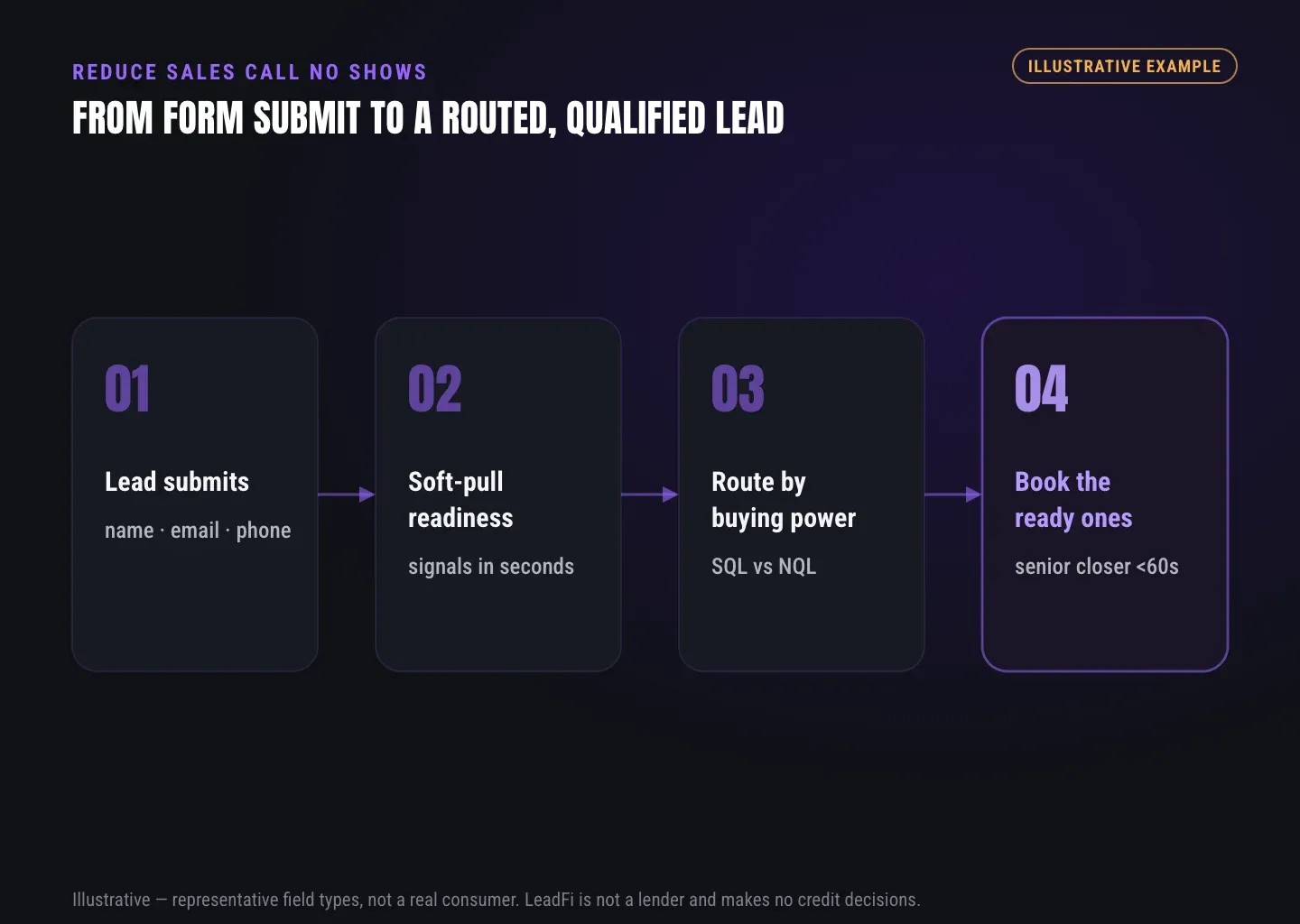
INTELLIGENCE LAYER
Readiness-based routing protects closer calendars
Readiness-based routing helps teams decide which next step fits each configured lead class. It does not establish that one route will reduce no-shows.
An SQL can trigger the primary closer calendar, a CRM stage, or a fast rep alert. An NQL can move to nurture, a lower-ticket offer, financing education, an alternate page, or another call type. Borderline or incomplete results can enter a setter or manual-review path so automation does not replace human judgment.
LeadFi can return readiness and SQL/NQL status to CRM fields, tags, stages, lists, and workflow triggers. It can connect through webhooks, APIs, Zapier, Make, or native workflows, then support redirects, alerts, follow-up sequences, and calendar logic in the team's existing stack.
Teams designing this process can consult Pre-Qualify Leads Before the Sales Call: A Practical Guide in practice. Begin with each route's intended outcome, owner, response target, and measurement rather than starting with software steps.
Example: A consulting company selling a $7,500 service creates SQL, review, and NQL paths. SQLs receive the main calendar, review-tier leads receive a short setter call, and NQLs enter nurture. The team then measures attendance and sales outcomes for every route without assuming that qualification caused those outcomes.
Example: An agency offering $1,500 and $9,000 services may route a lead who does not fit the larger offer toward the entry offer. That route remains an offer-specific sales decision, not a judgment about the consumer.
INTELLIGENCE LAYER
Show-rate tracking by readiness tier
Track submission, readiness result, booking, reminder delivery, cancellation, rescheduling, attendance, and completed-call timestamps. Assign a source of truth for each event, such as the CRM for lead status and the calendar for scheduling changes.
A practical schema includes:
- Lead ID: Stable key across the form, CRM, and calendar.
- Readiness tier and rule version: The class and criteria applied.
- Route: SQL, NQL, review, nurture, or another defined path.
- Source and campaign: Channel, campaign, ad set, keyword, or partner.
- Booked and meeting times: Used to calculate the booking gap.
- Attendance: Attended, canceled, rescheduled, no-show, or rep-canceled.
- Rep and offer: Assigned owner and intended sales path.
- CRM action: The tag, stage, alert, sequence, or workflow triggered.
Use mature cohorts whose meetings have already occurred. Show both percentages and counts, disclose excluded records, and avoid changing tier definitions during a test window.
LeadFi can also support sending configured SQL-quality or readiness events into CRM, attribution, and permitted Meta, Google, TikTok, or Hyros workflows. These are testing inputs; they do not guarantee platform learning, lead quality, cost, or attendance outcomes.
A weekly review should ask: Where is the no-show rate highest? Does the pattern remain after controlling for source and booking delay? Does the route give the lead a suitable next step? What single change should the team test next?
Example: A funding sales team initially sees more no-shows in its NQL path. After splitting the cohort by booking delay, it finds that most missed meetings were scheduled more than ten days out. It tests a shorter window before changing readiness rules.
Example: If identity signals do not support a high-confidence match, store the result as unmatched or insufficient data. Do not treat a missing result as evidence of weak buying power.
See which of the leads you already have can actually afford to buy.
INTELLIGENCE LAYER
Teams that should use readiness-based no-show analysis
Readiness analysis is most useful when sales calls are expensive and the business has enough volume to compare stable cohorts.
High-ticket coaches, consultants, course creators, info-product businesses, and agencies can use routing context to understand which paths consume closer capacity. Credit-adjacent teams—including business funding, mortgage, lending, insurance, real estate, and auto-loan businesses—may use financial context within a reviewed, compliance-aware setup.
RevOps teams can map readiness fields into stages, tags, alerts, and reports. Sales leaders can assess whether SQLs receive prompt attention and whether NQLs retain a useful next step. Media buyers can compare readiness events with source and campaign data where the platform and workflow allow, without assuming a performance outcome.
Low-volume teams can still implement consistent tracking, but they should avoid conclusions from small samples. Readiness data creates value only when the business can act on the result through a differentiated route, offer, rep workflow, or follow-up path.
LeadFi supports compliance-aware workflows and can help teams consider privacy language, consent language, TCPA-aware practices, and FCRA-aware workflow guidance. LeadFi does not provide legal advice or guarantee compliance. Clients should review their use case with counsel.
INTELLIGENCE LAYER
LeadFi supports the readiness test
LeadFi is a financial-readiness engine for high-ticket, lead-driven businesses—not a generic reminder tool or stand-alone soft-credit utility.
After a prospect submits a form, LeadFi can receive name, email, and phone from a funnel, calendar process, CRM, webhook, API, Zapier, Make, or native workflow. Depending on the setup, it can return a readiness result while the lead remains active in the sales journey.
Your team defines what SQL, NQL, and review mean for each offer. Rules can combine financial-readiness signals with form responses, source, geography, product, and human review. The same lead may fit one offer path but not another.
Results can return to CRM fields, stages, alerts, redirects, calendars, nurture sequences, alternate offers, and permitted advertising or attribution workflows. The objective is a measurable routing loop that helps the business answer its own readiness and attendance questions.
Before launch, LeadFi can support compliance-aware workflow planning, including privacy and consent-oriented choices and TCPA-aware practices. It does not remove consent and disclosure obligations, provide legal advice, guarantee compliance, or approve or deny consumers.
Related reading: How to Reduce Wasted Sales Calls on High-Ticket Offers in practice, Pre-Qualify Leads Before the Sales Call: A Practical Guide in practice, a practical guide to why leads dont convert on calls.
| Routing model | Main action | Calendar impact | Best measurement |
|---|---|---|---|
| Book everyone | Every lead receives the same calendar | Maintains broad calendar access | Overall attendance and sales outcomes |
| Form-score routing | Application answers determine the path | Filters by stated fit | Attendance by answer-based tier |
| Readiness routing | Permissioned signals and configured rules shape the path | Allocates closer slots by configured fit | Attendance by readiness tier and source |
| Hybrid routing | Form data, readiness, and human review work together | Adds review for edge cases | Attendance by final route |
| Post-booking triage | Leads book first and are reviewed afterward | May retain, move, or review bookings | Attendance by original and final path |
No model guarantees fewer no-shows. Each model provides a different structure for testing attendance patterns and managing sales capacity.
Key takeaways
The short version
- Treat a no-show as a signal, not a diagnosis.
- Control for source and booking delay when testing readiness.
- Route SQLs, NQLs, review leads, and unmatched records separately.
- Keep tier rules stable and report counts beside rates.
- LeadFi supports qualification and routing, not consumer decisions.
Quick answers
Fast answers before you dig in
How do you reduce sales call no shows?
Segment missed meetings by source, booking delay, offer, rep, reminder flow, route, and readiness tier. Test one variable at a time and compare mature cohorts using consistent definitions.
Can financial readiness improve show rate?
LeadFi does not claim that financial readiness improves show rate. Readiness is a segment you can test in your own funnel while controlling for source, booking delay, offer, reminders, and rep assignment.
How does SQL vs NQL routing help high-ticket sales teams?
SQL vs NQL routing can reserve the main sales path for leads who meet configured rules while directing other leads to review, nurture, lower-ticket products, or alternate offers.
What does LeadFi do with name, email, and phone?
In supported workflows, LeadFi uses thin inputs and identity signals to support high-confidence matching, soft-pull prescreening, financial-readiness qualification, and routing, subject to the setup, consent and disclosures.
FAQ
Common questions
How can a business reduce sales call no shows?
What is a good sales call no-show rate?
Can financial readiness improve show rate?
How does SQL NQL routing reduce wasted sales calls?
Does LeadFi run a soft credit check before a sales call?
Can LeadFi work without collecting an address first?
How do I track show rate by financial-readiness tier?
Sources
References
- CFPB — What is a credit inquiry? (hard vs. soft) (opens in a new tab)Federal regulator confirms a soft inquiry, unlike a hard inquiry, does not affect the consumer's credit score.
- VantageScore — VantageScore 4.0 credit scoring model (opens in a new tab)Official page describing VantageScore 4.0, the tri-bureau, trended-data model used to assess credit risk.
- Experian — What Is a Soft Inquiry? (opens in a new tab)Major credit bureau explains soft inquiries are informational and have no impact on credit scores.
- Consumer Financial Protection Bureau: Credit inquiries (opens in a new tab)General background on credit inquiries and the distinction between hard and soft inquiries.
- VantageScore 4.0 (opens in a new tab)Background on the VantageScore 4.0 credit-score model.
Know who is ready before your next sales call.
Do not assume readiness changes attendance. Build the cohorts and routes needed to answer that question for your own funnel.