
REDUCE WASTED SALES CALLS ON HIGH TICKET OFFERS
How to Reduce Wasted Sales Calls on High-Ticket Offers
High-ticket sales time is your most expensive resource. Yet many teams burn it on calls with people who were never able to buy. That's the quiet leak: closers spend hours on prospects who look interested but can't move forward.
Watch a contact get pre-qualified.
This is exactly what your CRM gets back.
Your opt-in form
Soft pull · no impact to their credit
This is not a real soft pull. It's an example of the data points that land in your CRM contact record when a lead fills out your form.
LEADFI DEMO
Watch the demo, then start free or book a call.
GUIDE
Where high-ticket teams lose time
Your form counts every submission the same way. A curious browser and a ready buyer look identical in the CRM. As a result, reps treat both like real deals until a call proves otherwise.
That gap is expensive on offers priced from $1,000 to $10,000 and up. For example, a coaching floor might book 40 calls a week, then learn on-call that half can't afford the program. That's not a closer problem — it's a qualification problem that showed up too late.
Interest is not the same as readiness
A booked call signals interest, not buying power. Many prospects want the outcome but can't fund it right now. That's why call volume alone is a weak measure of a healthy pipeline.
The finance step is a costly place to learn
When you find out about money at the close, the whole call was a sunk cost. By then, the rep already spent 30 to 45 minutes building rapport and pitching. Learning readiness earlier moves that discovery before the dial.
Stack sprawl hides the real signal
Leads scatter across forms, calendars, and a CRM that all speak different languages. Because no layer reads financial readiness, your team guesses. In addition, LeadFi adds that missing signal after capture, then writes it back where reps already work.
Speed-to-lead gets wasted on the wrong people
Fast follow-up matters — but only for leads who can actually buy. Otherwise you're rushing to call prospects who will never convert. First qualify, then apply speed where it pays off.
GUIDE
Scoring who can actually buy
Readiness is an operational label, not a judgment of anyone's worth. It answers one question: is this lead ready for a high-ticket talk right now? Your rules decide what happens next.
The soft pull reads signals after the lead submits. Because LeadFi can often work from name, email, and phone, many workflows skip asking for a full address and date of birth up front. As a result, you get less form friction and cleaner routing — set up as a compliance-aware workflow you design with your advisors.
Signals that map to buying power
LeadFi can surface readiness signals like VantageScore 4.0, available credit, income, debt, DTI, funding pre-approval signals, and age. For example, each one is framed as readiness for routing and rep prep. None of them is an underwriting decision.
Thin-input match before any pull
Patent-pending identity matching is designed to confirm a high-confidence match first — using name, email, and phone plus identity-related information such as current address and age where applicable. Only then does soft-pull prescreening run where it applies. As a result, the workflow stays accurate and consent-appropriate, not a guess from clicks.
A readiness tag, not a raw credit dump
Reps don't need a consumer's raw credit file to prep a call. Instead, they see a clean readiness tag and the context your rules allow. That respects buyer dignity and keeps the focus operational.
No impact on the consumer's credit score
A soft-pull prescreen is designed to read readiness signals as a soft inquiry, which is not intended to affect the person's credit score, and it never approves or denies anyone. In other words, that's the difference between prescreening for routing and a lending decision — LeadFi supports the first, never the second.
INTELLIGENCE LAYER
Routing lower-readiness leads elsewhere
An NQL is not a dead lead. It's a lead that isn't ready for your top offer today. So the right move is a different path, not the trash.
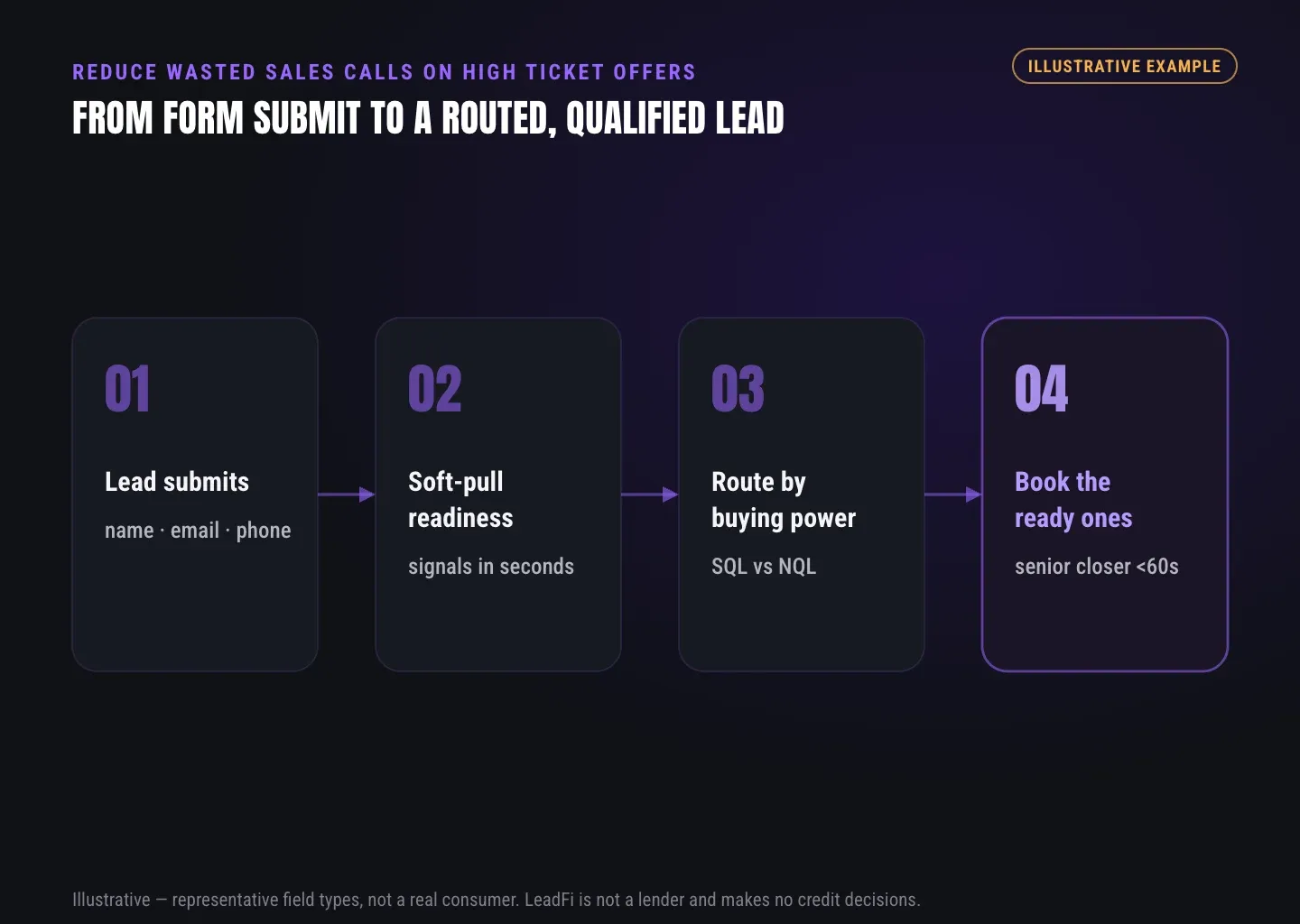
Routing happens after submit, while momentum is high. For instance, an SQL can hit your closer's calendar in minutes, and an NQL can land on a low-ticket offer or a financing page. Then LeadFi writes the outcome back to your CRM — fields, tags, stages, and workflows — so the status lives where your team already works.
SQL vs NQL routing, defined once
SQL means sales-qualified: ready for a high-ticket call. NQL means the opposite — not ready for that offer right now. LeadFi uses these labels the same way every time, then routes each to the step you configure.
Give SQLs your speed-to-lead
Sales-ready leads get the fast track: closer calendar, instant notification, permitted context for prep. As a result, your best prospects meet a rep while interest is still hot. That's where speed-to-lead actually earns its keep.
Monetize NQLs instead of dropping them
Route lower-readiness leads to a low-ticket offer, a payment plan, or a financing path. For example, some will grow into buyers later, and others convert on a smaller product today. Either way, you recover value that a straight "disqualify" would waste.
Feed clean signals back into ads and CRM
LeadFi can feed qualified-lead signals into Meta, Google, TikTok, Hyros, and your CRM — where permitted and correctly set up. In practice, this helps campaigns learn from financially qualified demand, not just raw form fills. No platform performance is guaranteed, but the signal quality improves.
Set it up compliance-aware before launch
Before go-live, LeadFi helps you align form disclosures, consent language, and CRM notes so prospects hear one consistent story. This setup is onboarding help, not legal advice. That said, LeadFi supports compliance-aware workflows and does not guarantee compliance. Clients should review their use case with counsel.
See which of the leads you already have can actually afford to buy.
GUIDE
Measuring calls saved
The point of qualification isn't vanity metrics. It's sales efficiency on high-ticket offers: more closer hours spent on people who can buy. So measure the resource, not just the leads.
Start with a simple before-and-after. First, log how many calls per week ended at "can't afford it." Next, turn on readiness routing and watch that number fall as NQLs move to other paths. Then convert the difference into hours and dollars of closer time recovered.
Track SQL share of booked calls
Watch what percent of your booked calls are SQLs. As routing tightens, that share should climb. A higher SQL share is the clearest sign you're reducing wasted sales calls.
Watch unqualified calls per rep drop
Count the calls per rep that end without a real buying-power fit. Because NQLs get a different path now, this number should fall week over week. That drop is closer capacity handed back to your team.
Convert saved hours into pipeline
Take the calls you no longer waste, multiply by average call length, and you get hours back. Then point those hours at more SQLs or better follow-up. That's how qualification turns into pipeline instead of just a cleaner report.
Optimize for lead quality, not volume
More leads can mean more wasted calls if readiness never enters the picture. Instead, optimize for SQL quality and let volume serve it. The goal is financially qualified demand, not a bigger inbox.
| What happens after submit | Capture / booking tool alone | LeadFi financial-readiness routing |
|---|---|---|
| Reads buying power | No — interest only | Yes — permissioned readiness signals (soft pull) |
| SQL vs NQL split | Manual or none | Automatic, rule-based, after submit |
| Where unqualified leads go | Same calendar as everyone | Low-ticket, payment plan, or financing path |
| Speed-to-lead focus | Applied to all leads | Focused on SQLs |
| CRM write-back | Basic contact fields | Fields, tags, stages, workflows |
| Ad signal quality | Raw form fills | Financially qualified signals (where permitted) |
| Consumer approve/deny | N/A | Never — routing only, no decisioning |
Key takeaways
The short version
- Wasted high-ticket calls come from qualifying interest instead of buying power — the mismatch surfaces at the finance step, too late.
- LeadFi reads permissioned readiness signals (VantageScore 4.0, income, available credit, debt, DTI) via soft-pull prescreening after submit — never a consumer approval or denial.
- SQL vs NQL routing sends sales-ready leads to speed-to-lead and moves NQLs to low-ticket, payment-plan, or financing paths so no lead is wasted.
- Measure impact with SQL share of booked calls, unqualified calls per rep, and closer hours recovered — then reinvest that time in pipeline.
- LeadFi sits behind your existing form, funnel, calendar, and CRM and writes readiness back as fields, tags, and stages; it supports compliance-aware workflows but does not provide legal advice or guarantee compliance.
Quick answers
Fast answers before you dig in
Where do high-ticket teams lose time?
High-ticket teams lose time when reps call leads with no clear buying power. Interest is easy to fake with a form fill; readiness is not. Because most tools stop at capturing the lead, closers only find the mismatch mid-call — often at the finance step. LeadFi reads readiness first, so unqualified leads never eat closer capacity.
How does LeadFi score who can actually buy?
LeadFi scores buying power using permissioned financial-readiness signals — not a survey guess and not a consumer approval. A soft-pull prescreen can read signals like VantageScore 4.0, income, available credit, debt, and debt-to-income (DTI) as a soft inquiry. LeadFi does not approve or deny anyone; it classifies leads so your team routes them well.
How does LeadFi route lower-readiness leads?
LeadFi splits every lead into an SQL or an NQL, then routes each path automatically. SQLs reach a closer calendar fast, while NQLs go to a low-ticket offer, a payment plan, or a financing path. Because no lead is thrown away, you stop wasting time on unqualified leads without losing the revenue they might still bring.
How do you measure calls saved?
Measure calls saved by comparing closer time before and after readiness routing. Track the share of booked calls that were SQLs, the drop in unqualified calls per rep, and speed-to-lead on qualified leads. Because LeadFi tags every lead SQL or NQL, you can tie saved hours to real readiness data — not a hunch.
FAQ
Common questions
How does LeadFi help reduce wasted sales calls?
What is a soft-pull prescreen, and does it hurt credit scores?
Can LeadFi work without asking for a full address up front?
What's the difference between SQL and NQL routing?
Does LeadFi replace my CRM, form, or calendar?
How does this improve sales efficiency on high-ticket offers?
Is LeadFi compliant, and does it give legal advice?
Sources
References
- CFPB — What is a credit inquiry? (hard vs. soft) (opens in a new tab)Federal regulator confirms a soft inquiry, unlike a hard inquiry, does not affect the consumer's credit score.
- VantageScore — VantageScore 4.0 credit scoring model (opens in a new tab)Official page describing VantageScore 4.0, the tri-bureau, trended-data model used to assess credit risk.
- CFPB — Who can request to see my credit report? (opens in a new tab)Federal regulator explains the FCRA rules governing who may obtain a credit report.
Know who is ready before your next sales call.
You already capture leads. The missing piece is knowing who can buy — before a rep spends an hour finding out the hard way.