
WHY LEADS DONT CONVERT ON CALLS
Why Your Leads Don't Convert on Sales Calls
You book the call. The rep shows up ready. Then the prospect goes quiet at the price, says they need to "think about it," or admits they can't swing the payment.
Watch a contact get pre-qualified.
This is exactly what your CRM gets back.
Your opt-in form
Soft pull · no impact to their credit
This is not a real soft pull. It's an example of the data points that land in your CRM contact record when a lead fills out your form.
LEADFI DEMO
Watch the demo, then start free or book a call.
GUIDE
The Four Reasons a Good Call Still Dies
Quick answer: Leads not converting on sales calls usually comes down to four things: the prospect can't afford the offer, the call was slow to happen, the rep had no context going in, or "book a call" attracted browsers instead of buyers. Financial-readiness qualification before the call targets all four.
Sales call conversion rate is a downstream number. It reflects who you let into the calendar in the first place. Below are the four failure modes we see most often with high-ticket teams.
1. No Buying Power Behind the Interest
The prospect wants the outcome but can't fund the offer. Take a $6,000 coaching program: it feels right until the payment plan hits a maxed-out card. Interest was real; capacity was not. As a result, the rep only learns that at the finance step.
2. Speed-to-Lead Was Too Slow
A hot lead cools fast. When the first touch lands the next morning instead of in minutes, momentum is gone. As a result, even a qualified buyer shows up half-committed, or ghosts the call entirely.
3. The Rep Walked in Blind
Without context, every call starts from zero. For example, the rep spends the first ten minutes guessing at fit instead of tailoring the pitch. That's wasted time on both sides, and it shows in the close rate.
4. "Book a Call" Attracts Browsers
A low-friction booking flow fills the calendar. Still, volume is not the same as buying power. When any click can book, your reps inherit a pile of tire-kickers alongside the real prospects.
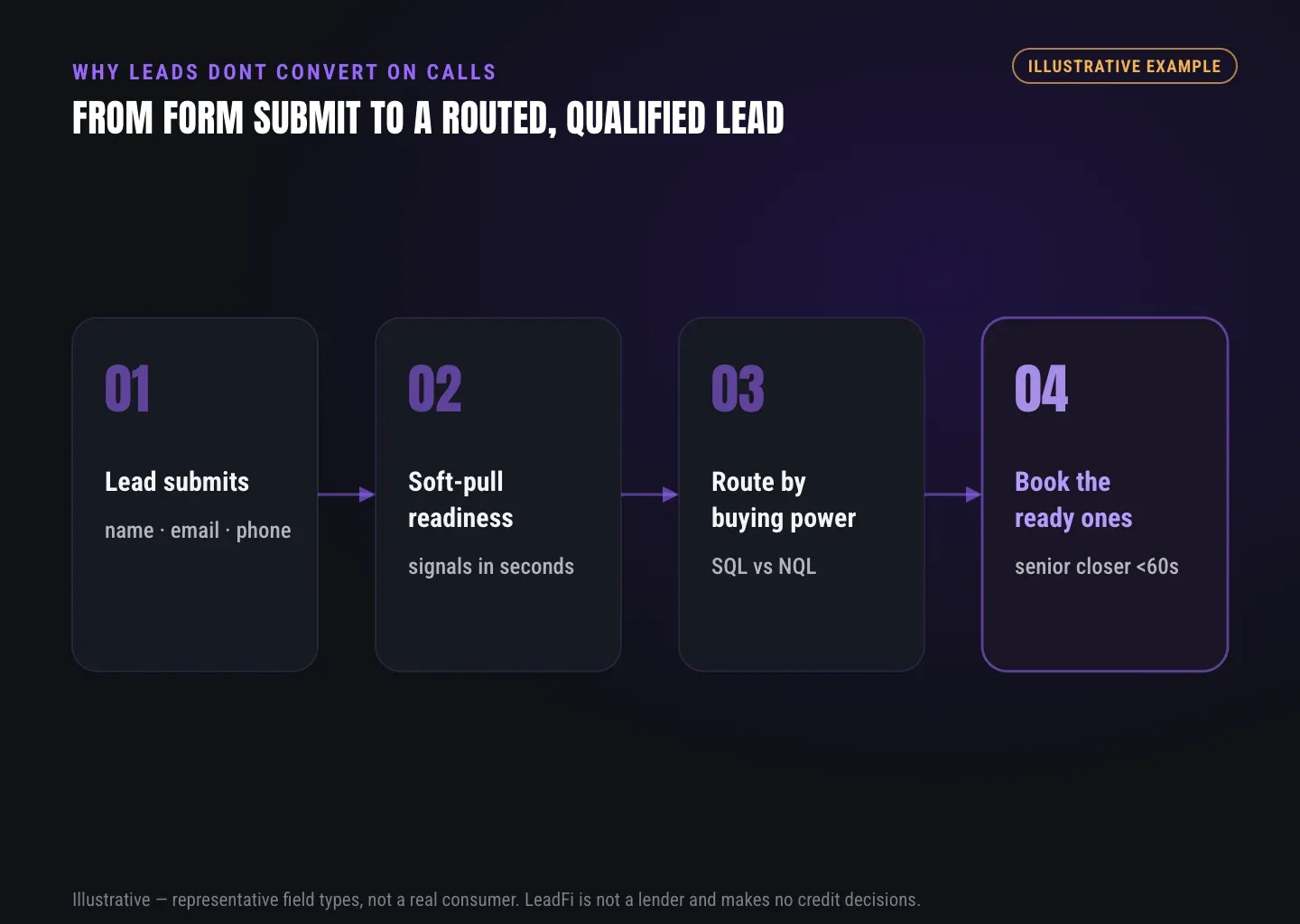
GUIDE
Telling Interest Apart From Capacity
Quick answer: Interest is behavioral — clicks, opt-ins, and booked calls. Capacity is financial — income, available credit, debt-to-income, and funding readiness. Financial-readiness qualification reads capacity signals after the lead submits, so you route by who can actually buy, not just who raised a hand.
Booked calls look like intent. In truth, they are just attention. To know whether attention converts, you need to see capacity — and that's a different signal set entirely.
LeadFi works from name, email, and phone to help generate real-time financial insights. First, patent-pending identity matching sets a high-confidence match. Then, where consent and disclosures support it, a soft pull reads readiness signals with no impact on the consumer's credit score. It never approves or denies anyone.
Interest Signals You Already Have
Your funnel already tracks clicks, form fills, and calendar bookings. These tell you someone is curious. However, they say nothing about whether that person can fund a five-figure offer.
Capacity Signals LeadFi Can Surface
Depending on your workflow and disclosures, readiness signals may include VantageScore 4.0, available credit, income, debt, and debt-to-income. In addition, funding pre-approval signals can factor in. Each one is framed as readiness for routing and rep prep, not a consumer decision.
The Soft Pull, in Plain Terms
A soft-pull prescreen reads financial-readiness signals for business qualification. It is not a hard credit check. On the paths where this applies, it is designed to carry no credit-score impact. Think of it as operational context — not a judgment of anyone's worth.
Readiness Is a Tag, Not a Verdict
LeadFi turns capacity signals into a readiness tag your team can route on. Your reps see the tag and the next step, not raw finance detail. In other words, the output is "who gets which calendar," not "who is a good person."
GUIDE
Fixing It Before the Call, Not During
Quick answer: Fix conversion upstream by qualifying leads by financial readiness after they submit, then routing SQL vs NQL automatically. Financially qualified leads reach a closer fast; lower-readiness leads go to a low-ticket offer, a payment plan, or a financing path — so no call slot is wasted on a lead that can't buy today.
You cannot coach a rep into fixing a capacity gap live on the call. The fix has to happen between submit and booking. That's where SQL/NQL routing earns its place.
First, define what "ready" means for your offer. Next, let LeadFi classify each lead after submission. Then route each path to the right next step while momentum is still high.
SQL vs NQL Routing, Defined Once
SQL means Sales-Qualified Lead, ready for a closer now. NQL means Non-Qualified Lead: real interest, but not ready to buy today. LeadFi splits the two based on your rules plus readiness signals, so the split is not a coin flip.
Speed-to-Lead for the SQLs
Financially qualified leads should reach a rep in minutes, not tomorrow. For example, LeadFi can route an SQL straight to a closer calendar, tag the CRM record, and fire a notification. As a result, your best leads get your fastest response.
A Real Path for the NQLs
An NQL is not a dead end. Instead of burning a closer slot, route them to a low-ticket offer, a payment plan, or a financing path where it fits. That's how you monetize interest that isn't ready yet.
Rep Prep Before the Call Starts
When an SQL books, the closer opens the record and sees a readiness tag plus context. As a result, the pitch and payment options are set before "hello." That's minutes saved on every call and a warmer open.
Compliance-Aware Setup as Onboarding Help
Before launch, LeadFi can help you align form disclosures, consent language, and CRM notes so prospects hear one consistent story. In short, this is onboarding help — a value-add rather than a blocker. LeadFi supports compliance-aware workflows, does not provide legal advice, and does not approve or deny consumers; review your use case with counsel.
See which of the leads you already have can actually afford to buy.
GUIDE
Measuring the Change in Booked-Call Quality
Quick answer: Track sales call conversion rate by segment — SQL vs NQL — not as one blended number. Watch closer show-rate, close rate on SQL calls, and wasted-call rate. Feed SQL-quality signals back into your CRM and ad platforms so future campaigns attract more financially ready buyers.
A single blended close rate hides the problem. Split it by readiness and the story gets clear fast, because you'll finally see where your calendar time actually goes.
Below are the metrics worth watching once readiness routing is live. None of these are guarantees; they're the numbers that tell you whether the change is working.
Split Conversion by SQL vs NQL
Report close rate on SQL calls separately from everything else. This shows the true ceiling when your reps talk to ready buyers. Meanwhile, the NQL path gets judged on low-ticket revenue, not closer close rate.
Wasted-Call Rate
Count calls that died on capacity: the "can't afford it" and "need financing" endings. Then track that number before and after routing. A falling wasted-call rate is the clearest sign the upstream fix is holding.
Speed-to-Lead on Qualified Traffic
Measure the gap between an SQL landing and the first rep touch. Faster contact on ready buyers tends to lift show rate. In turn, LeadFi can help close that gap, though outcomes depend on your stack and follow-up.
Feed the Signal Back to Ads
SQL-quality signals can flow back into Meta, Google, TikTok, Hyros, and your CRM, where the platform and your setup permit it. As a result, campaigns learn who your real buyers are. Still, LeadFi makes no platform performance or ROAS guarantee.
| Factor | Form + calendar only | With LeadFi readiness routing |
|---|---|---|
| Who reaches a closer | Anyone who books | SQLs — leads with buying power for the offer |
| Rep context before call | Name and form answers | Name, form answers, plus a readiness tag |
| NQL handling | Same calendar as everyone | Low-ticket, payment plan, or financing path |
| Speed-to-lead | Manual, often next-day | Automated routing for SQLs in minutes |
| Ad feedback | Optimizes to booked calls | Can feed SQL-quality signals back (where permitted) |
| Conversion view | One blended close rate | Split by SQL vs NQL |
Key takeaways
The short version
- Booked calls prove interest, not buying power — a low sales call conversion rate is often an upstream qualification gap, not a closing problem.
- LeadFi reads financial-readiness signals from name, email, and phone via soft-pull prescreening after submit; it does not approve or deny consumers.
- Route SQLs to a closer fast and send NQLs to a low-ticket offer, a payment plan, or a financing path so no call slot is wasted.
- Measure conversion split by SQL vs NQL — plus wasted-call rate and speed-to-lead — instead of one blended close rate.
- LeadFi sits behind your form, funnel, calendar, and CRM and supports compliance-aware setup; it does not provide legal advice or guarantee outcomes.
Quick answers
Fast answers before you dig in
Why don't leads convert on sales calls even when they book?
Booking shows interest, not buying power. Many leads book because the offer sounds good, then stall at price or payment. Financial-readiness qualification reads capacity signals after submit — income, available credit, debt-to-income — so you route ready buyers to closers and give the rest a low-ticket or financing path.
How do you fix low sales call conversion upstream?
Qualify leads by financial readiness after they submit, then route SQL vs NQL automatically. Financially qualified leads reach a closer fast; lower-readiness leads go to a low-ticket offer, a payment plan, or a financing path — so no call slot is wasted on a lead that can't buy today.
What's the difference between an SQL and an NQL?
An SQL (Sales-Qualified Lead) is ready for a closer now, based on your rules plus readiness signals. An NQL (Non-Qualified Lead) shows real interest but isn't ready to buy today. LeadFi splits the two after submission so each path gets the right next step.
FAQ
Common questions
Why don't my leads convert on sales calls even when they book?
What's the difference between an SQL and an NQL here?
Does the soft pull hurt the consumer's credit score?
Do I need a full address and date of birth to qualify a lead?
Will this fix a low sales call conversion rate on its own?
Does LeadFi replace my CRM, form, or calendar?
Can readiness signals help my paid ads?
Sources
References
- CFPB — What is a credit inquiry? (hard vs. soft) (opens in a new tab)Federal regulator confirms a soft inquiry, unlike a hard inquiry, does not affect the consumer's credit score.
- VantageScore — VantageScore 4.0 credit scoring model (opens in a new tab)Official page describing VantageScore 4.0, the tri-bureau, trended-data model used to assess credit risk.
- CFPB — Who can request to see my credit report? (opens in a new tab)Federal regulator explains the FCRA rules governing who may obtain a credit report.
Know who is ready before your next sales call.
If leads not converting on sales calls is eating your reps' time, the fix is upstream: qualify by financial readiness, then route SQL vs NQL before the call gets booked. LeadFi supports compliance-aware workflows and does not approve or deny consumers.