
LEAD SCORING SOFTWARE THAT SCORES LEADS BY REAL BUYING POWER
Lead Scoring Software That Scores Leads by Real Buying Power
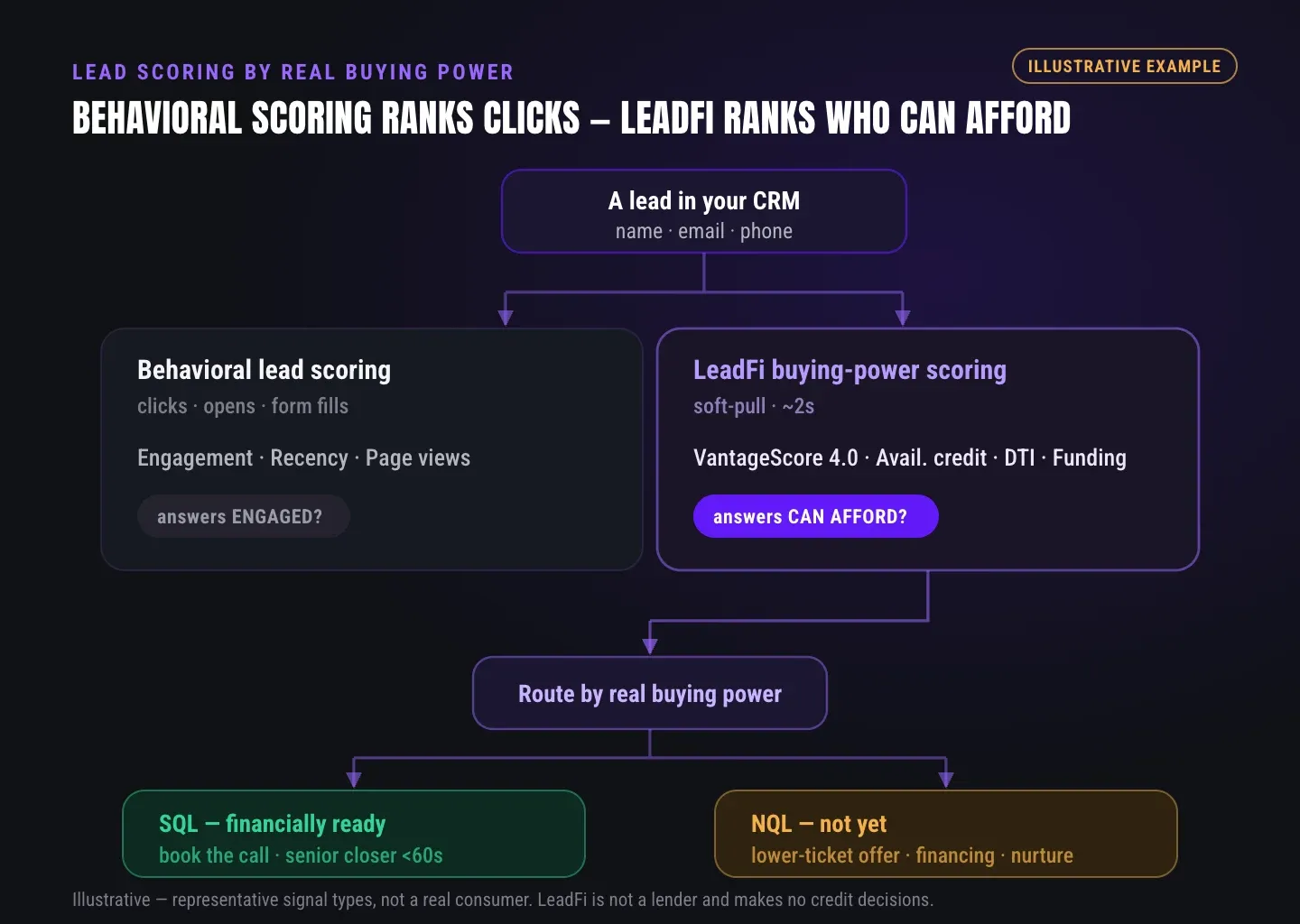
Most lead scoring software ranks leads by clicks, form fields, and page views. That tells you who's interested. It does not tell you who can actually pay for a $1,000–$10,000+ offer.
Watch a contact get pre-qualified.
This is exactly what your CRM gets back.
Your opt-in form
Soft pull · no impact to their credit
This is not a real soft pull. It's an example of the data points that land in your CRM contact record when a lead fills out your form.
LEADFI DEMO
Watch the demo, then start free or book a call.
PLATFORM OVERVIEW
What LeadFi lead scoring software does differently
Quick answer: Most lead scoring software infers a score from behavior — clicks, opens, form answers, and page views. LeadFi scores leads by financial readiness instead. It uses soft-pull prescreening to surface signals like VantageScore 4.0, income, and debt-to-income, then routes each lead by buying power. It does not approve or deny anyone, and credit-based signals should be used with consent and counsel-approved disclosures.
Behavioral scoring has a blind spot. For example, a prospect can open every email, watch the full VSL, and book a call — yet still be unable to pay. That is why teams burn hours on "hot" leads that never close.
LeadFi closes that gap. Instead of guessing readiness from engagement, it reads permissioned financial signals after the lead submits. Then it splits qualified from unqualified before a rep ever dials.
Reads buying power, not just behavior
Behavior shows intent. It does not show ability to pay. That's why LeadFi adds the missing layer — permissioned financial-readiness signals — so your score reflects who can actually buy, not just who clicked.
Runs behind your existing stack
LeadFi sits behind your form, funnel, calendar, or CRM. First it enriches the lead after submission. Then it writes routing outcomes back into the tools your team already lives in.
Splits SQLs from NQLs before the call
A Sales-Qualified Lead (SQL) shows the readiness to buy now. A Non-Qualified Lead (NQL) does not — yet. LeadFi separates the two, so closers get the SQLs while NQLs flow to a low-ticket offer or a payment plan.
Built for high-ticket math, not generic CRMs
For offers under $50, scoring by clicks is fine. For $3k+ offers, sales time is costly. That's why LeadFi is built for the high-ticket math — fewer wasted calls, higher-value calendars, and a cleaner picture of readiness.
INTELLIGENCE LAYER
Score leads by financial readiness, not just behavior
Quick answer: Financial-readiness lead scoring ranks leads by their ability to pay, using permissioned soft-pull signals. LeadFi can surface VantageScore 4.0, available credit, income, debt, debt-to-income (DTI), funding pre-approval signals, age, and current address. These inform routing and rep prep — they are not a consumer approval or denial, and their use depends on consent and disclosures you confirm with counsel.
Let's define the core term once. Financial readiness is a lead's ability to pay for your offer right now. It's a routing input — not a moral judgment, and not an underwriting decision.
The soft pull reads readiness signals via a soft-pull prescreen rather than a hard inquiry. For your team, it replaces guesswork with real numbers — used to prioritize and route sales attention, not to make a credit decision.
Here's why that matters for high-ticket. Self-reported income on a form is easy to fudge. Bureau-sourced data is harder to fudge — so your reps walk in with a more accurate picture than an application answer.
Credit-based lead scoring signals
Permissioned signals can include VantageScore 4.0, available credit, and funding pre-approval context. The score isn't a verdict on the person. Instead, it's one input that helps decide the next best step — used with consent your counsel has reviewed.
Lead scoring by income and DTI
Income and debt-to-income together show real capacity. For example, a strong income paired with high DTI may signal a financing path instead of full self-pay. Because age, income, and credit data can implicate fair-lending considerations, review this routing logic with counsel.
Readiness signals, not approvals
LeadFi classifies and routes — it never approves or denies a consumer. Treat every signal as operational readiness for the next conversation, not a credit decision your business is making.
Optional asset and net-worth context
Where the workflow supports it, optional signals like net-worth or asset context can add depth. Use these only when your disclosures and consent cover them.
HOW LEADFI FITS
Works from the lead data you already capture
Quick answer: LeadFi can work from name, email, and phone — the data your forms already collect. Patent-pending identity matching is designed to establish a high-confidence match before soft-pull prescreening. Because of that, many workflows don't need a heavy form asking for address or date of birth up front, which reduces friction at capture.
Most readiness tools demand more from the prospect. They want address, date of birth, sometimes more — and every extra field can drop your conversion rate.
LeadFi flips that. First, it starts from the identity signals you already have. Then it works to match identity-related information like current address and age behind the scenes. So your form stays short while your readiness data stays rich.
This is the real value behind "soft-pull prescreening lead qualification." The point isn't a trick to skip a field. Instead, it's thin-input qualification that keeps friction low while still returning meaningful signals.
Thin-input prescreening from 3 fields
Name, email, and phone are often enough to begin. That's a lighter ask than form-heavy tools that block submission until a prospect types an address and birthday.
Less reliance on self-reported forms
Application answers can be inaccurate. Bureau-sourced readiness data can fill the gap, so routing runs on real numbers instead of optimistic self-reports — with accuracy obligations met in your setup.
High-confidence match before the soft pull
Identity matching comes first by design. The aim is a confident consumer match before any prescreen runs, so the readiness signal maps to the right person.
ROUTING
SQL vs NQL routing for speed-to-lead
Quick answer: LeadFi splits leads into SQLs and NQLs, then routes each path automatically. SQLs go to a fast-track closer calendar for speed-to-lead. NQLs route to a low-ticket offer, a payment plan, or an alternate path. Routing can happen in your CRM workflows and, where your stack supports it, on the funnel page right after submit.
Speed-to-lead only pays off when you're fast for the right leads. For example, calling every booked prospect within 60 seconds is wasted if most can't afford the offer. So the split comes first, then the speed.
Routing runs in two places. First, in the CRM, automations send SQLs to a senior closer and NQLs to a separate calendar, a low-ticket offer, or a downsell. Next, on the funnel page, LeadFi data can return to where the prospect is sitting — so the next step adapts in real time.
No lead gets dropped. Lower-readiness leads still have value — they just belong on a different path. As a result, you monetize the whole list instead of only the top slice.
SQLs to a fast-track closer calendar
High-readiness leads book directly with a closer. As a result, your best reps spend their hours on prospects who can actually buy, not on triage calls.
NQLs to low-ticket, payment plan, or financing
Lower-readiness leads route to a low-ticket offer under $3,000, a payment plan, or a financing branch. Instead of a dead end, each NQL gets a path that fits its readiness.
Real-time routing on the funnel page
Because readiness data can return to the landing page, the next-step page can change instantly. For example, SQLs see a closer calendar while NQLs see an alternate offer — all right after submit.
Cleaner calendars, fewer wasted calls
High-ticket teams often report that a large share of booked calls can't afford the flagship offer (illustrative, not a guaranteed metric). Filtering those before the call gives closers cleaner calendars and far fewer wasted hours.
| Dimension | Generic behavioral scoring | LeadFi |
|---|---|---|
| Core input | Clicks, opens, form answers, page views | Permissioned financial-readiness signals |
| What the score reflects | Interest and engagement | Buying power (readiness) |
| Income / DTI data | Self-reported, if at all | Bureau-sourced soft-pull signals |
| Inputs needed at capture | Often heavy forms | Often name, email, phone |
| Routing logic | Generic lead grade | SQL vs NQL by readiness |
| NQL handling | Usually dropped | Low-ticket, payment plan, or financing path |
| Ad-signal quality | Optimizes for opt-ins | Can inform optimization toward better-fit leads (where permitted) |
| Consumer decisioning | N/A | Never — LeadFi does not approve or deny |
See which of the leads you already have can actually afford to buy.
ATTRIBUTION & FEEDBACK
Feed qualified-lead signals back into your CRM and ad platforms
Quick answer: LeadFi writes qualification outcomes into your CRM — fields, tags, stages, and workflow triggers — through webhook, API, Zapier, Make, or native paths. It supports common CRMs like GoHighLevel, HubSpot, Close, Pipedrive, and Keap. Where permitted by each platform's policies and your setup, qualification outcomes can also inform optimization in Meta, Google, TikTok, and Hyros — review any use of credit-derived signals for ad targeting with counsel.
Qualification only helps if the signal lands where your team works. So LeadFi pushes readiness status into the CRM as structured data, not a PDF nobody opens.
The same outcome can travel further. Most ad platforms optimize toward whatever event you send them — usually a lead or a booked call. Sending higher-quality lead events can help the pixel learn over time. Note that using consumer-report-derived data for ad targeting or exclusion raises disclosure, fair-lending, and platform-policy questions, so confirm your approach with counsel.
One caveat stays honest here. Ad results depend on your setup and each platform's rules — LeadFi does not guarantee ROAS or performance. It supplies a better signal; the platform still does the optimizing.
CRM fields, tags, stages, and triggers
Readiness writes back as real CRM data. As a result, a rep sees SQL status on the record, automations fire on the right tag, and the lead lands in the correct pipeline stage automatically.
Integrations via webhook, API, Zapier, Make
LeadFi can integrate through webhook, API, Zapier, Make, or native workflows. That covers most stacks — capture sends the lead, LeadFi returns the outcome.
Ad-signal feedback into Meta, Google, TikTok
Qualified-lead events can inform pixel optimization toward better-fit prospects, where the platform and your setup allow it. Any use of credit-derived signals for targeting or exclusion should be reviewed against platform policy and applicable law.
Complements attribution tools like Hyros
Attribution shows what happened. LeadFi adds a readiness layer on top — so booked calls become financially qualified booked calls. It complements Hyros and similar tools rather than replacing them.
WHO IT'S FOR
Built for high-ticket and credit-adjacent teams
Quick answer: LeadFi fits teams selling offers roughly $1,000–$10,000+, where sales time is expensive and unqualified calls are costly. That includes high-ticket coaching, consulting, course creators, agencies, business funding, mortgage and lending, real estate, insurance, and auto loans. The common thread is a lead-driven model where buying power helps decide the next move.
The math only works above a certain ticket size. When an offer costs $50, you don't need a soft pull to qualify the buyer. However, when it costs $3,000 or $30,000, every wasted call has a real price — and readiness data earns its keep.
Credit-adjacent teams get a second benefit. For funding, lending, or financing-heavy offers, readiness signals like income and DTI can help flag who likely needs a financing branch versus self-pay before the call. Because these offers involve credit, route this logic through counsel for fair-lending considerations.
High-ticket coaching, consulting, courses
Coaches and consultants selling $3k+ programs lose hours to prospects who can't pay. Filtering by readiness keeps closers focused on serious buyers and can lift show and close quality.
Agencies and sales teams
Agencies can embed financial-readiness qualification into their service offering. In addition, sales floors get cleaner calendars — and a data point to hold reps accountable when qualified buyers aren't closing.
Funding, lending, mortgage, real estate
For credit-adjacent offers, income and DTI can flag financing-ready versus self-pay before the call. As a result, the financing conversation can start earlier and fewer deals stall — within a counsel-reviewed, compliant workflow.
Insurance, auto, and $1k–$3k+ offers
Any lead-driven business selling roughly $1,000 and up can route by buying power. The higher the ticket, the more each filtered call is worth.
WORKFLOW DESIGN
Compliance-aware setup before launch
Quick answer: LeadFi helps clients stand up a compliance-aware qualification workflow before launch — including privacy policy language, consent language, and TCPA-aware and FCRA-aware workflow considerations. This is onboarding help, not a blocker. LeadFi does not provide legal advice, does not guarantee compliance, and does not approve or deny consumers. Clients should review their use case with counsel.
Adding financial signals raises a fair question: does this mean heavy forms and compliance headaches? It shouldn't. Instead, setup is part of onboarding — framed as workflow guidance, not a legal wall.
The goal is one consistent story. Your form disclosures, SMS consent, and CRM notes should align, so prospects hear the same thing at every step. When you collect financial signals, explain why — and make sure your consent and disclosures are in place before any soft pull.
Keep the framing operational. Readiness is about the next conversation, not a verdict on someone's worth. And the hard lines stay clear: no approving or denying consumers, no guaranteed outcomes, and counsel reviews your specifics.
Onboarding help, not a launch blocker
Compliance-aware setup happens during onboarding. As a result, you launch with a workflow that's been thought through, not bolted on after the fact.
Consent and disclosure alignment
Your form, SMS, and CRM should tell one consistent story. LeadFi helps you align that workflow language — your counsel reviews the customer-facing wording and disclosure representations.
Honest limits, stated plainly
LeadFi supports compliance-aware workflows but does not guarantee compliance or give legal advice. It classifies and routes leads — it never approves or denies a consumer.
Key takeaways
The short version
- LeadFi scores leads by financial readiness — using permissioned soft-pull signals like VantageScore 4.0, income, and DTI — instead of clicks and form fields.
- It can work from name, email, and phone; patent-pending identity matching aims for a high-confidence match before prescreening, so forms stay short.
- LeadFi splits SQLs from NQLs and routes each path: SQLs to fast-track closers, NQLs to low-ticket, payment plan, or financing.
- Qualification outcomes write back into CRMs (GoHighLevel, HubSpot, Close, Pipedrive, Keap) via webhook, API, Zapier, Make, or native workflows.
- LeadFi classifies and routes — it never approves or denies consumers, does not guarantee compliance or ad performance, and your counsel should review your use case.
Quick answers
Fast answers before you dig in
What is lead scoring software that scores by buying power?
It ranks leads by ability to pay rather than by clicks or form fields. LeadFi uses permissioned soft-pull prescreening to surface signals like VantageScore 4.0, income, and DTI, then routes SQLs and NQLs by financial readiness. It does not approve or deny consumers.
Does soft-pull prescreening affect a prospect's credit score?
A soft-pull prescreen does not impact the consumer's credit score the way a hard inquiry can. It reads readiness signals to inform routing and rep prep. Confirm the exact bureau product and disclosures for your workflow with your provider and counsel.
Can LeadFi work from only name, email, and phone?
Yes — many workflows begin from name, email, and phone. Patent-pending identity matching is designed to establish a high-confidence match to identity-related information before the soft-pull prescreen, keeping your form short while returning meaningful signals.
FAQ
Common questions
What is lead scoring software, and how is LeadFi different?
Does the soft pull affect a prospect's credit score?
Can LeadFi really work from just name, email, and phone?
How does SQL vs NQL routing work?
Which CRMs and ad platforms does LeadFi connect to?
Does LeadFi approve or deny leads for credit or financing?
Is this a fit for offers under $1,000?
How is scoring leads by buying power different from traditional lead scoring?
Does LeadFi replace my existing lead-scoring model, or work alongside it?
Is lead scoring real-time — how fast does a lead get scored?
Can I set my own qualification thresholds for what counts as a sales-qualified lead?
What lead data do I need to send for LeadFi to score a lead?
Does buying-power lead scoring work for both inbound and outbound leads?
How does scoring by buying power improve speed-to-lead on high-ticket offers?
Sources
References
- VantageScore — VantageScore 4.0 credit scoring model (opens in a new tab)Official page describing how VantageScore 4.0 uses trended data and machine learning to score credit risk predictively.
- CFPB — What is a credit inquiry? (hard vs. soft) (opens in a new tab)Federal regulator confirms a soft inquiry, unlike a hard inquiry, does not affect the consumer's credit score.
- Experian — Hard Inquiry vs. Soft Inquiry (opens in a new tab)Major credit bureau contrasts hard and soft inquiries and confirms soft inquiries do not affect a credit score.
Know who is ready before your next sales call.
You don't need more leads. You need to know which leads can actually buy, before a rep picks up the phone.