
REFUND RATE AFFORDABILITY
Customer Refund Rate: Reading Affordability Signals at Intake
A rising customer refund rate may point to support, delivery, expectations, offer fit, or payment issues. For high-ticket businesses, refund data may also reveal a qualitative relationship between buyer affordability and the selected offer.
Watch a contact get pre-qualified.
This is exactly what your CRM gets back.
Your opt-in form
Soft pull · no impact to their credit
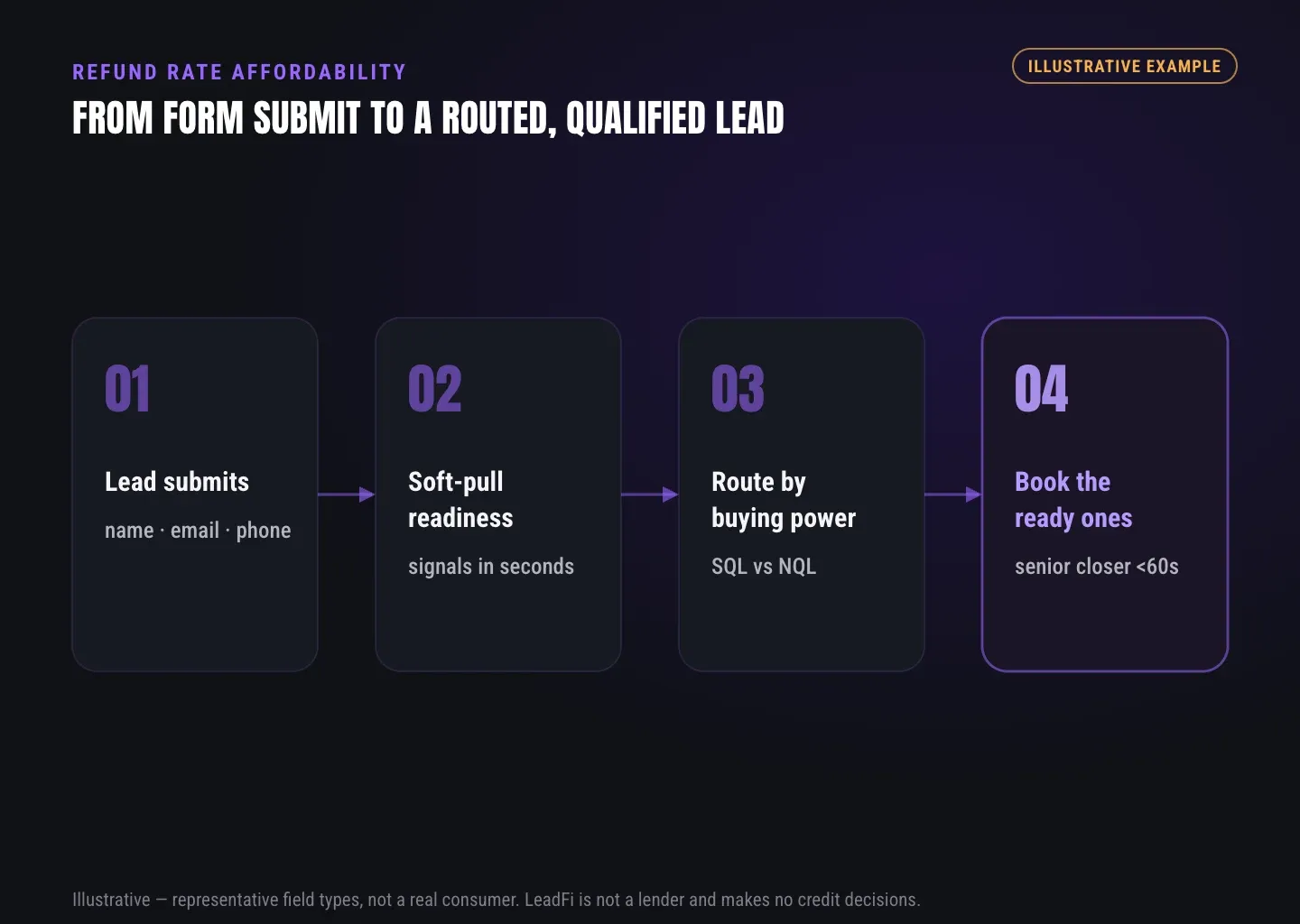
This is not a real soft pull. It's an example of the data points that land in your CRM contact record when a lead fills out your form.
LEADFI DEMO
Watch the demo, then start free or book a call.
PLATFORM OVERVIEW
What a refund costs after the sale is booked
Refunded revenue is only the first cost
Customer refund rate is the share of completed transactions that later become refunds:
Customer refund rate = Refunded transactions ÷ Completed transactions × 100
If 100 completed transactions produce eight refunds, the rate is 8%. Apply the same transaction rules in every reporting period, and track partial refunds and canceled payment plans separately when they materially affect the business.
The rate describes what happened, but it does not explain why. Refunds may follow financial strain, buyer remorse, an expectation mismatch, a delivery issue, a billing error, a personal event, or weak offer fit.
Acquisition and fulfillment costs remain
Returned revenue is only part of the economic effect. Advertising spend, payment fees, sales labor, onboarding work, and completed fulfillment may remain after a refund is issued. A useful cohort record connects the refund to its lead source, campaign, offer, payment structure, sale date, refund date, stated reason, and intake readiness status.
The purpose is to understand customer and offer patterns—not to blame a campaign, representative, or buyer. For more reporting context, see a closer look at closed lost reasons.
Payment timing can create cash pressure
A sale may appear as booked revenue in one period and reverse in another. Installment arrangements add complexity because service may begin after an initial payment but before the full contract amount is collected.
Finance and operations should compare gross cash collected, cash returned, pending requests, fulfillment costs already incurred, and net retained revenue by cohort. This analysis does not change how an individual refund request should be handled under the business's stated policy.
GUIDE
The affordability pattern behind repeat refunds
Financial readiness is not buyer intent
Intent asks whether a person wants an offer. Financial readiness asks whether that person is financially fit to buy the offer. A highly motivated lead may complete every form field while still having limited room for a new high-ticket expense.
Self-reported budget answers can begin a useful conversation, but they provide limited buying-power context. Two people may select the same budget while having materially different income, debt, available credit, or payment flexibility.
Affordability and refunds may be qualitatively related, but the relationship is not universal or causal. A financially ready buyer may request a refund because delivery missed expectations. A buyer experiencing financial pressure may still be satisfied with the service. LeadFi should not be described as having prevented a refund.
Use several signals rather than one field
Where supported by the configured workflow, financial-readiness inputs can include income, debt, debt-to-income ratio, available credit, VantageScore 4.0, age, current address, and optional asset or net-worth-style context. These signals provide routing and representative context; they are not consumer outcomes.
LeadFi can work from name, email, and phone. Its patent-pending identity matching is designed to establish a high-confidence match before an applicable soft-pull workflow or, where configured, a deeper bureau-backed workflow. Consent and disclosures must match the specific implementation.
No single signal should be treated as a complete explanation of affordability or refund behavior. Teams should evaluate signals together with the offer's price, payment structure, delivery timeline, and the buyer's stated refund reason. For CRM implementation ideas, read a closer look at financial readiness signals in your crm.
Entrepreneurship programs need offer-specific context
Entrepreneurship programs may combine education, expert access, peer interaction, tools, or operating systems at a high price. Buyers may expect future business progress, but intake analysis should remain grounded in their current financial readiness and the program's actual terms.
Teams should compare refund patterns across price points, payment structures, delivery milestones, and neutral reason codes. They should not promise business outcomes or assume that financial strain caused every refund. Any refund request should continue to be handled under the stated policy.
INTELLIGENCE LAYER
Reading refund data as an affordability signal at intake
Start with a consistent refund taxonomy
Connect every refund to the original lead record, then preserve the buyer's stated reason separately from the team's analysis. A practical taxonomy may include affordability concern, buyer remorse, expectation mismatch, delivery issue, personal event, duplicate or billing error, and unclear reason.
Do not assign an affordability label when the buyer gives another reason. Compare cohorts by source, offer, payment structure, time to refund, stated reason, intake readiness status, and delivery stage without claiming that one field caused the outcome.
Define SQL and NQL clearly
An SQL, or Sales-Qualified Lead, is someone who is financially fit to buy your offer. An NQL, or Non-Qualified Lead, is someone who is not financially fit to buy your offer.
These labels apply the business's configured financial-readiness rules. They do not represent a judgment about a person's character or enthusiasm. The Lead Routing Decision Framework (SQL/NQL by financial readiness) explains how teams can translate readiness signals into consistent CRM rules.
Keep each signal tied to a business rule
Raw financial data is not a routing rule. The business must define which signals matter for its price, payment terms, offer, and workflow. LeadFi can return an SQL or NQL status to CRM fields, tags, lists, stages, workflow triggers, or reporting systems.
This page describes a routing input, not a credit decision, approval, or eligibility determination.
Readiness status must not be used to shame a buyer, hide terms, or resist a requested refund. LeadFi does not approve or deny consumers.
Feed suitable quality signals into connected systems
Where platform rules, consent, data-use terms, and technical setup allow, teams can send suitable readiness or SQL-quality events to Meta, Google, TikTok, Hyros, and connected operations systems. This provides more context than raw lead volume, but it does not guarantee campaign performance.
LeadFi qualifies existing inbound leads; it does not generate or purchase them. Integrations may use a webhook, API, Zapier, Make, or a supported native workflow.
See which of the leads you already have can actually afford to buy.
GUIDE
Tracing refunds back to the intake record
Store stable identifiers and intake snapshots
Refund analysis becomes unreliable when the form, CRM, checkout, and finance system cannot identify the same customer. Use a stable internal lead ID and carry it through opportunity, order, transaction, refund, campaign, and readiness records.
Preserve the intake timestamp, SQL or NQL status, rule-set version, offer, price, payment option, lead source, match status, and CRM action. Because financial circumstances can change, do not overwrite an earlier intake result and present a newer value as historical truth.
Version the routing rules
Offers, prices, payment terms, and qualification rules change. Store a rule identifier beside each readiness event so analysts can distinguish cohorts evaluated under different configurations.
Versioning also makes it easier to review whether a pattern remains after an offer or workflow change. Any relationship between affordability and refunds should still be reported qualitatively rather than as proof that the readiness rule caused or prevented an outcome.
Connect the CRM and payment stack
A practical event flow is:
- The prospect submits name, email, phone, and required form data.
- Identity matching supports a high-confidence match for the configured workflow.
- Applicable financial-readiness signals support SQL/NQL classification.
- The CRM receives the status, timestamp, and rule version.
- Checkout stores the shared lead ID with the transaction.
- A later refund is linked to the same transaction and lead.
- The team compares cohorts by source, offer, reason, timing, and readiness.
This structure lets teams analyze intake quality without guessing which record produced a transaction.
Separate refund service from analysis
Customer support should handle each refund request according to the company's stated terms. Readiness status is not a reason to withhold, delay, or discourage a refund.
Analysts can review aggregate patterns independently, using neutral reason codes and controlled access to financial fields. In many workflows, most staff need only the readiness label and configured action rather than the underlying data.
Build a compliance-aware workflow
Form language, privacy terms, consent and disclosures, data access, communication practices, and downstream use should align with the implemented workflow. LeadFi supports compliance-aware setup and can help teams consider privacy- and consent-oriented choices, TCPA-aware practices, and FCRA-aware workflow guidance.
LeadFi does not provide legal advice or guarantee compliance. Clients should review their use case with counsel.
Related reading: practical insights on financial readiness signals for sales teams, a closer look at financial readiness signals in your crm, a closer look at closed lost reasons.
| Signal or record | When it appears | What it can show | Operational use |
|---|---|---|---|
| Customer refund rate | After completed sales | Share of transactions later refunded | Finance and cohort reporting |
| Stated refund reason | After a request | Buyer's reported reason | Support review and pattern analysis |
| Time to refund | After purchase | How quickly the issue appeared | Offer and delivery analysis |
| Income and debt | At intake where supported | Earnings and existing obligations | Financial-readiness context |
| Debt-to-income ratio | At intake where supported | Debt load relative to income | Configured readiness input |
| Available credit | At intake where supported | Remaining credit capacity | Buying-power context |
| VantageScore 4.0 | At intake where applicable | A score signal | Configured qualification input |
| SQL/NQL status | After qualification | Fit under the business's readiness rules | CRM routing and reporting |
| Retained revenue | After the refund window | Revenue that remained | Campaign and offer analysis |
Key takeaways
The short version
- Refund data can reveal qualitative affordability patterns without proving causation.
- Never use readiness status to deny, delay, or discourage a requested refund.
- Link refund events to the original lead, offer, transaction, and intake snapshot.
- SQL and NQL statuses apply configured financial-readiness rules to existing inbound leads.
- LeadFi adds buying-power context from thin inputs and writes routing signals into connected workflows.
Quick answers
Fast answers before you dig in
What is customer refund rate?
Customer refund rate is the share of completed transactions that later receive refunds. Divide refunded transactions by completed transactions and multiply by 100.
Can affordability signals explain customer refunds?
They can add qualitative context, but they cannot explain every refund or prove causation. Delivery, expectations, billing, personal events, and offer fit must also be reviewed.
How should refund data affect intake?
Link refunds to original intake records and compare cohorts by readiness, source, offer, payment structure, timing, and stated reason. Use the findings to refine future routing—not refund handling.
What do SQL and NQL mean in LeadFi?
An SQL is someone who is financially fit to buy your offer. An NQL is someone who is not financially fit to buy your offer.
FAQ
Common questions
What is a customer refund rate?
Can buyer affordability signals explain every customer refund rate pattern?
How should entrepreneurship programs study buyer-remorse refunds?
How does financial-readiness qualification support customer refund rate analysis?
What is SQL/NQL routing in LeadFi?
Does a LeadFi soft pull affect the consumer's credit score?
Can LeadFi connect readiness data with CRM and advertising systems?
Sources
References
- CFPB — What is a credit inquiry? (hard vs. soft) (opens in a new tab)Federal regulator confirms a soft inquiry, unlike a hard inquiry, does not affect the consumer's credit score.
- VantageScore — VantageScore 4.0 credit scoring model (opens in a new tab)Official page describing VantageScore 4.0, the tri-bureau, trended-data model used to assess credit risk.
- CFPB — Who can request to see my credit report? (opens in a new tab)Federal regulator explains the FCRA rules governing who may obtain a credit report.
Know who is ready before your next sales call.
Refund reports show what happened after a sale. LeadFi adds financial-readiness and buying-power context near intake so high-ticket teams can classify existing inbound leads, write SQL/NQL signals into their CRM, and study customer quality with a more complete record.