
QUALIFY LIVE EVENT AUDIENCE
Qualify a Live Event Audience Before You Sell From Stage
A packed room feels like proof. Every seat is full, the energy is high, and the close should be easy. Then the offer drops, and only a handful of hands go up.
Watch a contact get pre-qualified.
This is exactly what your CRM gets back.
Your opt-in form
Soft pull · no impact to their credit
This is not a real soft pull. It's an example of the data points that land in your CRM contact record when a lead fills out your form.
LEADFI DEMO
Watch the demo, then start free or book a call.
GUIDE
Why a full room is not a buying room
Quick answer: A full room mixes buyers, browsers, and people who cannot afford the offer. Headcount measures interest, not buying power. Financial-readiness qualification scores attendees on real capacity to act, so your from-stage pitch and your closers focus on people who can actually say yes to a $3,000–$10,000+ offer.
Registration counts are a vanity number. For example, 400 signups can hide the fact that only 60 people fit your price band. You feel the crowd; you do not feel the wallets. That surprise lands at the worst moment: mid-close, on stage, in front of everyone.
The usual fix is a form question: "What's your income?" or "Do you have access to capital?" That approach has a well-known flaw. People round up, guess, or just skip it. As a result, your qualification is only as honest as the box they typed into.
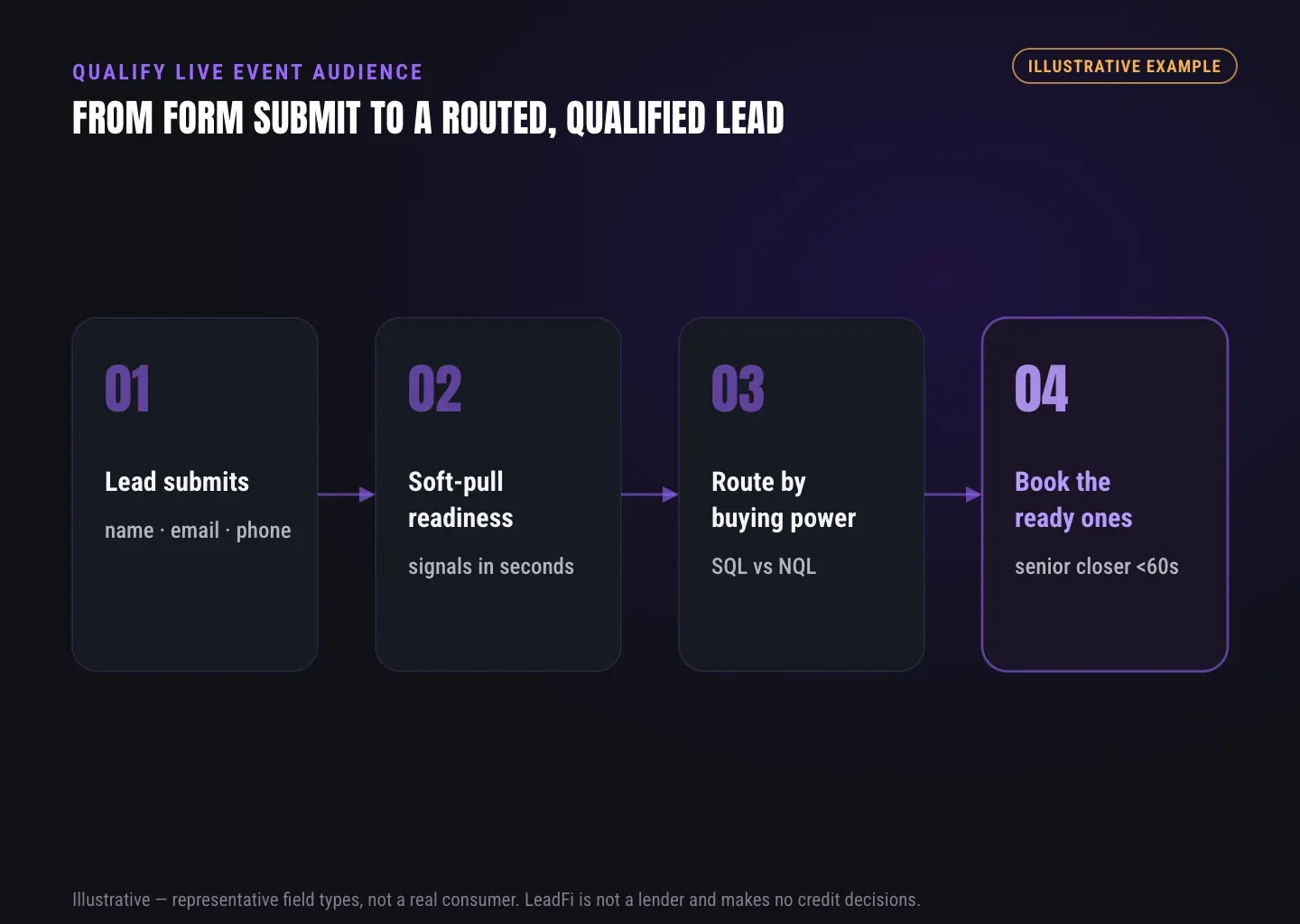
LeadFi does not ask harder. Instead, it reads. From name, email, and phone, it supports permissioned soft-pull prescreening — a read of financial-readiness signals with no impact on the attendee's credit score. It never approves or denies anyone; it classifies for routing.
The headcount trap
Big numbers feel like momentum. Still, a 400-person room and a 60-buyer room can look the same from the stage. You only learn the difference when the offer lands. By then, it's too late to change the pitch.
Self-reported answers drift
Forms ask people to grade their own wallets. As a result, the income field gets rounded, guessed, or left blank. Readiness signals read the situation instead of trusting a self-report.
Sell-from-stage momentum is fragile
A from-stage close runs on energy and timing. When half the room can't buy, the silence kills that momentum for everyone. That's why knowing buying power in advance lets you frame the offer to the people who can act.
Buyer dignity still matters
Readiness is operational, not moral. LeadFi turns signals into a buyer-FIT tag — never a score, income, or debt figure shown to a rep or on a badge. You route with respect, and the attendee never feels graded.
INTELLIGENCE LAYER
Reading readiness from a registration or check-in
Quick answer: LeadFi reads financial-readiness signals from the name, email, and phone an attendee already submits at registration or check-in. Where consent and disclosures support it, signals can include VantageScore 4.0, available credit, income, debt, debt-to-income (DTI), and funding pre-approval signals — always as readiness for routing and rep prep, not a consumer approval or denial.
Most events already collect a registration. That form is your handoff point. When a lead submits, LeadFi can receive the payload by webhook, API, Zapier, Make, or a native workflow, consistent with your consent and disclosures.
Then patent-pending identity matching works to confirm a high-confidence match before any soft-pull prescreening runs. For example, a current address or age helps set that match. This step matters: you want the read tied to the right person, not a near-match.
From there, LeadFi classifies each attendee as an SQL or an NQL. SQL means a sales-qualified lead — someone whose readiness signals fit your offer. NQL means a non-qualified lead: interested, but not a fit for the top-tier price right now.
For instance, one real-estate-education operator ran attendees through LeadFi ahead of a live event and color-coded qualified registrants at check-in. The reported outcome was a meaningful top-line lift on that single-client event. Results vary; that is one reported outcome, not a promise.
Signals LeadFi can surface
Where consent and disclosures allow, readiness signals may include VantageScore 4.0, available credit, income, debt, and DTI. For asset-heavy offers, optional net-worth-style context can help. Each stays a routing input, never a decision about the person.
Identity match comes first
The read is only useful if it's the right person. That's why identity matching runs before the soft pull, using details like current address or age. High-confidence matching keeps the readiness signal clean.
SQL vs NQL, defined once
An SQL is a financially qualified attendee for your top offer. An NQL is interested but not a fit for that price right now. You'll see these two labels throughout, and they drive every routing choice.
No credit-score impact
Soft-pull prescreening reads readiness without affecting the attendee's credit score. It is not underwriting, and LeadFi does not approve or deny consumers. The output is a routing tag, nothing more.
ROUTING
Routing the ready ones to a same-day conversation
Quick answer: Once the room is scored, LeadFi routes each attendee to the right next step. SQLs get fast-tracked to a same-day conversation — a closer, a VIP calendar, a priority follow-up. NQLs go to a low-ticket offer, a payment plan, or a financing conversation. Every attendee gets a path, so your closers spend their time on people ready to buy.
Speed matters most for your ready buyers. So LeadFi is built to flag SQLs fast, while event energy is still high. In one LeadFi use case, teams aim to reach a sales-qualified lead within 60 seconds — the white-glove treatment your best buyers expect.
NQLs are not dead weight. Instead of a hard pass, route them to a low-ticket offer, a payment plan, or a financing conversation. That way you monetize the whole room, not just the top 15%.
Funding is often the missing piece for high-ticket. For instance, when income and DTI fit, a qualified attendee can be pointed toward financing paths your partner or team offers. LeadFi surfaces the readiness; your financing partner or team handles the offer and any approval decision.
This is sell-from-stage qualification with a plan for every seat. First, the ready buyers move fast. Meanwhile, the not-yet-ready buyers get a real path instead of a cold shoulder, and your closers keep clean calendars.
Fast-track the SQLs
Financially qualified attendees deserve speed. Route them straight to a closer, a VIP calendar, or a same-day call while the room's energy carries. The goal is a first touch in seconds, not the next morning.
Give NQLs a real path
A non-qualified attendee is not a lost attendee. Instead, send them to a low-ticket offer, a payment plan, or a financing conversation. You monetize interest today and keep the relationship for later.
Financing where it fits
Some buyers want the offer but need a path to pay. When income and DTI line up, LeadFi can flag readiness so your financing partner can present options. It surfaces the fit; it never guarantees an approval and does not make the credit offer.
Cleaner calendars for closers
Your best closers should talk to buyers, not tire-kickers. Routing by readiness keeps their calendars full of SQLs. As a result, close rates and show rates tend to reflect a better-matched room.
| Approach | What it measures | Failure mode | Who it fits |
|---|---|---|---|
| Show of hands / room read | Visible interest | Interest ≠ buying power | Nobody who sells high-ticket |
| Self-reported income field | What the attendee types | People round up, guess, or skip | Low-stakes surveys |
| Post-event sales calls | Everyone, slowly | Closer time burned on non-buyers | Very small rooms |
| LeadFi readiness signals | Permissioned buying-power signals | Depends on identity match + consent | High-ticket ($3k–$10k+) teams |
See which of the leads you already have can actually afford to buy.
GUIDE
What you set up: registration fields, disclosures, CRM tags
Quick answer: Setup is light. You keep your registration form, add clear consent and disclosure language, and connect LeadFi behind it by webhook, API, Zapier, Make, or native workflow. LeadFi writes SQL/NQL tags and readiness fields into your CRM, then triggers your routing. Compliance-aware setup happens before launch as onboarding help, not a blocker.
First, start with the form you already use. Typeform, Jotform, ClickFunnels, GoHighLevel, HubSpot, or a custom page all work as capture surfaces. LeadFi sits behind that form and enriches each registration after submit.
Next, align your language. Your form disclosure, your SMS consent, and your CRM notes should tell one consistent story about why you collect what you collect. In practice, LeadFi helps teams with privacy and consent-oriented workflow choices and TCPA-aware practices — onboarding help, not legal advice.
Then map the outcomes into your CRM. LeadFi can write standard or custom fields, tags, lists, and pipeline stages, and trigger the workflow that moves each attendee. As a result, your qualification status lives where your team already works.
Finally, close the loop on ads. You can feed SQL-quality signals back into Meta, Google, TikTok, Hyros, and your ops stack, where each platform permits it and the setup is correct. That trains your campaigns on buyers, not just opt-ins. LeadFi does not guarantee platform performance.
Keep your existing registration form
You do not rebuild capture. LeadFi receives submissions from common forms and funnels, then enriches after submit. Your event page and check-in flow stay the same.
Align consent and disclosures
One consistent story matters: form, SMS, and CRM should match. In addition, LeadFi helps you shape privacy and consent language and TCPA-aware practices as part of onboarding. This is compliance-aware setup, not a legal guarantee.
Write tags and fields into your CRM
Qualification belongs where your team works. LeadFi pushes SQL/NQL status, readiness fields, tags, stages, and workflow triggers into your CRM. From there, your existing automations route each attendee.
Feed signals back to ad platforms
SQL-quality signals can flow into Meta, Google, TikTok, and Hyros where permitted. As a result, campaigns can optimize toward financially qualified buyers over cheap opt-ins. Setup and platform rules govern what's possible.
INTELLIGENCE LAYER
Comparison: self-reported forms vs. LeadFi readiness
Here's how the usual ways of reading a room stack up against financial-readiness qualification.
| Approach | What it measures | Failure mode | Who it fits |
|---|---|---|---|
| Show of hands / room read | Visible interest | Interest ≠ buying power | Nobody who sells high-ticket |
| Self-reported income field | What the attendee types | People round up, guess, or skip | Low-stakes surveys |
| Post-event sales calls | Everyone, slowly | Closer time burned on non-buyers | Very small rooms |
| LeadFi readiness signals | Permissioned buying-power signals | Depends on identity match + consent | High-ticket ($3k–$10k+) teams |
LeadFi does not replace your form, CRM, or calendar. Instead, it adds the financial-readiness layer behind them, then routes by SQL/NQL.
Key takeaways
The short version
- Headcount is a vanity number — a 400-person room can hide only 60 buyers who fit a $3k–$10k+ offer.
- LeadFi reads financial-readiness signals from name, email, and phone via soft-pull prescreening, with no impact on the attendee's credit score.
- Patent-pending identity matching confirms a high-confidence match before any soft pull, then classifies attendees as SQL or NQL for routing.
- SQLs get fast-tracked to same-day conversations; NQLs get low-ticket, payment-plan, or financing paths — every seat gets a plan.
- Setup is light: keep your existing form and CRM, connect via webhook/API/Zapier/Make, and align consent and disclosures before launch.
Quick answers
Fast answers before you dig in
How do you qualify a live event audience?
Read financial-readiness signals from the name, email, and phone attendees already submit, instead of trusting a self-reported income box. LeadFi supports permissioned soft-pull prescreening to classify each attendee as SQL or NQL for routing — with no impact on the attendee's credit score, and no approval or denial of any consumer.
What is an SQL vs an NQL at a live event?
An SQL (sales-qualified lead) is an attendee whose readiness signals fit your high-ticket offer. An NQL (non-qualified lead) is interested but not a fit for that price right now. LeadFi fast-tracks SQLs to same-day conversations and routes NQLs to low-ticket, payment-plan, or financing paths.
FAQ
Common questions
How do you qualify a live event audience without asking people to self-report income?
What is the difference between an SQL and an NQL for event lead qualification?
Does the soft pull hurt an attendee's credit score?
Can LeadFi work behind my existing registration form and CRM?
How does sell-from-stage qualification change my pitch?
What about compliance and consent for reading financial signals?
Do I need an address and date of birth up front to qualify attendees?
Sources
References
- CFPB — What is a credit inquiry? (hard vs. soft) (opens in a new tab)Federal regulator confirms a soft inquiry, unlike a hard inquiry, does not affect the consumer's credit score.
- VantageScore — VantageScore 4.0 credit scoring model (opens in a new tab)Official page describing VantageScore 4.0, the tri-bureau, trended-data model used to assess credit risk.
- CFPB — Who can request to see my credit report? (opens in a new tab)Federal regulator explains the FCRA rules governing who may obtain a credit report.
Know who is ready before your next sales call.
You already fill the room. The next step is knowing who in it can buy — before you walk on stage, not after the offer lands.