
PRE SALES QUESTIONNAIRE QUESTIONS
Pre Sales Questionnaire: Which Questions Earn a Place?
A pre sales questionnaire sent after booking should help the closer prepare for the scheduled conversation. It should capture the buyer’s goals, current process, urgency, prior attempts, and decision context without repeating the booking form or conducting the sales call in writing.
Watch a contact get pre-qualified.
This is exactly what your CRM gets back.
Your opt-in form
Soft pull · no impact to their credit
This is not a real soft pull. It's an example of the data points that land in your CRM contact record when a lead fills out your form.
LEADFI DEMO
Watch the demo, then start free or book a call.
GUIDE
Questionnaire purpose after the call is booked
Once a call is booked, the questionnaire has one job: improve the coming conversation. It should not decide whether the buyer keeps the call, and it should not attempt to complete live discovery in writing.
Context to capture before the call
Ask what prompted the booking. “What changed that made this a priority now?” usually gives the closer more useful context than a broad request to describe the business.
Desired change to identify
Ask for one primary result: “What result would make this project worth doing?” A focused answer helps the closer select relevant examples and plan the opening.
Current operating state to understand
Request a short description of the current process, team, or workflow only when the answer changes preparation. The form does not need to become a systems audit.
Prior attempts to review
Ask, “What have you tried so far, and where did it fall short?” This reveals the buyer’s experience without inviting blame or forcing a long history.
Decision process to map
Ask who will help review or sign off on the project and what the group needs to understand. This is preparation context, not a tactic for forcing every stakeholder onto the call.
A useful questionnaire gives the closer a brief, not a script. The rep should use written answers to choose a productive starting point while keeping the actual discovery conversation live.
GUIDE
Questions that change the sales conversation
A question earns its place when at least one possible answer changes the closer’s opening, discovery order, examples, proof, stakeholder plan, or next step. For every field, complete this sentence internally: “If the buyer answers X, the closer will do Y.” Remove the field if the team cannot name an action.
Eight core questions
- Goal: What is the main result you want from this work?
- Trigger: Why is this a priority now?
- Current state: How do you handle this today?
- Main gap: Where does the current approach break down most often?
- Past action: What have you tried so far?
- Timing: When would you want the new process in place?
- Decision roles: Who else will help review or sign off on the project?
- Decision criteria: What would you need to understand before choosing a path?
These are written post-booking questions. They are not a list of questions the closer must read aloud during the call.
One optional scale question
When operational volume affects implementation, ask something like, “About how many new inquiries or booked calls does your team handle each month?” Use the answer to prepare around workflow scope—not to assess the buyer’s personal finances.
Do not request Social Security numbers, birth dates, account or card numbers, credit scores, income figures, or debt figures. The closer should not mention, confirm, quote, or allude to financial-readiness details during the scheduled conversation.
Low-value questions to remove
Remove company trivia, broad demographic fields, and questions collected only because someone finds the answer interesting. Unused fields create friction and teach buyers that the form is administrative busywork.
INTELLIGENCE LAYER
Pre sales questionnaire data versus readiness data
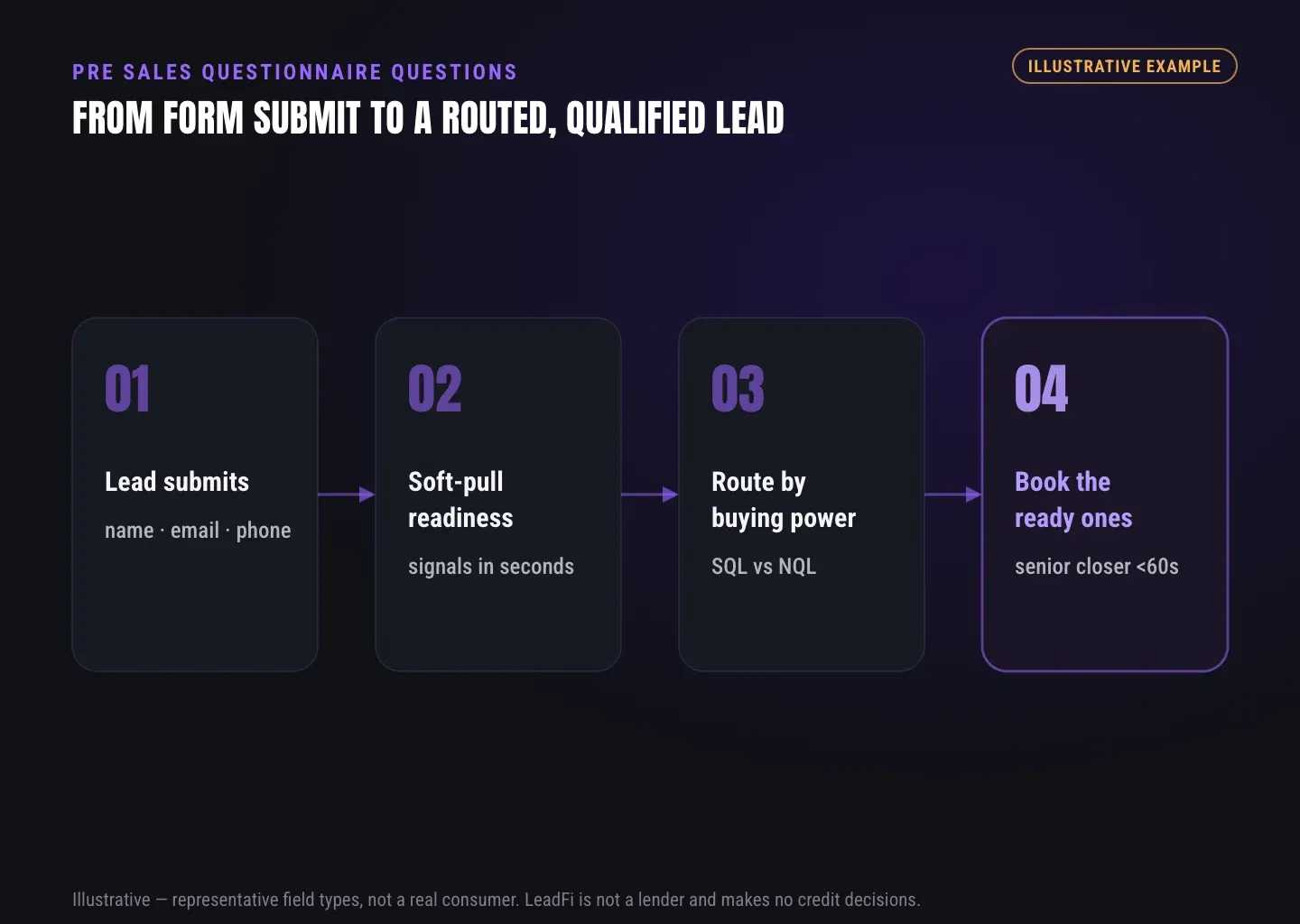
A post-booking questionnaire and a financial-readiness engine answer different questions. The questionnaire records what the buyer says about goals, operations, timing, and decision context. LeadFi adds permissioned financial-readiness signals behind the existing form, funnel, calendar, or CRM when the configured workflow supports them.
Questionnaire data explains buyer intent
Written responses help the closer understand why the buyer booked and what they want to change. Because those answers are self-reported, they should not be treated as financial-readiness data.
LeadFi adds a separate readiness layer
LeadFi can work from name, email, and phone in configured thin-input workflows. Its patent-pending identity matching is designed to establish a high-confidence match before deeper bureau-backed workflows where applicable.
Depending on consent and disclosures, configuration, and available data, internal signals may include VantageScore 4.0, available credit, income, debt, debt-to-income ratio, address, age, and optional asset context. These signals support internal routing and rep preparation; they are not questions for the written form.
Consent and disclosures start at opt-in
Any financial-readiness information on the record must arrive from the lead’s own consent and disclosures at opt-in, never from the questionnaire. Buyer-facing language should accurately describe the workflow. LeadFi supports compliance-aware setup but does not provide legal advice.
SQL and NQL labels guide internal routing
An SQL, or Sales-Qualified Lead, is someone who is financially fit to buy your offer. An NQL, or Non-Qualified Lead, is someone who is not financially fit to buy your offer. These labels can support CRM fields, alerts, ownership rules, nurture, lower-ticket paths, or alternate offers.
This page describes a routing input, not a credit decision, approval, or eligibility determination.
LeadFi does not approve or deny consumers, and it qualifies existing inbound leads rather than generating or buying leads.
Readiness details stay out of call language
The closer may use the internal record to prepare time, ownership, and workflow. The rep should not mention, quote, confirm, or allude to a lead’s score, income, available credit, debt, or debt-to-income ratio. The conversation should remain focused on the buyer’s stated goals, needs, work context, and project fit.
GUIDE
Teams that should use a post-booking questionnaire
A post-booking questionnaire is most useful when sales time is expensive and the buyer’s situation changes how the closer should prepare.
High-ticket sales teams
Coaches, consultants, agencies, course creators, and other high-ticket teams can use the form to surface offer goals, process gaps, delivery constraints, and stakeholder needs before the call.
Credit-adjacent teams
Business funding, mortgage, lending, insurance, real estate, and auto teams often operate near sensitive information. Their questionnaires should remain narrow and avoid personal financial figures. Clients should review their use case with counsel.
Revenue operations teams
RevOps can map buyer-written answers into dedicated CRM properties while keeping readiness status in separate fields. This separation makes the source and purpose of each field clear to sales managers and closers.
Media buyers and funnel owners
LeadFi can send allowed qualified-lead signals into Meta, Google, TikTok, Hyros, CRM, and operations workflows when platform rules and setup support the connection. This can help teams evaluate lead quality rather than relying only on submission or booking volume, but it does not guarantee advertising performance.
GUIDE
Questionnaire timing, length, and reading order
Send the written questionnaire while booking intent is fresh, usually through the confirmation page or booking message. Explain its value in one line: “These questions help your closer prepare so the call can focus on your goals and current setup.”
Send it immediately after booking
Place the link on the confirmation page and repeat it in the confirmation message. This makes the form feel like preparation rather than a surprise test.
Aim for six to ten questions
Most teams should begin with six to ten focused questions that take roughly five minutes. Keep response boxes short and make only essential fields required.
Put the highest-value questions first
Lead with the desired result, reason for acting, current process, and main gap. Follow with prior attempts, timing, decision roles, and decision criteria. Leave broader context optional.
Give the closer a clear reading order
A practical CRM view should show the main goal, trigger, current state, key gap, timing, decision roles, form status, and next action. A separate internal field can show SQL/NQL routing from the consent-based readiness workflow.
The form is a preparation map, not a live-call script. The buyer may introduce a more important topic once the conversation begins.
See which of the leads you already have can actually afford to buy.
GUIDE
Reading a skipped or half-finished questionnaire
A skipped or incomplete questionnaire may reflect timing, mobile friction, a lost link, unclear instructions, or a preference to speak. It is weak evidence about intent and says nothing reliable about financial readiness.
Treat completion as a preparation signal
Form status tells the closer how much written context is available. A blank form calls for a broader opening; a completed form may support a more tailored one. Neither result determines the buyer’s value.
Keep the booked call on the calendar
Do not cancel or downgrade a scheduled call because the questionnaire is incomplete. The written form supports preparation and should not operate as a gate.
Use neutral reminders
A suitable reminder is: “If you have a few minutes before the call, your answers will help the closer prepare. If not, we can cover the key context together.”
Separate completion from readiness routing
Store questionnaire status and SQL/NQL status in separate CRM fields. Do not infer readiness from completion, and do not treat a skipped field as a reason to change call access. Review recurring abandonment by field so the team can remove confusing or unnecessary questions.
GUIDE
Building a discovery questionnaire template your team will use
Start with the eight core questions and document the preparation action associated with each answer. A near-term implementation target might move rollout planning higher in the call plan. A multi-person decision may prompt the closer to prepare a concise recap for wider review.
Map each answer to a rep action
Managers should be able to explain why each field exists and how a closer uses it. If closers repeatedly ignore a field, remove or rewrite it.
Keep data sources in separate CRM fields
Buyer-written context, questionnaire status, operational fields, and financial-readiness signals should not be blended into one notes box. LeadFi can return SQL/NQL status, tags, or workflow triggers through a webhook, API, Zapier, Make, or a supported native workflow.
Build a feedback loop
Ask closers which fields improve preparation, which they ignore, and what context is still missing. Compare those answers with field-level completion patterns. The questionnaire should evolve around actual rep use rather than internal curiosity.
HOW LEADFI FITS
How LeadFi fits beside the questionnaire
LeadFi complements the written questionnaire, CRM, funnel, and calendar. The questionnaire supplies buyer-written context; LeadFi supplies a separate financial-readiness qualification and routing layer for existing inbound leads.
Receive existing inbound leads after capture
After a lead opts in or books through the current stack, a configured workflow can send name, email, and phone to LeadFi. The associated consent and disclosures must support that use. The post-booking questionnaire remains a separate preparation step.
Write readiness status into the CRM
LeadFi can return routing results to CRM fields, tags, lists, stages, alerts, or workflow triggers. The closer can review the buyer’s stated goal and an internal routing status without discussing private readiness details.
Route SQLs and NQLs by rule
Teams can prioritize timely follow-up for SQLs and route NQLs toward nurture, lower-ticket education, or another suitable path. In this post-booking context, questionnaire completion does not decide whether the scheduled call remains on the calendar.
Support timely internal follow-up
Readiness signals can trigger internal alerts and ownership rules while interest is fresh. The routing result supports timely action, while the questionnaire supports better preparation. Neither replaces the live sales conversation.
Set up the workflow with care
LeadFi helps teams think through privacy policy language, consent language, TCPA-aware practices, CRM configuration, and FCRA-aware workflow guidance before launch. LeadFi does not guarantee compliance or replace legal counsel. Clients should review their use case with counsel.
Related reading: practical insights on sales lead qualification, a closer look at credit restoration client retention, a closer look at prequalifying leads before the sales call.
| Data or task | Post-booking questionnaire | LeadFi readiness layer | Closer conversation |
|---|---|---|---|
| Primary goal | Ask in one short field | Not its role | Explore impact and scope |
| Current process | Request a brief summary | Not its role | Test gaps and constraints |
| Past attempts | Ask what was tried | Not its role | Learn what must differ |
| Project timing | Ask when change is needed | Can support configured routing rules | Discuss a realistic next step |
| Decision roles | Ask who helps review | Not its role | Plan stakeholder follow-up |
| Sensitive financial figures | Do not request | May be available through a consent-based workflow | Do not quote or allude to them |
| SQL/NQL status | Do not infer from answers | Return as an internal routing signal | Use only for internal preparation |
| CRM action | Store answers in mapped fields | Write status, tags, alerts, or triggers | Review the brief before the call |
| Form completion | Use only to assess preparation depth | Keep separate from readiness | Do not use it to cancel or downgrade the call |
| Signal feedback | Usually not a quality event by itself | Send allowed signals when supported | Not a closer task |
Key takeaways
The short version
- Use the post-booking questionnaire only to improve closer preparation.
- Start with eight questions covering goals, urgency, process, gaps, timing, and decisions.
- Never request sensitive financial figures or payment data in the questionnaire.
- Keep questionnaire completion separate from LeadFi SQL/NQL routing.
- Do not cancel or downgrade a booked call because the form is incomplete.
Quick answers
Fast answers before you dig in
What should a pre sales questionnaire ask?
Ask about the buyer’s main goal, reason for acting, current process, primary gap, prior attempts, timing, decision roles, and decision criteria. Include a field only when its answer changes call preparation.
What should a post-booking questionnaire avoid?
Avoid sensitive financial figures, payment details, identity credentials, low-value company trivia, and questions that attempt to conduct the live sales conversation in writing.
Should questionnaire completion determine whether a booked call continues?
No. Completion should affect preparation depth, not call access. A skipped or partial form should not be used to infer intent, financial readiness, SQL status, or NQL status.
How does LeadFi work with a pre sales questionnaire?
The questionnaire captures buyer-written context. LeadFi adds a separate, consent-based financial-readiness layer for SQL/NQL routing, CRM actions, rep preparation, and supported signal feedback workflows.
FAQ
Common questions
What is a pre sales questionnaire?
How many questions should a pre sales questionnaire include?
What should a pre sales questionnaire not ask?
Is a client intake questionnaire the same as a discovery questionnaire?
Should an incomplete pre sales questionnaire affect the booked call?
Can LeadFi replace a pre sales questionnaire?
How does LeadFi use financial-readiness data with a booked call?
Sources
References
- CFPB — What is a credit inquiry? (hard vs. soft) (opens in a new tab)Federal regulator confirms a soft inquiry, unlike a hard inquiry, does not affect the consumer's credit score.
- VantageScore — VantageScore 4.0 credit scoring model (opens in a new tab)Official page describing VantageScore 4.0, the tri-bureau, trended-data model used to assess credit risk.
- CFPB — Who can request to see my credit report? (opens in a new tab)Federal regulator explains the FCRA rules governing who may obtain a credit report.
Know who is ready before your next sales call.
A strong post-booking questionnaire gives the closer a concise preparation brief. LeadFi adds a separate financial-readiness layer, allowing the written form to stay focused on goals, operations, timing, and decision context.