
NET 30 ACCOUNTS
Net 30 Accounts: What Trade Credit Says About Buyer Readiness
Net 30 accounts give a business time to pay a supplier invoice, usually under a 30-day term defined by the supplier agreement. They can show how a company has handled specific vendor bills, but they do not establish its current buying power for a high-ticket purchase.
Watch a contact get pre-qualified.
This is exactly what your CRM gets back.
Your opt-in form
Soft pull · no impact to their credit
This is not a real soft pull. It's an example of the data points that land in your CRM contact record when a lead fills out your form.
LEADFI DEMO
Watch the demo, then start free or book a call.
GUIDE
Net 30 accounts define supplier payment terms
Net 30 defines invoice timing
A net 30 account is a trade-credit arrangement between a supplier and a business customer. The supplier provides goods or services, and the customer pays the full invoice under the agreed 30-day term.
The contract controls when that period begins. It may run from the invoice, shipment, delivery, or receipt date. Net 30 does not automatically create a grace period after the due date; late fees, account holds, and order limits depend on the supplier terms.
Supplier terms can vary
Suppliers may use net 15, net 30, net 45, net 60, deposits, staged billing, or payment before shipment. A term such as 2/10, net 30 may provide a discount when the invoice is paid within 10 days, with the full balance otherwise due under the 30-day term.
Order size, account history, and the commercial agreement can affect the terms available to each customer. Teams should read the underlying agreement rather than infer details from the net 30 label alone.
Trade credit differs from other financing arrangements
Trade credit arises from a supplier relationship and concerns payment for that supplier’s invoice. It does not provide a complete view of cash, revenue, total obligations, or capacity for another purchase.
For example, an $8,000 supply order under net 30 terms may help a cleaning company align its bill with expected customer collections. The same account does not establish whether the company has present capacity for a separate $10,000 service engagement.
Trade references document supplier relationships
A trade reference may confirm account age, usual invoice size, current balance, supplier terms, and payment timing. Its usefulness depends on the depth and freshness of the supplier’s records.
Not every supplier reports trade activity or agrees to provide a reference. A thin record can reflect limited reporting, a young business, or different payment methods rather than poor financial management.
INTELLIGENCE LAYER
Trade-credit behavior shows context, not full buying power
Payment timing shows one financial habit
Paying supplier invoices as agreed can show sound bill management within that relationship. Repeated delays may indicate cash-timing pressure or operational issues, but disputed deliveries, billing errors, and seasonal cycles can also affect payment timing.
A team should record the source, date, and context instead of turning one payment event into a broad conclusion.
Account age and invoice size add depth
A five-year supplier relationship with many completed payment cycles generally provides more context than one new invoice. Scale matters too: recurring $20,000 invoices say something different from a lightly used $200 office-supply account.
Even substantial invoice history does not equal free cash. The buyer may have matching revenue, other obligations, or a supplier limit that is already heavily used.
Current balances need due-date context
An open vendor account does not reveal its unused capacity. Likewise, a $15,000 balance due tomorrow creates different working-capital pressure from the same balance due several weeks later.
Sales and RevOps teams should keep supplier terms, balance dates, and reference dates visible in the CRM. That prevents old trade information from appearing current.
Business trade history and personal readiness are distinct
A business and its owner are related, but they are not the same subject. Teams should define whether an offer depends on business context, permissioned personal financial-readiness signals, or a clearly separated combination of the two.
For adjacent customer-lifecycle considerations, see a practical guide to credit restoration client retention.
Net 30 accounts do not prove affordability
One active account does not establish current income, liquid resources, available credit, debt load, or capacity for a new high-ticket payment. It should remain supporting buyer context rather than a shortcut for readiness qualification.
A company can have a strong supplier history while facing tight current capacity. Conversely, a young company can have thin trade history while its present financial signals support the client’s readiness criteria.
INTELLIGENCE LAYER
Financial-readiness inputs put trade credit in context
Financial readiness focuses on present buying power
Financial readiness asks whether a lead is financially fit for the offer and next sales step. It adds buying-power context beyond interest, job title, self-reported budget, or an old supplier relationship.
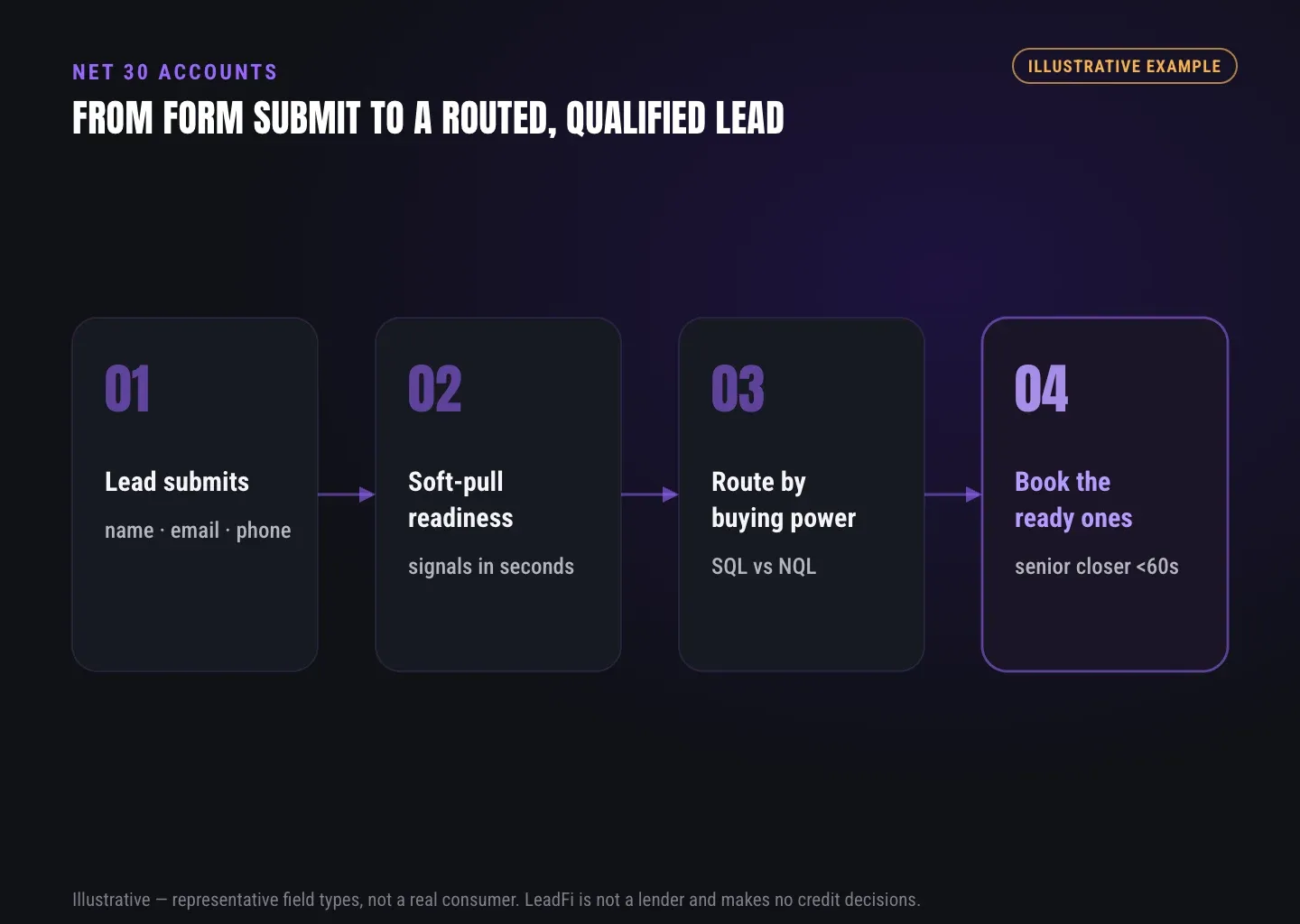
LeadFi sits behind forms, funnels, calendars, and CRMs. After an existing inbound lead submits, LeadFi can return readiness signals that support routing and rep preparation before the sales call.
SQL and NQL define the route
An SQL, or Sales-Qualified Lead, is someone who is financially fit to buy your offer. An NQL, or Non-Qualified Lead, is someone who is not financially fit to buy your offer.
The business then applies its chosen action. SQLs may receive faster follow-up and a closer path. NQLs may move to nurture, a lower-ticket product, or another relevant workflow instead of taking the same sales route.
Soft-pull workflows add current context
Depending on the configured workflow, consent and disclosures, financial-readiness signals may include VantageScore 4.0, available credit, income, debt, debt-to-income ratio, age, current address, and optional asset or net-worth-style context where available.
These signals support readiness routing and rep preparation. Net 30 accounts and supplier references can remain separate CRM context. Teams researching lower-friction data collection can read a closer look at soft credit check without address for lead qualification.
Thin-input qualification reduces form friction
LeadFi can work from name, email, and phone for many permissioned workflows. Its patent-pending identity matching is designed to establish a high-confidence match before soft-pull prescreening and, where applicable, deeper bureau-backed credit-report workflows.
Some configurations may not require address and date of birth up front. That is a workflow design choice, not a substitute for appropriate consent and disclosures.
CRM routing turns signals into action
LeadFi can return results through a webhook, API, Zapier, Make, or supported native workflow. CRM fields, tags, stages, tasks, pages, and calendars can then reflect the selected route.
For example, an SQL can trigger a priority task and suitable closer calendar. An NQL can trigger nurture or an alternate offer. Trade-reference notes remain available to the rep without being presented as a live buying-power signal.
Qualified-lead signals support campaign optimization
Where the setup and platform rules allow, teams can feed qualified-lead events back into Meta, Google, TikTok, Hyros, and operational reporting. This gives media teams an optimization event based on lead quality rather than form completion alone.
LeadFi does not promise campaign performance. The objective is to give sales, RevOps, and media teams a clearer signal for evaluating lead sources.
See which of the leads you already have can actually afford to buy.
INTELLIGENCE LAYER
Qualification criteria should link every signal to an action
Offer price sets the readiness baseline
Start with the offer price, deposit, payment schedule, and sales path. A $3,000 workshop and a $12,000 advisory program should not automatically use the same readiness rule.
Supplier history can remain visible for both offers, while the current financial-readiness workflow applies the appropriate route to each one.
Each signal needs a defined purpose and source
Give every field one clear role. Supplier terms may help a rep understand bill timing; debt-to-income may add current obligation context; CRM engagement may show intent.
Label each field with its source and date. A prior-year trade reference should not look like a current financial-readiness signal, and a self-reported budget should remain identified as self-reported.
Thresholds require named sales actions
Connect every result to a calendar, queue, rep, page, offer tier, or nurture path. A threshold without a resulting action does not improve sales operations.
Useful CRM fields can include readiness_status, readiness_rule_version, routing_reason, signal_date, and next_step. Trade context can remain in fields such as supplier_terms, vendor_reference_count, and trade_reference_notes.
Exceptions need a review path
Identity data, trade history, or current signals may be thin or mixed. Create a manual-review state with a named owner instead of allowing each rep to invent a different rule.
If an identity match does not meet the configured workflow standard, an old supplier reference should not be used as a substitute. The reviewer should follow the written process and record the resulting route.
Rule versions prevent hidden drift
Assign each readiness rule an owner, version, effective date, and review schedule. Update it when the offer, price, funnel, or sales path changes.
Versioning gives sales, RevOps, and media teams a shared definition of the qualified-lead event and helps prevent unnoticed routing changes.
Compliance belongs in onboarding
Align the form, privacy language, consent and disclosures, CRM fields, routing actions, and follow-up channels before launch. Send only the smallest useful event to advertising and operational platforms, rather than raw financial details.
LeadFi supports compliance-aware workflows and can help teams consider privacy language, consent language, and TCPA-aware practices. LeadFi does not provide legal advice, and clients should review their use case with counsel.
Related reading: a practical guide to credit restoration client retention, a closer look at soft credit check without address for lead qualification, a practical guide to refund rate affordability.
| Input | What it can show | What it cannot establish | Best operational use |
|---|---|---|---|
| Net 30 account | Supplier relationship and stated payment term | Current buying power or unused capacity | Add business context to the CRM |
| Trade reference | Account age, invoice range, balance, and payment pattern | A complete or current financial picture | Support rep preparation and rule review |
| Self-reported form data | Stated budget, revenue, needs, or timing | Independently supported buying power | Capture goals and intent |
| Soft-pull financial-readiness signals | Permissioned income, debt, available-credit, score, or ratio context where configured | Product fit, intent, or a guaranteed sales outcome | Support SQL vs NQL routing |
| CRM engagement | Forms, messages, calls, source, and sales stage | Financial fitness | Measure intent and follow-up activity |
Key takeaways
The short version
- Net 30 accounts define supplier invoice timing, not total buying power.
- Trade references need source, date, balance, and invoice-scale context.
- LeadFi qualifies existing inbound leads before the sales call.
- SQLs and NQLs can follow distinct sales, nurture, or alternate routes.
- Compliance-aware setup still requires suitable consent and disclosures.
Quick answers
Fast answers before you dig in
What are net 30 accounts?
Net 30 accounts are supplier arrangements under which the full invoice is due according to an agreed 30-day term. The contract or invoice determines when that period starts.
What do net 30 accounts say about buyer readiness?
They can provide context about a specific supplier relationship and payment pattern, but they do not establish present income, available credit, debt load, liquid resources, or high-ticket buying power.
How should sales teams use trade-credit references?
Store the reference source, date, account age, invoice range, terms, and payment pattern as CRM context. Keep it separate from current financial-readiness signals used for routing.
How does LeadFi use net 30 account context?
LeadFi qualifies a client’s existing inbound leads by readiness before the sales call. Supplier information can remain separate rep context while permissioned signals support SQL vs NQL routing.
FAQ
Common questions
What are net 30 accounts?
Do net 30 accounts prove that a business can afford a high-ticket offer?
What are net 30 vendor accounts used for?
What information can a trade-credit reference include?
How should net 30 accounts affect lead qualification?
Can LeadFi use name, email, and phone for financial-readiness qualification?
Does LeadFi use net 30 accounts as a stand-alone readiness result?
Sources
References
- CFPB — What is a credit inquiry? (hard vs. soft) (opens in a new tab)Federal regulator confirms a soft inquiry, unlike a hard inquiry, does not affect the consumer's credit score.
- VantageScore — VantageScore 4.0 credit scoring model (opens in a new tab)Official page describing VantageScore 4.0, the tri-bureau, trended-data model used to assess credit risk.
- CFPB — Who can request to see my credit report? (opens in a new tab)Federal regulator explains the FCRA rules governing who may obtain a credit report.
- VantageScore (opens in a new tab)Official information about VantageScore models, including VantageScore 4.0.
- Federal Trade Commission: Credit and Finance Guidance (opens in a new tab)General business guidance relevant to credit- and finance-adjacent workflows.
Know who is ready before your next sales call.
Net 30 accounts can inform a sales conversation, but current financial-readiness signals determine what the team should do next. LeadFi can sit behind your form, funnel, calendar, or CRM to qualify existing inbound leads before the sales call and support SQL vs NQL routing.