
MORTGAGE TRIGGER LEADS
Mortgage Trigger Leads: What They Are and How Teams Handle Them After the HPPA
Mortgage trigger leads have changed. Historically, the term described consumer data associated with a recent mortgage credit inquiry and used for competing outreach.
Watch a contact get pre-qualified.
This is exactly what your CRM gets back.
Your opt-in form
Soft pull · no impact to their credit
This is not a real soft pull. It's an example of the data points that land in your CRM contact record when a lead fills out your form.
LEADFI DEMO
Watch the demo, then start free or book a call.
GUIDE
Mortgage trigger leads came from credit inquiry data
Credit inquiries created the trigger
A mortgage trigger occurred when a consumer sought mortgage credit and a lender requested a consumer report. Historically, consumer reporting companies could use that event to create lists for competing mortgage outreach. The inquiry indicated activity, but it did not establish financial readiness, intent to speak with another firm, or fit for a particular sales process.
HPPA restrictions changed the market
The HPPA became law in 2025, and its principal restrictions took effect 180 days later, on March 4, 2026. The law generally restricts furnishing consumer reports connected to residential mortgage transactions unless the consumer has consented or a narrowly defined current relationship and statutory use applies.
Those current-relationship paths address specified circumstances involving an existing mortgage originator, mortgage servicer, or qualifying financial-institution relationship. Teams should use the enacted text and counsel—not vendor summaries—to assess whether a particular path applies.
Current lead sources need review
A vendor may continue using the phrase “mortgage trigger leads” even if its sourcing model has changed. Buyers should ask what event produced the record, which entity collected the information, whether the consumer consented to the specific furnishing, and how the planned outreach aligns with that record.
The source contract, data flow, consent and disclosures, and intended contact channels should all be reviewed before launch.
Inbound mortgage leads are different
An inbound lead enters a company's own intake through its form, funnel, referral path, or booking flow. That differs from receiving data because another lender initiated an inquiry. First-party capture provides more control over the intake experience, but it still requires appropriate privacy, consent, data-use, and outreach practices.
GUIDE
Mortgage trigger leads arrive unevenly qualified
Mortgage trigger leads historically varied because the trigger recorded one event, not a complete sales profile. A consumer might have been researching, comparing options, supporting a co-borrower, or already working with another company.
Inquiry activity is not buying power
A recent inquiry does not by itself explain income, debt, available credit, debt-to-income ratio, or readiness for a particular high-ticket offer. Reps therefore need more context than an inquiry date before deciding how to prioritize a conversation.
Contact does not equal intent
A consumer may have substantial buying power without wanting outreach from another mortgage company. Conversely, someone who requested information may not fit the business's financial-readiness rules. Intent and readiness are separate operating questions.
Readiness needs a defined next action
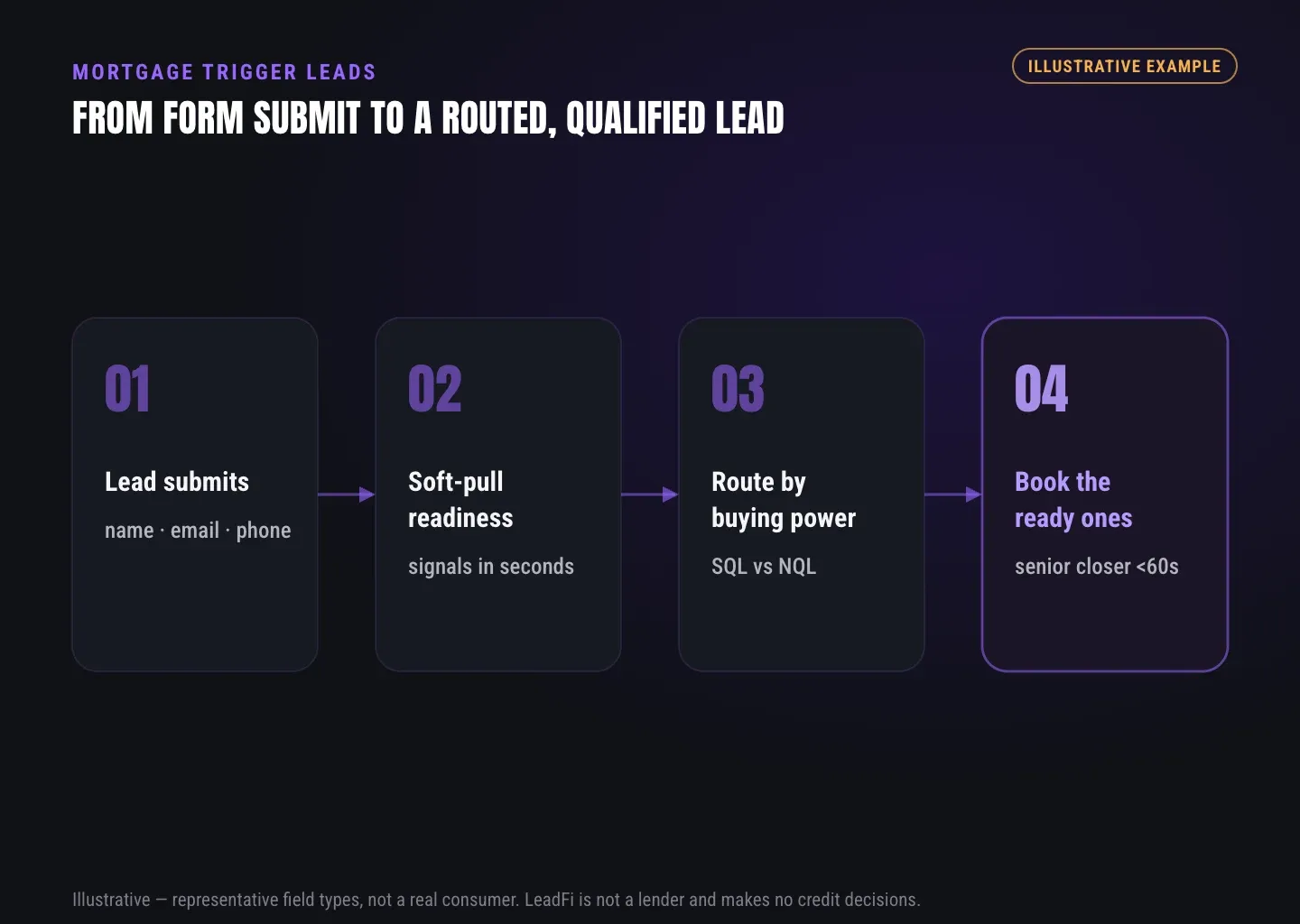
LeadFi uses SQL and NQL as sales-routing labels. An SQL, or Sales-Qualified Lead, is someone who is financially fit to buy your offer. An NQL, or Non-Qualified Lead, is someone who is not financially fit to buy your offer.
These labels determine internal sales paths. An SQL can receive prompt rep attention, while an NQL can enter education, nurture, a lower-ticket path, or another suitable offer.
One intake event can create several routes
Suppose three consumers submit the same mortgage education form. One matches the company's readiness rules and requests a conversation, another is not financially fit for the offer, and a third needs an operations review because submitted details are incomplete. The workflow can route them respectively to a rep, an educational sequence, and a manual-review queue.
GUIDE
Inbound mortgage leads can be qualified before the sales call
LeadFi sits behind a client's existing form, funnel, calendar, or CRM. After submission, it enriches the lead and returns financial-readiness information for routing. In other words, LeadFi qualifies a client's existing inbound leads by readiness before the sales call; it is not a source of mortgage trigger lists.
Thin inputs can start identity matching
LeadFi can work from name, email, and phone for supported thin-input workflows. Its patent-pending identity matching is designed to establish a high-confidence match before soft-pull prescreening and, where applicable, deeper bureau-backed workflows. Identity-related information and identity signals, such as current address or age, may also support the configured process.
This does not remove consent and disclosures or other workflow requirements. The exact fields and matching path depend on the client's configuration and counsel-reviewed use.
Soft-pull prescreening supports readiness routing
Where configured and supported, soft-pull prescreening can provide financial-readiness context without a hard inquiry. LeadFi uses the result to support routing and rep preparation within the client's sales workflow.
This capability should be reviewed for the client's specific use. LeadFi is a readiness engine rather than a generic endpoint that merely returns consumer data.
Readiness signals add sales context
Depending on configuration and availability, signals may include VantageScore 4.0, available credit, income, debt, debt-to-income ratio, age, address, and optional asset or net-worth-style context. Teams should expose only the information needed for the assigned task and use the signals to apply their internal readiness rules.
SQL and NQL results update the existing stack
An SQL result can update a CRM field, apply a tag, alert a rep, assign an owner, or direct the lead to a selected calendar. An NQL can enter nurture, education, a lower-ticket path, or an alternate offer. Integrations may use webhooks, APIs, Zapier, Make, or supported native workflows.
Qualified-lead signals support marketing analysis
Where platform rules, client settings, and the reviewed data flow allow, teams can send qualified-lead events to Meta, Google, TikTok, Hyros, or other operations and attribution systems. This gives media teams a lead-quality event to study alongside raw submissions, without promising a particular advertising result.
INTELLIGENCE LAYER
Financial readiness qualification fits inbound mortgage teams
Financial-readiness qualification fits mortgage businesses that already generate inbound demand but need clearer prioritization before calls. LeadFi complements the existing capture stack rather than requiring a replacement CRM, form builder, scheduler, or funnel.
Mortgage sales teams prioritize fit
Sales managers can build queues around readiness instead of treating every form submission alike. This supports speed-to-lead for financially qualified inbound leads while giving lower-readiness leads a defined alternate path.
Agencies report lead quality
Mortgage marketing and lead-generation agencies can report SQL and NQL volume alongside raw form volume. Teams evaluating adjacent workflows may also use a practical guide to solar lead qualification to understand how readiness-based routing applies in another high-ticket vertical.
Revenue operations teams manage handoffs
RevOps can write readiness results into CRM fields, tags, stages, lists, or alerts. Teams serving education businesses may find a closer look at coaching program lead qualification useful when designing nurture, rep assignment, and alternate-offer paths.
Related high-ticket workflows use the same readiness layer
The same operating model can support other credit-adjacent or high-ticket funnels while keeping each client's rules and responsibilities separate. For an adjacent example, see practical insights on readiness layer alongside credit repair software. CROA and FCRA responsibility depends on the client's use and remains with the client and its counsel.
See which of the leads you already have can actually afford to buy.
INTELLIGENCE LAYER
LeadFi capabilities turn readiness into routing
LeadFi combines financial-readiness signals with workflow actions. The client defines the financial-fit rules for its offer, LeadFi classifies existing inbound submissions, and the connected stack applies the selected route.
Identity matching comes before configured enrichment
Patent-pending identity matching is designed to establish a high-confidence match from submitted identity-related information before supported soft-pull or bureau-backed steps. The specific process depends on the workflow, consent and disclosures, and configuration.
Real-time classification supports prompt routing
For supported workflows, LeadFi can return the readiness result while the lead is still moving through intake. Teams can prioritize financially qualified leads without sending every submission into the same queue.
CRM and calendar outcomes guide action
A readiness result can assign an owner, update a pipeline stage, send an alert, select a calendar, display an appropriate page, or begin nurture. Reps can receive the result where they already work instead of checking a separate system for each submission.
Current tools can stay in place
LeadFi can work with common form builders, CRMs, funnels, calendars, and custom applications. Connection options include webhooks, APIs, Zapier, Make, and supported native workflows. The goal is to add a readiness layer behind the current intake rather than rebuild the complete technology stack.
GUIDE
Compliance responsibility stays with the team and counsel
The HPPA makes current source review essential for any company evaluating mortgage trigger leads. The historical assumption that a mortgage inquiry could broadly support competing outreach no longer reflects the rules in force as of September 2026.
HPPA review starts with the lead source
Teams should document the event that generated each lead, the entity furnishing the data, the relevant consumer consent, any claimed statutory relationship, and the intended outreach. Counsel should compare those facts with the enacted HPPA text and other applicable rules.
Consent should match the workflow
Form language, privacy terms, contact-channel consent, CRM records, vendor data flows, and sales scripts should describe a consistent use. Thin-input identity matching does not remove consent and disclosures. A readiness label also does not authorize every form of outreach.
FCRA and CROA responsibility stays with the client
FCRA responsibility depends on how the client configures and uses consumer-report or prescreening functionality. CROA may require review when the client's offer involves credit-repair services. In both cases, responsibility for the use remains with the client and its counsel.
LeadFi stays within financial-readiness qualification and routing. Clients should not present SQL or NQL status as a mortgage eligibility result.
Compliance-aware setup belongs before launch
LeadFi can help teams map privacy-policy language, consent-oriented workflow choices, TCPA-aware practices, access controls, and FCRA-aware configuration during onboarding. LeadFi does not provide legal advice or guarantee compliance. Final decisions remain with the client and its advisors.
Related reading: practical insights on readiness layer alongside credit repair software, a practical guide to solar lead qualification, a closer look at coaching program lead qualification.
| Area | Historical mortgage trigger leads | Existing inbound with LeadFi |
|---|---|---|
| Lead origin | Mortgage inquiry associated with another process | Consumer submits the client's form, funnel, or booking flow |
| Primary motion | Competing outreach | Qualification and routing after first-party capture |
| Current context | Sharply restricted by the HPPA | Requires reviewed consent, data use, and outreach practices |
| Core information | Recent mortgage inquiry event | Configured financial-readiness and identity signals |
| Sales action | Historically call, text, email, or mail | SQL/NQL route, CRM update, alert, calendar, or nurture |
| Stack role | Typically a bought or furnished list | Works behind existing forms, CRMs, funnels, and calendars |
| Primary value | Timing around mortgage shopping | Rep prioritization, alternate routing, and lead-quality feedback |
| Required review | HPPA source, consent, statutory relationship, and outreach | Consent and disclosures, data flow, access, retention, and follow-up |
Key takeaways
The short version
- HPPA trigger-lead restrictions took effect March 4, 2026.
- Mortgage inquiry activity does not establish financial readiness.
- LeadFi qualifies existing inbound leads before the sales call.
- SQLs receive priority; NQLs enter alternate sales paths.
- HPPA, FCRA, and CROA use remains with clients and counsel.
Quick answers
Fast answers before you dig in
What are mortgage trigger leads?
Mortgage trigger leads historically came from consumer data associated with a recent mortgage credit inquiry. The HPPA now sharply restricts when that data may be furnished for competing mortgage outreach.
Are mortgage trigger leads still available after the HPPA?
The former broad trigger-lead model is sharply restricted. Limited paths involving consumer consent or specified current relationships may remain, but counsel should review the exact source and intended use.
When did the HPPA mortgage trigger lead restrictions take effect?
The principal HPPA restrictions took effect on March 4, 2026, 180 days after enactment. They remain in force as of September 21, 2026.
How does LeadFi handle mortgage inbound leads?
LeadFi qualifies a client's existing inbound leads by financial readiness before the sales call, returns an SQL or NQL routing label, and sends the result to the client's existing sales stack.
What is the difference between an SQL and an NQL?
An SQL is someone who is financially fit to buy your offer. An NQL is someone who is not financially fit to buy your offer. Both labels are used for internal sales routing.
FAQ
Common questions
What are mortgage trigger leads?
Are mortgage trigger leads still legal after the HPPA?
When did the mortgage trigger leads restrictions take effect?
Are trigger mortgage leads the same as inbound mortgage leads?
How does LeadFi qualify mortgage inbound leads?
Which financial-readiness signals can LeadFi provide?
Does LeadFi replace a mortgage CRM or lead source?
Who is responsible for FCRA and CROA review?
Sources
References
- CFPB — What is a credit inquiry? (hard vs. soft) (opens in a new tab)Federal regulator confirms a soft inquiry, unlike a hard inquiry, does not affect the consumer's credit score.
- VantageScore — VantageScore 4.0 credit scoring model (opens in a new tab)Official page describing VantageScore 4.0, the tri-bureau, trended-data model used to assess credit risk.
- CFPB — Who can request to see my credit report? (opens in a new tab)Federal regulator explains the FCRA rules governing who may obtain a credit report.
- Congress.gov — H.R. 2808, Homebuyers Privacy Protection Act (opens in a new tab)Legislative history, enacted status, statutory text, and effective-date provision for the HPPA.
- GovInfo — Public Law 119-36 (opens in a new tab)Official published text of the enacted Homebuyers Privacy Protection Act.
- Consumer Financial Protection Bureau — Prescreened credit offers (opens in a new tab)General consumer-facing background on prescreened credit offers and consumer reporting data; the HPPA text controls the mortgage-specific restrictions discussed here.
Know who is ready before your next sales call.
The HPPA changed the mortgage trigger leads market, while inquiry activity alone never solved financial-fit routing. A more durable approach is to qualify the inbound demand your business already generates.