
LEAD VENDOR RETURN POLICY
Lead Return Policy: What to Negotiate Before You Buy
A lead return policy defines when a delivered lead fails the agreed order terms. Strong policies name each defect, the required evidence, the reporting deadline, the review process, and the remedy.
Watch a contact get pre-qualified.
This is exactly what your CRM gets back.
Your opt-in form
Soft pull · no impact to their credit
This is not a real soft pull. It's an example of the data points that land in your CRM contact record when a lead fills out your form.
LEADFI DEMO
Watch the demo, then start free or book a call.
GUIDE
Lead return clauses: What they cover
A return clause should answer five questions: What counts as defective? How quickly must it be reported? What evidence is required? Who decides the claim? What remedy follows approval?
Contact defects
Define invalid phone numbers, hard email bounces, fake information, and missing required fields separately. A disconnected number is easier to verify than a person who simply does not answer, so those outcomes should not share one reason code.
Duplicate records
State the identifier used for matching and the lookback period. Exact-match rules are easier to review than informal judgments about similar names or households.
Geography and eligibility
Name the fields that determine whether a record fits the order, such as region or an agreed audience attribute. Preserve the submission-time value and timestamp so later changes do not distort the review.
Consent and source limits
If the order requires particular consent and disclosures, describe the required records and retention process. A return clause does not replace the buyer’s responsibility to review forms, privacy language, outreach, and CRM practices.
Delivery and exclusivity
Define the delivery event, controlling system, and timestamp. If exclusivity matters, specify its duration, campaign scope, and buyer group instead of relying on the word “exclusive” alone.
Remedy type
An approved claim may result in a replacement, account credit, cash refund, make-good volume, or another negotiated remedy. State which applies and when it must be delivered.
Contact validity versus lead quality
A reachable person can still be a poor fit for a high-ticket offer. Keep record validity, engagement, sales fit, and financial readiness as separate measurements.
GUIDE
Unqualified leads: Define them in the contract
“Unqualified” is too broad to serve as a return rule. Separate objective order defects from outcomes influenced by pricing, sales execution, timing, and internal qualification standards.
Data-invalid leads
A data-invalid record fails a defined delivery test, such as an invalid required contact field. The agreement should name the test and the system used to document it.
Order-invalid leads
An order-invalid record falls outside an agreed campaign attribute. Evaluate the facts recorded at submission rather than a prospect’s later circumstances.
Sales-unqualified leads
Sales qualification can depend on discovery questions and rep judgment. If it affects credits, define the questions, accepted answers, and evidence before launch.
Financially unqualified leads
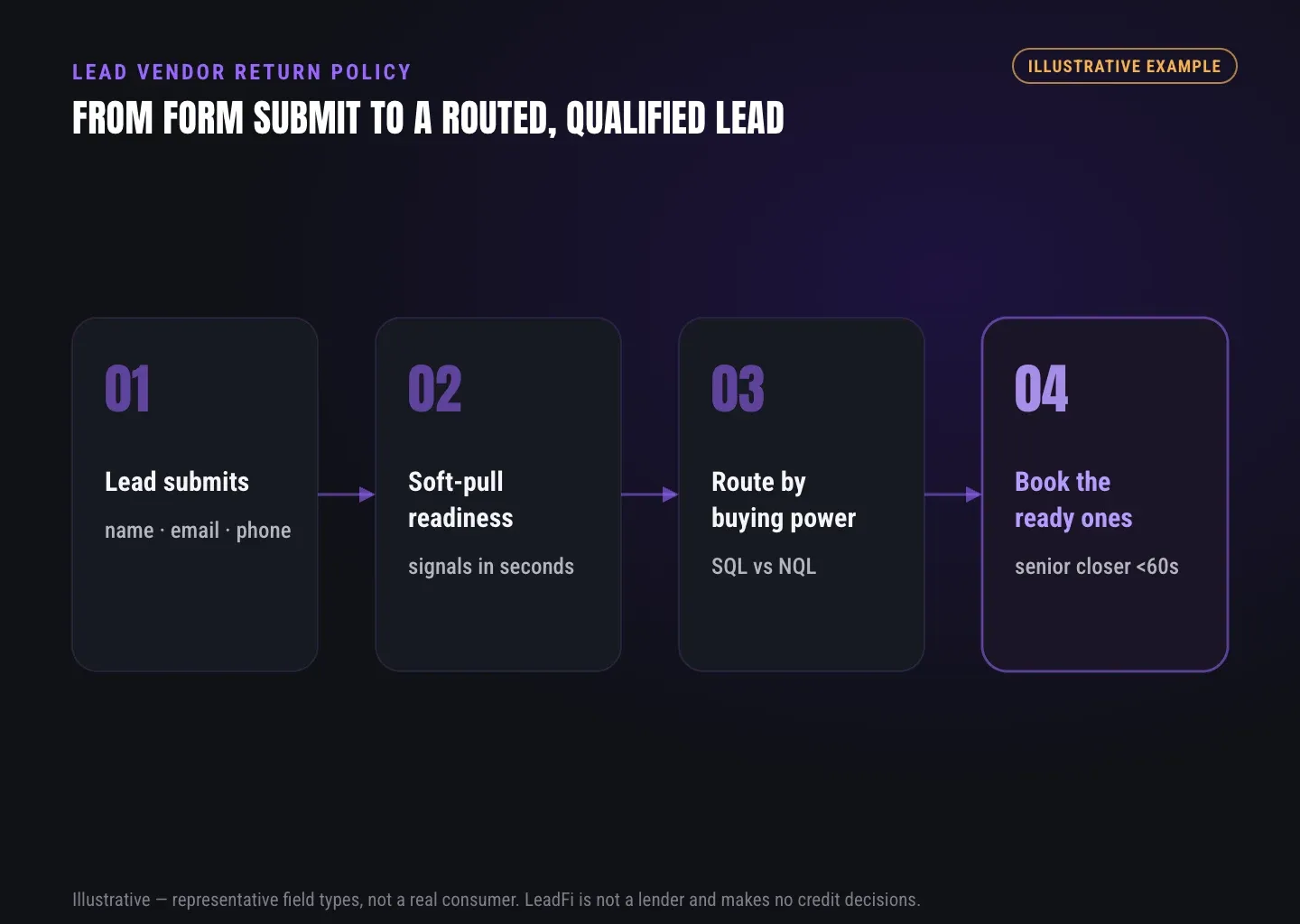
For LeadFi terminology, an SQL, or Sales-Qualified Lead, is someone who is financially fit to buy your offer. An NQL, or Non-Qualified Lead, is someone who is not financially fit to buy your offer. These labels support financial-readiness routing; they are not consumer approval or denial decisions.
LeadFi is designed for soft-pull prescreening and thin-input financial-readiness qualification within appropriately configured workflows. The exact workflow depends on the client’s setup, consent and disclosures, and applicable requirements.
Unresponsive leads
A person who does not answer is not automatically an invalid record. If unresponsiveness is returnable, specify the required attempts, channels, and follow-up period.
Disqualified versus returnable leads
Use separate CRM fields for return reason and qualification status. An NQL may satisfy every delivery term, while an invalid record may never reach qualification.
Qualification matrix
A practical matrix should map each outcome to its test, evidence, return treatment, and operational next step. The signed agreement—not a generic template—controls whether an outcome is returnable.
GUIDE
Return evidence: What the vendor should accept
A return right has limited value when evidence rules are vague. List acceptable proof for each reason and make the submission process simple enough for weekly use.
Source and delivery records
Preserve the original payload, lead ID, campaign ID, source label, and delivery timestamp before staff edit the record.
CRM activity history
Track first response time, outreach attempts, ownership, status changes, and standardized outcome codes. “Phone disconnected at 10:14 a.m.” is stronger evidence than “bad lead.”
Duplicate proof
Show both record IDs, the matching field, and the dates establishing that the earlier record falls inside the agreed lookback window.
Call and message outcomes
Use fixed outcomes such as disconnected, hard bounce, wrong person, no answer, callback requested, or opted out. Free-form notes can add context but should not replace standard fields.
Qualification records
If financial readiness affects renewal economics or credits, agree on the qualification method, cohort, and reporting source before the campaign. Keep the resulting status separate from rep opinion and return status.
Return submission log
Maintain the lead ID, reason code, evidence link, submission date, decision, remedy, and owner. Finance should be able to reconcile approved credits without searching email threads.
Practical review windows
Different defects may justify different deadlines. Immediate data defects can have a short window, while contact-cadence or cohort qualification reviews may require more time.
Weak evidence rules
Avoid one-sided discretion without a stated test. Require record IDs, timestamps, and a written reason when a claim is rejected.
GUIDE
Lead return remedies: Compare the options
Remedies affect cash flow, sales capacity, and future purchasing differently. Confirm whether credits expire, whether they require another order, and whether replacement records follow the same return rules.
Replacement credits
Lead vendor replacement credits can restore contracted volume after verified defects. They are less useful when the sales team is already at capacity or the broader campaign has weak fit.
Cash refunds
Bad lead refund terms should state when an approved claim results in money rather than future volume, plus the payment method and deadline.
Price adjustments
A future rate adjustment can reflect an agreed defect or qualification band. Use a fixed cohort, shared exclusions, and one reporting source so both parties calculate the rate consistently.
Renewal concessions
Possible concessions include a shorter term, lower minimum, test cohort, or revised quality band. Document each concession rather than relying on informal commitments.
GUIDE
Renewal terms: Tie them to qualified rate
Individual return claims measure contract defects. Renewal reviews should evaluate the campaign as a defined cohort. A campaign may have valid contact records but still produce too few financially qualified opportunities for a high-ticket offer.
Cohort definition
Choose a fixed campaign, source, offer, and measurement period. Do not mix newly delivered records with older nurture leads.
Three separate quality rates
At minimum, track contact validity, sales qualification, and financial qualification separately. A high contact-valid rate does not imply a high SQL rate.
Useful supporting metrics include duplicate rate, first-response time, route completion, and conversion. Each answers a different operational question.
Performance bands
Define green, yellow, and red bands before results arrive. Each band can trigger an agreed action, such as renewal, review, reduced volume, or a new test cohort.
Sales execution controls
Response time, contact cadence, pricing, sales skill, and offer fit influence conversion. Do not treat every lost sale as a delivery defect.
Financial readiness at renewal
Financial-readiness qualification helps teams evaluate whether captured demand fits the economics of a high-ticket offer. LeadFi qualifies a client’s existing inbound leads after capture and can complement current forms, funnels, calendars, and CRM workflows.
Funnel feedback and routing
Where configured, SQLs can receive faster sales follow-up while NQLs can move to nurture, lower-ticket offers, or another appropriate path. Qualified-lead status may also inform CRM and paid-media optimization workflows when allowed and correctly configured. No platform or campaign outcome is guaranteed.
See which of the leads you already have can actually afford to buy.
GUIDE
Lead return policy scorecard: What to track
Build the scorecard before the first record enters the CRM. Standard fields prevent sales, operations, and finance from using different labels for the same result.
Contract fields
Track the campaign ID, contract version, delivery timestamp, return reason, and evidence link. Use fixed reason codes for each agreed defect.
Qualification fields
Store SQL/NQL status separately from return status. This preserves the distinction between buying-power fit and contractual validity.
Workflow fields
Record the configured next action and whether it occurred. Examples include a closer queue, nurture sequence, lower-ticket path, alternate offer, or manual review.
Finance fields
Track requested value, approved value, remedy type, invoice application, expiration date, and remaining balance.
Ownership fields
Assign an operations owner, finance owner, and escalation contact. Review open claims regularly rather than waiting for renewal.
GUIDE
Stronger return processes: Who needs them?
The more expensive each sales conversation becomes, the more important it is to separate delivery defects from financial fit.
High-ticket sales teams
Coaches, consultants, agencies, course businesses, and other high-ticket teams should track SQL rate alongside show rate and close rate. This helps protect scarce setter and closer capacity.
Credit-adjacent teams
Business funding, mortgage, lending, insurance, real estate, and auto finance workflows require particular care around consent and disclosures. LeadFi supports compliance-aware workflows but does not provide legal advice or guarantee compliance. Clients should review their use case with counsel.
RevOps teams
RevOps needs standardized source IDs, timestamps, evidence, return reasons, and qualification fields. One report can reconcile contractual remedies while another evaluates SQL vs NQL routing.
Media buyers
Media buyers benefit from evaluating financially qualified demand rather than optimizing only for inexpensive form submissions. Any feedback loop should follow the organization’s approved data and platform practices.
Sales leaders
Sales leaders need fast action on financially qualified leads without treating every NQL as defective. Clear statuses let invalid records enter the claim process while valid NQLs follow an alternate path.
GUIDE
Lead return policy negotiation checklist
Settle these points before buying or renewing:
- Return reasons: List every returnable defect.
- Required fields: Define a valid delivery.
- Duplicate rule: State the matching field and lookback period.
- Order fit: Define included and excluded attributes.
- Delivery event: Name the controlling system and timestamp.
- Evidence standard: Match proof requirements to each reason.
- Contact cadence: Set attempts, channels, and duration.
- Submission and review windows: Establish deadlines for both parties.
- Rejection process: Require a written reason.
- Remedy: Choose replacement, credit, refund, or another treatment.
- Credit terms: Address expiration and invoice application.
- Replacement treatment: Confirm whether replacements remain returnable.
- Cohort: Fix the source, campaign, offer, and measurement period.
- Qualification rates: Separate sales fit from financial readiness.
- Renewal bands: Define the action attached to each result range.
- Source of truth: Name the reporting system.
- Owners: Assign operational, financial, and escalation contacts.
- Compliance setup: Align privacy language, consent and disclosures, and follow-up practices.
- CRM setup: Build fields, reason codes, and routes before delivery.
A good lead return policy does not promise that every lead will purchase. It creates a fair process for verified defects while preserving a separate view of sales fit and financial readiness.
Related reading: a closer look at what is lead qualification, practical insights on ai lead qualification, a closer look at marketing lead qualification.
| Remedy | What the buyer receives | Main benefit | Main limitation | Typical use |
|---|---|---|---|---|
| Replacement lead | Another record under the order | Restores planned volume | More volume may not resolve weak fit | Stable campaigns with isolated defects |
| Account credit | Value applied to a future invoice | Simple for ongoing orders | May expire or require another purchase | Recurring relationships |
| Cash refund | Money returned for approved claims | Protects cash after a campaign ends | May face stricter review terms | Tests or discontinued campaigns |
| Make-good volume | Additional records in a later batch | Offsets a delivery shortfall | Quality concerns may continue | Temporary delivery problems |
| Rate adjustment | Lower future unit price | Connects price to agreed results | Requires a precise formula | Recurring, measurable cohorts |
| Renewal concession | Revised term, minimum, or test structure | Reflects overall cohort performance | Delays the benefit until renewal | Continuing relationships |
Key takeaways
The short version
- Define every return reason with an objective test.
- Keep contractual defects separate from SQL/NQL status.
- Match evidence and deadlines to each defect type.
- Negotiate credit, refund, and replacement details upfront.
- Measure financial readiness by fixed campaign cohorts.
Quick answers
Fast answers before you dig in
What is a lead return policy?
A lead return policy defines which delivered records can be reported as defective, the evidence and deadline required, who reviews the claim, and the remedy for approval.
What should lead return clauses cover?
They should cover contact defects, duplicates, order mismatches, delivery rules, evidence standards, reporting windows, dispute handling, and remedies.
Is an unqualified lead automatically returnable?
No. A lead is returnable only under the signed terms. Sales or financial disqualification should remain separate unless the contract expressly links it to a remedy.
How should high-ticket teams assess lead quality?
Track contractual defect rate, contact validity, sales fit, SQL rate, NQL rate, speed-to-lead, and route completion as separate measurements.
How does LeadFi fit into a lead return process?
LeadFi qualifies a client’s existing inbound leads through financial-readiness workflows, supporting SQL vs NQL routing after capture without acting as a lead vendor.
FAQ
Common questions
What is a lead return policy?
What should a lead return policy include?
Are unresponsive leads covered by a lead return policy?
How do lead vendor replacement credits work?
What are fair bad lead refund terms?
Should financial readiness be part of a lead return policy?
How does LeadFi support lead return policy reviews?
Sources
References
- CFPB — What is a credit inquiry? (hard vs. soft) (opens in a new tab)Federal regulator confirms a soft inquiry, unlike a hard inquiry, does not affect the consumer's credit score.
- VantageScore — VantageScore 4.0 credit scoring model (opens in a new tab)Official page describing VantageScore 4.0, the tri-bureau, trended-data model used to assess credit risk.
- CFPB — Who can request to see my credit report? (opens in a new tab)Federal regulator explains the FCRA rules governing who may obtain a credit report.
Know who is ready before your next sales call.
A lead return policy helps recover value from verified delivery defects. LeadFi addresses a different question: which existing inbound leads should receive scarce high-ticket sales time?