
LEAD ROUTING BY BUYING POWER SQL NQL
Lead Routing by Buying Power: SQLs to Closers, NQLs to Low Ticket
Two leads fill out the same form on the same day. One can fund a $6,000 program this week. The other likes the idea but has no room on any card.
Watch a contact get pre-qualified.
This is exactly what your CRM gets back.
Your opt-in form
Soft pull · no impact to their credit
This is not a real soft pull. It's an example of the data points that land in your CRM contact record when a lead fills out your form.
LEADFI DEMO
Watch the demo, then start free or book a call.
ROUTING
Why route by ability to pay, not just interest
Quick answer: Interest tells you someone raised a hand. Ability to pay tells you whether that hand is worth a closer's hour. Routing by buying power sends financially ready leads to sales first and moves lower-readiness leads to a low-ticket offer or financing. As a result, costly sales time lands on people who can actually buy a $1,000–$10,000+ offer. LeadFi does not approve or deny anyone; it classifies and routes.
Interest and ability are two different things. A lead can want your offer badly and still lack the credit, income, or funding room to say yes this month. However, when you route on interest alone, your best closers spend hours on calls that were never going to close.
That is the core waste high-ticket teams feel. Paid ads pour in call volume, calendars fill up, and booking numbers look healthy — yet close rates stay flat. The problem is rarely volume. More often, sales time gets eaten by interested people who are not ready to buy.
The cost of one wasted closer hour
A closer working $5,000 offers has a set number of live slots each week. Every slot spent on a lead who cannot fund the offer is a slot a ready buyer never got. So route by buying power and you protect that scarce time.
Booked calls vs financially qualified calls
Booked calls matter, but financially qualified booked calls matter more. A full calendar is a vanity metric if half the attendees stall at the payment step. That is why readiness routing shifts the number that counts from "how many booked" to "how many could pay."
Buyer dignity stays intact
Treat readiness as operational, not moral. A lower-readiness lead is not a bad person. Instead, they are simply a better fit for a low-ticket offer or a financing path today. LeadFi frames this as the next right step, never a judgment of personal worth.
Who this is for
This fits high-ticket coaches, consultants, course creators, agencies, funding companies, mortgage and lending shops, real estate, insurance, and auto. In short, any team selling roughly $1,000–$10,000+ where sales time is costly and buying power varies widely across leads.
| Dimension | Interest-based routing | Lead routing by buying power (LeadFi) |
|---|---|---|
| Route trigger | Form submit, clicks, page views | Permissioned financial-readiness signals + your rules |
| Signal depth | Behavioral guesses | VantageScore 4.0, available credit, income, DTI, funding pre-approval signals |
| SQL definition | "Filled out the form" | Reads as financially ready to fund the offer |
| NQL handling | Same pipeline as everyone | Low-ticket offer, payment plan, or financing path |
| Sales time | Spread across all leads | Concentrated on ready buyers first |
| Ad feedback | Optimizes for lead volume | Can feed permitted qualified-lead signals (where allowed) |
| Consumer decision | n/a | None — LeadFi classifies and routes, never approves or denies |
INTELLIGENCE LAYER
How readiness signals drive routing
Quick answer: Financial readiness routing starts with a high-confidence identity match from name, email, and phone. Where consent and disclosures support it, LeadFi runs soft-pull prescreening to read readiness signals. Those signals feed rules you define, and the rules decide the route. LeadFi surfaces readiness for routing and rep prep, never a consumer approval or denial.
Let's define readiness in plain terms. Financial readiness is a lead's real ability to fund your offer right now. It comes from permissioned signals, not guesses from behavior. In other words, it is the difference between "seems keen" and "can pay."
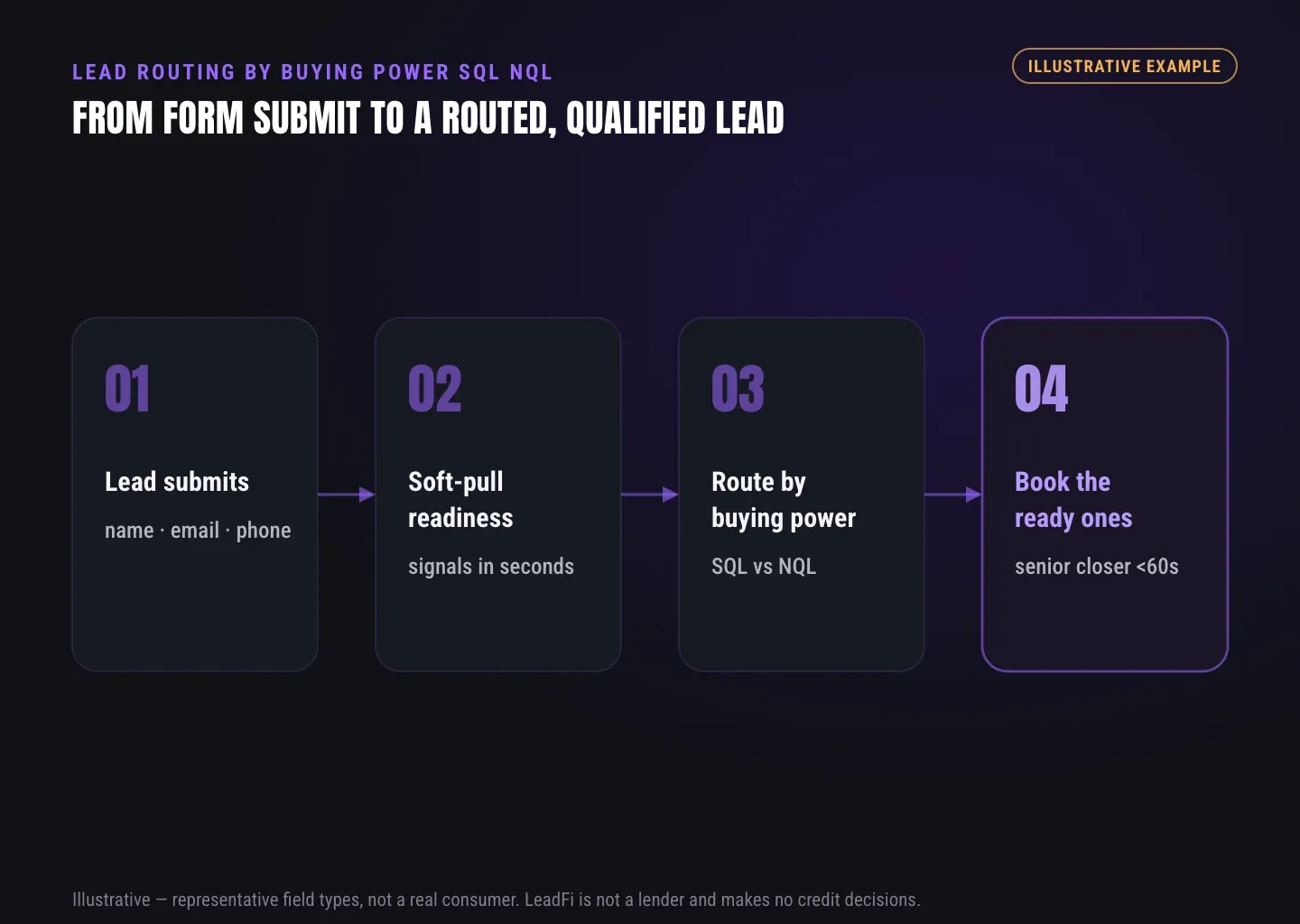
The workflow runs in a clear order. First, LeadFi sets a confident identity match. Then, where your setup allows, a soft pull reads the readiness signals. Finally, your rules turn those signals into a route: SQL to a closer, NQL to a low-ticket offer or financing.
Identity match comes first
LeadFi's identity matching is designed to confirm a high-confidence match before any soft-pull prescreening. Many workflows run from name, email, and phone alone. As a result, you often need not ask for an address and date of birth up front. Keep consent and disclosure language conspicuous even on a lighter form; a compliance-aware setup does not depend on omitting disclosures.
Signals LeadFi can surface
Readiness signals depend on setup, consent, and disclosures. For example, they may include VantageScore 4.0, available credit, income, debt, and debt-to-income ratio. They can also include funding pre-approval signals, current address, age, and optional net-worth or asset context. Each one is a routing and rep-prep input, not an underwriting decision.
Debt-to-income as a routing lever
Debt-to-income (DTI) compares what a lead owes against what they earn. A low DTI plus healthy available credit often points to a ready buyer for a cash offer. However, a stretched DTI might route the same lead toward a financing path — same interest, different next step.
You set the thresholds
Readiness rules are yours to tune. For example, a funding agency serving a younger, thin-credit audience will set different cutoffs than a mortgage shop. You can also run several campaigns at once, each with its own qualified and unqualified thresholds. That way, routing matches the audience behind each ad set.
Soft pull, no credit-score impact
A soft pull is designed to read readiness signals as a soft inquiry, which typically does not affect a consumer's credit score. It is not a hard inquiry, and it is not a lending decision. LeadFi is built for soft-pull prescreening and financial-readiness qualification for businesses; it does not approve or deny consumers. Confirm the exact behavior of your configured data source with your provider and counsel.
ROUTING
SQL, NQL, and financing paths
Quick answer: SQL vs NQL routing splits leads into two lanes after they submit. An SQL (sales-qualified lead) reads as financially ready, so it goes to a closer fast for speed-to-lead. An NQL (non-qualified lead) reads as lower-readiness right now, so it routes to a low-ticket offer, a payment plan, or a financing path — monetized or progressed instead of dropped. You define the rules; LeadFi runs the route.
Here is the vocabulary, defined once. An SQL is a lead your readiness rules mark as ready for a sales talk. An NQL is a lead that does not clear those rules yet: still valuable, just on a different path.
The point of the split is speed and fit. Ready buyers reach a human while momentum is high. Meanwhile, lower-readiness leads enter a path built to warm them up or monetize them another way. Nobody gets thrown out; everybody gets a next step.
SQL → closer calendar, fast
When a lead clears your readiness bar, route it straight to a closer calendar or a priority queue. Speed-to-lead is the goal here — minutes, not the next morning. You can also push permitted context to the rep, so the call opens prepared, not cold.
NQL → low ticket that keeps earning
A lower-readiness lead is not a dead lead. Instead, route NQLs to a low-ticket offer, with an email or SMS follow-up that keeps your flagship front of mind. As readiness improves over weeks, some of those contacts re-enter the SQL lane — and this time they can pay.
NQL → financing or lower-ticket offer
Rather than losing the sale, offer a different way in. For example, a financing path or a lower-ticket product can convert a lead who wanted the flagship offer but lacked the room today. That is how routing turns a "no" into revenue rather than a dead record.
Setter vs closer handoff
Routing is not only about SQL vs NQL. You can split ready leads further: a warmer setter for borderline cases, a senior closer for the strongest readiness scores. As a result, each rule you write points a lead at the right human for the right talk.
Reprocess your backlog
Routing rules are not only for new leads. Where you have consent and disclosures that still apply, you can run an existing backlog of captured contacts through the same readiness logic. Confirm with counsel that a fresh soft pull on stale contacts is supported before you reprocess a list.
See which of the leads you already have can actually afford to buy.
ROUTING
Writing routing back into your CRM
Quick answer: Routing is only useful if the outcome lands where your team works. LeadFi writes qualification results back into your CRM as fields, tags, and pipeline stages, then triggers workflows, notifications, and redirects. It connects via webhook, API, Zapier, Make, native workflow, or MCP — so SQL/NQL status lives next to the lead, not in a separate dashboard nobody opens.
LeadFi does not replace your stack. Instead, it sits behind the form, funnel, calendar, or CRM you already run and adds a readiness-and-routing layer after the lead submits. Your capture tools keep capturing; LeadFi decides what happens next.
The flow is short. First, a form or funnel captures the lead. Next, the payload hands off to LeadFi, which enriches and classifies it. Then the outcome writes back to your systems. All of it aims for near-real-time, so the route fires while the lead is still warm.
CRM fields, tags, and stages
LeadFi can push SQL/NQL status, permitted readiness tags, and pipeline stage changes into your CRM records. As a result, reps see the classification on the record itself — the actual fields and tags they already scan. Never show a consumer's raw credit or income value; show the readiness tag instead.
Redirects and next-step pages
Routing can drive the thank-you page too. For instance, an SQL might redirect straight to a closer's calendar, while an NQL lands on a low-ticket offer or a financing page. As a result, the lead moves to the right next step without waiting on a human to triage them.
Feed ad platforms better signals
Depending on your setup and what each platform and applicable data rules allow, you may be able to feed qualified-lead outcome signals back into Meta, Google, TikTok, Hyros, and your ops stack. Do not pass raw consumer-report data to ad platforms; work with counsel to confirm what signals are permitted. LeadFi makes no platform performance or ROAS guarantees.
Connectors that fit your stack
LeadFi connects via webhook, API, Zapier, Make, native workflow, or MCP for AI-agent builders. For example, it can receive submissions from ClickFunnels, Typeform, Jotform, GoHighLevel, HubSpot, custom pages, and more. Think "can integrate with patterns like these" rather than a specific one-click connector for every tool.
Compliance-aware setup before launch
Before go-live, LeadFi helps teams stand up a compliance-aware workflow. In practice, it aligns form disclosures, consent language, and CRM notes so prospects hear one consistent story. This is onboarding help, not legal advice. LeadFi supports compliance-aware workflows, does not guarantee compliance, and does not approve or deny consumers; review your use case with counsel.
Key takeaways
The short version
- Route leads by real buying power, not clicks: SQLs go to closers fast, NQLs go to a low-ticket offer or financing.
- Financial readiness routing starts with a high-confidence identity match from name, email, and phone before any soft-pull prescreening.
- You define the thresholds — per campaign — so a thin-credit audience and a high-income audience each get their own SQL/NQL cutoffs.
- LeadFi writes SQL/NQL status, tags, and pipeline stages back into your CRM via webhook, API, Zapier, Make, native workflow, or MCP.
- LeadFi classifies and routes; it does not approve or deny consumers, and compliance-aware setup with counsel is part of onboarding.
Quick answers
Fast answers before you dig in
Why route by ability to pay, not just interest?
Interest tells you someone raised a hand; ability to pay tells you whether that hand is worth a closer's hour. Routing by buying power sends financially ready leads to sales first and moves lower-readiness leads to a low-ticket offer or financing, so costly sales time lands on people who can actually buy. LeadFi classifies and routes — it does not approve or deny anyone.
How do readiness signals drive routing?
Routing starts with a high-confidence identity match from name, email, and phone. Where consent and disclosures support it, LeadFi runs soft-pull prescreening to read readiness signals, and your rules turn those signals into an SQL or NQL route.
What is the difference between SQL and NQL routing?
An SQL clears your readiness rules and routes to a closer for speed-to-lead. An NQL does not clear them yet and routes to a low-ticket offer, a payment plan, or a financing path — monetized or progressed rather than dropped. You define where each line sits.
FAQ
Common questions
What is lead routing by buying power?
How does financial readiness routing work without asking for an address up front?
Does the soft pull hurt the lead's credit score?
What is the difference between an SQL and an NQL here?
Will LeadFi replace my CRM or funnel?
How does LeadFi handle compliance?
Sources
References
- CFPB — What is a credit inquiry? (hard vs. soft) (opens in a new tab)Federal regulator confirms a soft inquiry, unlike a hard inquiry, does not affect the consumer's credit score.
- VantageScore — VantageScore 4.0 credit scoring model (opens in a new tab)Official page describing VantageScore 4.0, the tri-bureau, trended-data model used to assess credit risk.
- Experian — What Is a Soft Inquiry? (opens in a new tab)Major credit bureau explains soft inquiries are informational and have no impact on credit scores.
Know who is ready before your next sales call.
If your closers spend hours on interested leads who cannot fund the offer, routing by financial readiness is the fix. LeadFi keeps your capture tools, your CRM, and your calendars.