
LEAD QUALIFICATION FRAMEWORK
Lead Qualification Framework: How to Select Criteria for an Offer
A lead qualification framework is a set of team-owned rules for assessing existing inbound leads and selecting the right sales path. It converts broad ideas such as fit, intent, timing, and buying power into criteria, review steps, CRM actions, and follow-up routes.
Watch a contact get pre-qualified.
This is exactly what your CRM gets back.
Your opt-in form
Soft pull · no impact to their credit
This is not a real soft pull. It's an example of the data points that land in your CRM contact record when a lead fills out your form.
LEADFI DEMO
Watch the demo, then start free or book a call.
GUIDE
Define the purpose of a framework
A lead qualification framework should answer one operational question: what should happen next for this inbound lead? The result should trigger a sales action, review task, CRM update, nurture sequence, or alternate offer.
Start with the routing decision
Define the available destinations before selecting criteria. Common routes include a setter, closer, specialist, review queue, nurture track, lower-ticket product, or alternate offer. If a criterion does not affect a route or prepare the next rep, it probably does not belong in the first version.
Keep the framework team-owned
Sales leaders should own the criteria and review rules, with input from marketing, RevOps, frontline representatives, and compliance advisors. Software can apply those rules consistently, but it should not create the company's sales policy.
LeadFi supports team-defined financial-readiness rules for existing inbound leads. The framework remains an internal sales-routing system based on the offer, not a system for determining consumer lending outcomes.
Separate fit, interest, and readiness
Interest reflects engagement, such as requesting a call or attending a webinar. Offer fit considers the buyer's needs, use case, location, business type, and delivery-model alignment. Financial readiness adds buying-power context.
Keep these dimensions separate. A highly engaged lead may not fit the flagship offer, while a financially ready lead may need a different service because of timing or use case.
Define SQL and NQL precisely
SQL means Sales-Qualified Lead: someone who is financially fit to buy your offer. NQL means Non-Qualified Lead: someone who is not financially fit to buy your offer.
These are internal routing labels applied through team-owned, offer-specific sales criteria. An SQL can receive fast sales follow-up, while an NQL can enter nurture, a lower-ticket path, or another relevant offer.
Measure downstream actions
Do not optimize for the largest SQL group. Measure whether the framework creates useful action: contact speed, booked and attended calls, sales outcomes, nurture progression, wrong-offer cases, and movement between offer tiers.
GUIDE
Choose criteria for an offer
Criteria should reflect the specific offer rather than a generic concept of a qualified buyer. A $1,500 course and a $7,500 consulting engagement may require different fit, timing, delivery, and financial-readiness rules.
Map the offer architecture
List the flagship offer, price, delivery model, ideal use cases, sales capacity, and alternate paths. Then decide which leads belong with a closer, setter, lower-ticket product, nurture sequence, or manual review.
Classify each criterion
Place every criterion into one of four categories:
- Required: A hard rule tied to clear offer suitability, such as service area or accepted use case.
- Scored: Evidence that can exist in degrees, such as industry alignment, need, timing, or delivery fit.
- Review-only: Context that helps a rep assess an edge case but does not change the route alone.
- Routing-only: Information such as time zone, language, product line, or specialist ownership.
Use required rules sparingly. Too many hard filters can conceal leads that belong in a different offer path.
Add readiness as a separate dimension
Do not bury financial readiness inside a broad engagement score. A page visit or booked call does not establish buying power, and low email engagement does not establish low readiness. Keeping readiness distinct makes routing logic easier to explain, test, and revise.
Build a decision matrix
A short matrix helps teams convert multiple dimensions into consistent actions:
| Offer fit | Intent | Financial readiness | Review state | Suggested route |
|---|---|---|---|---|
| High | High | High | Clear | Priority sales follow-up |
| High | Medium | High | Clear | Setter or closer outreach |
| High | High | Lower | Clear | Nurture or lower-ticket offer |
| Medium | High | High | Context needed | Human review |
| Low | Any | Any | Clear | Alternate offer or standard exit path |
| Any | Any | Unclear | Match or data issue | Review queue |
The labels are team-owned sales criteria. They do not measure personal worth and should not be presented to a lead as a hidden judgment.
Test the framework against past leads
Review a mixed sample of prior inbound leads, including wins, losses, no-shows, nurture cases, and wrong-offer routes. Look for unclear rules, unnecessary criteria, missing paths, and frequent exceptions. Version the framework so results remain traceable when criteria change.
INTELLIGENCE LAYER
Add financial readiness with human review
Financial readiness adds buying-power context to a standard lead qualification framework. It can help high-ticket teams prioritize existing inbound leads before sales follow-up while retaining human review for defined exceptions.
Use thin-input identity matching
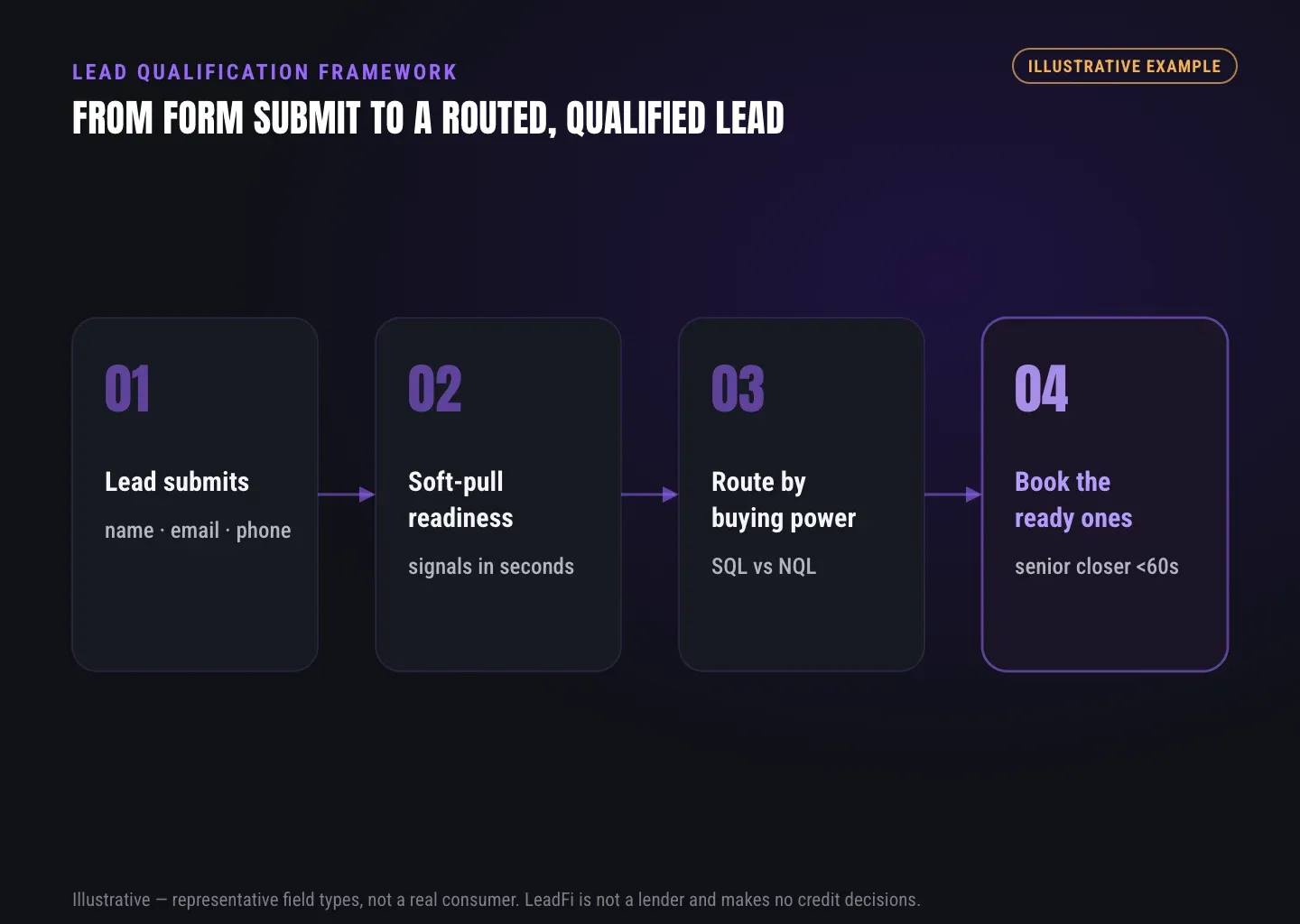
LeadFi can work from a lead's name, email, and phone in many configured workflows. Its patent-pending identity matching is designed to establish a high-confidence match before soft-pull prescreening and, where applicable, deeper bureau-backed workflows.
Some suitable flows may not require an address or date of birth at the first step. Exact inputs depend on configuration, identity matching, data availability, consent and disclosures, and the business's reviewed workflow. The goal is buying-power-aware routing, not removing useful fields for its own sake.
Treat soft-pull prescreening as one input
Soft-pull prescreening can add financial-readiness signals without serving as the entire framework. LeadFi combines those signals with team-owned rules, SQL versus NQL routing, CRM actions, and rep-preparation context.
Soft inquiries generally do not affect a consumer's credit score, but teams should confirm that their specific data source, workflow, notices, and product configuration support the intended use.
Select signals tied to the offer
Depending on configuration and availability, readiness context may include VantageScore 4.0, available credit, income, debt, debt-to-income ratio, age, current address, and optional asset or net-worth-style signals. Use only signals that support a defined routing decision or approved rep-preparation need.
Avoid one universal threshold across every offer. Criteria should reflect the offer price, payment structure, buyer profile, alternate paths, and sales process.
Create a match-review path
Keep uncertain identity results separate from NQL status. If identity signals conflict, required information is unavailable, or match confidence is insufficient, send the lead to a review queue or standard follow-up path rather than treating uncertainty as lower financial readiness.
Human review should cover specific edge cases, such as known clients, strategic accounts, and data mismatches. Document acceptable override reasons, ownership, and review timing.
Align the workflow before launch
Form language, privacy notices, consent and disclosures, CRM access, redirects, and follow-up practices should tell a consistent story. LeadFi supports compliance-aware workflows and can help teams consider privacy- and consent-focused setup, TCPA-aware practices, and FCRA-aware workflow guidance.
LeadFi does not provide legal advice. Clients should review their use case with counsel.
See which of the leads you already have can actually afford to buy.
GUIDE
Apply criteria consistently across follow-up paths
A framework creates value only when the result changes what happens next. Apply the same evaluation rubric to every qualifying inbound lead, then map each result to defined CRM fields, owners, alerts, calendars, pages, and nurture tracks.
Route SQLs and NQLs
Write the qualification status into the CRM and trigger the appropriate workflow. SQLs can receive priority follow-up from a setter, closer, specialist, or account owner. NQLs can receive a lower-ticket offer, educational sequence, longer nurture path, or alternate resource.
Buyer-facing messages should protect dignity and avoid exposing private financial context. Use neutral route-specific copy rather than telling a person that an undisclosed score determined the page they received.
Connect the existing sales stack
LeadFi typically complements existing forms, funnels, calendars, and CRMs. Connections may use webhooks, APIs, Zapier, Make, or supported native workflows. Returned results can populate fields, tags, stages, tasks, alerts, redirects, or automations.
Store reasons and review states
Store a short reason code with each status, such as main-offer fit, alternate tier, review needed, or identity match issue. Also record the framework version and evaluation time. Track overrides with an owner, timestamp, and documented reason.
Feed quality signals back to marketing
Where platform rules and configuration allow, grouped SQL-quality signals can flow into Meta, Google, TikTok, Hyros, and related operations stacks. This gives media buyers context beyond raw lead volume, but it does not guarantee campaign, cost, or sales improvements.
Marketing generally needs aggregated quality feedback rather than access to every underlying financial field. Role-based access helps keep the workflow focused.
Audit and improve the framework
Review sales outcomes, no-shows, nurture progression, wrong-offer cases, match-review volume, and overrides on a fixed schedule. Frequent exceptions may indicate unclear rules, weak data, broken automation, or a framework that no longer fits the offer.
Related reading: practical insights on what is lead qualification, a practical guide to ai lead qualification, practical insights on marketing lead qualification.
| Workflow area | Manual or form-only framework | Financial-readiness framework |
|---|---|---|
| Budget context | Primarily self-reported | Self-report plus permissioned readiness signals |
| Qualification timing | During or after rep follow-up | After inbound submission and before follow-up |
| SQL/NQL logic | Rep judgment or broad form rules | Team-owned criteria with defined readiness inputs |
| CRM action | Manual notes and tags | Configured fields, stages, alerts, and triggers |
| NQL path | Often a general nurture list | Planned lower-ticket, nurture, or alternate route |
| Exception handling | Informal overrides | Review states, reason codes, and audit records |
| Marketing feedback | Lead and booking volume | Grouped SQL-quality signals where supported |
Key takeaways
The short version
- Build criteria around a specific offer and routing decision.
- Keep fit, intent, and financial readiness as separate dimensions.
- Use SQL and NQL as team-owned internal sales-routing labels.
- Send uncertain identity results to review, not an automatic NQL route.
- Connect qualification results to CRM, nurture, and marketing workflows.
Quick answers
Fast answers before you dig in
What is a lead qualification framework?
A lead qualification framework is a team-owned set of criteria, review rules, and routing actions used to assess existing inbound leads and select the appropriate sales or nurture path.
How should a high-ticket team select qualification criteria?
Work backward from the offer price, ideal buyer, delivery model, sales capacity, and alternate paths. Classify criteria as required, scored, review-only, or routing-only.
How does LeadFi add financial readiness?
LeadFi can apply permissioned financial-readiness signals after an inbound submission, then return SQL, NQL, or review-needed results to the team's CRM and follow-up workflows.
What should happen to NQLs?
NQLs should enter a planned path such as nurture, a lower-ticket product, education, or another suitable offer instead of being left in a general lead list.
FAQ
Common questions
What criteria should a lead qualification framework include?
How is financial-readiness qualification different from lead scoring?
What does SQL versus NQL routing mean in LeadFi?
Can LeadFi support thin-input soft-pull prescreening?
Does a soft pull affect a consumer's credit score?
Can LeadFi replace a CRM, form, funnel, or calendar?
Sources
References
- CFPB — What is a credit inquiry? (hard vs. soft) (opens in a new tab)Federal regulator confirms a soft inquiry, unlike a hard inquiry, does not affect the consumer's credit score.
- VantageScore — VantageScore 4.0 credit scoring model (opens in a new tab)Official page describing VantageScore 4.0, the tri-bureau, trended-data model used to assess credit risk.
- CFPB — Who can request to see my credit report? (opens in a new tab)Federal regulator explains the FCRA rules governing who may obtain a credit report.
- VantageScore 4.0 (opens in a new tab)Official overview of the named scoring model referenced as a potential readiness signal.
- Consumer Financial Protection Bureau: Credit inquiries (opens in a new tab)Consumer guidance concerning credit inquiries and their treatment.
Know who is ready before your next sales call.
Your lead qualification framework should reflect your offer, sales capacity, buyer paths, and review standard. LeadFi can add financial-readiness context to existing inbound leads while your team retains ownership of its sales criteria and routing rules.