
HIGH TICKET MASTERMIND SEATS
Vet Mastermind Members Without Turning the Application Into a Wallet Test
To vet mastermind members well, evaluate the room before buying power. Peer fit—including relevant experience, useful perspective, clear goals, and willingness to contribute—decides who receives an enrollment call. Financial readiness has a narrower operational role.
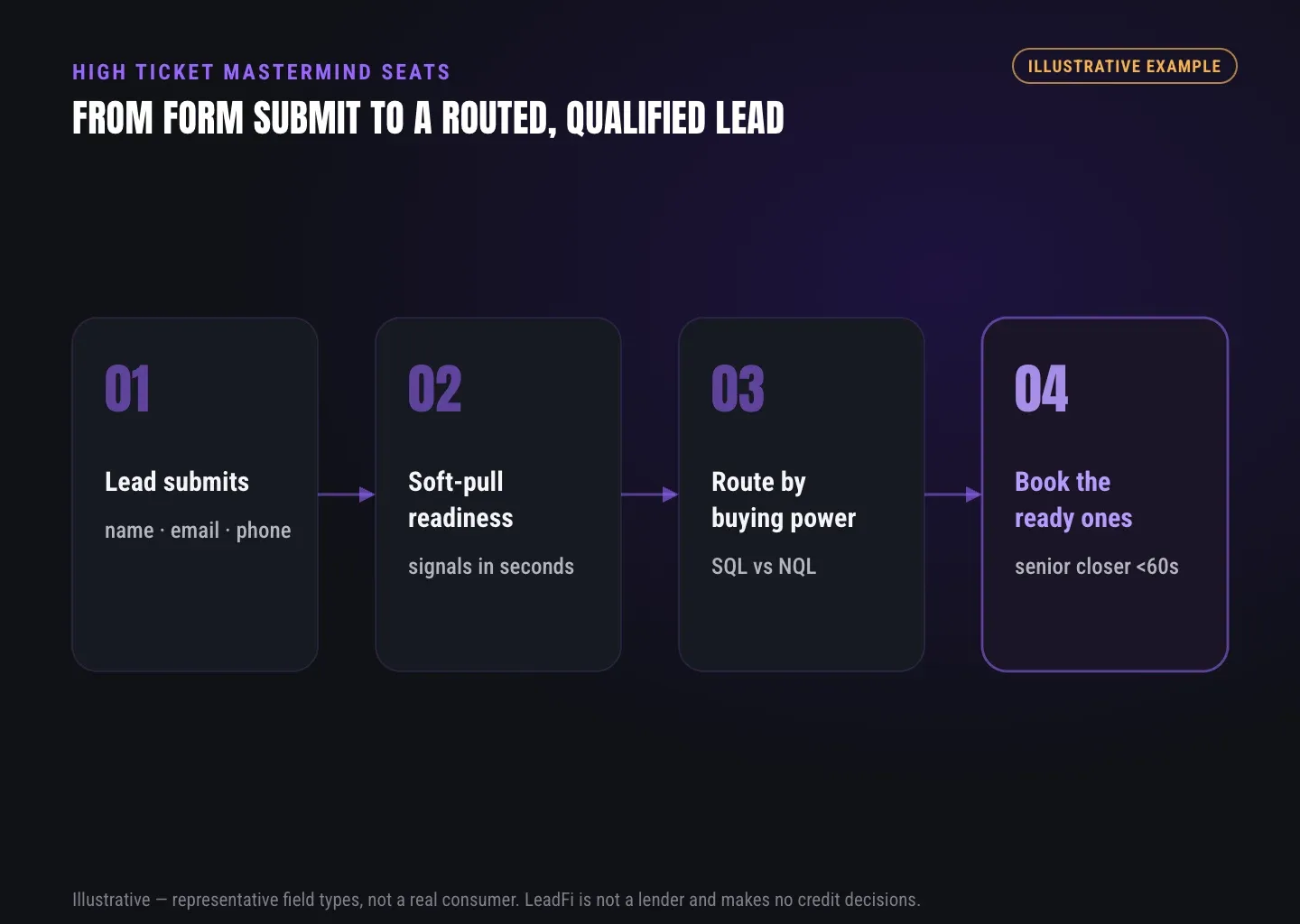
Watch a contact get pre-qualified.
This is exactly what your CRM gets back.
Your opt-in form
Soft pull · no impact to their credit
This is not a real soft pull. It's an example of the data points that land in your CRM contact record when a lead fills out your form.
LEADFI DEMO
Watch the demo, then start free or book a call.
GUIDE
Why a mastermind application reviews the room, not one buyer
A limited-seat mastermind is shaped by every participant. The application should therefore protect the quality of the room before sales organizes the call queue.
Peer value comes before call order
Build a written peer-fit rubric around contribution, goal fit, conduct, experience, and cohort relevance. Ask applicants what they are working on, which decisions they face, and where peer input would help. Keep this score separate from any readiness route.
Cohort design protects member trust
A host may consider role, operating model, subject matter, market, or direct conflicts when evaluating the room. These are peer-fit factors, not financial factors. Someone may have strong buying power and still be a poor fit for the current cohort.
Application answers need clear proof
Specific questions produce more useful answers than broad prompts such as “What are your goals?” Ask applicants to describe a current decision or the kind of peer feedback they need. Do not use a readiness result to verify claimed revenue, profit, or business income.
Host judgment still has a role
A scoring guide supports consistency, but human review can account for group dynamics. Record the peer-fit result and a short peer-fit reason. Do not record personal score, income, debt, or available-credit figures.
Room rules should be visible
State participation, privacy, attendance, and contribution expectations before submission. Clear standards help applicants self-assess and give reviewers a stable basis for peer-fit decisions. Do not promise business or income outcomes.
INTELLIGENCE LAYER
What peer fit and readiness each tell the host
Peer fit asks whether an applicant would contribute to the group. Financial readiness asks how sales should order and staff calls for applicants who have already passed peer fit.
Peer fit controls the call list
Complete peer-fit review first. Applicants who pass enter the enrollment workflow, and every one of them receives a call before any seat is offered. Readiness cannot remove an applicant from that list.
Readiness controls queue priority
After submission with consent and disclosures, the readiness route can set call priority and rep assignment. Sales may see an SQL route, NQL route, or separate no-result route. Missing results must not be classified as NQLs.
Soft pulls support routing, not judgment
Where configured, an applicable soft pull occurs only after the applicant submits with consent and disclosures. It does not affect the applicant’s credit score. Signals may include VantageScore 4.0, available credit, income, debt, debt-to-income ratio, age, address, and optional asset context.
Those raw values must not appear in setter, closer, or manager views for this workflow. The routing team sees only the readiness band or route, and reps do not quote personal financial figures to applicants.
Readiness bands preserve buyer dignity
A readiness band is a private routing label, not a judgment about an applicant’s worth. It is not shared with other members or anyone outside the people responsible for routing applications.
Every member receives the same published seat price and payment options under one written policy. The route cannot change a price, discount, deposit, scholarship, payment schedule, or access to a payment option.
No-result records need their own route
Matching may not return a result for every valid submission. Keep those records in a distinct no-result group and use a standard call queue. A missing result is not evidence that an applicant lacks financial fit.
GUIDE
Ordering enrollment calls and choosing the rep
Once peer fit establishes the call list, readiness can help the team work that list efficiently. LeadFi sits behind the existing application, CRM, funnel, or calendar and returns a route after a valid submission.
SQL calls receive fast follow-up
An SQL route can create a priority task, alert the assigned rep, or move the application into a priority CRM view. This supports speed-to-lead while preserving the standard enrollment process.
For related operating guidance, see a practical guide to speed to lead for high ticket offers and a practical guide to qualifying high ticket leads before the call.
NQL calls receive the right rep
An NQL applicant who passes peer fit still receives an enrollment call before any seat is offered. The route can assign a rep prepared to explain both the mastermind and a lower-ticket product that fits the buyer’s financial capability. The lower-ticket product sits alongside the seat offer and does not replace it.
No-result calls use the standard lane
A no-result applicant enters a standard queue without an assumed readiness label. Operations can track the no-result group to identify form, matching, or setup issues without treating missing data as poor financial fit.
Rep views show routes, not raw data
CRM records should contain peer-fit status, SQL or NQL route, no-result status, call priority, rep assignment, and task state. They should not contain personal VantageScore 4.0 values, income, debt, or available-credit figures.
This controlled routing can support practical insights on reducing wasted sales calls on high ticket offers without turning private financial details into sales talking points.
Call scripts avoid borrowing pressure
Reps should focus on program fit, the published seat offer, and the applicant’s stated goals. They should not encourage an applicant to borrow, open new credit, or seek financing to bridge a funding gap. Everyone hears the same published price and payment options.
See which of the leads you already have can actually afford to buy.
WORKFLOW DESIGN
A right-fit next step when peer fit points elsewhere
Applicants who do not match the current room should receive an answer based only on published peer-fit criteria. Applicants who pass peer fit but receive an NQL route remain in the full enrollment-call process.
Peer-fit misses get a clear answer
Explain a cohort mismatch through program scope, role, topic, or group design. Do not mention financial readiness. A future application or relevant public resource may be offered when appropriate.
Lower-ticket options sit alongside
For a peer-fit applicant on the NQL route, a lower-ticket product that fits the buyer’s financial capability may be discussed alongside the mastermind. It should have its own scope and published price and should not be positioned as a substitute imposed by the route.
Seat terms remain the same
Every member pays the same published seat price using the same published options. A readiness route never changes the price, deposit, schedule, scholarship, discount, or access to a payment option.
Future follow-up follows peer interest
Follow-up should reflect the applicant’s questions and chosen next step. Customer-facing messages must not expose the readiness band or claim that the applicant needs more money or credit. The route may guide internal task ownership only.
ROUTING
LeadFi capabilities for mastermind application routing
LeadFi is a financial-readiness engine for high-ticket teams. It qualifies existing inbound applications after submission and returns a route to the business’s stack. It does not generate applicants, decide peer fit, or approve or deny consumers.
Thin-input matching reduces form load
LeadFi can work from name, email, and phone in many configured workflows. Identity-related information and identity signals, such as current address or age, may support matching. LeadFi’s patent-pending identity-matching technology is designed to support matching before an applicable soft pull.
Any readiness read occurs only after the applicant submits through the business’s intake process with consent and disclosures. Required fields vary by use case and setup.
CRM routes keep sales focused
LeadFi can return SQL, NQL, or no-result routes through a webhook, API, Zapier, Make, or supported native workflow. The CRM can then update a field, assign an owner, create a task, or trigger an alert. Store the route—not raw personal financial figures.
Calendar logic follows the route
The existing calendar remains the booking tool. An SQL route can alert a priority rep, an NQL route can select the appropriate rep, and a no-result route can use the standard queue. Every route preserves the requirement that all peer-fit applicants receive a call before any seat is offered.
Ad signals focus on lead quality
Where the team’s setup supports it, qualified-lead events may be returned to Meta, Google, TikTok, Hyros, or operations systems. These signals can help teams optimize around lead quality rather than form volume alone, but advertising performance is not guaranteed. Personal financial figures should never be included in those events.
Setup aligns consent and routing
LeadFi supports compliance-aware setup, including privacy and consent language, CRM field design, and TCPA-aware communication practices. LeadFi does not provide legal advice, and clients should review their use case with counsel.
Related reading: a practical guide to speed to lead for high ticket offers, a practical guide to qualifying high ticket leads before the call, practical insights on reducing wasted sales calls on high ticket offers.
| Workflow question | Peer fit | Financial readiness |
|---|---|---|
| Main purpose | Protect the quality of the room | Order and staff enrollment calls |
| Timing | Reviewed before routing | Used after submission with consent and disclosures |
| Inputs | Goals, experience, contribution, conduct, cohort fit | Permissioned signals translated into a route |
| Call access | Decides who receives a call | Does not decide |
| Call order | Does not decide | Sets priority |
| Rep assignment | Does not decide | Selects the appropriate rep |
| Seat price and options | Does not change them | Does not change them |
| Sales output | Peer-fit result and brief reason | SQL, NQL, or no result |
| CRM record | Peer-fit status | Readiness band or route only |
| Visibility | Restricted application context | Restricted to application-routing personnel |
Key takeaways
The short version
- Peer fit decides who receives an enrollment call.
- Every peer-fit applicant is called before any seat is offered.
- Readiness only sets call order and rep assignment.
- CRM users see routes, not raw financial figures.
- NQLs may see a lower-ticket product alongside the seat offer.
Quick answers
Fast answers before you dig in
How should you vet mastermind members?
Use a written peer-fit rubric to decide who receives an enrollment call. After submission with consent and disclosures, use financial readiness only to order calls and assign reps.
What do SQL and NQL mean for mastermind applications?
An SQL can afford the offer being sold. An NQL is not financially fit to buy it. Both receive calls if they pass peer fit; the route changes only call order and rep assignment.
What happens to an NQL mastermind applicant?
A peer-fit NQL still receives an enrollment call before any seat is offered. A lower-ticket product fitting the buyer’s financial capability may be presented alongside the seat offer.
What should sales see from a readiness read?
Sales should see only the SQL, NQL, or no-result route plus call priority and rep assignment—not personal score, income, debt, or available-credit values.
FAQ
Common questions
How do you vet mastermind members fairly?
Can financial readiness help vet mastermind members?
What is SQL vs NQL routing for a high-ticket mastermind?
Can a mastermind application use a soft pull?
Can LeadFi work from name, email, and phone?
What should the CRM store from financial-readiness qualification?
What happens when a peer-fit applicant is not financially qualified?
Sources
References
- CFPB — What is a credit inquiry? (hard vs. soft) (opens in a new tab)Federal regulator confirms a soft inquiry, unlike a hard inquiry, does not affect the consumer's credit score.
- VantageScore — VantageScore 4.0 credit scoring model (opens in a new tab)Official page describing VantageScore 4.0, the tri-bureau, trended-data model used to assess credit risk.
- CFPB — Who can request to see my credit report? (opens in a new tab)Federal regulator explains the FCRA rules governing who may obtain a credit report.
Know who is ready before your next sales call.
Keep peer-fit decisions separate from sales routing. Request a LeadFi workflow assessment to see how financial-readiness qualification could sit behind your current application, CRM, funnel, or calendar and return SQL, NQL, or no-result routes after submission with consent and disclosures.