
FRANCHISE CANDIDATE FINANCIAL SCREENING
Franchise Candidate Screening by Financial Capacity: A Practical Guide for Franchisors
Franchise candidate screening often starts with forms, calls, and document requests, but those steps may reveal financial capacity only after representatives have spent weeks on follow-up and discovery-day planning. A better process adds a financial-readiness layer near the start of intake.
Watch a contact get pre-qualified.
This is exactly what your CRM gets back.
Your opt-in form
Soft pull · no impact to their credit
This is not a real soft pull. It's an example of the data points that land in your CRM contact record when a lead fills out your form.
LEADFI DEMO
Watch the demo, then start free or book a call.
GUIDE
Where franchise development teams lose weeks
Franchise development teams often have plenty of candidate information, but they receive the useful financial context too late. An initial form may capture location, experience, goals, and a self-reported investment range. Detailed financial review may not begin until after multiple calls.
Intake forms rely on self-reporting
Candidates may estimate their cash, debt, credit, or access to capital. Those answers provide context, but they can be incomplete, inconsistent, or out of date. One person may include retirement assets but omit debt, while another may enter the amount they hope to invest rather than funds they can access.
Qualification happens after sales work
When financial capacity becomes visible only after introductory calls and executive interviews, representatives build momentum without a clear view of the appropriate next step. Earlier readiness signals can help teams prioritize work before committing scarce executive or discovery-day capacity.
This routing layer complements rather than replaces calls, document collection, and the franchisor's full review. The FTC's franchise guidance provides broader context for franchise sales processes and required disclosures.
CRM stages can hide financial uncertainty
Stages such as “interviewed” or “discovery day invited” measure activity, not financial readiness. A stronger CRM model stores candidate stage and readiness route separately. It should also timestamp the result so representatives can distinguish current information from stale data.
Who benefits from an earlier readiness layer?
This approach is most useful for teams with steady inbound volume, expensive representative time, multiple concepts, or limited executive calendars. Franchise development leaders, RevOps teams, marketing teams, and broker-facing teams can use a shared routing framework without turning it into a final judgment about a candidate.
For process design beyond marketing intake, a practical guide to sales lead qualification can help teams align ownership, fields, and handoffs.
ROUTING
Using capacity thresholds as a routing input
Capacity thresholds turn financial data into working rules for the next conversation. Franchisors should use the figures their own franchise systems publish rather than quoting, copying, or approximating another brand's liquidity or net-worth figures.
Quick answer: Financial capacity can support franchise candidate screening when it is used to prioritize workflow, request clarification, or prepare representatives. It should not operate as a stand-alone franchise award decision.
This page describes a routing input, not a credit decision, approval, or eligibility determination.
Start with your own published criteria
Use consistent terminology across the website, intake form, CRM, and representative scripts. If the franchise system distinguishes liquid capital from broader asset context, the routing workflow should preserve that distinction.
Keep liquidity and net worth distinct
Liquidity describes resources that may be accessible within the relevant timeframe. Net worth can include assets that are harder to convert into cash. A single “capital available” field may therefore conceal important context.
Use only the figures your own franchisor publishes. Do not state, quote, estimate, or import another franchise system's liquidity or net-worth requirements.
Use financial signals as context
Depending on configuration, candidate authorization, consent and disclosures, signals may include VantageScore 4.0, available credit, income, debt, debt-to-income ratio, current address, age, and optional asset or net-worth-style context. A configured soft-pull workflow may provide some of these signals without creating a hard inquiry; the Consumer Financial Protection Bureau explains the distinction between hard and soft credit inquiries.
Before personal financial data is accessed, the candidate must receive the applicable disclosure and authorize the configured workflow. Identity-related information and identity signals should be handled according to the team's approved access and retention model.
LeadFi can begin with name, email, and phone in many configurations. Its patent-pending identity matching is designed to establish a high-confidence match before an applicable soft pull and, where configured, deeper bureau-backed workflows. This does not remove consent and disclosures or other workflow obligations.
Define SQL and NQL clearly
SQL means Sales-Qualified Lead: someone who is financially fit to buy your offer. NQL means Non-Qualified Lead: someone who is not financially fit to buy your offer.
These labels should control workflow priority, not determine whether a person receives final consideration. An SQL can enter a priority representative queue. An NQL can enter clarification, education, nurture, or another informational development path. The output should not be recorded or communicated as a reason to decline a candidate.
Connect each route to an action
A practical routing model can include:
- Priority review: Alert the assigned representative and open the appropriate calendar.
- Clarification: Request missing information or route the record to human review.
- Education: Provide concept, ownership, or process information relevant to the current stage.
- Another development path: Introduce another concept or format when independently suitable and requested.
- Long-term nurture: Maintain the relationship and set a future review point.
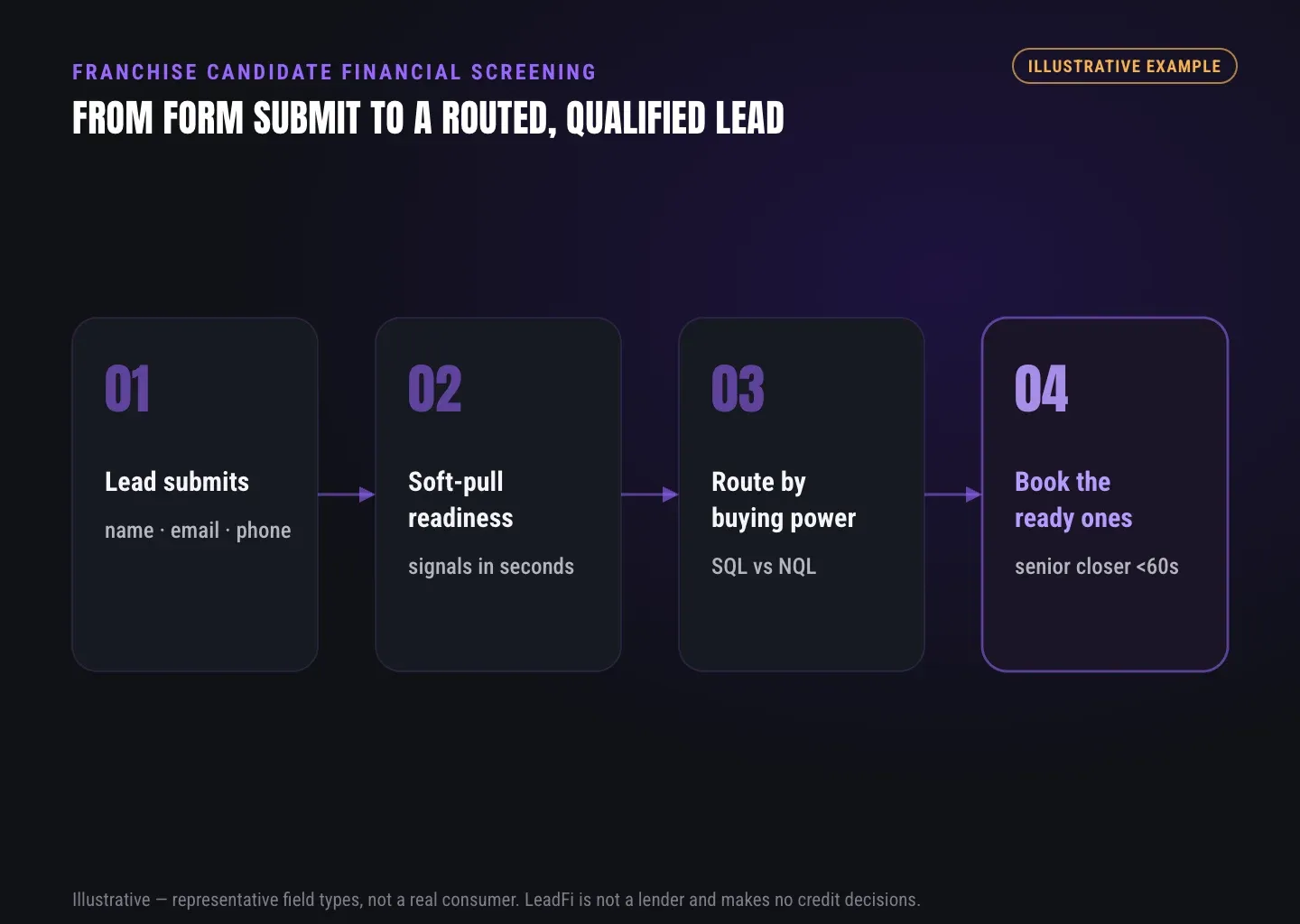
LeadFi can return the route to a CRM through webhook, API, Zapier, Make, or a supported native workflow. It can update fields, tags, tasks, pages, and calendars without replacing the franchisor's final review.
| Screening approach | Best use | Main limitation | Useful routing point |
|---|---|---|---|
| Self-reported intake questions | Early intent and candidate context | Answers may be incomplete or outdated | Initial grouping |
| Introductory development call | Goals, role fit, and concept education | Uses representative time before capacity is clear | Human review |
| Manual document review | Detailed later-stage review | Collection and review can create delays | Advanced review |
| Permissioned financial-readiness signals | Early capacity-based routing and rep preparation | Requires candidate authorization, consent and disclosures, and configured rules | After form submission |
| Final team review | Full candidate and business review | Not suited to every early inbound record | Later-stage process |
GUIDE
Sequencing discovery-day invitations by capacity
Discovery days require time from executives, operators, legal teams, support staff, and candidates. Financial readiness can help sequence invitations, but it should be considered alongside interviews, territory review, operating fit, experience, and the proposed ownership structure.
Quick answer: Use readiness routes to determine which candidates are prepared for the next review step, which records need clarification, and which relationships need continued education. Do not use the result alone to make or communicate a final franchise decision.
Reserve invitations for the appropriate stage
An invitation should follow completion of the franchisor's required steps and entry into the relevant readiness route. The CRM should show which gates are complete, which information is missing, and who owns the next action.
Route priority records quickly
When an engaged candidate matches the franchisor's defined route, the CRM can notify the assigned representative, update the stage, and open the correct calendar. This supports speed-to-lead without promising a franchise outcome.
Create a clarification path
Some records require human context. A candidate may have a business partner, entity structure, planned asset transaction, or other information that was not captured at intake. A short clarification form or call can resolve these gaps before executive scheduling.
Keep every candidate in a defined workflow
A lower-readiness result should trigger a useful next step rather than silent exclusion. Depending on the candidate's interests and the franchisor's process, that may mean education, a future review date, or another informational path. Financial-readiness output should prioritize workflow and representative preparation, not serve as a reason to deny further consideration.
LeadFi can sit between an application and the existing booking tool. After a candidate submits the form and authorizes the configured workflow, LeadFi can return a status to the CRM and direct the candidate to the appropriate page, task, or calendar.
Candidate-facing explanations should stay consistent across forms, email, SMS, and calls. LeadFi can support privacy and consent language, TCPA-aware practices, and compliance-aware workflow choices, but it does not provide legal advice.
See which of the leads you already have can actually afford to buy.
GUIDE
Keeping the record current as candidates progress
Franchise development cycles can last weeks or months, so an intake result may become stale before discovery day or final team review. The answer is not constant checking. Teams should define specific review points based on record age or meaningful changes.
Timestamp every readiness result
Store the current route, route date, criteria version, next action, action owner, and review date as separate fields. This helps representatives avoid treating an old result as current.
Preserve route history
Do not overwrite every previous result. Operations teams may need a route history, while representatives need a simple current-status field. Any manual override should include a reason, owner, and timestamp.
Refresh at meaningful events
A refresh may be appropriate after a long pause, the addition of a business partner, a revised ownership plan, or movement toward discovery day. Each refresh must follow the current authorization, consent and disclosures, and the franchisor's approved process.
Separate source signals from workflow labels
A source signal and an SQL/NQL route are different records. Source signals provide context; the route applies the franchisor's configured rules. If those rules change, the route may change even when the underlying signal does not.
Role-based access should expose only the information needed for each task. A representative may need the route and next action, while an operations owner may require additional workflow detail.
Sync useful outcomes across the stack
Choose one system as the primary candidate record. LeadFi can return routing outcomes through webhook, API, Zapier, Make, or supported native workflows. Where configured appropriately, financially qualified lead events can also be sent to Meta, Google, TikTok, Hyros, or related operational workflows to help teams optimize for lead quality rather than form volume. Platform performance is not guaranteed.
A practical CRM record may include candidate stage, readiness route, route date, criteria version, next action, next owner, review date, override reason, source channel, and the workflow record for consent and disclosures. Avoid storing financial details that are unnecessary for the approved workflow.
Related reading: a closer look at pre-screen leads by financial readiness, a practical guide to marketing lead qualification, a practical guide to sales lead qualification.
Key takeaways
The short version
- Add financial-readiness routing early in franchise intake.
- Use only the criteria and figures your own franchisor publishes.
- Treat capacity as a workflow input, not a final decision.
- Route SQLs promptly and give NQLs a defined development path.
- Timestamp results and refresh them after meaningful changes.
Quick answers
Fast answers before you dig in
How should franchisors use financial capacity in franchise candidate screening?
Use financial capacity as an early routing and representative-preparation input based on the criteria the franchisor publishes. It should guide priority review, clarification, education, or nurture—not act as a final franchise decision.
What information can support financial-readiness routing?
Depending on configuration, candidate authorization, consent and disclosures, signals may include VantageScore 4.0, available credit, income, debt, debt-to-income ratio, age, address, and optional asset context.
How does LeadFi fit into franchise development intake?
LeadFi sits behind existing forms, funnels, calendars, and CRMs to classify and route existing inbound candidates. It can return SQL/NQL statuses and trigger CRM, calendar, nurture, or human-review workflows.
FAQ
Common questions
What is franchise candidate screening?
How can franchise candidate screening include financial capacity?
Can a soft pull support franchise candidate screening?
Can LeadFi start without an address?
How does SQL/NQL routing work in franchise development?
Should discovery-day scheduling depend only on financial capacity?
Sources
References
- CFPB — What is a credit inquiry? (hard vs. soft) (opens in a new tab)Federal regulator confirms a soft inquiry, unlike a hard inquiry, does not affect the consumer's credit score.
- VantageScore — VantageScore 4.0 credit scoring model (opens in a new tab)Official page describing VantageScore 4.0, the tri-bureau, trended-data model used to assess credit risk.
- CFPB — Who can request to see my credit report? (opens in a new tab)Federal regulator explains the FCRA rules governing who may obtain a credit report.
- Federal Trade Commission: Franchise Rule Compliance Guide (opens in a new tab)Background on franchise sales processes and required disclosures.
- Consumer Financial Protection Bureau: What is a credit inquiry? (opens in a new tab)General explanation of hard and soft credit inquiries.
- VantageScore: Credit-scoring models (opens in a new tab)Official background on VantageScore models, including VantageScore 4.0.
Know who is ready before your next sales call.
LeadFi can sit behind your current form, funnel, calendar, or CRM and route existing inbound candidates using permissioned financial-readiness signals. Map SQL/NQL outcomes to representative queues, clarification steps, nurture workflows, and reporting without replacing your final review process.