
COST PER QUALIFIED APPOINTMENT
Cost Per Qualified Appointment: The Number Behind Your CAC
Cost per qualified appointment shows what you spend to put a financially fit lead on the calendar. Unlike cost per booked call, it excludes bookings that do not meet your written sales and financial-readiness rules.
Watch a contact get pre-qualified.
This is exactly what your CRM gets back.
Your opt-in form
Soft pull · no impact to their credit
This is not a real soft pull. It's an example of the data points that land in your CRM contact record when a lead fills out your form.
LEADFI DEMO
Watch the demo, then start free or book a call.
GUIDE
Why cost per booking hides the real number
Booking cost counts intent, not financial fit
A booking proves that a lead selected a time. It can indicate interest or urgency, but it does not establish that the lead is financially fit to buy the offer.
Cost per booked call remains useful for evaluating calendar completion. It is incomplete as a sales-capacity metric because it treats every valid booking as equally useful.
Cheap bookings can create costly calendars
Consider two campaigns that each spend $10,000:
- Campaign A produces 250 bookings and 40 qualified appointments.
- Campaign B produces 160 bookings and 80 qualified appointments.
Campaign A has a $40 booked-call cost but a $250 cost per qualified appointment. Campaign B has a $62.50 booked-call cost but a $125 cost per qualified appointment.
These figures illustrate the calculation; they are not performance benchmarks. They show why the cheapest booking source may not produce the lowest cost for financially fit calendar demand.
Rep time belongs in appointment economics
A booked call consumes more than media spend. Setters confirm it, closers prepare for it, and managers review outcomes. Weak-fit calls can also occupy scarce calendar capacity.
Report two clearly labeled versions when useful:
- Media CPQA: Media and campaign costs divided by unique qualified appointments.
- Fully loaded CPQA: Media, creative, booking, qualification, and allocated sales-development costs divided by unique qualified appointments.
Do not compare a media-only result with a fully loaded result without labeling the difference.
CAC starts before the sales call
Customer acquisition cost appears at the end of the funnel. Cost per qualified appointment shows the economics one stage earlier:
Implied CAC from qualified held appointments
= cost per qualified held appointment ÷ close rate
If a qualified held appointment costs $180 and 20% become customers, the implied CAC is $900. This is planning math rather than a forecast.
Qualification rate exposes hidden waste
Qualification rate gives booked-call cost the context it lacks:
Qualified appointment rate
= unique qualified appointments ÷ unique booked appointment journeys
A $50 booked-call cost at a 25% qualification rate produces a $200 CPQA. The same booking cost at a 50% qualification rate produces a $100 CPQA.
One funnel can hold several costs
A practical dashboard separates these stages:
- Cost per unique inbound lead
- Cost per unique booked appointment journey
- Cost per unique qualified appointment
- Cost per qualified appointment that occurred
- Cost per new customer
Use the same attribution window and cost scope across the report. Cohort-based channel reporting should not be mixed with an unlabeled event-period sales report.
GUIDE
Defining the qualified appointment before you divide
The denominator is the difficult part of cost per qualified appointment. A credible definition uses written criteria, a fixed decision cutoff, stable record identifiers, explicit exclusions, and one rule for reschedules and repeat opportunities.
Quick answer: Count one unique lead-opportunity-appointment journey with a valid booking when the lead meets the written qualification rule by the fixed cutoff. A reschedule remains part of the same journey. Keep qualified booked appointments separate from qualified held appointments.
SQL means financially fit
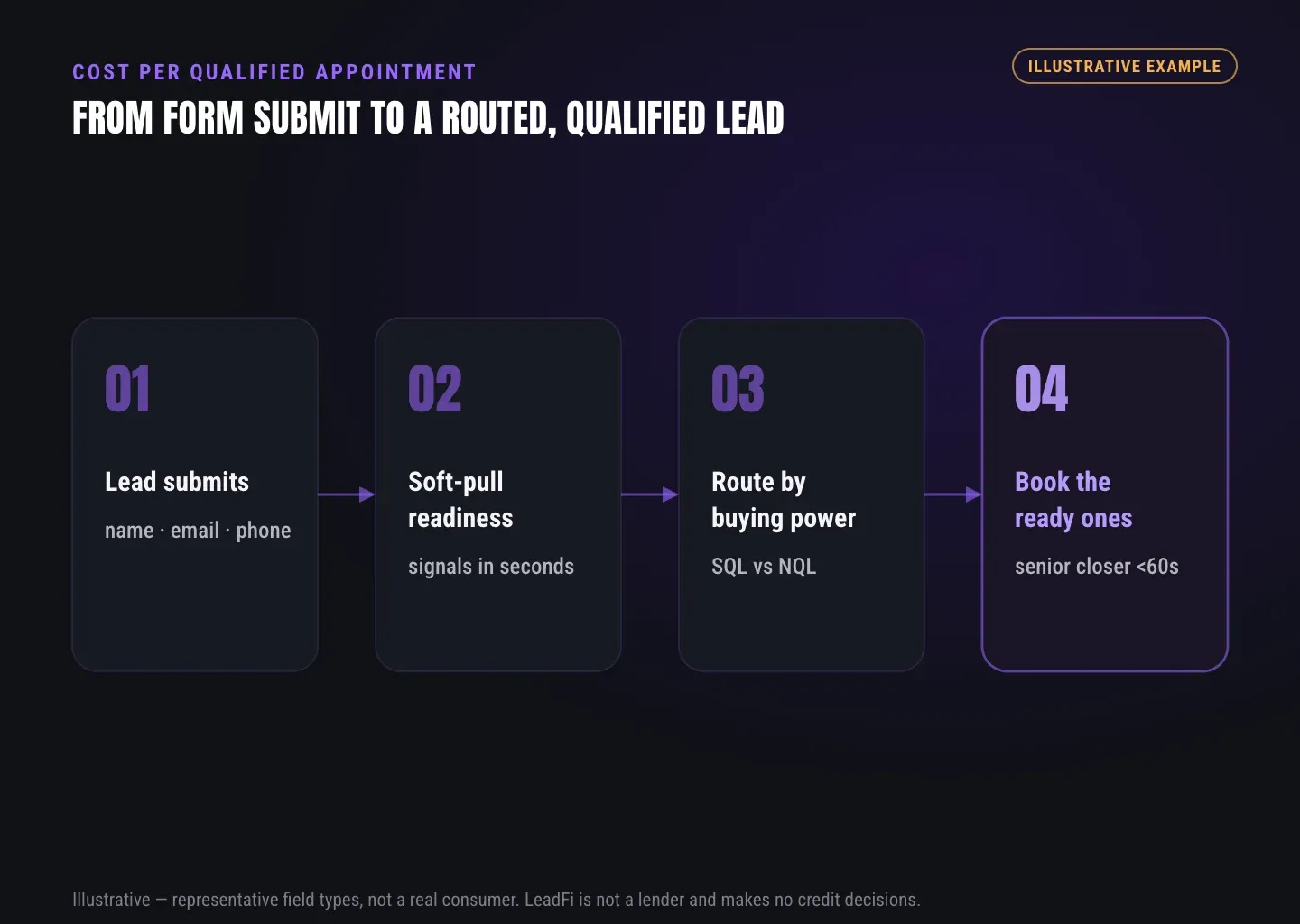
An SQL, or Sales-Qualified Lead, is someone who is financially fit to buy your offer. An NQL, or Non-Qualified Lead, is someone who is not financially fit to buy your offer.
For this metric, a qualified appointment normally requires SQL status plus a valid booking. These labels determine workflow routing; they are not judgments of personal worth.
Financial and sales fit need written rules
“Good lead” is not a reportable definition. Establish offer-specific rules before reviewing campaign results. Depending on the configured workflow, readiness signals may include VantageScore 4.0, available credit, income, debt, debt-to-income ratio, age, current address, or optional asset context.
Not every signal comes from the same source. Availability depends on configuration, consent and disclosures, supported data sources, and information supplied by the lead or client. The signals support routing and rep preparation rather than consumer approval or denial.
Nonfinancial criteria can also matter, including service area, business stage, offer match, or required experience. Store financial-readiness and other sales-fit reason codes separately so analysts can identify why a record did not qualify.
Teams designing this stage can also review practical insights on qualifying high ticket leads before the call.
Booking validity needs one standard
A valid booking should map to a real lead, a defined opportunity, a supported appointment type, and a scheduled time. Exclude spam, tests, staff bookings, unsupported meeting types, and known duplicate records.
Choose one cancellation policy and retain the final appointment status. A canceled qualified booking may remain in the qualified-booked denominator while being excluded from qualified-held appointments.
Qualification needs a fixed cutoff
Freeze qualification at a stated point, such as the latest valid status recorded before the scheduled start time. Store the status, timestamp, and reason code.
This prevents a later sale from retroactively qualifying a booking and prevents a later loss from erasing the status that existed when the appointment was due to occur.
Identity resolution needs confidence
LeadFi can work from name, email, and phone in supported thin-input workflows. Identity-related information may include current address or age when available. Its patent-pending identity matching is designed to establish a high-confidence match before a configured soft-pull workflow and, where applicable, a deeper bureau-backed workflow.
Reduced form input does not remove consent and disclosures obligations. Clients should review their use case and customer-facing language with counsel.
Denominator rules prevent metric drift
A useful record key is:
lead ID + opportunity ID + appointment journey ID
The denominator should pass these tests:
- Identity: The record maps to one trusted lead identity.
- Opportunity: The booking belongs to one offer or sales motion.
- Validity: The booking is not a test, spam entry, internal booking, or unsupported appointment.
- Qualification: The lead met the written rule by the fixed cutoff.
- Uniqueness: Duplicate calendar rows and reschedules count once.
- Repeat opportunity: A new count requires a genuinely distinct opportunity under the written policy.
- Window: The journey belongs to the stated cohort or event period.
- Stage: Qualified booked and qualified held appointments remain separate.
The base formula is:
Cost per qualified appointment
= eligible acquisition and qualification cost
÷ unique qualified appointment journeys
A fully loaded numerator may include allocated media, creative, funnel, scheduling, qualification, automation, and setter or sales-development costs. Document how shared costs are allocated and apply that method consistently.
GUIDE
Who should track qualified appointment cost
Quick answer: High-ticket and credit-adjacent teams should track cost per qualified appointment when lead volume or booking volume does not reliably represent sales value. It is especially useful when paid traffic, setter labor, and closer capacity are meaningful costs.
High-ticket teams protect closer time
Coaching, consulting, course, agency, and information-product teams often rely on setters and closers. Each weak-fit appointment uses a calendar slot and creates follow-up work. These teams need the cost of a booking that meets their written financial and sales rules, not merely the cost of filling the calendar.
Sales leaders planning capacity can pair CPQA with a practical guide to how many setters per closer.
Credit-adjacent teams need clear routing
Business funding, mortgage, lending, insurance, auto, real estate, and related teams may use financial context before a sales handoff. Their qualification rule must match the specific workflow and be reviewed by the appropriate internal owners and counsel.
LeadFi can support readiness-based routing after capture. It supports the sales workflow and does not approve or deny consumers.
RevOps teams need stable definitions
Revenue operations should publish a short metric contract covering the numerator, denominator, exclusions, cutoff, cost scope, attribution window, reschedule policy, repeat-opportunity rule, and system of record.
Controlled CRM values are essential. Free-text statuses such as “good,” “maybe,” or “looks solid” cannot support repeatable reporting.
Media buyers need downstream truth
Lead and booking events happen quickly, but they can reward channels that produce low-fit volume. A qualified appointment event adds a deeper business outcome.
Where supported, LeadFi can pass SQL-quality signals into Meta, Google, TikTok, Hyros, CRM, and operations workflows. Platform performance is not guaranteed.
Sales leaders need capacity math
Raw booking volume does not show how many useful calls closers can take. Qualified booked volume helps sales leaders distinguish a staffing constraint from a lead-mix problem. Pair it with qualified show rate, close rate, and sample size before making staffing decisions.
GUIDE
What the number changes about channel decisions
Cost per qualified appointment shifts the optimization target from calendar volume to financially fit booked demand.
Quick answer: Compare channels using qualified appointment cost, qualification rate, qualified show rate, close rate, revenue, and sample size. Send controlled SQL or NQL events to the CRM and supported advertising workflows without exposing raw financial fields.
Channel rankings can reverse
A channel with a low booked-call cost can become expensive after qualification. Another channel may produce fewer bookings but a lower CPQA because more appointment journeys meet the written readiness rule.
Avoid decisions based on a small sample. Show the denominator beside CPQA and use a defined minimum-sample policy.
Creative and landing pages shape lead mix
Price framing, offer details, audience promises, and form design influence who submits and books. Clear offer language can reduce raw volume while improving the qualified share; CPQA makes that tradeoff visible.
LeadFi can sit behind an existing form and enrich an inbound lead after submission. In supported workflows, name, email, and phone can initiate identity matching and financial-readiness qualification. The value comes from the routing action after a reliable match—not from positioning LeadFi as generic soft-pull plumbing.
For campaign implementation, see a practical guide to optimizing Meta ads for qualified leads.
SQLs should receive fast action
When a lead receives SQL status, the workflow can update the CRM and trigger a priority task, pipeline move, alert, calendar route, or rep assignment. This helps teams apply speed-to-lead where the lead is financially fit to buy the offer.
NQLs still need a path
An NQL should not be discarded. Depending on the business, the next step may be a lower-ticket product, nurture sequence, alternate offer, custom page, or later follow-up.
Routing NQLs away from the primary closer calendar protects capacity while preserving a useful customer journey.
CRM fields make the metric usable
Useful fields include:
- Lead ID, opportunity ID, and appointment journey ID
- Original booking and current scheduled timestamps
- Qualification status, reason code, and decision timestamp
- Appointment status and final meeting result
- Source, campaign, and ad identifiers
- Sales outcome and attributable revenue where available
Keep raw financial fields out of advertising event names and custom parameters. A controlled status event is generally easier to manage within a documented workflow.
Budget moves need guardrails
Do not move all budget toward the lowest CPQA without reviewing sample size, offer mix, qualified show rate, close rate, revenue, margin, and cohort maturity.
A working ceiling can be estimated as:
Maximum target CPQA
= target CAC × expected qualified-appointment close rate
Treat the result as planning math, not a guarantee or forecast.
See which of the leads you already have can actually afford to buy.
GUIDE
LeadFi capabilities behind the metric
Quick answer: LeadFi receives an existing inbound lead, uses supported identity and financial-readiness signals, and returns an SQL or NQL routing outcome. It can then support CRM updates, calendar paths, redirects, nurture, alternate offers, and qualified signal feedback through supported integrations.
Inputs start with existing inbound leads
LeadFi does not generate or buy leads. It sits behind an existing form, funnel, calendar, application, or CRM workflow and enriches leads after submission.
For many configurations, it can begin with name, email, and phone. Identity-related information such as current address or age may also be used when available and appropriate for the workflow.
Signals add buying-power context
Depending on configuration, source availability, consent and disclosures, readiness signals may include VantageScore 4.0, available credit, income, debt, debt-to-income ratio, age, address, and optional net-worth-style or asset context.
These signals help teams assess buying power for routing and rep preparation. They are not consumer approval or denial outcomes, and not every field is automatically supplied by credit data.
Rules create SQL vs NQL routing
The client defines the offer-specific rules. LeadFi applies supported readiness signals to return an SQL or NQL status for workflow use.
SQLs can move toward a setter, closer, calendar, or priority sales task. NQLs can enter nurture, a lower-ticket path, an alternate offer, or another documented next step.
Integrations return usable outcomes
LeadFi can connect through webhook, API, Zapier, Make, or supported native workflows. Outcomes can update CRM fields, tags, stages, lists, alerts, redirects, and automation triggers.
Qualified status signals can also flow into supported Meta, Google, TikTok, Hyros, and operations stacks. Results depend on the offer, data, implementation, and sales process; platform outcomes are not guaranteed.
Setup aligns the data flow
Before launch, agree on the qualification rule, cutoff, event names, CRM fields, exclusions, reschedule policy, and repeat-opportunity policy. Customer-facing privacy language, consent and disclosures, and internal CRM notes should describe a consistent workflow.
LeadFi supports compliance-aware setup and can help teams consider privacy language, consent language, TCPA-aware practices, and FCRA-aware workflow choices. LeadFi does not provide legal advice or guarantee compliance.
GUIDE
Reporting it without double-counting reschedules
Calendar tools may create several rows for one sales journey. Separate booking events from appointment journeys so a time change does not inflate the denominator.
Quick answer: Group the original booking and all reschedules under one appointment journey ID. Preserve the first booking date for acquisition reporting and the latest scheduled date for sales operations. Create a new journey only when a distinct sales opportunity begins under the documented policy.
Appointment journeys group calendar changes
An appointment journey begins when a lead books a valid call for a specific opportunity. Moving the same call to another time or rep does not create another qualified appointment.
The journey can end when the appointment is held, canceled without rebooking, disqualified, lost, or closed according to the documented rules.
Original dates protect cohort reports
Store both timestamps:
- Original booking timestamp: Connects the journey to its acquisition and booking cohort.
- Current scheduled timestamp: Tells sales when the latest appointment should occur.
A reschedule should not receive a new acquisition source merely because its meeting date changed.
Rebooks need a written rule
A lead may cancel and return later. Define when the booking remains part of the same journey and when a distinct opportunity creates a new journey.
For example, a same-offer rebook within a documented interval may remain one journey, while a later application for a different offer may become a separate opportunity. The interval is a business rule, not a universal standard.
No-shows and cancellations remain distinct
A qualified no-show can remain a qualified booked appointment but should not count as a qualified held appointment. A cancellation can follow the same treatment if that is the written policy.
Retain the final status rather than deleting the journey. This separates acquisition quality from reminder, attendance, and sales-operations issues.
Qualification changes need timestamps
Store each SQL or NQL change with a timestamp and reason code. Historical CPQA should use the status that existed at the fixed cutoff; live routing can use the current status.
This prevents prior reports from changing whenever someone edits a CRM record.
Reconciliation catches broken counts
At the same record level, the funnel should generally follow this order:
Unique inbound leads
≥ unique booked appointment journeys
≥ unique qualified appointment journeys
≥ unique qualified held appointments
≥ customers from qualified appointments
Review exceptions such as multiple valid opportunities for one lead. Warning signs include more qualified appointments than valid bookings, missing decision timestamps, multiple sources attached to one journey, free-text statuses, or reschedules recorded as new opportunities.
Related reading: a practical guide to how many setters per closer, a practical guide to optimizing Meta ads for qualified leads, practical insights on qualifying high ticket leads before the call.
| Metric | Basic formula | What it shows | What it can hide |
|---|---|---|---|
| Cost per lead | Cost ÷ unique inbound leads | Price of captured demand | Booking intent and buying power |
| Cost per booked call | Cost ÷ unique appointment journeys | Price of calendar activity | Financial fit, attendance, and duplicates if IDs are weak |
| Cost per qualified appointment | Cost ÷ unique qualified appointment journeys | Price of financially fit booked demand | Attendance and sales performance |
| Cost per qualified held appointment | Cost ÷ qualified journeys that occurred | Price of completed qualified calls | Work and outcomes after the call begins |
| Customer acquisition cost | Cost ÷ new customers | Price of completed acquisitions | The funnel stage where waste began |
| Revenue per qualified appointment | Attributed revenue ÷ qualified appointments | Revenue yield from qualified demand | Margin, refunds, collections, and timing |
Key takeaways
The short version
- CPQA divides eligible cost by unique qualified appointment journeys.
- The denominator needs written rules, fixed cutoffs, exclusions, and stable IDs.
- Reschedules count once; qualified booked and qualified held remain separate.
- SQL means financially fit to buy the offer; NQL means not financially fit.
- LeadFi routes existing inbound leads using supported financial-readiness signals.
Quick answers
Fast answers before you dig in
What is cost per qualified appointment?
Cost per qualified appointment is eligible acquisition and qualification cost divided by unique qualified appointment journeys that met a written qualification rule by a fixed cutoff.
What belongs in the qualified-appointment denominator?
Count one valid lead-opportunity-appointment journey that met the written rule by the cutoff. Exclude spam, tests, unsupported bookings, and duplicates; count reschedules once and keep booked separate from held.
How does CPQA differ from cost per booked call?
Cost per booked call counts all valid bookings. CPQA counts only unique bookings that meet the financial and sales qualification rules, making it a narrower measure of actionable calendar demand.
How does LeadFi support CPQA reporting?
LeadFi qualifies existing inbound leads using supported financial-readiness signals, returns SQL or NQL routing outcomes, and can write controlled statuses, timestamps, and workflow events into supported systems.
FAQ
Common questions
What is cost per qualified appointment?
How is cost per qualified appointment different from cost per booked call?
What costs should be included in cost per qualified appointment?
Should no-shows count in cost per qualified appointment?
How should reschedules affect cost per qualified appointment?
Can financial-readiness qualification improve appointment economics?
How does LeadFi support cost per qualified appointment reporting?
Sources
References
- CFPB — What is a credit inquiry? (hard vs. soft) (opens in a new tab)Federal regulator confirms a soft inquiry, unlike a hard inquiry, does not affect the consumer's credit score.
- VantageScore — VantageScore 4.0 credit scoring model (opens in a new tab)Official page describing VantageScore 4.0, the tri-bureau, trended-data model used to assess credit risk.
- Experian — What Is a Soft Inquiry? (opens in a new tab)Major credit bureau explains soft inquiries are informational and have no impact on credit scores.
Know who is ready before your next sales call.
Cost per qualified appointment becomes useful when the written definition, routing logic, and reporting data agree. LeadFi can add financial-readiness qualification, SQL vs NQL routing, CRM events, and next-step logic behind an existing inbound form, funnel, calendar, or CRM.