
CANT AFFORD IT OBJECTION
The “I Can’t Afford It” Objection: What It Really Means
The i cant afford it objection can signal either a genuine financial constraint or an unresolved concern about value, trust, fit, risk, or timing. Treating both situations alike can create unnecessary pressure or end a useful conversation too early.
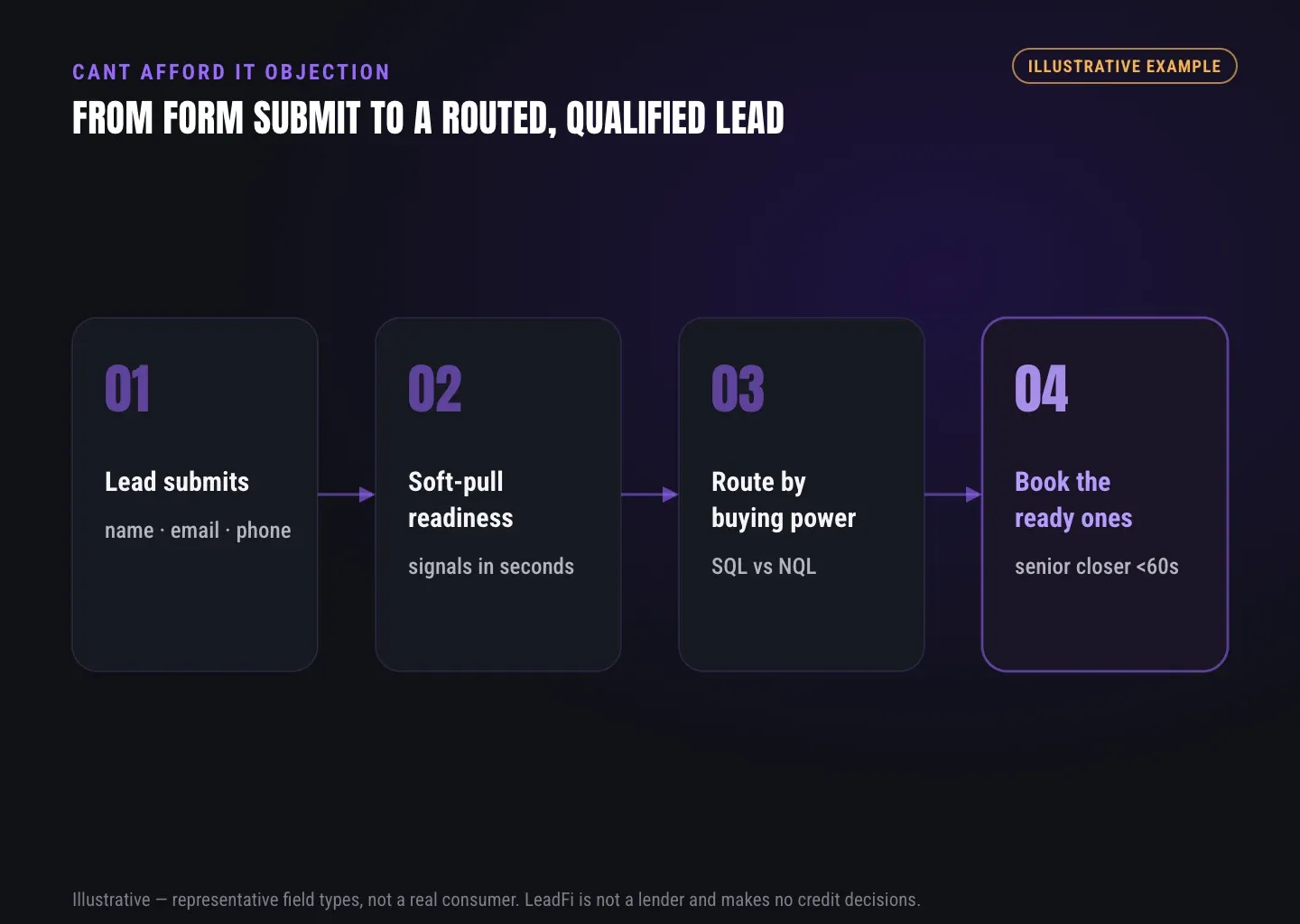
Watch a contact get pre-qualified.
This is exactly what your CRM gets back.
Your opt-in form
Soft pull · no impact to their credit
This is not a real soft pull. It's an example of the data points that land in your CRM contact record when a lead fills out your form.
LEADFI DEMO
Watch the demo, then start free or book a call.
GUIDE
Affordability objections can mean different things
A genuine financial constraint
A genuine constraint means the cost does not fit the lead’s current finances. It is not a sales puzzle or an invitation for a stronger rebuttal. Respect the boundary and choose an appropriate next route, such as helpful nurture, a suitable lower-cost offer, or a clean close.
A stall or unresolved concern
A lead may use price to express uncertainty about value, trust, scope, risk, or expected work. One calm question can identify the gap without assuming the person is being evasive.
Poor offer fit
Some leads may have financial capacity but still be wrong for the offer. Their goals, circumstances, or expected outcomes may not align with what the business provides. That calls for another route or a clean exit, not objection handling.
Timing and uncertainty
A lead may be interested but unwilling to add a new commitment during an uncertain period. Record the stated reason and use a clear follow-up rule rather than applying a vague “not now” label to every lost opportunity.
The key distinction is simple: a genuine affordability constraint is a boundary, while a stall leaves a specific question open. This page diagnoses that difference; it does not supply a rebuttal script for overriding a real no.
GUIDE
How to tell a real constraint from a stall
Listen for a clear boundary
If the lead clearly says the cost does not fit and declines further discussion, accept the answer. Do not turn a firm no into a debate.
Test whether value is clear
If the concern is vague, ask whether the issue is the amount itself or uncertainty about the offer’s value, scope, or support. Address only the named gap. A repeated firm no should end the sales push.
Compare discovery with readiness signals
Application answers can provide context, but self-reported budget fields rarely show the complete picture. When the workflow, consent and disclosures, and configuration support it, LeadFi can surface permissioned signals such as VantageScore 4.0, available credit, income, debt, and debt-to-income ratio.
These are inputs for routing and rep preparation. They do not replace respectful discovery or the consumer’s stated choice.
Objection or routing category?
An objection may be clarified when missing information is the problem. A genuine affordability constraint should instead inform a respectful route away from the main sales push.
This page describes a routing input, not a credit decision, approval, or eligibility determination.
For LeadFi workflows, an SQL, or Sales-Qualified Lead, is someone who is financially fit to buy your offer. An NQL, or Non-Qualified Lead, is someone who is not financially fit to buy your offer. These operational labels guide configured workflows; they do not measure a person’s worth.
GUIDE
What to say for each affordability concern
A useful price-objection response acknowledges the concern and asks only enough to identify whether the issue is capacity, value, trust, timing, or fit.
When the constraint is genuine
Try: “Thanks for being direct. I do not want to push you into something that does not fit your situation.” Then stop selling and offer an appropriate next path only if one exists.
When value is unclear
Try: “Is the concern the amount itself, or whether the result and support justify it?” This lets the lead identify the gap without suggesting that the rep knows their finances better than they do.
When trust is weak
Try: “What would you need to understand before this felt like a sound choice?” Address the specific question about delivery, scope, proof, expectations, or support rather than giving a broad rebuttal.
When timing or fit is wrong
Ask whether the offer is wrong or whether this is simply not a safe time to take it on. A clear timing issue may support a later follow-up. Poor fit should produce another route or a clean close.
GUIDE
Why the affordability objection is often an upstream miss
Forms measure intent more easily than buying power
A form submission shows interest, not necessarily financial readiness. Budget and income questions can help, but the answers may be incomplete or based on expectations rather than current capacity.
Calendars need qualification rules
A calendar can collect details and create appointments, but it cannot select an appropriate path without routing logic. A busy calendar may therefore conceal a mismatch between lead volume and financially qualified calls.
CRMs need defined routes
The CRM must know what each status triggers. An SQL might move to a priority sales queue, while an NQL might enter nurture, receive a suitable alternate offer, or reach a custom page.
Sales may discover the issue too late
When every applicant follows the same path, reps may spend calls discovering basic financial fit. Earlier qualification can reduce wasted sales conversations while giving each lead a more appropriate experience.
INTELLIGENCE LAYER
Financial-readiness qualification before the call
LeadFi sits behind existing forms, funnels, calendars, and CRMs to qualify inbound leads after submission. It does not generate or buy leads.
Thin-input identity matching
LeadFi can work from name, email, and phone for many workflows. Its patent-pending identity matching is designed to establish a high-confidence match before an applicable soft-pull workflow. Identity-related information and identity signals, such as current address or age, may also be relevant depending on the setup.
The objective is accurate matching and readiness-based routing—not avoiding consent and disclosures.
Permissioned readiness signals
Depending on configuration, available signals may include VantageScore 4.0, available credit, income, debt, debt-to-income ratio, age, address, and optional asset or net-worth-style context. Teams can use selected signals for routing and rep preparation.
SQL vs NQL routing
Configured rules can write an SQL or NQL status into the workflow. SQLs can receive faster sales follow-up, while NQLs can move to nurture, a suitable low-ticket path, an alternate offer, or another custom experience.
CRM and paid-media workflows
LeadFi can connect through a webhook, API, Zapier, Make, or a supported native workflow. Readiness fields may update CRM records, queues, alerts, redirects, and reporting. Where platform rules and configuration allow, qualified-lead events can also feed Meta, Google, TikTok, Hyros, and operations stacks. Results depend on the broader campaign, data, offer, and workflow.
Compliance-aware setup
LeadFi supports compliance-aware workflows and can help teams consider privacy policy language, consent language, TCPA-aware practices, and FCRA-aware workflow choices before launch. LeadFi does not provide legal advice or guarantee compliance. Clients should review their use case with counsel.
See which of the leads you already have can actually afford to buy.
INTELLIGENCE LAYER
Who financial-readiness routing is for
High-ticket sales teams
Coaches, consultants, agencies, course creators, and information-product businesses can use readiness routing to prioritize financially qualified inbound leads while giving lower-readiness leads a more suitable path.
Credit-adjacent businesses
Business funding, mortgage, lending, insurance, auto, and related teams may use financial context for routing and rep preparation. Each client remains responsible for its products, processes, consent and disclosures, and legal review.
Revenue operations and media buyers
Shared SQL and NQL fields can help marketing, sales, and operations evaluate lead quality using a consistent routing signal. Where supported, those signals can also return to attribution and advertising workflows without replacing those tools.
Teams with costly calendars
When closer time is limited, routing can determine which queue, page, or next step fits each inbound lead. The goal is not simply fewer appointments; it is better alignment between the calendar, the offer, and the team’s qualification rules.
GUIDE
Measuring how often the affordability objection appears
Define a consistent objection code
Use one CRM event, such as AFFORDABILITY_MENTIONED, and a separate field for the diagnosed cause: genuine constraint, unclear value, trust, poor fit, timing, or unknown.
Separate mentions from diagnosed causes
A mention does not prove a genuine constraint, and a closed-lost outcome does not explain why the concern appeared. Record the call stage and next route separately.
Compare SQL and NQL routes
Frequent affordability concerns among NQLs may indicate that routing should happen earlier. Frequent concerns among SQLs may point to offer framing, trust, value, or sales discovery because financial capacity does not establish willingness to buy.
Review source, offer, and rep context
Compare patterns by campaign, page, form, source, offer, and rep, using enough data to avoid reacting to isolated calls. Review call context alongside fields so the team understands both what happened and why.
GUIDE
Diagnose the objection before trying to answer it
“I can’t afford it” is useful information, but it is not a complete diagnosis. A genuine financial constraint, unclear value, weak trust, poor fit, and bad timing can all produce the same words.
LeadFi adds buying-power-aware qualification behind the tools a high-ticket business already uses. That context helps teams prioritize SQLs, route NQLs appropriately, and prepare reps without pushing past a genuine capacity constraint.
Related reading: a practical guide to refund rate affordability, practical insights on pre-screen leads by financial readiness, a closer look at soft credit check without address for lead qualification.
| Signal | Likely genuine constraint | Likely unresolved concern | Appropriate next action |
|---|---|---|---|
| Price response | Clear statement that the cost does not fit | General price concern without detail | Accept the limit or ask one calm question |
| Offer value | Value is understood | Scope, support, or outcome remains unclear | Clarify the named gap |
| Trust | Trust appears intact | Process, proof, or expectations are unclear | Address the specific trust concern |
| Offer fit | Offer matches the stated need | Lead is unsure the offer fits | Revisit goals and required work |
| Timing | Current financial pressure is specific | “Not now” has no clear cause | Set a suitable follow-up or close the loop |
| Readiness route | Configured signals support an NQL path | Configured signals support an SQL path | Apply the workflow, then respect the lead’s choice |
| Final answer | Firm no after clarification | A specific question remains open | Stop selling or continue limited discovery |
Key takeaways
The short version
- A genuine capacity constraint is different from a value or trust stall.
- A firm financial boundary should end the sales push.
- LeadFi qualifies existing inbound leads rather than generating them.
- SQL vs NQL status can control sales, nurture, or alternate routes.
- Thin-input readiness workflows still require appropriate consent and disclosures.
Quick answers
Fast answers before you dig in
What does the i cant afford it objection mean?
It may reflect a genuine financial constraint or an unresolved concern about value, trust, fit, risk, or timing. Diagnose the cause before responding.
How should a rep respond to a genuine affordability constraint?
Acknowledge the boundary, stop the sales push, and offer a suitable nurture, alternate path, or clean close only when appropriate.
How can financial-readiness data help?
Permissioned readiness signals can support rep preparation and SQL vs NQL routing, but they should not override the lead’s stated choice.
Does LeadFi generate leads?
No. LeadFi qualifies and routes existing inbound leads behind a business’s forms, funnels, calendars, and CRM.
What is the difference between an SQL and an NQL?
An SQL is someone financially fit to buy the offer. An NQL is someone not financially fit to buy the offer; each status triggers a configured routing path.
FAQ
Common questions
What does the i cant afford it objection usually mean?
What is the best price objection response?
How can LeadFi help with the i cant afford it objection?
Does LeadFi replace sales discovery?
Can LeadFi work from name, email, and phone?
How does SQL vs NQL routing work in a CRM?
Sources
References
- CFPB — What is a credit inquiry? (hard vs. soft) (opens in a new tab)Federal regulator confirms a soft inquiry, unlike a hard inquiry, does not affect the consumer's credit score.
- VantageScore — VantageScore 4.0 credit scoring model (opens in a new tab)Official page describing VantageScore 4.0, the tri-bureau, trended-data model used to assess credit risk.
- CFPB — Who can request to see my credit report? (opens in a new tab)Federal regulator explains the FCRA rules governing who may obtain a credit report.
- VantageScore credit-scoring models (opens in a new tab)Official background on VantageScore models, including VantageScore 4.0.
Know who is ready before your next sales call.
See how LeadFi can sit behind your current form, funnel, calendar, or CRM to qualify existing inbound leads and support SQL vs NQL routing. Request a soft demo and guided buying-power assessment.