
BANT LEAD QUALIFICATION BUDGET
Lead Qualification BANT: Budget, Authority, Need, and Timing
Lead qualification BANT is a sales qualification process built around four deal factors: Budget, Authority, Need, and Timing. Teams use these factors to decide whether an inbound lead should receive active sales follow-up, nurture, an alternate offer, or later review.
Watch a contact get pre-qualified.
This is exactly what your CRM gets back.
Your opt-in form
Soft pull · no impact to their credit
This is not a real soft pull. It's an example of the data points that land in your CRM contact record when a lead fills out your form.
LEADFI DEMO
Watch the demo, then start free or book a call.
GUIDE
Define Budget, Authority, Need, and Timing
The lead qualification BANT framework gives sales teams a shared way to review deal fit. BANT means Budget, Authority, Need, and Timing.
Budget tests economic fit
Budget asks whether the prospect has a realistic buying path for the offer. A stated budget is useful, but it may be an estimate, a monthly target, future cash, or an answer shaped by the form. It should be confirmed during discovery rather than treated as proof.
Authority maps the decision group
Authority identifies who can make or influence the business decision. The first contact may be the decision-maker, a champion, a manager, a spouse, or one member of a shared decision group.
Need tests the problem and impact
Need determines whether the offer addresses a clear problem that the buyer wants to solve. Strong Need includes a desired result, the consequences of waiting, and evidence that the offer fits the situation.
Timing identifies the action window
Timing asks when the buyer expects to decide or begin. Useful Timing includes both a target date and the event behind it, such as a launch, contract ending, hiring plan, or missed target.
BANT should guide discovery
BANT factors affect one another. A financially ready buyer may lack authority, while a buyer with strong Need may have a later timeline. Use neutral CRM labels such as “shared authority,” “Need unclear,” or “later Timing” so every gap leads to an appropriate next action.
Criteria should also match the offer. A $2,000 course and a $25,000 consulting engagement should not use identical qualification rules.
INTELLIGENCE LAYER
Inform the Budget dimension with financial readiness
Financial-readiness data can inform a team's BANT Budget dimension instead of relying only on a self-reported budget answer. Depending on the configured workflow, supported signals may include income, debt, available credit, debt-to-income ratio, or VantageScore 4.0. These signals support routing and rep preparation; they do not decide the sale.
Readiness adds buying-power context
LeadFi can work from a submitted name, email, and phone to provide real-time financial insights in supported thin-input prescreening workflows. Soft-pull prescreening can add readiness context without affecting the consumer's credit score, while the workflow still requires appropriate consent and disclosures.
Financial readiness should inform Budget rather than define it completely. A buyer may have strong readiness signals but weak Need or no urgency. Another buyer may fit the offer but require a longer nurture path.
Identity matching supports the workflow
LeadFi's patent-pending identity matching is designed to establish a high-confidence match before supported soft-pull prescreening and, where applicable, deeper bureau-backed workflows. It uses identity-related information and identity signals, which may include current address or age when available.
Blend stated and observed context
A practical Budget review combines:
- Buyer-stated context: Expected price, planned spend, timing, and preferred buying path.
- Readiness context: Supported financial signals made available under the configured consent and disclosures.
- Sales context: Offer fit, Authority, Need, Timing, trust, and the appropriate next action.
This blended approach gives reps better questions to ask without replacing respectful discovery or human judgment.
Use SQL and NQL as routing states
An SQL, or Sales-Qualified Lead, meets the team's current rules for active sales follow-up. An NQL, or Non-Qualified Lead under those rules, may be routed to nurture, a lower-ticket product, an alternate offer, or later review. NQL should describe the current route, not a permanent judgment about the buyer.
LeadFi qualifies existing inbound leads by financial readiness. It does not approve or decline people, and it does not offer credit.
Give reps actionable context
Instead of displaying every available field, a CRM can show the readiness status, stated Budget range, BANT gaps, routing reason, and approved next action. A concise record might include SQL, NQL, or manual review; confirmed or shared Authority; Need strength; Timing band; and the assigned sales or nurture path.
GUIDE
Review Authority, Need, and Timing
Financial readiness adds depth to Budget, but it does not answer the other BANT questions. Sales still needs to review Authority, Need, and Timing.
Map Authority to an action
Ask what role the lead plays in the decision and who else must participate. Useful CRM states include confirmed authority, shared authority, champion, unknown, and blocked. Each state should trigger an action—for example, a shared-authority result can create a task to invite the second stakeholder.
Confirm Need and offer fit
A booked call shows interest, not necessarily fit. Reps should identify the current problem, its impact, previous attempts, desired result, and whether the offer can address the situation. Financial readiness without a clear Need may call for education rather than an immediate closer call.
Connect Timing to a real event
A date is stronger when it is tied to a real event. Teams can use simple Timing states such as now, dated, open, later, or unknown. These states should determine pipeline stage, follow-up pace, and nurture length without creating false certainty.
Avoid routing on Budget alone
A lead may satisfy the team's Budget and readiness criteria but still need an Authority task, Need discovery, or a later follow-up. Conversely, a lead with strong Need may benefit from a different offer or nurture path. The route should reflect all four BANT dimensions and the rules for the specific offer.
See which of the leads you already have can actually afford to buy.
GUIDE
Document team-owned follow-up choices
BANT becomes operational when every status has an owner and next step. Define the routes, CRM fields, alerts, exceptions, and review cadence before launch.
Build an owned route map
A practical workflow can include:
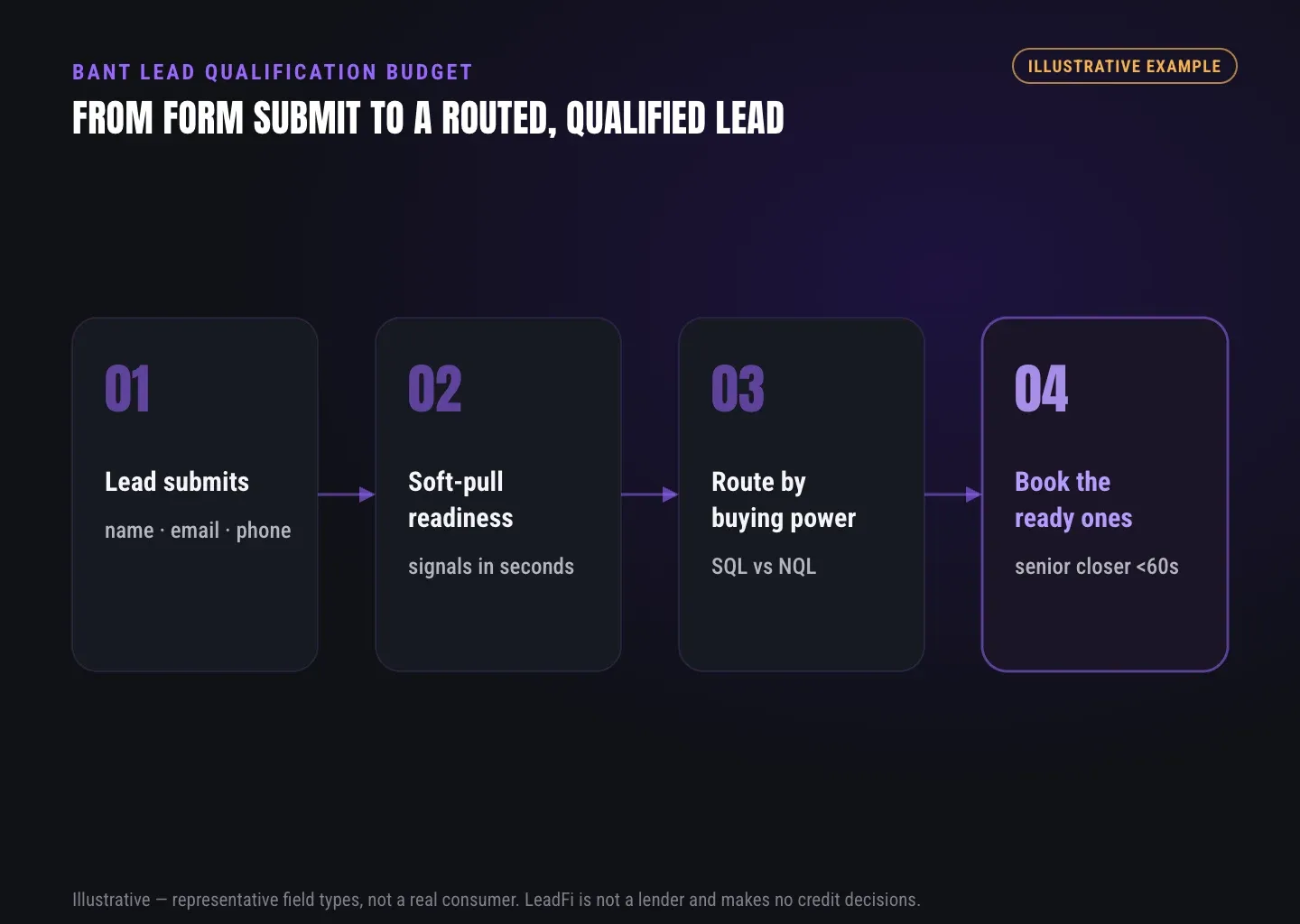
- Capture: A form, funnel, application, or calendar creates an inbound lead.
- Match: LeadFi evaluates submitted identity-related information and available identity signals.
- Classify: The configured workflow returns financial-readiness data and an SQL, NQL, or review result.
- Write back: CRM fields, tags, stages, alerts, and tasks update.
- Route: The lead reaches a setter, closer, calendar, page, nurture sequence, or alternate offer.
- Learn: Approved quality events can return to reporting and advertising systems where supported.
Connect LeadFi to the existing stack
LeadFi sits behind existing forms, funnels, calendars, and CRMs rather than requiring teams to replace their full stack. Connections can use a webhook, API, Zapier, Make, or a supported native workflow.
Configured signals and status fields can also feed into Meta, Google, TikTok, Hyros, and operational reporting where the platform and setup allow. This creates a lead-quality feedback loop, but it does not guarantee advertising or sales performance.
Create valuable SQL and NQL paths
SQLs can move to a fast-response queue, setter, closer, or primary calendar. NQLs can receive education, a low-ticket product, an alternate offer, a later review, or another suitable next step. Manual review can handle missing data, identity uncertainty, complex deals, or mixed signals.
Use quality signals carefully
Keep definitions stable across sales, marketing, and RevOps. Compare routes by source, offer, BANT gap, and eventual outcome rather than evaluating campaigns only by form-fill volume. Use readiness data to improve routing and rep preparation, not to shame or make assumptions about a person's worth.
Prepare a compliance-aware launch
LeadFi supports compliance-aware workflows and can help teams with privacy policy language, consent language, and TCPA-aware follow-up choices. LeadFi does not provide legal advice, remove consent and disclosure obligations, or approve or deny consumers. Clients should review their use case with counsel.
Related reading: a closer look at what is lead qualification, practical insights on ai lead qualification, a closer look at marketing lead qualification.
| Budget approach | Main input | Useful for | Main limitation | Best next step |
|---|---|---|---|---|
| Self-reported only | Form or call answer | Understanding the buyer's stated plan | Budget may mean something different to the buyer | Confirm the meaning during discovery |
| Readiness only | Supported financial-readiness signals | Adding buying-power context | Does not establish intent, Need, Authority, or Timing | Pair signals with BANT discovery |
| Blended BANT | Stated Budget, readiness, and sales context | Routing and rep preparation | Requires offer-specific rules and clear ownership | Define SQL, NQL, and review paths before launch |
Key takeaways
The short version
- BANT means Budget, Authority, Need, and Timing.
- Financial readiness adds context beyond self-reported Budget.
- LeadFi routes inbound leads; it does not approve or decline them.
- SQLs and NQLs need distinct, team-owned follow-up paths.
- LeadFi connects through CRM and workflow integrations.
Quick answers
Fast answers before you dig in
What does lead qualification BANT mean?
Lead qualification BANT means reviewing Budget, Authority, Need, and Timing during the sales process. The framework helps teams select an appropriate sales, nurture, or follow-up path.
How can financial readiness inform BANT Budget?
Financial-readiness signals can add buying-power context to a self-reported Budget answer. They support routing and rep preparation but do not replace discovery or determine whether a sale occurs.
What is SQL vs NQL routing?
An SQL meets the team's current rules for active sales follow-up. An NQL follows another defined path, such as nurture, a lower-ticket offer, an alternate offer, or later review.
Does LeadFi approve or decline inbound leads?
No. LeadFi qualifies existing inbound leads by financial readiness and returns signals for team-defined routing. It does not approve or decline people, and it does not offer credit.
FAQ
Common questions
What does lead qualification BANT mean?
How does financial readiness improve lead qualification BANT?
What are the limits of a self-reported Budget?
Does LeadFi replace BANT discovery?
How does SQL vs NQL routing work with BANT?
Can LeadFi work with an existing CRM and form?
Does LeadFi use a soft pull for lead qualification BANT?
Sources
References
- CFPB — What is a credit inquiry? (hard vs. soft) (opens in a new tab)Federal regulator confirms a soft inquiry, unlike a hard inquiry, does not affect the consumer's credit score.
- VantageScore — VantageScore 4.0 credit scoring model (opens in a new tab)Official page describing VantageScore 4.0, the tri-bureau, trended-data model used to assess credit risk.
- CFPB — Who can request to see my credit report? (opens in a new tab)Federal regulator explains the FCRA rules governing who may obtain a credit report.
- VantageScore 4.0 (opens in a new tab)Background on the named scoring model referenced as a potential readiness signal.
Know who is ready before your next sales call.
BANT gives your team a shared language for Budget, Authority, Need, and Timing. LeadFi adds financial-readiness context, SQL/NQL routing, CRM actions, and quality-signal feedback behind the tools you already use.