
APPLICATION ABANDONMENT FINANCIAL QUESTIONS
Application Abandonment: Where Financial Questions Stall the Journey
Application abandonment describes a journey that ends before its defined handoff. Depending on the funnel, that handoff may be submission, authorisation, booking, or a routed next step. Financial questions can create a particularly fragile moment.
Watch a contact get pre-qualified.
This is exactly what your CRM gets back.
Your opt-in form
Soft pull · no impact to their credit
This is not a real soft pull. It's an example of the data points that land in your CRM contact record when a lead fills out your form.
LEADFI DEMO
Watch the demo, then start free or book a call.
GUIDE
Application journey: locate the exact stall
A top-line form drop off rate cannot identify the operational problem. Track the sequence from landing-page view through application start, identity completion, financial-section view, disclosure view, authorisation, submission, route return, calendar view, and completed booking.
Define the intended handoff
Choose one finish event for each report. If marketing treats submission as completion while sales treats booking as completion, the teams are measuring different journeys. Record both events rather than blending them into one number.
A useful sequence is:
- Landing page viewed
- Application started
- Name, email, and phone completed
- Fit questions completed
- First financial question viewed
- Financial section completed
- Consent and disclosures presented
- Authorisation completed
- Application submitted
- Route returned
- Assigned next step completed
Instrument the journey by step
Suppose 1,000 visitors view an application, 600 start, and 300 submit. The view-to-submit rate is 30%, but that figure does not explain the exits. If 550 people reach the financial section and 310 continue, that section becomes a focused test area. The pattern does not establish why people left.
Break events down by source, device, campaign, offer, and form version. A mobile interaction problem, a traffic-mix change, and unclear financial wording can produce similar aggregate patterns.
Separate abandonment from qualification
Someone who exits before a valid result is not an NQL. An SQL, or Sales-Qualified Lead, is someone who is financially fit to buy your offer. An NQL, or Non-Qualified Lead, is someone who is not financially fit to buy your offer.
LeadFi can classify an existing inbound lead after submission using configured rules and financial-readiness signals. When additional applicant data is obtained for that process, it happens with the applicant's disclosure and authorisation. A missing answer or unavailable result should use a neutral status such as readiness unavailable, not a forced NQL label.
Check segments before changing the workflow
A blended rate can conceal opposite patterns. One campaign may attract informed prospects who expect a readiness step, while another reaches people encountering the offer for the first time. Compare like-for-like traffic before changing the experience for everyone.
No universal abandonment benchmark is supplied for this article. Use the funnel's historical versions and controlled tests, and monitor downstream route completion alongside submissions.
GUIDE
Financial questions that create completion risk
Financial questions become fragile when they are sensitive, difficult to answer, unclear in purpose, or perceived as carrying an immediate consequence. The same question can work late in an informed journey and fail when shown without context on the first screen.
Income and debt combine sensitivity with recall
Exact income can be hard to state for households, commission earners, and seasonal businesses. Exact debt can require records or calculations, while an unclear label leaves applicants unsure which obligations count.
If self-reported context is sufficient, a range may be more usable than an exact figure. If the answer does not change a page, route, CRM stage, rep brief, or offer path, the operator should question why it is collected at that moment.
Credit and available-funds questions can imply judgment
Asking someone to estimate a score can produce stale or inaccurate information. Asking about available funds or payment sources too early can make the journey feel transactional before value and purpose are clear.
When a score is relevant to an applicable LeadFi workflow, VantageScore 4.0 may be surfaced after submission. Any applicant data obtained in that workflow requires the applicant's disclosure and authorisation. The signal supports readiness classification, routing, and rep preparation; LeadFi does not approve or deny consumers.
Every question needs an operational owner
Map each financial question to a specific action. Possible actions include selecting a calendar, assigning a sales queue, updating a CRM stage, preparing a rep, entering nurture, or presenting an alternate offer.
A practical review asks:
- Does this answer change the immediate route?
- Can the applicant answer accurately without checking records?
- Has the purpose been explained before the question appears?
- Does the wording suggest that one response ends the journey?
- Which system stores and acts on the result?
The takeaway is sequencing, not generic field reduction. A necessary question may remain before submission because it controls the next step. Another may belong after submission because it is sensitive, hard to estimate, and better handled through an applicable workflow.
Post-submit signals can reduce reliance on estimates
For supported configurations, LeadFi can begin from name, email, and phone supplied through the existing form. Its patent-pending identity matching is designed to establish a high-confidence match before an applicable soft pull. Any additional applicant data obtained at that stage is accessed with the applicant's disclosure and authorisation.
Depending on the configured workflow, readiness signals may include VantageScore 4.0, available credit, income, debt, debt-to-income ratio, current address, age, and optional asset context where available. These are routing and rep-preparation inputs, not consumer decisions. An applicable soft pull does not affect the consumer's credit score.
GUIDE
Financial-question timing before and after submit
Timing should follow the decision each answer supports. Keep questions before submission when the applicant can answer them reliably and the response changes the immediate path. Place suitable readiness assessment after submission when the workflow supports it and the applicant has received the required disclosure and provided authorisation.
Before submit: capture fit and intent
Common pre-submit inputs include name, email, phone, goals, role, business type, offer interest, and purchase timing. These describe what the applicant knows directly and give the CRM a usable lead record.
Financial questions may also remain before submission when they are essential to a defined route. The operator should document the action tied to each answer rather than collecting it for possible future use.
At submit: explain the readiness handoff
Customer-facing language should explain the purpose, scope, and next step. If an applicable soft pull follows, it should not appear as an unexplained redirect. Consent and disclosures must match the actual workflow.
A clear handoff answers three questions: what will happen, why it supports the journey, and where the applicant goes next.
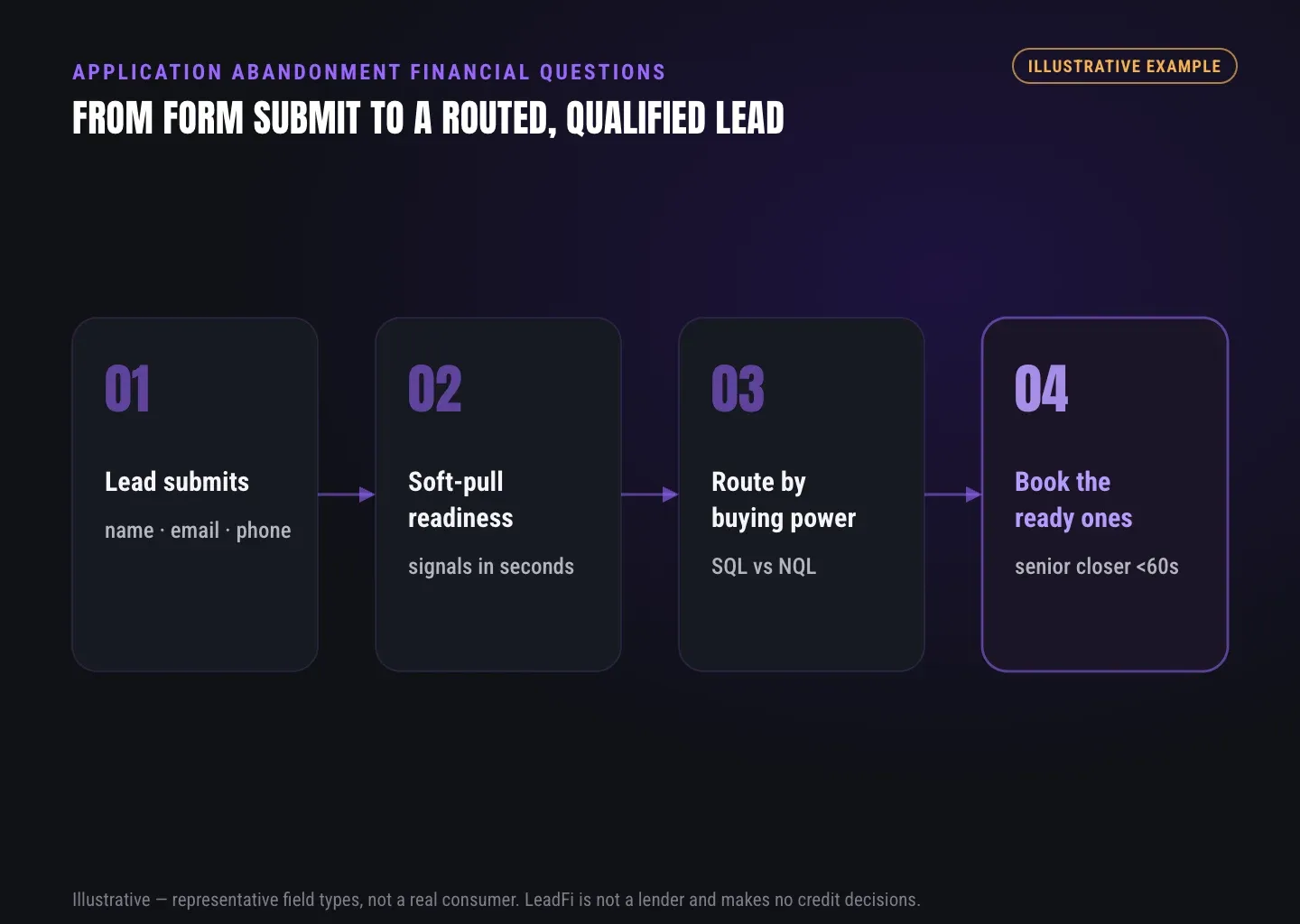
After submit: classify and route
After a valid handoff, LeadFi can use configured readiness rules to return an SQL, NQL, or unavailable result. Any additional applicant data obtained for the assessment requires the applicant's disclosure and authorisation.
A concrete workflow can:
- Receive the existing inbound lead through webhook, API, Zapier, Make, or a supported native workflow.
- Run the configured identity-matching and readiness steps.
- Write the result to CRM fields, tags, stages, or workflow triggers.
- Route an SQL to the selected sales queue or calendar.
- Route an NQL to nurture, a lower-ticket offer, or another defined path.
- Send unavailable results to review or general nurture.
- Return a permitted qualified-lead event to Meta, Google, TikTok, Hyros, or another configured system.
For implementation planning, use the Lead Routing Decision Framework (SQL/NQL by financial readiness). It helps connect readiness definitions to destinations rather than treating qualification as a label with no next action.
Build a neutral fallback
Identity mismatches, input errors, missing authorisation, thin files, integration failures, and unavailable data can interrupt the normal path. Do not force these records into SQL or NQL.
Use a neutral status, retain the lead in the CRM, log a reason code, and assign a review or general-nurture action. Exclude unresolved records from events intended to represent financially qualified leads.
Fintech onboarding requires staged trust
Fintech onboarding can combine identity, financial context, consent, product education, and account steps. The reader-focused design problem is sequencing those commitments so applicants understand purpose, scope, control, and the next action.
High-ticket and credit-adjacent teams should keep sales qualification distinct from consumer decisioning. LeadFi qualifies and routes existing inbound leads based on financial readiness; it does not approve or deny consumers. Fast processing cannot compensate for unclear expectations.
LeadFi supports compliance-aware workflows and can help teams align privacy language, consent language, TCPA-aware practices, and the planned data flow. LeadFi does not provide legal advice, and clients should review their use case with counsel.
See which of the leads you already have can actually afford to buy.
INTELLIGENCE LAYER
Treat abandonment as a routing and demand signal
Abandonment can reveal a mismatch among traffic expectations, the offer, financial-question timing, and the promised next step. It should not be interpreted only as a form defect.
Read exits with source and downstream outcomes
Track at least four measures:
- Start rate: starts divided by application views
- Submit rate: submissions divided by starts
- SQL rate: SQLs divided by valid completed readiness workflows
- Route completion rate: assigned next steps completed divided by routed leads
A higher submission rate is not automatically better if added records fail to complete their assigned paths or do not fit the sales motion. Conversely, an exit at a sensitive question does not establish low buying power.
Use SQL and NQL paths differently
SQLs can receive prioritized alerts or the selected closer path when sales capacity supports it. NQLs can enter nurture, a lower-ticket offer, or another appropriate route. Those alternatives require their own offer and economics; NQL volume alone does not establish that an alternate product will work.
Operators comparing adjacent workflow questions may also review practical insights on refund rate affordability, a closer look at ai lead qualification, and practical insights on iso broker crm readiness band. Each topic should be evaluated against the team's actual offer, traffic, and CRM rules.
Test hypotheses without inventing causation
Use a test log that distinguishes observation from explanation:
- Observation: More exits appeared after the financial section changed.
- Hypothesis: The new wording increased uncertainty.
- Test: Compare versions within the same source and device segment.
- Guardrail: Monitor SQL mix and route completion, not submission alone.
- Limit: Results may not transfer across offers, sources, or devices.
The available evidence does not support universal completion, show-rate, or conversion claims. Treat each pattern as a hypothesis until a controlled comparison supports it.
Connect CRM and marketing feedback carefully
LeadFi can write readiness classes and route codes into the systems where sales and operations already work. The same valid status can support a permitted marketing feedback event where the platform and workflow allow it.
Platform rules, match quality, event volume, and configuration affect how those systems use signals. The workflow does not guarantee advertising performance. Its purpose is to provide a financial-readiness event that is more specific than a raw form submission.
Related reading: practical insights on refund rate affordability, a closer look at ai lead qualification, practical insights on iso broker crm readiness band.
| Timing model | Applicant experience | Operator value | Primary risk | Suitable use |
|---|---|---|---|---|
| Financial questions before submit | Applicant self-reports money-related details | Early context for immediate rules | Sensitivity, recall burden, and unclear consequences | A workflow that genuinely requires the answers before creating the route |
| Fit first, finance late | Applicant establishes goals and fit before financial questions | Intent context before sensitive inputs | Exit may move to a later form stage | Consultative journeys with a clearly explained purpose |
| Fit before submit, readiness after | Applicant supplies identity and fit details before an authorised readiness step | Intent plus financial-readiness signals | Weak disclosure, missing authorisation, or poor handoff | High-ticket teams with defined SQL, NQL, and fallback routes |
| Financial context during the call | Applicant discusses constraints with a representative | Rich human context | Sales time is used before readiness is known | Bespoke or lower-volume sales motions |
| No financial-readiness step | Applicant supplies contact and intent details only | Simple capture | Sales queues lack buying-power context | Lower-ticket offers or journeys without readiness-based routing |
Key takeaways
The short version
- Measure abandonment at each financial question and handoff.
- Sequence questions according to the routing decision they support.
- Obtain applicant data only with disclosure and authorisation.
- Keep unavailable results separate from SQL and NQL classes.
- Judge tests by readiness and route completion, not submissions alone.
Quick answers
Fast answers before you dig in
What is application abandonment?
Application abandonment occurs when a person starts a defined application journey but exits before its specified handoff, such as submission, authorisation, booking, or routing.
Which financial questions are most likely to stall an application?
Exact income, debt, credit, available-funds, and payment-source questions can create friction because they combine sensitivity, recall difficulty, unclear purpose, or perceived consequences.
Should financial questions come before or after submit?
Ask necessary fit and intent questions before submit. Use post-submit readiness assessment where supported for sensitive or difficult-to-estimate signals, with the applicant's disclosure and authorisation.
How should application abandonment affect SQL vs NQL routing?
Do not classify an abandoned or unresolved record as an NQL. Route only valid results as SQL or NQL, and send unavailable outcomes to a neutral review or nurture path.
FAQ
Common questions
How do I calculate an application abandonment rate?
Which financial questions increase application abandonment?
Should financial-readiness questions appear before or after submit?
Can LeadFi reduce application abandonment?
How does LeadFi support SQL vs NQL routing?
Does a LeadFi soft pull affect the applicant's credit score?
What should happen when financial readiness is unavailable?
Sources
References
- CFPB — What is a credit inquiry? (hard vs. soft) (opens in a new tab)Federal regulator confirms a soft inquiry, unlike a hard inquiry, does not affect the consumer's credit score.
- VantageScore — VantageScore 4.0 credit scoring model (opens in a new tab)Official page describing VantageScore 4.0, the tri-bureau, trended-data model used to assess credit risk.
- CFPB — Who can request to see my credit report? (opens in a new tab)Federal regulator explains the FCRA rules governing who may obtain a credit report.
Know who is ready before your next sales call.
LeadFi can complement your current form, funnel, calendar, CRM, and marketing stack with financial-readiness qualification for existing inbound leads.