
AI LEAD SCORING FOR FINANCIAL ADVISORS
AI Lead Scoring for Financial Advisors: What to Compare
AI lead scoring for financial advisors should organize readiness-focused qualification rules for existing inbound leads before a sales conversation. The useful test is not whether software produces a sophisticated number.
Watch a contact get pre-qualified.
This is exactly what your CRM gets back.
Your opt-in form
Soft pull · no impact to their credit
This is not a real soft pull. It's an example of the data points that land in your CRM contact record when a lead fills out your form.
LEADFI DEMO
Watch the demo, then start free or book a call.
GUIDE
Where AI lead scoring fits before a sales conversation
Capture the lead before scoring
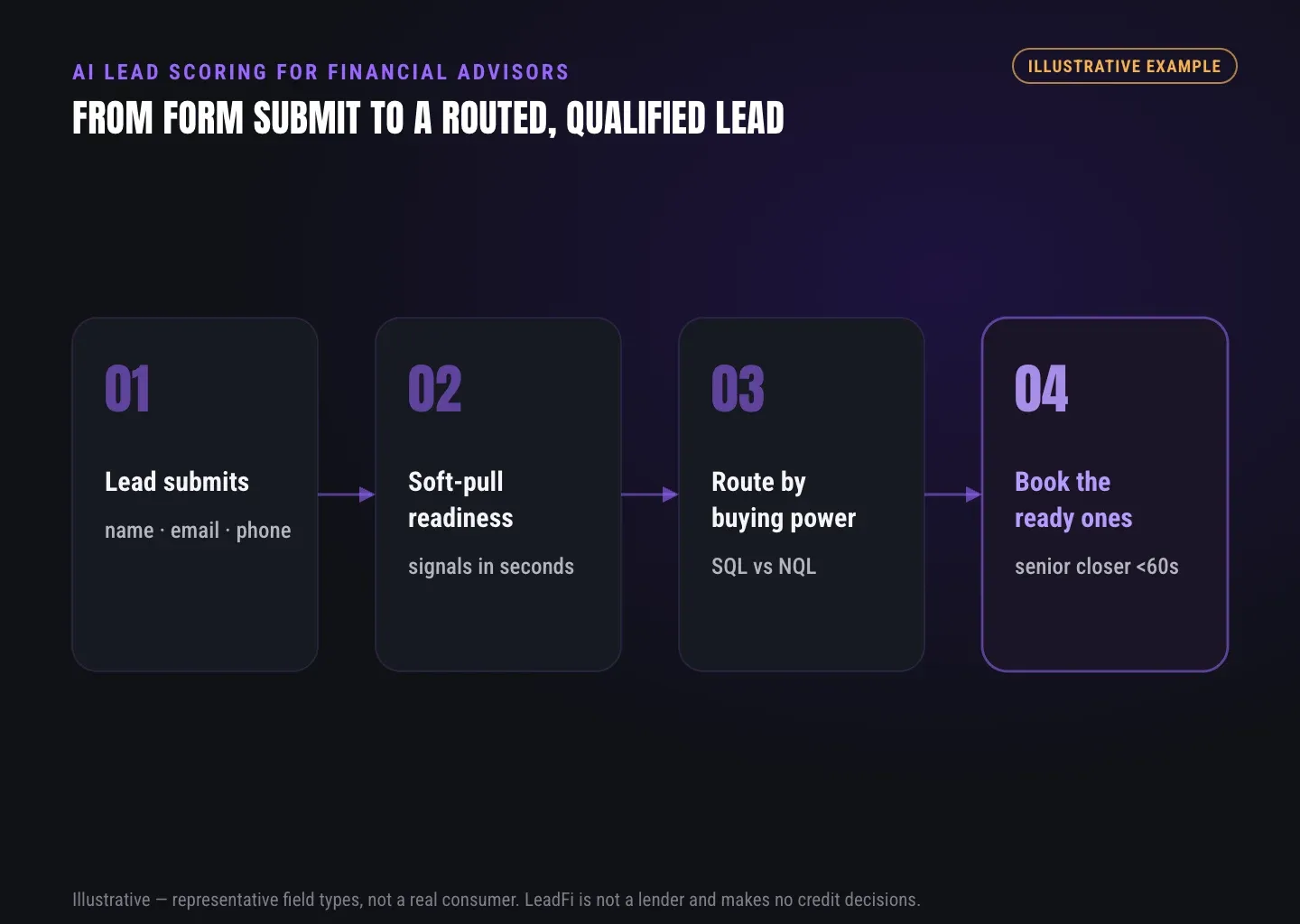
The workflow begins after a prospect submits a form, referral request, event application, or booking flow. LeadFi can work from name, email, and phone in many configurations, supporting thin-input prescreening without requiring every identity-related field at the first step.
Match identity with care
LeadFi uses patent-pending identity matching designed to establish a high-confidence match before soft-pull prescreening and, where applicable, deeper bureau-backed workflows. Match confidence should be recorded, and uncertain records should move to human review.
Identity matching does not remove consent and disclosures obligations. Forms, privacy language, CRM handling, and follow-up channels should reflect the configured workflow.
Add readiness after intent
Clicks, bookings, and content engagement indicate interest. Permissioned readiness signals can add context about whether the inbound lead is financially fit for the offer. Neither category should operate as an unexplained, single-factor rule.
For a closer look at data-source tradeoffs, read practical insights on soft credit pull vs data enrichment.
Route leads while momentum is high
A result becomes useful when it changes the next sales action. An SQL can move to a priority calendar or assigned advisor. An NQL can receive education, nurture, a lower-ticket service, or another relevant offer.
SQL means Sales-Qualified Lead: someone who is financially fit to buy your offer. NQL means Non-Qualified Lead: someone who is not financially fit to buy your offer. An incomplete-data or low-confidence result should have a separate human-review path.
See a practical guide to sql vs nql lead routing by financial readiness for a closer routing comparison.
Keep human review in the loop
AI should organize the practice's documented qualification rules, flag missing inputs, assign reason codes, and suggest approved workflow actions. People should review exceptions, monitor rule drift, and authorize changes.
Who this workflow fits
Readiness-based scoring is most relevant to advisory practices with high-value services, steady inbound volume, multiple calendars, or expensive sales time. A small referral-only practice that personally reviews every inquiry may need only basic CRM automation.
INTELLIGENCE LAYER
Defining readiness-focused routing inputs
Separate intent, fit, and readiness
Intent covers actions such as booking, form completion, content engagement, source, and stated timing. Fit covers the requested service, location, and other facts that determine whether the practice can serve the inquiry. Financial readiness adds buying-power context for the sales route.
The workflow should not confuse frequent clicking with readiness or use one score across offers with different prices and sales motions.
Use financial signals for routing context
Depending on configuration, availability, consent and disclosures, LeadFi may surface VantageScore 4.0, available credit, income, debt, debt-to-income ratio, funding pre-approval signals, and optional net-worth-style context. Optional context may include liquid, retirement, brokerage, or real estate assets where available.
These signals support qualification, routing, and rep preparation. Teams should document why each input changes a sales action, minimize unnecessary data, restrict access, and check whether rules create uneven routing patterns.
Treat identity signals narrowly
Current address, age, and related identity signals can support matching, but they should not automatically establish sales suitability. A team using these fields should define their matching purpose, access controls, retention approach, and exception process.
Start with explainable rules
Begin with plain rules for required inputs, match confidence, SQL routing, NQL routing, and manual review. Add weights only if they improve a specific operational choice. Readiness bands such as priority, standard, nurture, and review are often easier to manage than falsely precise scores.
Record reasons and CRM actions
Each route should write a status, reason code, owner, and timestamp into the CRM. LeadFi can connect through webhook, API, Zapier, Make, or supported native workflows. Configured actions can include field updates, tags, stages, alerts, redirects, nurture entry, and calendar selection.
Teams evaluating implementation options can also review practical insights on LeadFi with isoftpull.
GUIDE
How financial advisors can review scoring rules
Start with the next action
Define what each category triggers before designing a score. Every category needs an owner, response rule, and respectful fallback. Otherwise, scoring creates labels without improving lead management.
Trace inputs from submission to route
Map each field and derived signal to matching, service fit, readiness, routing, or reporting. Remove inputs with no documented purpose. Then trace sample records through capture, match, validation, qualification, routing, and CRM write-back.
Test normal and edge cases
Test clear SQL and NQL examples along with missing data, low match confidence, conflicting inputs, duplicate records, and service-fit mismatches. Uncertain cases should reach a person rather than receive an unsupported automatic route.
Review thresholds by offer
A premium engagement, paid planning session, and educational product may require different readiness rules. Avoid copying thresholds between offers without reviewing price, advisor capacity, sales process, and the intended next step.
Limit role-based visibility
An advisor may need a readiness band and reason code rather than every raw value. A media buyer may need an allowed qualified-lead event rather than personal financial details. Role-based access should keep each team member focused on the information needed for the workflow.
Inspect feedback loops
LeadFi can feed configured qualified-lead signals into CRM, Meta, Google, TikTok, Hyros, and operations workflows where the setup and destination permit. Teams should validate event definitions, data contents, match quality, volume, and destination policies. These feedback loops support quality-oriented optimization without promising platform results.
See which of the leads you already have can actually afford to buy.
WORKFLOW DESIGN
How to assess a workflow without performance promises
Measure process evidence
Evaluate whether the workflow operates as designed rather than forecasting sales or investment outcomes. Useful measures include required-field completeness, match coverage, routing time, route completion, explanation coverage, CRM write-back completeness, and duplicate-trigger frequency.
Review manual-review volume
Manual review is appropriate when information is missing, conflicts, or falls outside normal rules. Track why records enter the queue. Repeated reasons may reveal a form, mapping, matching, or policy problem that should be fixed at the source.
Check CRM usability
The advisor view should quickly answer: Who is this lead? Why is the lead here? What happens next? A concise status, reason code, owner, and action is usually more useful than a crowded screen of raw inputs.
Evaluate NQL path health
Confirm that NQLs enter the planned nurture, lower-ticket path, education sequence, or alternate offer. They should not reappear in the priority queue without a documented new trigger or human reassessment.
Run a controlled pilot
Start with one form, one offer, and a limited rule set. Review a fixed sample of records for match confidence, route reasons, exceptions, CRM actions, advisor agreement, and access controls. The pilot should test operational clarity, not promise commercial results.
Review the setup before launch
LeadFi supports compliance-aware setup and can help teams consider privacy language, consent language, TCPA-aware practices, and FCRA-aware workflow design. LeadFi does not provide legal advice. Clients should review their use case with counsel.
GUIDE
Comparison: What should advisors compare?
Compare the inputs, explanation, and next action
The useful comparison is not simply AI versus no AI. Advisors should compare what each approach measures, whether it distinguishes engagement from financial readiness, how clearly it explains a result, and whether that result creates an appropriate next sales action.
Manual CRM rules can serve simple lead flows. Engagement-led scoring can identify active prospects. A readiness-focused LeadFi workflow adds permissioned buying-power context, explainable SQL/NQL routing, CRM write-backs, and human handling for exceptions. Capabilities vary by product configuration, data availability, and implementation.
Related reading: a practical guide to sql vs nql lead routing by financial readiness, practical insights on soft credit pull vs data enrichment, practical insights on LeadFi with isoftpull.
| Evaluation area | Manual CRM rules | Engagement-led AI score | Readiness-focused LeadFi workflow |
|---|---|---|---|
| Primary inputs | Form fields and staff updates | Clicks, opens, visits, and bookings | Form data, identity signals, and permissioned readiness signals |
| Main question | Did the record meet stated rules? | How engaged is the lead? | Which sales path matches the configured readiness rules? |
| Financial context | Usually self-reported | Often behavior-focused | May include VantageScore 4.0, income, debt, available credit, debt-to-income, and optional asset context |
| Starting inputs | Defined by the form | Defined by tracking setup | Name, email, and phone can support many workflows |
| Identity process | Depends on CRM data | Varies by vendor | Patent-pending matching designed to establish a high-confidence match |
| Typical output | Custom tag or stage | Number, rank, or tier | SQL, NQL, or human-review route with reason codes |
| Workflow action | Staff action or basic automation | Often a queue update | CRM updates, alerts, redirects, nurture, or calendar paths |
| Human oversight | Usually direct | Varies | Client-controlled rules, reviews, and exceptions |
| Best fit | Low volume or simple routing | Teams prioritizing engagement | High-ticket teams needing buying-power-aware routing |
| Key limitation | Manual effort can grow | Interest may not reflect readiness | Requires documented rules, suitable setup, and ongoing review |
Key takeaways
The short version
- Score existing inbound leads before the sales conversation.
- Separate engagement signals from financial-readiness signals.
- Use explainable SQL, NQL, and human-review routes.
- Write statuses, reasons, owners, and actions into the CRM.
- Assess process quality without promising commercial outcomes.
Quick answers
Fast answers before you dig in
What is AI lead scoring for financial advisors?
AI lead scoring for financial advisors organizes approved rules for existing inbound leads using intent, service-fit, identity, and financial-readiness signals. It should recommend explainable sales routes while people control rules, exceptions, and changes.
Which inputs should readiness-focused lead scoring compare?
Compare lead source, stated need, timing, engagement, identity confidence, permissioned readiness signals, operational capacity, route reasons, and CRM actions. Use only inputs tied to a documented sales purpose.
How should advisors evaluate an AI scoring workflow?
Trace sample leads from submission through matching, qualification, routing, and CRM write-back. Review completeness, match confidence, explanation coverage, exceptions, access controls, and whether every category triggers a useful next action.
Where does LeadFi fit in an advisor's stack?
LeadFi works behind forms, funnels, calendars, and CRMs. It adds financial-readiness context after submission and can send configured statuses, reason codes, tags, stages, alerts, and triggers into the existing workflow.
FAQ
Common questions
What is AI lead scoring for financial advisors?
Which signals should AI lead scoring for financial advisors use?
Can AI lead scoring for financial advisors use a soft pull?
Can LeadFi work without asking for an address up front?
What is SQL/NQL routing for an advisory practice?
Does LeadFi replace an advisor's CRM or calendar?
How should a practice review readiness-focused AI lead scoring?
Sources
References
- CFPB — What is a credit inquiry? (hard vs. soft) (opens in a new tab)Federal regulator confirms a soft inquiry, unlike a hard inquiry, does not affect the consumer's credit score.
- VantageScore — VantageScore 4.0 credit scoring model (opens in a new tab)Official page describing VantageScore 4.0, the tri-bureau, trended-data model used to assess credit risk.
- CFPB — Who can request to see my credit report? (opens in a new tab)Federal regulator explains the FCRA rules governing who may obtain a credit report.
- VantageScore 4.0 (opens in a new tab)Background on the named scoring model referenced as an available signal in applicable workflows.
- FTC Privacy and Security Guidance (opens in a new tab)General business guidance relevant to privacy, data handling, and access-control review.
Know who is ready before your next sales call.
Request a LeadFi demo or workflow assessment to explore how thin-input financial-readiness qualification could fit behind your current form, funnel, CRM, or calendar. Review potential SQL, NQL, and human-review paths, relevant CRM write-backs, and compliance-aware setup before launch.