
AGENCY CLIENT LEAD QUALITY REPORTING
Agency Client Lead Quality Report: Show Which Campaigns Send Financially Ready Leads
An agency client lead quality report should show more than cost per lead, form fills, and booked calls. It should connect campaign spend to financial-readiness qualification, sales follow-up, and pipeline outcomes.
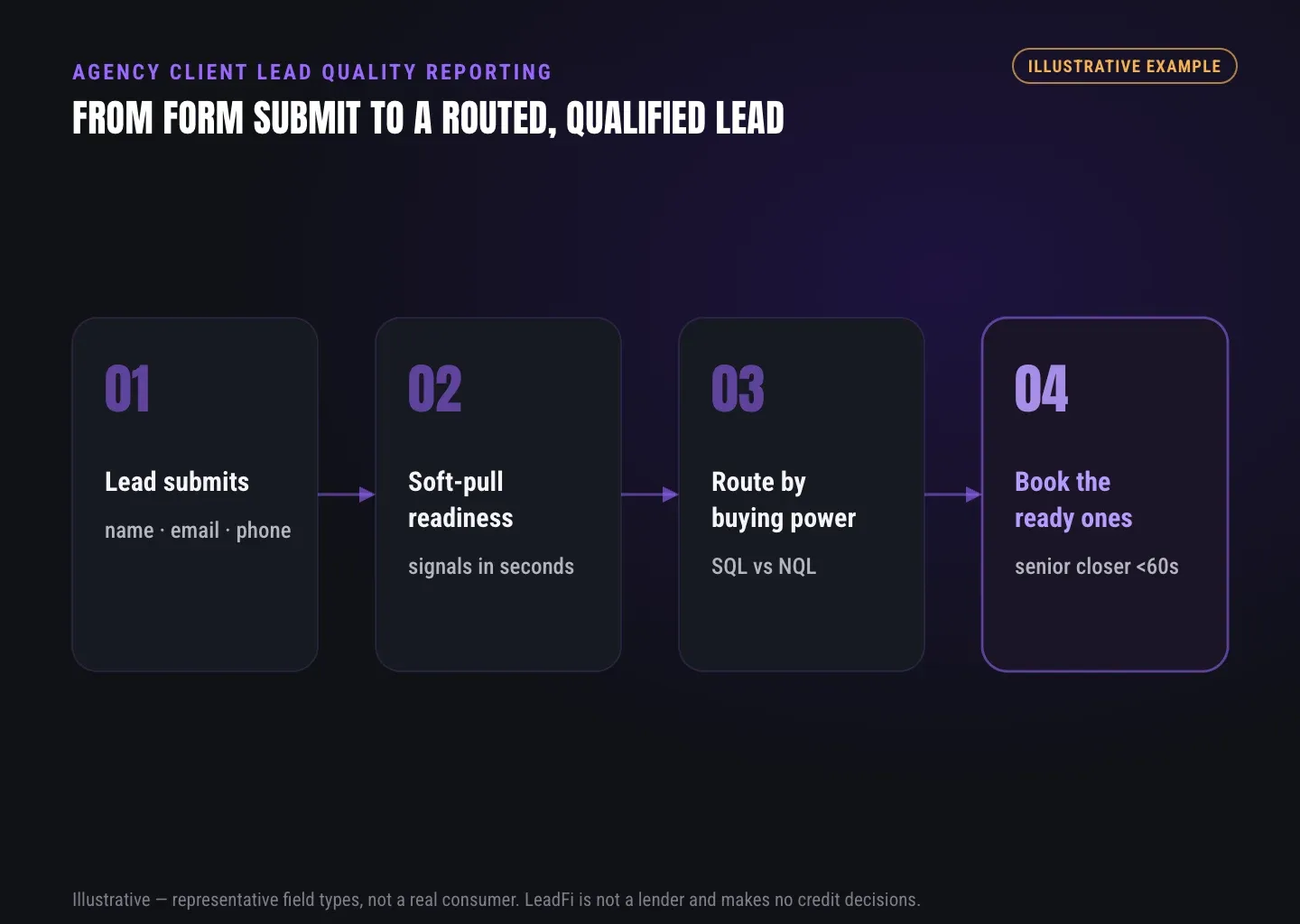
Watch a contact get pre-qualified.
This is exactly what your CRM gets back.
Your opt-in form
Soft pull · no impact to their credit
This is not a real soft pull. It's an example of the data points that land in your CRM contact record when a lead fills out your form.
LEADFI DEMO
Watch the demo, then start free or book a call.
GUIDE
Why clients stop trusting cost-per-lead reports
Cost per lead answers how much it cost to capture a contact. It does not show whether the lead is financially fit for a $3,000, $5,000, or $10,000 offer. Two campaigns can therefore have identical CPLs but create very different sales workloads.
Lead volume can hide the readiness gap
A campaign may generate hundreds of leads while sending relatively few SQLs. Sales then spends time calling contacts who are not financially fit for the main offer.
For LeadFi reporting, an SQL (Sales-Qualified Lead) is someone who is financially fit to buy your offer. An NQL (Non-Qualified Lead) is someone who is not financially fit to buy your offer. These labels support routing and prioritization; LeadFi does not approve or deny consumers.
Booked calls measure intent, not financial readiness
A booking shows interest and scheduling intent. Financial-readiness qualification adds another view by helping the client distinguish booked SQLs from booked NQLs. The report should still include contact time, attendance, offer status, and close results so readiness is not confused with sales execution.
Self-reported qualification has limits
Forms commonly ask about budget, income, credit, or access to funds, but those answers are self-reported. Depending on the configured workflow, consent and disclosures, LeadFi may surface signals such as VantageScore 4.0, available credit, income, debt, debt-to-income ratio, and optional asset context. These are readiness indicators for routing and rep preparation, not proof of affordability or a consumer approval decision.
Shared definitions improve client trust
“Bad lead” can mean an invalid phone number, weak intent, poor offer fit, low readiness, or slow follow-up. A credible report separates contact validity, offer fit, financial readiness, sales action, and final outcome.
For examples in adjacent markets, agencies can consult a practical guide to solar lead qualification, a closer look at debt consolidation lead qualification, and a closer look at credit card stacking lead qualification.
INTEGRATIONS
Make the readiness mix a monthly client metric
An agency client lead quality report should present the readiness mix for the account and each meaningful campaign. The mix can include SQLs, NQLs, unmatched records, and pending results under the client’s configured rules.
SQL and NQL rates show the quality mix
Calculate SQL rate as SQLs divided by completed readiness results. Calculate NQL rate the same way. Always show counts beside percentages: a 50% SQL rate from 10 results is less informative than a 35% rate from 1,000 results.
NQLs should not simply disappear. Report whether they entered nurture, a lower-ticket offer, an alternate path, or another approved workflow. Different routing should be validated and monitored for fairness, especially in credit-adjacent use cases.
Match rate protects the analysis
Missing inputs, duplicates, consent choices, identity-match confidence, and workflow errors can affect the usable result set. Report completion or match rate beside SQL rate before making major budget decisions.
LeadFi can work from name, email, and phone. Its patent-pending identity matching is designed to establish a high-confidence match using identity-related information and identity signals before soft-pull prescreening and, where applicable, deeper bureau-backed workflows.
Cost per SQL connects media spend to readiness
Cost per SQL equals media spend divided by SQL count. A campaign with a higher CPL may still produce financially fit leads more efficiently.
For example, a campaign with a $40 CPL and 25% SQL rate has an approximate $160 cost per SQL. A campaign with a $65 CPL and 50% SQL rate has an approximate $130 cost per SQL.
Grouped reporting limits unnecessary data exposure
Most client decks do not need individual scores, income values, debt totals, or available-credit amounts. SQL/NQL counts, grouped readiness bands, rates, routes, and sales outcomes can provide useful campaign insight with less sensitive detail.
Use role-based access, data minimization, retention rules, audit controls, and documented deletion practices for readiness information stored in a CRM or reporting stack.
GUIDE
Show which campaigns produce financially qualified demand
Each lead record should preserve source, campaign ID, ad set or group ID, creative ID, landing page, offer, readiness result, route, and sales outcome. This joins the media buyer’s spend data to the sales team’s pipeline data.
Use stable campaign IDs and attribution fields
Campaign names can change, so retain platform IDs alongside readable names. UTM source, medium, campaign, content, and term can support cross-channel analysis, although agencies should document the attribution model and keep direct or unknown traffic visible.
Build a campaign quality ladder
A practical ladder is:
- Spend
- Captured leads
- Completed readiness results
- SQLs
- Booked SQLs
- Contacted SQLs
- Showed SQLs
- Closed SQLs
Calculate conversion between stages. A breakdown may originate in targeting, identity matching, routing, speed-to-lead, booking, attendance, or the sales conversation.
Feed back qualified-lead signals carefully
Where the client’s setup and platform rules support it, qualified-lead signals may feed Meta, Google, TikTok, Hyros, CRM, or attribution workflows. Keep the internal readiness class separate from the event sent to an external platform, and record delivery status and timestamp.
Financially derived events require platform-specific policy and legal review. LeadFi does not guarantee advertising-platform acceptance, campaign performance, or revenue outcomes.
Separate media quality from sales execution
Include first-action time, contact attempts, booking status, show status, rep owner, disposition, and close reason. If a campaign produces 90 SQLs but only 40 receive timely follow-up, the report should identify the operational gap rather than labeling the campaign low quality.
See which of the leads you already have can actually afford to buy.
GUIDE
Set the reporting cadence and CRM field map
LeadFi can return configured outcomes through webhook, API, Zapier, Make, or a native workflow. The exact implementation depends on the client’s CRM, capture flow, consent and disclosures, and intended use.
Route SQLs in real time
Do not wait for a monthly report to act on an SQL. A real-time or near-real-time route can assign a rep, notify a setter, update a CRM stage, or open the appropriate calendar while the lead is fresh.
Check data quality weekly
Weekly checks should flag missing campaign data, duplicate records, low completion rates, delayed CRM updates, failed routes, and qualified leads that did not receive sales action.
Review client performance monthly
The monthly report should cover spend, lead volume, SQL and NQL counts, match rate, cost per SQL, route mix, speed-to-lead, pipeline outcomes, and recommended tests. Every chart should support a budget, creative, landing-page, routing, or sales action.
Revisit qualification rules quarterly
Offers, prices, audiences, and alternate paths change. Review qualification rules when the offer changes and on a regular cadence, but version the rules so month-to-month comparisons remain interpretable.
Store only the fields the workflow needs
A practical CRM map includes:
- Lead ID and capture timestamp
- Original and latest source
- Campaign, ad set, and creative IDs
- Landing page and offer code
- Readiness result status and timestamp
- SQL or NQL class
- Selected route and route completion
- Rep owner and first-action timestamp
- Booking, show, disposition, and close status
- NQL path
- Qualified-signal delivery status
- Qualification-rule version
Keep sensitive financial signals out of broad-access fields unless the configured use, access model, consent and disclosures support them. LeadFi supports compliance-aware workflows but does not provide legal advice or guarantee compliance. Clients should review their use case with counsel.
GUIDE
Turn lead quality into a report clients can use
The strongest report does not merely rank campaigns by cheap leads. It shows which sources produced financially qualified demand, whether sales responded quickly, where NQLs went, and what the agency will test next.
LeadFi complements the client’s current forms, funnels, calendars, CRMs, and reporting tools. It adds thin-input financial-readiness qualification, SQL vs NQL routing, and workflow feedback without acting as the consumer’s approver or replacing required consent and disclosures.
Related reading: a practical guide to solar lead qualification, a closer look at debt consolidation lead qualification, a closer look at credit card stacking lead qualification.
| Reporting area | CPL-only report | Readiness-based report |
|---|---|---|
| Core question | How cheaply did we capture a lead? | Which campaigns produced financially qualified demand? |
| Main measures | Spend, leads, and CPL | Spend, SQLs, NQLs, SQL rate, and cost per SQL |
| Booking view | Total booked calls | Booked SQLs and booked NQLs |
| Sales view | Aggregate calls or deals | Follow-up and outcomes by readiness class |
| Campaign insight | Lowest-cost source | SQL volume and cost per SQL by source |
| NQL handling | Often grouped as poor leads | Nurture, low-ticket, or alternate route |
| CRM output | Source and campaign | Source, readiness class, route, and result |
| Optimization signal | Generic lead event | Qualified-lead event where supported |
| Client discussion | Volume and price | Quality mix, sales action, and next test |
Key takeaways
The short version
- Report cost per SQL alongside CPL.
- Show SQL, NQL, unmatched, and pending counts.
- Connect readiness to campaign and CRM outcomes.
- Route SQLs quickly and track sales response.
- Use grouped data and compliance-aware access controls.
Quick answers
Fast answers before you dig in
What should an agency client lead quality report include?
Include spend, lead volume, completed readiness results, SQL and NQL counts, match rate, cost per SQL, speed-to-lead, routes, bookings, shows, and pipeline outcomes by source and campaign.
How is lead quality reporting different from CPL reporting?
CPL measures capture cost. Lead quality reporting connects that cost to financial-readiness classification, routing, sales follow-up, and final pipeline results.
What is SQL vs NQL routing?
An SQL is someone financially fit to buy the offer, while an NQL is someone not financially fit to buy the offer. Routing sends each class to its configured sales, nurture, low-ticket, or alternate path.
Can agencies report lead quality without exposing personal credit details?
Yes. Client-facing reports can use grouped SQL/NQL counts, readiness bands, rates, routes, and outcomes instead of displaying individual financial values.
FAQ
Common questions
What should an agency client lead quality report include?
How is an agency client lead quality report different from CPL reporting?
What is SQL vs NQL routing?
Can an agency report lead quality without showing credit data?
Can LeadFi support thin-input prescreening without an address up front?
Does a LeadFi soft-pull workflow affect a consumer’s credit score?
Can agencies send qualified-lead signals back to ad platforms?
Sources
References
- CFPB — What is a credit inquiry? (hard vs. soft) (opens in a new tab)Federal regulator confirms a soft inquiry, unlike a hard inquiry, does not affect the consumer's credit score.
- VantageScore — VantageScore 4.0 credit scoring model (opens in a new tab)Official page describing VantageScore 4.0, the tri-bureau, trended-data model used to assess credit risk.
- CFPB — Who can request to see my credit report? (opens in a new tab)Federal regulator explains the FCRA rules governing who may obtain a credit report.
Know who is ready before your next sales call.
Request a tailored LeadFi demo or workflow assessment to see how thin-input prescreening, SQL vs NQL routing, CRM updates, and grouped lead-quality reporting could fit behind your existing form, funnel, calendar, or CRM.