
PAID DISCOVERY CALL VS FREE CALL
Paid Discovery Call vs Free Call: What Each Filters
A paid discovery call shows whether someone will make a financial commitment to the first session. That payment does not, by itself, establish buying power for a $3,000, $10,000, or higher-ticket offer.
Watch a contact get pre-qualified.
This is exactly what your CRM gets back.
Your opt-in form
Soft pull · no impact to their credit
This is not a real soft pull. It's an example of the data points that land in your CRM contact record when a lead fills out your form.
LEADFI DEMO
Watch the demo, then start free or book a call.
GUIDE
What a paid discovery call fee actually screens for
A paid discovery call mainly tests willingness to pay for that session. It may also signal intent, trust, or respect for expert time, but it provides limited evidence that the applicant is financially fit to buy the main offer.
Signal: Payment shows commitment
Requiring payment asks the applicant to move from passive interest to a concrete action. The signal is most meaningful when the call delivers advice, planning, or another useful result.
Signal: Price sets the strength
A $25 booking charge and a $500 strategy session represent different commitments. Neither maps directly to the ability to fund a substantially more expensive engagement.
Gap: Intent is not buying power
Intent asks whether someone will take the next step. Financial readiness asks whether someone is financially fit to buy the offer. Those signals may overlap, but they measure different things.
Use case: The call has real value
A fee is easier to support when the session produces a useful result on its own, such as an audit, plan, review, or defined advisory deliverable. The applicant is then buying the session rather than merely paying to hear a sales presentation.
Risk: Some suitable buyers may resist the format
A financially ready buyer may still expect a brief fit conversation before paying. This can reflect purchasing habits, trust, or company procurement processes rather than financial capacity.
Boundary: This is not a no-show tactic
This article addresses one choice: whether the first call should be paid or free. Reminders, calendar confirmation, and attendance workflows are separate decisions.
GUIDE
Who a fee turns away that you wanted to talk to
A fee filters a mix of trust, habit, payment friction, timing, and expected session value. It does not divide applicants neatly into serious and unserious groups.
Buyer: The cautious high-value lead
A cautious buyer may have sufficient resources but want evidence of fit before paying. This is common when comparing several agencies, coaches, or consultants.
Buyer: The referral who expects access
A warm referral may expect a short introductory conversation before purchasing formal advice. The call policy should match what referral partners communicate.
Buyer: The enterprise evaluator
A manager may control a substantial budget but lack authority to use a card for vendor calls. Here, the fee can measure procurement friction rather than buying power.
Buyer: The skeptical ad lead
An applicant from cold traffic may need basic scope and fit information before paying. Requiring a fee before that trust exists can end the conversation early.
Buyer: The wrong-fit enthusiast
Someone may happily pay for access while needing a service the company does not provide. Forms should still assess goals, timing, need, role, and product fit.
Buyer: The ready lead who dislikes fees
Some buyers object to paying for a conversation tied to a sale even when the main offer is affordable for them. Call-format preference is not a financial verdict.
Example: A $7,500 consulting offer
One applicant pays $150 for a first session but lacks a suitable business need for the engagement. Another has a strong use case and adequate buying power but leaves because they expected a free fit call. The payment confirms willingness to spend $150, not fit for the $7,500 engagement.
Example: A paid strategy session
An agency sells a two-hour strategy session with a written plan. Because the session provides standalone value, its fee is part of the service rather than merely a gate before another offer.
INTELLIGENCE LAYER
Filtering on readiness without charging for the call
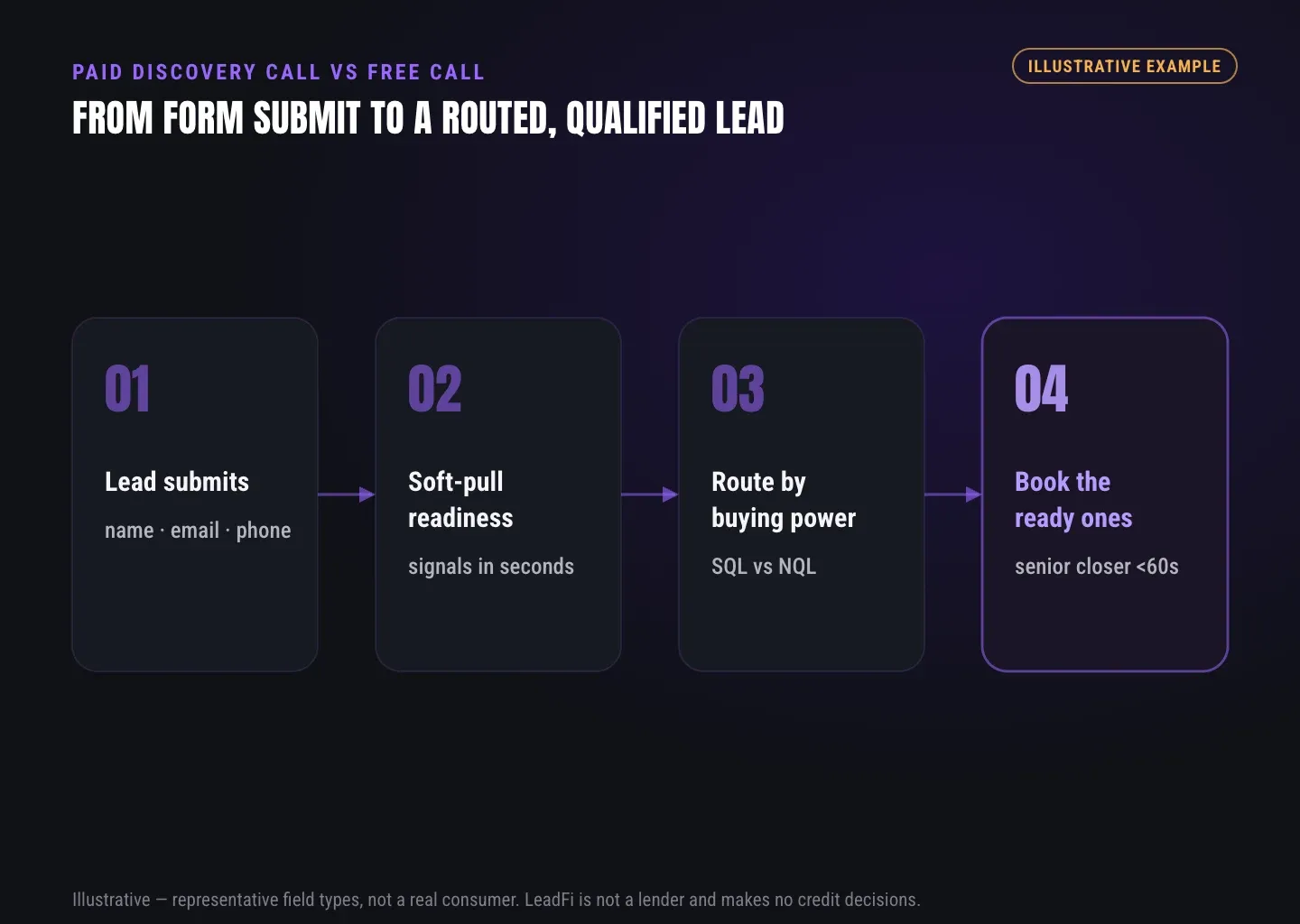
A free first call does not require an unrestricted calendar. High-ticket teams can qualify existing inbound leads after form submission and route them according to product fit and financial readiness.
LeadFi sits behind forms, funnels, calendars, and CRMs. Only after an applicant submits with consent and disclosures can a configured workflow use name, email, and phone for thin-input financial-readiness qualification. Patent-pending identity matching is designed to establish a high-confidence match before a soft pull and, where configured, deeper bureau-backed workflows.
This page describes a routing input, not a credit decision, approval, or eligibility determination.
Data: Readiness goes beyond form claims
Self-reported budget or income answers can guide a conversation, but they do not establish buying power alone. Depending on the configured workflow, LeadFi can surface readiness signals such as VantageScore 4.0, available credit, income, debt, debt-to-income ratio, age, address, and optional asset context. These signals support routing and rep preparation.
Input: Start after a valid submission
Any applicant financial-readiness analysis occurs only after that applicant submits with consent and disclosures. LeadFi does not conduct an unrequested lookup on someone who has not completed that step.
Many workflows can start with name, email, and phone. Identity-related information and identity signals, such as current address or age, may also be used when the configuration calls for them.
Match: Confirm the right person
Thin-input qualification depends on accurate matching. LeadFi's patent-pending identity matching is designed to establish a high-confidence match before the configured soft pull. It is not a substitute for consent and disclosures.
Signal: A soft pull adds context
A configured soft pull can add financial-readiness context for routing. LeadFi does not approve or deny consumers, and the result should be combined with product fit, stated need, timing, location, and the company's sales rules.
Route: Define SQL and NQL clearly
An SQL, or Sales-Qualified Lead, is someone who is financially fit to buy your offer. An NQL, or Non-Qualified Lead, is someone who is not financially fit to buy your offer. These are operational routing labels, not judgments about personal value.
Action: Send each lead to a path
An SQL can move to the main calendar, closer queue, or faster follow-up workflow. An NQL can enter price-neutral education, nurture, or manual review. The same published call-fee policy, price, and terms apply to every lead regardless of the readiness result.
CRM: Write back useful fields
LeadFi can write SQL/NQL status and related routing fields into CRM tags, stages, lists, tasks, and workflow triggers. That gives sales and operations teams a consistent handoff.
Stack: Keep the tools you use
LeadFi can sit behind an existing form builder, funnel, CRM, calendar, or custom application. Handoffs can use a webhook, API, Zapier, Make, or a suitable native workflow.
Ads: Return quality signals
Where platform rules and the client's configuration allow, financially qualified lead events can be returned to Meta, Google, TikTok, Hyros, and related systems. This supports optimization around lead quality rather than raw form volume, without promising platform performance.
Setup: Align consent and disclosures
A compliance-aware launch should align the form, privacy language, consent text, CRM fields, and follow-up workflow. LeadFi helps teams with privacy- and consent-oriented workflow choices and TCPA-aware practices, but it does not provide legal advice or guarantee compliance. Clients should review their use case with counsel.
Example: Free call with two routes
A coaching company keeps one free-call policy for every applicant. After an applicant submits with consent and disclosures, an SQL can reach the closer calendar while an NQL enters a price-neutral educational workflow.
Example: Existing booking flow
A marketing agency sends submitted contact details from its form to LeadFi through an API. LeadFi returns the configured SQL or NQL routing result, and the CRM applies the appropriate stage, task, and follow-up workflow.
Example: Paid session plus readiness routing
A consultancy charges every applicant the same published fee for a strategy session with standalone value. Financial-readiness qualification can inform internal routing after submission, but it never changes the session fee, access rule, price, or payment terms.
INTELLIGENCE LAYER
Paid call, free call, and readiness comparison
These approaches answer different questions. A paid session tests willingness to pay for that session. A free consultation provides access without a call fee. Readiness qualification identifies which submitted applicants are financially fit for the main offer after consent and disclosures.
No single signal replaces the others. Teams can combine one consistent fee policy with application data, sales-fit rules, and permissioned financial-readiness signals.
See which of the leads you already have can actually afford to buy.
GUIDE
Deciding by offer price and calendar load
Use a paid first call when the session creates enough standalone value to justify its fee. Use a free first call when open access fits the sales process. In either model, separate qualification rules can help the team identify financial fit for the main offer.
Price: Under $1,000
A separate call fee can create unnecessary friction unless the session is itself a product. Extensive financial-readiness qualification may also be unnecessary for many low-ticket funnels.
Price: $1,000 to $3,000
The choice depends on margin, session length, sales effort, and the value delivered during the call. A focused free fit call may suit some teams, while a substantive advisory session may support a fee.
Price: $3,000 to $10,000
Financial fit carries more operational weight as the main price rises. A discovery-call payment remains a narrow commitment signal, while readiness qualification can help distinguish SQL and NQL paths after submission.
Price: Above $10,000
Larger purchases may involve longer cycles, multiple stakeholders, and company procurement. Forms should capture need, authority, timing, and business fit alongside permissioned readiness signals.
Load: A lightly used calendar
A free first call can support market learning when capacity is available. Basic form rules should still keep obvious product mismatches away from specialist calendars.
Load: A full closer calendar
When closer time is constrained, sharper routing becomes more important. Product fit, location, readiness, and sales rules can work together before a rep receives the record.
Load: Multiple offers and sales teams
A business may have several sales queues or service paths. SQL/NQL routing can assign a submitted lead to the appropriate team or price-neutral follow-up while preserving one public fee and pricing policy.
Team: Founder-led sales
A founder may charge when the session includes real advisory work. Alternatively, a free fit call can work with strict application and readiness routing so founder judgment is not the only qualification mechanism.
Team: Setter and closer model
Setters can confirm need, timing, and decision roles. LeadFi can add financial-readiness context after submission with consent and disclosures, allowing CRM rules to route SQLs to closers and NQLs to a price-neutral alternate workflow.
Team: RevOps and media buying
RevOps teams can use stable SQL/NQL fields for handoffs, while media teams can return allowed qualified-lead events to supported platforms. This creates a feedback loop from capture through qualification and routing without guaranteeing campaign outcomes.
GUIDE
A simple decision framework
Start with the value of the first call rather than expecting a fee to solve every qualification problem. Then map the paths that follow a valid submission.
- Call value: Decide whether the session produces a useful result on its own.
- Fee policy: Set one paid or free policy that applies to every lead.
- Application fit: Ask about need, timing, goals, role, and relevant business facts.
- Consent step: Obtain consent and disclosures before any financial-readiness analysis.
- Readiness rules: Define financial fitness for the specific offer.
- SQL path: Route financially fit leads to the appropriate sales workflow.
- NQL path: Use nurture, education, or manual review without changing price or terms.
- CRM handoff: Write the result into fields, stages, tasks, and workflows.
- Ad signal: Return allowed qualified-lead events to supported advertising or attribution systems.
- Review cycle: Review lead mix, rep feedback, and routing logic without assuming a fixed sales result.
For adjacent funnel decisions, explore practical insights on one call close vs triage call, a closer look at LeadFi vs OmniaIQ, and a practical guide to instant form vs landing page.
Finally, explain why information is collected and what the applicant should expect next. Financial readiness is an operational routing input, not a measure of personal worth.
Related reading: practical insights on one call close vs triage call, a closer look at LeadFi vs OmniaIQ, a practical guide to instant form vs landing page.
| Decision factor | Paid discovery call | Free consultation | Readiness-based routing |
|---|---|---|---|
| Primary signal | Willingness to pay for the first session | Willingness to apply and book | Financial fit for the main offer |
| Typical input | Payment and booking details | Form and booking details | Submitted identity details plus permissioned readiness signals |
| Buying-power context | Confirms funds for the session only | Relies on form answers unless another layer is added | Can include configured VantageScore 4.0, income, debt, available credit, and debt-to-income signals |
| Typical use | The session provides standalone value | The call is primarily for fit or sales discovery | The team needs SQL/NQL routing after capture |
| CRM action | Record payment and booking status | Record application and booking status | Update SQL/NQL fields, stages, tasks, and triggers |
| Policy rule | One stated fee applies to every lead | One free-call policy applies to every lead | Readiness does not change the call fee, price, or terms |
| Operational consideration | A session payment measures a limited form of commitment | Application data may provide limited financial context | The workflow calls for consent and disclosures, configured rules, and integration |
| Setup needs | Checkout, terms, agenda, and booking flow | Form, calendar, agenda, and booking flow | Consent and disclosures, matching rules, routing logic, and integration |
Key takeaways
The short version
- A paid discovery call tests willingness to pay for that session, not buying power for the main offer.
- Charge when the first session provides valuable standalone work.
- Apply the same call-fee, price, and terms policy to every lead.
- LeadFi qualifies existing inbound leads only after submission with consent and disclosures.
- SQL/NQL routing can prioritize sales follow-up and send NQLs to price-neutral nurture.
Quick answers
Fast answers before you dig in
What does a paid discovery call filter for?
It primarily filters for willingness to pay for the first session. It may also indicate intent or trust, but it does not establish buying power for the main high-ticket offer.
Can a free call still use financial-readiness qualification?
Yes. After an applicant submits with consent and disclosures, LeadFi can add financial-readiness signals and route SQLs and NQLs while the same free-call policy applies to everyone.
How should NQLs be routed?
NQLs can enter price-neutral nurture, education, or manual review. The readiness result must not change the published call fee, offer price, payment terms, or access policy.
FAQ
Common questions
What does a paid discovery call filter for?
When should a paid discovery call have a fee?
How do free and paid consultation formats compare?
Is a paid strategy session the same as a discovery call?
Can financial-readiness qualification replace a call fee?
How does SQL vs NQL routing work after a free-call form?
Can LeadFi use name, email, and phone for qualification?
Sources
References
- CFPB — What is a credit inquiry? (hard vs. soft) (opens in a new tab)Federal regulator confirms a soft inquiry, unlike a hard inquiry, does not affect the consumer's credit score.
- VantageScore — VantageScore 4.0 credit scoring model (opens in a new tab)Official page describing VantageScore 4.0, the tri-bureau, trended-data model used to assess credit risk.
- CFPB — Who can request to see my credit report? (opens in a new tab)Federal regulator explains the FCRA rules governing who may obtain a credit report.
Know who is ready before your next sales call.
Charge for the first session when it provides valuable standalone work, or keep the call free when open access fits the sales process. In either case, use one consistent fee and pricing policy for every lead.