
ONE CALL CLOSE VS TRIAGE CALL
One Call Close vs Two Call Close: Choosing the Right Call Structure
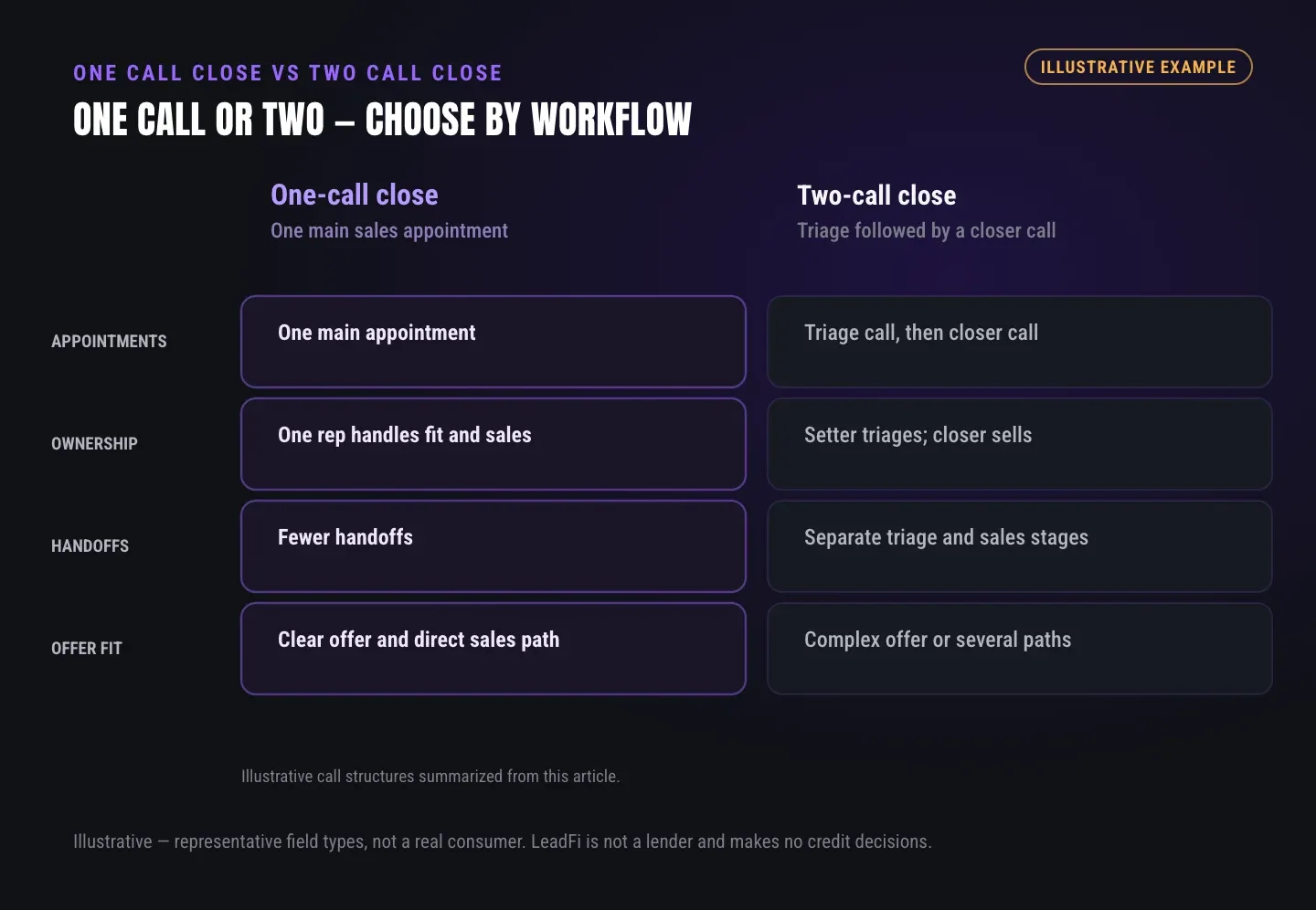
The one call close vs two call close choice affects rep workload, prospect handoffs, and the information available before the main sales conversation. A one-call close puts qualification, discovery, and selling into one appointment.
Watch a contact get pre-qualified.
This is exactly what your CRM gets back.
Your opt-in form
Soft pull · no impact to their credit
This is not a real soft pull. It's an example of the data points that land in your CRM contact record when a lead fills out your form.
LEADFI DEMO
Watch the demo, then start free or book a call.
GUIDE
What each structure asks of the prospect and the team
A one-call close sends the prospect from a form or booking page to one primary sales conversation. One rep confirms fit, explores the problem, explains the offer, and manages the sales discussion. This reduces handoffs but places more weight on rep skill and pre-call context.
A two-call close begins with a shorter triage conversation. A setter confirms problem fit, product fit, expectations, timing, and stakeholders before handing the prospect to a closer. This can protect closer capacity and support complex offers, but every additional appointment introduces another handoff.
Small or senior teams may prefer one rep to own the relationship. Larger teams with distinct roles may benefit from a setter-closer structure when lead volume and offer complexity justify it. For an adjacent comparison, see a closer look at LeadFi vs OmniaIQ.
Forms can capture goals, timing, budget, and business needs, but self-reported answers do not always establish buying power. Only after an applicant submits with consent and disclosures can financial-readiness signals become an internal routing input. That input can help determine whether the lead enters the core sales path, receives triage, or receives a lower-ticket product that meets the lead's financial capability.
GUIDE
What a triage call actually screens for
A triage call should gather information that changes the next step. It should cover the prospect's problem, the relevant product, expectations, timing, stakeholders, and delivery needs. It should not become an unfocused warm-up or duplicate the closer's full sales conversation.
Setters need clear authority and CRM fields. The team should define which facts must reach the closer, which product paths are available, and which missing details require follow-up. A lower-ticket offer can be used when it better matches an applicant's financial capability.
Financial readiness may guide internal routing only after the applicant submits with consent and disclosures. Setters and closers should not discuss the applicant's credit, income, debt, or internal readiness result. They should focus on stated goals, business needs, product fit, and the sales process.
A useful triage call can end in a closer path, a follow-up for missing use-case details, a lower-ticket product path, or no sales path when the stated problem does not match the company's products.
This page describes a routing input, not a credit decision, approval, or eligibility determination.
INTELLIGENCE LAYER
How knowing readiness before the first call changes the choice
Only after an applicant submits with consent and disclosures can LeadFi process configured financial-readiness signals. This can reduce the financial guesswork placed on sales reps while leaving discovery, product fit, and sales judgment with the team.
LeadFi can work from name, email, and phone in supported workflows. Its patent-pending identity matching is designed to establish a high-confidence match using identity-related information and identity signals before a configured soft pull or, where applicable, a deeper bureau-backed workflow. Exact inputs and results depend on the workflow, identity data, consent and disclosures, and match requirements.
Configured signals may include VantageScore 4.0, available credit, income, debt, debt-to-income ratio, current address, and optional asset context where available. These signals support internal financial-readiness qualification and rep preparation; they are not instructions for reps to discuss personal financial data on a call.
A typical workflow is:
- The applicant submits name, email, phone, and required form data with consent and disclosures.
- LeadFi uses identity-related information and identity signals to support a high-confidence match.
- Configured signals are processed for financial-readiness qualification.
- LeadFi returns an SQL or NQL routing status based on the business's rules.
- The result updates a CRM field, stage, tag, workflow, or alert.
- The applicant is routed to a closer, triage call, lower-ticket offer, or another suitable product path.
- Where allowed and configured, qualified-lead events can be sent to Meta, Google, TikTok, Hyros, or related systems.
LeadFi can connect through webhooks, APIs, Zapier, Make, or supported native workflows. It complements the existing form, funnel, calendar, and CRM rather than requiring the business to replace its stack. Teams designing these rules can consult a practical guide to sql vs nql lead routing by financial readiness.
Qualified-lead feedback can help teams optimize for lead quality rather than raw volume, but platform rules, data quality, campaign setup, and the sales process affect how those events are used. LeadFi does not guarantee advertising or sales performance.
See which of the leads you already have can actually afford to buy.
GUIDE
Choosing one call close vs two call close by offer price and team size
Offer price matters because larger commitments can require more context, but price alone should not determine the call structure. A clear offer sold by a small or senior team may work well with one main call. A complex service, multiple product paths, or several stakeholders may justify triage.
Use six questions to select a starting structure:
- Can one rep explain and sell the offer without a separate fact-finding call?
- Does the business have one core product or several suitable products?
- What does the team know after submission and before a rep engages?
- Can the same rep qualify product fit, diagnose the problem, and manage the sales discussion?
- Is there enough inbound volume for separate setter and closer roles?
- Can the CRM assign, alert, route, and track every path?
A hybrid model can route a suitable SQL directly to a closer when the use case is clear. Another SQL may receive triage because the correct service or delivery model is unclear. An NQL can receive a lower-ticket offer or another product that meets the lead's financial capability.
Growing teams should map SQL and NQL definitions to CRM fields, owners, stages, calendars, and next-step codes. Credit-adjacent teams should also review consent and disclosures, data use, and customer-facing language before launch. LeadFi supports compliance-aware setup but does not provide legal advice.
Related reading: a closer look at LeadFi vs OmniaIQ, a practical guide to sql vs nql lead routing by financial readiness, a practical guide to instant form vs landing page.
| Decision factor | One-call close | Two-call close |
|---|---|---|
| Prospect commitment | One main appointment | Triage call plus closer call |
| Rep responsibility | One rep qualifies product fit and sells | Setter screens product fit; closer sells |
| Main advantage | Fewer handoffs | Clear division between triage and selling |
| Main risk | Closer time goes to poor-fit calls | Extra appointment creates friction |
| Best data environment | Strong form, CRM, and routing context | Complex discovery or limited pre-call context |
| Team fit | Small or senior sales team | Larger team with defined roles |
| Offer fit | Clear offer and direct sales path | Complex offer or several product paths |
| Readiness use | Route suitable SQLs to the main call | Route leads to triage, closer, or another product |
| CRM requirement | Fast alerts and complete rep context | Clear owners, stages, and handoff notes |
Key takeaways
The short version
- One call reduces handoffs but requires strong rep skill and pre-call context.
- Two calls separate triage from selling but add another appointment.
- An SQL is financially qualified; an NQL is not financially fit for the offer.
- Readiness signals are processed only after submission with consent and disclosures.
- LeadFi routes existing inbound leads without approving or denying consumers.
Quick answers
Fast answers before you dig in
What is the difference between a one call close and a two call close?
A one-call close combines qualification, discovery, presentation, and the sales discussion in one appointment. A two-call close uses a triage or setter call before the closer call.
When should a high-ticket team use a one-call close?
Consider one call when the offer is clear, the team is small or senior, and strong form, CRM, and permissioned routing data give the rep useful context before the conversation.
When should a high-ticket team use two calls?
Consider two calls when discovery is complex, several products may fit, multiple stakeholders are involved, or distinct setter and closer roles improve ownership.
How does LeadFi affect the call structure?
After an applicant submits with consent and disclosures, LeadFi can return an SQL or NQL routing input to the CRM so the business can route existing inbound leads to a closer, triage, or a suitable lower-ticket product.
FAQ
Common questions
What is the main difference in one call close vs two call close?
Is a one-call close better than a setter-closer model?
What should a triage call cover?
Can financial-readiness qualification replace a triage call?
How does SQL vs NQL routing work in a one-call close?
Can a soft pull determine whether a team should use one call or two calls?
Does LeadFi require an address before routing a lead?
Sources
References
- CFPB — What is a credit inquiry? (hard vs. soft) (opens in a new tab)Federal regulator confirms a soft inquiry, unlike a hard inquiry, does not affect the consumer's credit score.
- VantageScore — VantageScore 4.0 credit scoring model (opens in a new tab)Official page describing VantageScore 4.0, the tri-bureau, trended-data model used to assess credit risk.
- CFPB — Who can request to see my credit report? (opens in a new tab)Federal regulator explains the FCRA rules governing who may obtain a credit report.
- VantageScore 4.0 (opens in a new tab)Background information about the named scoring model referenced as a potential configured signal.
Know who is ready before your next sales call.
See how LeadFi can sit behind your current form, funnel, calendar, or CRM and route existing inbound leads based on financial readiness after submission with consent and disclosures.