
BUSINESS FUNDING BROKER LEAD QUALIFICATION
Business Funding Broker Lead Qualification: Read Buying Power Before the Call
Funding brokers live or die by call quality. You run ads, buy lists, or work referrals — then your team dials people who can't actually get funded. That's the core problem business funding broker lead qualification is built to solve.
Watch a contact get pre-qualified.
This is exactly what your CRM gets back.
Your opt-in form
Soft pull · no impact to their credit
This is not a real soft pull. It's an example of the data points that land in your CRM contact record when a lead fills out your form.
LEADFI DEMO
Watch the demo, then start free or book a call.
GUIDE
What unqualified funding leads cost a broker
Quick answer: Unqualified funding leads cost you rep hours, calendar slots, and morale. A closer who spends 30 minutes on a low-readiness lead with no revenue is 30 minutes short on a fundable deal. Multiply that across a week, and dead-end calls quietly eat your pipeline. Readiness-based qualification helps you spend that time on people who can actually get funded.
The math is simple, and it hurts. Say a rep can run 12 real calls a day. If half are dead-end leads, you just cut real capacity in half. That's why volume alone is a vanity number for funding brokers.
There's a second cost that's easy to miss. Reps who get burned on junk leads slow down on follow-up. They stop trusting the pipeline, so even good leads sit longer. Meanwhile, speed-to-lead drops right when it matters most.
Wasted closer hours
Every call to a non-fundable lead is time a closer can't spend on a real deal. For a funding desk, that's the most costly line item you don't track. Readiness screening helps you protect it.
Dirty ad signal
When your pixel learns from cheap opt-ins, it finds more cheap opt-ins. Feeding qualified signals back to Meta or Google can help the algorithm chase buyers, not tire-kickers — where the platform and your setup allow it.
Slow speed-to-lead
Reps buried in junk calls answer real leads late. In funding, a short delay can lose a deal to the next broker. That's why ranking SQLs first helps your best leads get a call while intent is hot.
Blurry forecasting
If your "qualified" count includes people who can't get approved, your forecast lies. Readiness tags give you a cleaner pipeline number. As a result, you plan against demand that can actually close.
INTELLIGENCE LAYER
Readiness signals that matter before a funding call
Quick answer: For funding brokers, the signals that matter tie to approval odds: credit score, income, debt, debt-to-income, and available credit. LeadFi can surface these as permissioned readiness signals after a lead submits, using name, email, and phone. They inform routing and rep prep — not a consumer approval or denial.
Let me define the terms once, then keep it plain. First, a soft pull reads readiness signals with no impact on the consumer's credit score. Next, debt-to-income (DTI) compares monthly debt to income, a core input to approval odds. And financial readiness just means how ready a lead is to buy or get funded right now.
These signals are for routing and prep, not underwriting. LeadFi does not decide who gets funded. Instead, it helps your team see who's worth a fast call and who needs a different path.
Credit score (VantageScore 4.0)
Score is a first-pass readiness signal for most funding programs. A soft-pull prescreen can surface it with no credit-score impact for the consumer. Use it to route, not to approve or deny.
Income and DTI
Income and debt-to-income shape real approval odds. A lead with strong income but high DTI may still stall at underwriting. Seeing both before the call helps a rep frame the right program.
Available credit
Available credit hints at capacity for larger tickets. In practice, it's a useful readiness signal for brokers who help clients access capital. Frame it as fit, never as a promise of funds.
Funding pre-approval signals
Pre-approval signals flag leads closer to a yes. They are signals, not a guaranteed outcome. Still, they help you rank who deserves speed-to-lead first, and who belongs on a low-ticket or credit-building path.
ROUTING
Lead routing: who gets a call, who gets a low-ticket path
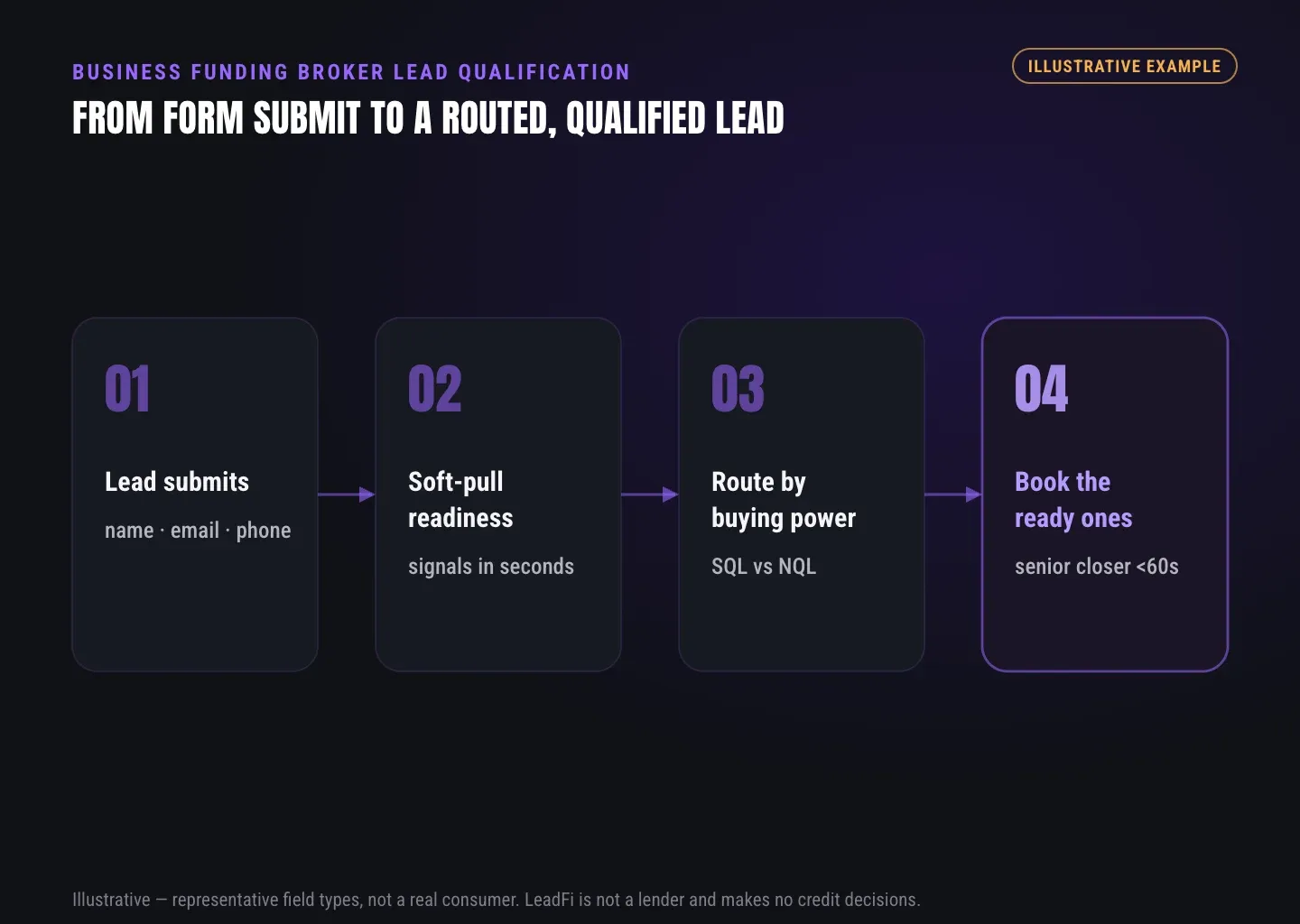
Quick answer: Routing splits leads into SQLs and NQLs, then sends each to the right next step. An SQL — a sales-qualified lead with strong readiness — books a call fast. An NQL, a non-qualified lead, goes to a low-ticket offer, a payment plan, or a credit-building path. LeadFi applies your rules plus readiness signals right after submission, so momentum stays high.
Here's the useful part for funding desks: NQL does not mean worthless. A lead with a lower score and high debt might be a perfect fit for a credit-repair or debt path. The signal is inverted for those offers, so you monetize traffic you'd otherwise dump.
You set the thresholds. One campaign might route a strong-score, higher-income, lower-DTI lead straight to a closer calendar. Below that, the lead gets a low-ticket offer or an alternate path. You decide the cutoffs; LeadFi runs them consistently.
SQL: fast track to a closer
An SQL clears your readiness rules, so it should reach a rep fast. Route it to a closer calendar or fire an instant alert. In practice, that means a call while the lead is still warm, not the next morning.
NQL: low ticket, not trash
An NQL doesn't clear the bar today. Instead, route it to a low-ticket offer, a credit-building offer, or a payment plan. Then it can convert later or monetize now, instead of getting a wasted call.
Alternate offers for inverted fit
Some funding-adjacent offers want the lower-readiness lead. Credit repair and debt consolidation serve high-debt, low-score prospects. Readiness tags help you route those leads to the right partner offer.
Real-time redirects
After submit, a lead can hit a custom page by status. An SQL sees a calendar while an NQL sees a low-ticket offer page. This depends on your stack, but the pattern keeps every lead moving.
| Factor | Self-reported form | Readiness-based qualification (LeadFi) |
|---|---|---|
| Data source | What the lead types | Permissioned readiness signals after submit |
| Accuracy risk | People round up or fudge | Signals read, not asked |
| Credit impact | None (no pull) | Soft pull — no credit-score impact |
| Rep prep | Guesswork on the call | Score, income, DTI before the call |
| Routing | Manual or none | Auto SQL/NQL by your rules |
| NQL monetization | Usually dumped | Low-ticket, payment plans, alt offers |
| Approve/deny | N/A | Never — routing only, not a decision |
See which of the leads you already have can actually afford to buy.
WORKFLOW DESIGN
Where qualification sits in the broker workflow
Quick answer: Qualification sits behind your form, funnel, calendar, or CRM — not in front of it. A lead submits through your existing capture. LeadFi receives it via webhook, API, Zapier, Make, or a native path, enriches it with readiness signals, then writes SQL/NQL status and routing back into your tools. Your reps work where they already work.
You don't rip out your stack. LeadFi works with ClickFunnels, GoHighLevel, HubSpot, Typeform, and custom forms. It sits in the middle: capture on one side, your CRM and calendar on the other.
Because it works after submission, some paths need fewer up-front form fields, which can reduce friction and drop-off. Patent-pending identity matching is designed to establish a high-confidence match before any soft-pull prescreening runs, consistent with your consent and disclosures.
Sits behind your form or funnel
Your form still captures the lead. LeadFi enriches it after submit, then classifies it. So your funnel stays the same, but the handoff to sales gets smarter.
Writes back to your CRM
Qualification status lands in CRM fields, tags, and pipeline stages. Reps see readiness where they already work, with no new tab. In addition, workflows and alerts can trigger off the tag.
Feeds ad platforms
You can send SQL-quality signals back to Meta, Google, TikTok, or Hyros. Over time, that can help campaigns optimize for fundable buyers, where the platform and your setup permit. No ROAS guarantees — just cleaner signal.
Compliance-aware setup first
Before launch, LeadFi helps you align form disclosures, consent language, and CRM notes. It's onboarding help, not legal advice. Your counsel reviews the customer-facing language.
Key takeaways
The short version
- Unqualified funding leads burn closer hours, calendar slots, and speed-to-lead — volume alone is a vanity metric.
- LeadFi reads permissioned readiness signals (score, income, DTI, available credit) after submit to inform routing, not consumer approvals.
- SQL vs NQL routing sends fundable leads to a closer fast and routes lower-readiness leads to low-ticket, payment-plan, or credit-building offers.
- A soft-pull prescreen surfaces readiness signals with no impact on the consumer's credit score.
- LeadFi sits behind your form, funnel, calendar, or CRM via webhook, API, Zapier, or Make, and supports compliance-aware setup before launch.
Quick answers
Fast answers before you dig in
What is business funding broker lead qualification?
It's scoring and routing funding leads by financial readiness before a rep calls. Instead of trusting a form, you read permissioned signals — score, income, debt, DTI — to gauge approval-odds fit, then route strong leads to a closer and weaker ones to a low-ticket offer or alternate paths. LeadFi runs this after submit and never approves or denies anyone.
What do funding readiness signals include?
Signals tied to approval odds: credit score (VantageScore 4.0), income, debt, debt-to-income, available credit, and funding pre-approval signals. LeadFi surfaces them as permissioned readiness data for routing and rep prep — not underwriting, and not a consumer approval or denial.
Does readiness screening hurt the consumer's credit?
No. A soft-pull prescreen reads readiness signals with no impact on the consumer's credit score. It informs routing and rep prep only, run under your consent and disclosures.
FAQ
Common questions
What is business funding broker lead qualification?
How does soft-pull prequalification work without hurting credit?
Can I pre-screen leads without asking for a full address up front?
What do "approval odds" actually mean here?
What's the difference between an SQL and an NQL for funding?
Does LeadFi replace my CRM or form builder?
Is this compliant?
Sources
References
- CFPB — What is a credit inquiry? (hard vs. soft) (opens in a new tab)Federal regulator confirms a soft inquiry, unlike a hard inquiry, does not affect the consumer's credit score.
- VantageScore — VantageScore 4.0 credit scoring model (opens in a new tab)Official page describing VantageScore 4.0, the tri-bureau, trended-data model used to assess credit risk.
- CFPB — Who can request to see my credit report? (opens in a new tab)Federal regulator explains the FCRA rules governing who may obtain a credit report.
Know who is ready before your next sales call.
You already generate leads. The question is which ones can actually get funded, and how fast your team finds out.