
SIMPLECHECK ALTERNATIVE
Looking for a SimpleCheck Alternative? What to Compare
If you searched for a SimpleCheck alternative, you probably run a high-ticket funnel — and sales time is your most expensive resource. So the real question is not "which soft-pull tool is cheaper." It is "which tool tells my closers who can afford the offer, and routes them fast?" That frame drives this guide.
Watch a contact get pre-qualified.
This is exactly what your CRM gets back.
Your opt-in form
Soft pull · no impact to their credit
This is not a real soft pull. It's an example of the data points that land in your CRM contact record when a lead fills out your form.
LEADFI DEMO
Watch the demo, then start free or book a call.
GUIDE
What Both Tools Are Actually For
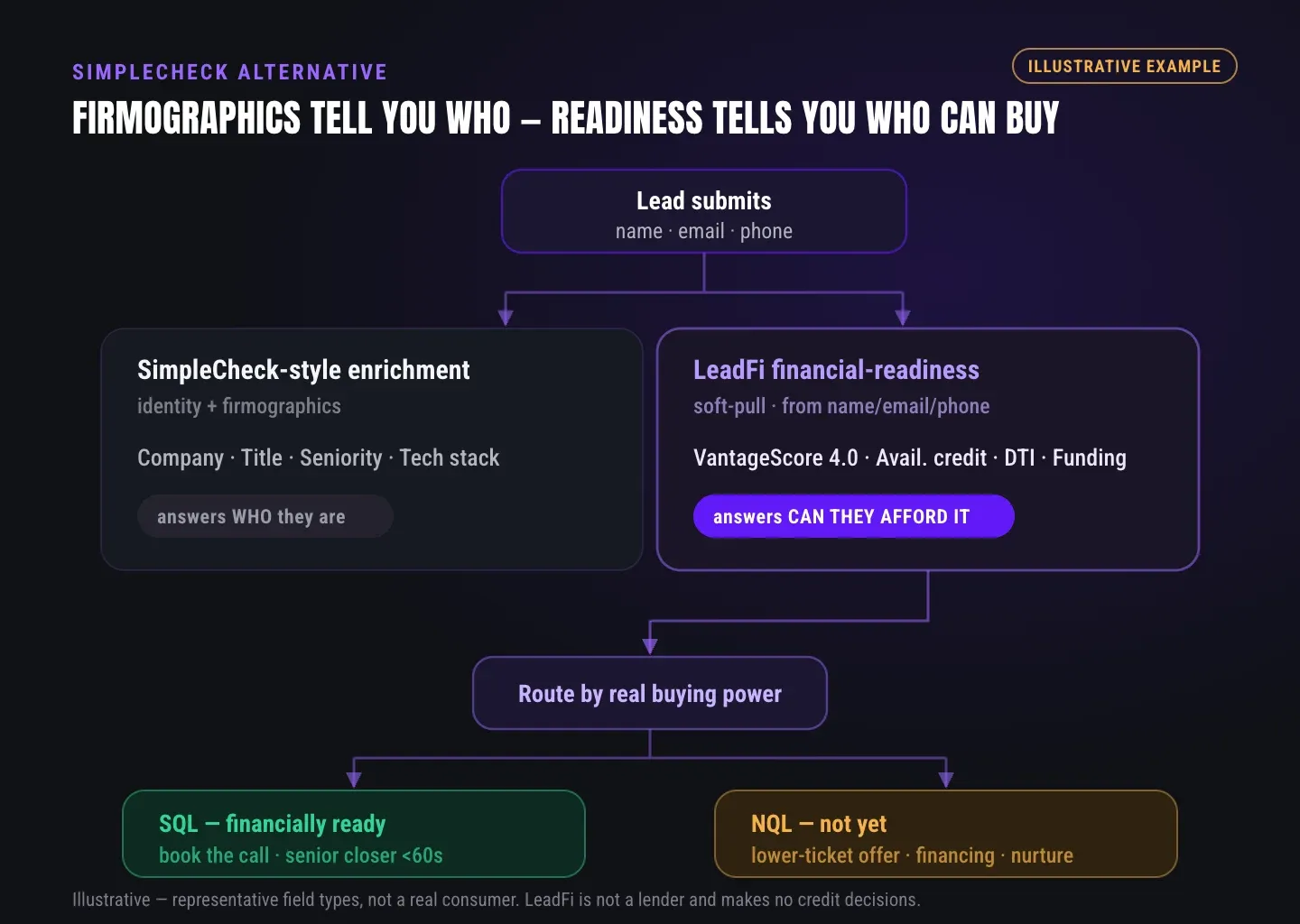
Quick answer: Both a SimpleCheck-style tool and LeadFi sit behind your form or funnel to read financial signals after a lead submits. The difference is scope. A pure soft-pull tool mainly returns a credit-style reading. LeadFi turns that reading into routing — SQL vs NQL — plus CRM actions and ad signals, so the right next step happens while the lead is still warm.
Most soft-pull tools do one job well: they run a soft pull and hand back data. That job matters. Still, the data alone does not book calls or clear your closers' calendars.
LeadFi starts from the same input — often just name, email, and phone. Then it adds the workflow layer. It scores each lead, picks a path, and writes the outcome where your team already works. In other words, the "check" is step one, not the whole product.
Soft-Pull Prescreening, Defined Once
A soft pull reads financial-readiness signals without hurting the consumer's credit score. It is a prescreen, not an approval. LeadFi uses the soft pull to score readiness for routing and rep prep — never to approve or deny anyone.
Financial-Readiness Signals It Can Surface
Signals may include VantageScore 4.0, available credit, income, debt, and debt-to-income (DTI). Depending on your setup, they can also include funding pre-approval signals, age, and optional asset context. Each one feeds a routing rule, not a verdict on the person.
SQL vs NQL, in Plain Terms
An SQL is a sales-qualified lead — someone whose readiness clears your bar. An NQL is a non-qualified lead — still valuable, just a different path. LeadFi is designed to split the two automatically, so closers see SQLs first.
Who This Comparison Is For
This guide fits high-ticket teams: coaches, consultants, agencies, funding shops, mortgage, real estate, and insurance. The common thread is a $3,000+ offer and paid or organic lead volume. If you sell low-ticket with no upsell, most of this will not apply.
GUIDE
The Questions Worth Asking of Either Tool
Quick answer: Judge any SimpleCheck alternative on five things: input friction, signal depth, routing, CRM write-back, and ad-signal feedback. A tool that only returns a score leaves your team to route by hand. A financial-readiness engine closes that gap and acts on the reading in seconds.
Below are the questions that separate a data feed from a workflow. Ask them of every vendor on your shortlist, LeadFi included. Where an answer depends on your stack, get it in writing before launch.
What Inputs Does It Need to Match a Lead?
Some tools want a full address and date of birth up front, which adds form friction. LeadFi can often work from name, email, and phone for many paths. Its identity matching is designed to confirm a high-confidence match before the soft pull. As a result, fewer required fields usually means higher form completion.
How Deep Are the Readiness Signals?
A single score is thin. For high-ticket routing, you often want income, debt, DTI, and available credit together. That fuller picture is what tells a closer whether a lead can fund a $5,000 program today or needs a financing path.
Does It Route, or Just Report?
This is the big fork: reporting hands you data, while routing acts on it. LeadFi is built to send SQLs to a closer calendar and push NQLs to a low-ticket offer, a payment plan, or a financing path — in real time, based on rules you set.
Where Do Outcomes Land in Your CRM?
Ask exactly what gets written back: fields, tags, pipeline stages, or workflow triggers. Vague "CRM integration" is not enough. In practice, LeadFi can push qualification status and permitted fields into GoHighLevel, HubSpot, and similar stacks via webhook, API, Zapier, or Make.
Can It Feed Ad Platforms Cleaner Signals?
Most funnels optimize on opt-ins, so ad algorithms learn to find cheap leads. LeadFi can send SQL-quality events back to Meta, Google, TikTok, or Hyros where permitted. As a result, campaigns train on financially ready buyers instead of every form-fill. No platform performance is guaranteed.
INTELLIGENCE LAYER
Where a Financial-Readiness Layer Changes the Workflow
Quick answer: A readiness layer changes what happens in the 60 seconds after submit. Instead of every lead hitting one calendar, SQLs book instantly, NQLs get a monetization path, and your CRM records why. As a result, closers spend their hours on buyers with real buying power — not on interested-but-broke leads that stall at the payment step.
Here is the mechanical difference. A soft-pull-only tool ends at the reading. However, a financial-readiness engine treats the reading as a trigger for the next action.
Speed-to-Lead for Qualified Buyers
When a lead clears your readiness bar, seconds matter. LeadFi is designed to flag SQLs on submit, so your team can reach out quickly — with prior consent in place for any automated call or SMS. In practice, faster contact on ready buyers tends to lift show rates and close rates.
NQL Monetization Instead of Dead Ends
An NQL is not a wasted lead — it is a different offer. For example, LeadFi can route lower-readiness leads to a sub-$3,000 low-ticket offer, a payment plan, or a financing path. Consequently, more of your paid traffic earns its keep instead of clogging a closer's calendar.
Cleaner Signals Back to Your Ad Stack
Booked calls matter, but financially qualified booked calls matter more. When LeadFi feeds SQL events into your pixels, the algorithm has better data to chase. Over time, that can lower cost per acquisition without raising spend — results vary and are never guaranteed.
Financing Paths for High-Ticket Offers
For offers over $10,000, affordability is the real blocker. LeadFi can use income and DTI to flag leads for financing options, then route them to a credit-stacking team. This is readiness for routing — not a funding promise or approval.
Compliance-Aware Setup as Onboarding Help
Adding financial questions raises real questions about consent and disclosures. LeadFi helps teams line up privacy language, consent language, and TCPA-aware and FCRA-aware workflow choices before launch. That is onboarding help, not legal advice — your counsel still reviews your use case.
See which of the leads you already have can actually afford to buy.
GUIDE
How to Evaluate Against Your Own Funnel
Quick answer: Map your funnel first, then test the tool against it. Name the metric you want to move — raw leads, applications, pre-calls, or booked calls. Next, run a small batch of real leads and check the outputs: match rate, signal depth, routing accuracy, and CRM write-back. A SimpleCheck alternative only earns a switch if it improves that named metric.
Do not evaluate in the abstract. The founders who convert fastest run their own lead volume against a tool and watch what lands. Here is a simple order of operations.
Step 1 — Name the Metric You Want to Move
First, pick one KPI: cheaper cost per SQL, fewer wasted closer hours, or higher show rate. That number is your scoreboard. Every other feature is secondary to whether the tool moves it.
Step 2 — Reprocess a Real Backlog
Then run a sample of leads you already know through the tool. You can often tell within a batch whether the readiness split matches reality. This beats any demo, because it uses your audience instead of a vendor's cherry-picked example.
Step 3 — Confirm Integration Scope in Writing
Next, ask whether setup is API-only or includes hands-on CRM build. If your team is not fluent in GoHighLevel or Salesforce, done-for-you wiring removes adoption risk. LeadFi can integrate via webhook, API, Zapier, Make, or native workflow — confirm the exact path for your stack.
Step 4 — Tune Thresholds to Your Audience
Finally, check that qualification cutoffs are programmable. A younger, thin-credit audience needs a different bar than a mortgage list. LeadFi lets you set thresholds per campaign, so "qualified" means what it means for your offer.
| Capability | Typical soft-pull-only tool | LeadFi (financial-readiness engine) |
|---|---|---|
| Core job | Return a soft-pull reading | Qualify, route, and monetize by buying power |
| Inputs | Often address + DOB up front | Can work from name, email, phone for many paths |
| Signal depth | Credit-style score | VantageScore 4.0, income, debt, DTI, available credit, more |
| SQL vs NQL routing | Manual, done by your team | Built-in, real-time after submit |
| CRM write-back | Varies | Fields, tags, stages, workflows via webhook/API/Zapier/Make |
| Ad-signal feedback | Rare | SQL events to Meta, Google, TikTok, Hyros (where permitted) |
| NQL monetization | Not addressed | Low-ticket, payment plans, or financing paths |
| Compliance-aware setup | Varies | Onboarding help (not legal advice) |
| SimpleCheck specifics | Not verified here | — |
Key takeaways
The short version
- Judge any SimpleCheck alternative on five things: input friction, signal depth, SQL vs NQL routing, CRM write-back, and ad-signal feedback.
- A soft-pull tool ends at the reading; a financial-readiness engine like LeadFi acts on it — routing SQLs to closers and NQLs to low-ticket or financing paths.
- LeadFi can often work from name, email, and phone, using identity matching to confirm a high-confidence match before soft-pull prescreening.
- Signals like VantageScore 4.0, income, debt, and DTI feed routing rules and rep prep — never a consumer approval or denial.
- Test any tool against a real lead backlog and a named KPI before switching; LeadFi supports compliance-aware setup but does not provide legal advice.
Quick answers
Fast answers before you dig in
What is a good SimpleCheck alternative for high-ticket teams?
If you only need a soft-pull reading, a data-only tool may be enough. If you want that reading to trigger SQL vs NQL routing, CRM write-back, and cleaner ad signals, a financial-readiness engine like LeadFi is built for that job. Test both against a real lead batch first.
How is a financial-readiness engine different from a soft credit check tool?
A soft credit check tool mostly returns data. LeadFi uses soft-pull prescreening as step one, then scores each lead, routes it SQL vs NQL, and writes the outcome into your CRM. It acts on the reading instead of stopping at it — and never approves or denies anyone.
Does a SimpleCheck alternative need an address to run a soft pull?
Not always. LeadFi can often work from name, email, and phone for many paths, because its identity matching is designed to confirm a high-confidence match before the soft pull. Confirm the exact rules for your specific workflow and disclosures.
FAQ
Common questions
What is the best SimpleCheck alternative for high-ticket teams?
How is LeadFi different from a soft credit check tool?
Does a SimpleCheck alternative need an address to run a soft pull?
What does SimpleCheck vs LeadFi come down to?
Will this affect a consumer's credit score?
How does LeadFi handle NQLs — the leads that don't qualify?
Can LeadFi feed signals back into my ads and CRM?
Sources
References
- CFPB — What is a credit inquiry? (hard vs. soft) (opens in a new tab)Federal regulator confirms a soft inquiry, unlike a hard inquiry, does not affect the consumer's credit score.
- VantageScore — VantageScore 4.0 credit scoring model (opens in a new tab)Official page describing VantageScore 4.0, the tri-bureau, trended-data model used to assess credit risk.
- CFPB — Who can request to see my credit report? (opens in a new tab)Federal regulator explains the FCRA rules governing who may obtain a credit report.
Know who is ready before your next sales call.
LeadFi sits behind the tools you already run and acts on financial readiness after a lead submits. It does not replace your CRM, form, funnel, or calendar — it makes them smarter about who can buy.