
OMNIAIQ ALTERNATIVE
Looking for an OmniaIQ Alternative? What to Compare Before You Switch
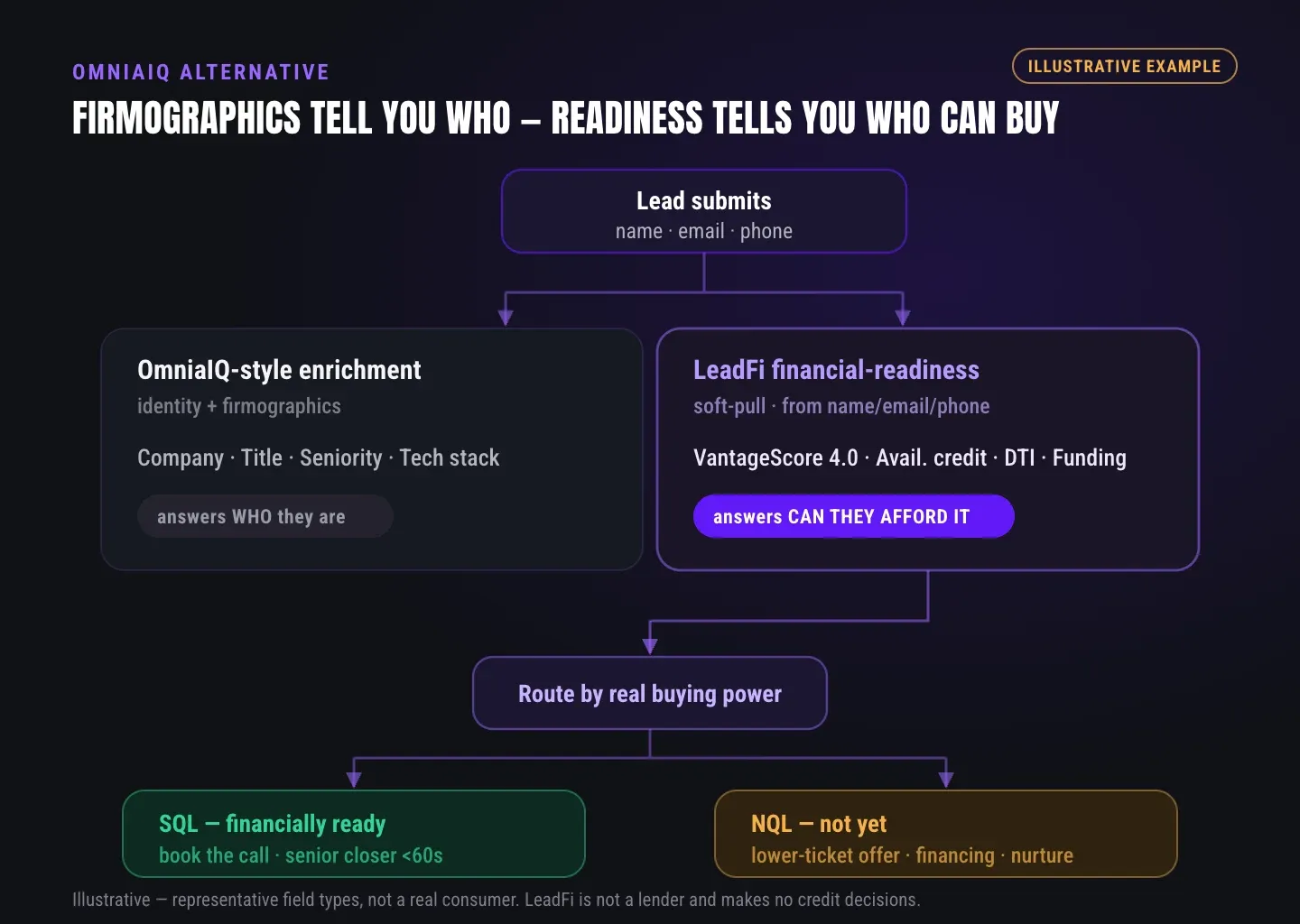
High-ticket teams searching for an OmniaIQ alternative are rarely shopping for a feature list. They are deciding one thing: which leads reach a closer's calendar, and which branch to a low-ticket, payment-plan, or financing path right after the submit.
Watch a contact get pre-qualified.
This is exactly what your CRM gets back.
Your opt-in form
Soft pull · no impact to their credit
This is not a real soft pull. It's an example of the data points that land in your CRM contact record when a lead fills out your form.
LEADFI DEMO
Watch the demo, then start free or book a call.
GUIDE
What both tools are actually for
Both platforms answer a narrow, costly question: can this lead afford what I sell — before a rep spends time on them?
For high-ticket teams, sales time is scarce. A closer working a $5,000 or $10,000 offer can only take so many calls a day. When half of those calls are with people who cannot pay, capacity gets burned on the wrong talks. That is the pain both OmniaIQ and LeadFi are built to reduce.
Quick answer: Both are financial pre-qualification tools that read soft-pull readiness signals from thin inputs, then route leads. LeadFi frames the whole motion as financial-readiness qualification — qualify, route, monetize, and feed signals back to ads. OmniaIQ's public materials describe qualification plus named loan-program matching and calendar intelligence for lenders and high-ticket sellers.
The shared job: qualify before the call
Each tool reads a soft pull, a permissioned credit check that does not affect the consumer's credit score. From that read, it estimates whether a lead is ready for the offer. That is the core value both sides sell.
Where the paths split
OmniaIQ's public pages lean into loan and mortgage program matching. LeadFi, by contrast, leans into SQL/NQL routing, monetizing lower-readiness leads, and pushing readiness signals into ad platforms. The starting point is the same, but the downstream focus differs.
Who each is for
OmniaIQ's public target market lists SMB lenders, lead providers, mortgage lenders, coaches, and BNPL. LeadFi serves the same high-ticket and credit-adjacent world: coaches, agencies, consultants, funding shops, mortgage, real estate, and insurance teams selling roughly $3,000 and up.
GUIDE
What OmniaIQ appears to focus on
Grounded only in OmniaIQ's public materials. Where a detail is not public, we mark it or omit it.
OmniaIQ's public materials describe a financial-qualification-before-the-call platform for lenders and high-ticket sellers. In practice, the positioning points to a strong focus on program matching — connecting a qualified lead to the loan, mortgage, or BNPL product they fit.
Public positioning
OmniaIQ positions itself as financial qualification before a phone call, with a soft-pull credit read, available credit, and debt-to-income. Its public home page describes pre-qualifying every application within seconds, soft-pull only, with no SSN and no score impact. In addition, public materials describe TCPA-aware handling and encryption.
What it appears to do well
Their public pages describe several genuine strengths. For example, named program matching stands out, since public materials list SBA 7(a), Term Loan, Business LOC, Equipment Lease, MCA, Conventional, FHA, VA, Jumbo, Affirm, Klarna, Bread, and HELOC. For a lending or mortgage shop, that kind of program library is real value. In addition, public materials describe published pricing, broad no-code form coverage, and a Verified File artifact.
Named integrations
OmniaIQ's home page names a wide integration list. For example, it includes HubSpot, Typeform, Webflow, WordPress, Zapier, Mailchimp, Calendly, Leadpages, ClickFunnels, Gravity Forms, GoHighLevel, Unbounce, Jotform, Kajabi, Salesforce, Meta Ads, and Google Ads. That breadth of no-code capture coverage is a clear buyer-facing plus.
Why teams still evaluate an alternative
Buying reasons vary, and none of them are knocks on OmniaIQ. For instance, some teams want native ad-platform feedback loops as the center of the workflow. Others run AI-agent stacks and want a live MCP connection. Still others live in Close, Pipedrive, or Zoho and want that coverage. When one of those needs is central, comparing a second option is just good diligence.
GUIDE
The questions worth asking of either
Before you switch, get concrete. The right tool is the one that fits how you already run leads, not the one with the longest feature list.
Quick answer: Ask five things. What inputs does it need? What signals does it read? How does it route SQLs vs NQLs? What does it write back to your CRM? And can it feed readiness signals to your ad platforms? Match those answers to your stack, not to a demo script.
What inputs does it need?
Both tools work from thin inputs. For example, OmniaIQ's public comparison page states its inputs are name, phone, and email — no address, no SSN. LeadFi also works from name, email, and phone. Then it uses patent-pending identity matching to reach a high-confidence match before the soft pull. For both, thin input means less form friction and fewer drop-offs.
What readiness signals come back?
LeadFi can surface VantageScore 4.0, available credit, income, debt, debt-to-income, funding pre-approval signals, age, and address — always as readiness for routing and rep prep, never as approval or denial. OmniaIQ's public materials describe a soft-pull credit read, available credit, and DTI. So ask each vendor which signals map to your qualification rules.
How does it route — SQL vs NQL?
This is the heart of it. An SQL is financially ready; an NQL is not, at least not yet. LeadFi splits the two, then acts: SQLs book a closer instantly, and NQLs redirect to a sub-$3,000 low-ticket offer, a payment plan, or financing. Ask whether routing is programmable per campaign, since a thin-credit audience needs different cutoffs than an established one.
What does it write back to your CRM?
Qualification is only useful where your team works. LeadFi writes outcomes into CRM fields, tags, pipeline stages, and workflows. Then it can trigger notifications and next steps. So ask any tool exactly what it pushes back, and whether it fits GoHighLevel, HubSpot, Salesforce, Close, Pipedrive, or Zoho.
Can it feed your ad platforms?
For high-ticket teams running paid traffic, this is often the deciding factor. LeadFi can send SQL-quality and readiness events back into Meta, Google, and TikTok — where permitted and correctly implemented — so ad algorithms train on financially qualified buyers, not cheap opt-ins. There are no platform performance guarantees. Still, the signal quality upgrade is the point.
WORKFLOW DESIGN
Where the workflow distinctions appear
Quick answer: LeadFi treats qualification as the start of a routing and monetization loop — SQL/NQL split, CRM writes, redirects, and ad-signal feedback. OmniaIQ's public materials emphasize qualification plus named loan-program matching and calendar intelligence. Choose by which downstream motion matters most to your team.
The two tools share the front door. However, the distinctions show up in what happens after a lead is scored.
LeadFi routes and monetizes every lead
LeadFi does not stop at "qualified vs not." NQLs are an asset, not waste. For example, a lower-readiness lead can route to a low-ticket offer under $3,000, a payment plan, or a financing path. As a result, paid traffic gets monetized end to end instead of half of it hitting a dead calendar.
LeadFi feeds the ad loop natively
For teams that live in paid acquisition, native CAPI-style feedback to Meta, Google, and TikTok is central. LeadFi's own readiness signal is VantageScore 4.0. OmniaIQ's public comparison page attributes native Meta/Google/TikTok feedback, a live MCP for agent stacks, and Close/Pipedrive/Zoho coverage to LeadFi. So treat those as their own public read of the distinction.
OmniaIQ leans into program matching
Their public materials describe matching qualified leads to named loan, mortgage, and BNPL programs. For a lending or mortgage operation, that program library is a real, differentiated strength. So if program matching is your core motion, weigh it heavily.
Both handle scheduling — differently framed
LeadFi does not replace your calendar tool. Instead, it decides which lead reaches which calendar or next step based on readiness. OmniaIQ's public materials describe Calendar Intelligence as part of its own routing engine. Either way, scheduling stays scheduling; the value is deciding who gets on it.
See which of the leads you already have can actually afford to buy.
WHO IT'S FOR
Practical LeadFi workflows for high-ticket teams
Here is how LeadFi runs behind a live funnel. Each example assumes consent and disclosures are already in place, and that setup was designed to be compliance-aware before launch.
Example 1 — High-ticket coaching funnel
A coaching business sells a $7,500 program through a paid application funnel.
- First, a prospect submits the application form (ClickFunnels, Typeform, or a custom page).
- Then the form fires a webhook to LeadFi with name, email, and phone.
- Next, LeadFi runs the soft pull and reads readiness signals, with no impact on the prospect's credit score.
- SQL path: financially ready leads redirect straight to the closer's calendar and get a fast-follow-up flag in the CRM.
- NQL path: lower-readiness leads redirect to a sub-$3,000 low-ticket offer instead of the main calendar.
- After that, LeadFi writes the SQL/NQL tag, readiness fields, and pipeline stage back into the CRM.
- Finally, it sends an SQL-quality event to Meta and Google so the ad algorithm optimizes toward buyers who can pay.
The result: closers stop burning slots on people who cannot afford the program. Meanwhile, no traffic goes to waste, because NQLs still get a path.
Example 2 — Funding / lending / mortgage workflow
A funding agency sells high-ticket financing help and wants affordability clear before the call.
- First, a lead completes an application on a landing page or GoHighLevel form.
- Then the submit triggers LeadFi via API or Zapier.
- Next, LeadFi reads income, debt, DTI, available credit, and funding pre-approval signals.
- Ready path: leads that clear the team's thresholds route to a financing specialist's calendar, with readiness context attached for rep prep.
- Not-yet path: leads below threshold route to a low-ticket or credit-building offer — an alternate path rather than a dead end.
- After that, LeadFi updates the CRM record, tags the program fit, and moves the pipeline stage.
- Optionally, readiness signals feed the ad platforms so future spend attracts more qualified applicants.
For financing teams, this makes the affordability talk concrete before a rep ever dials. LeadFi does not approve or deny anyone; it prepares the routing and the rep.
GUIDE
How to evaluate against your own funnel
Quick answer: Map your current stack first — capture surface, CRM, calendar, ad platforms — then check which tool acts on all of it after submit. LeadFi complements what you already run. It sits behind the form or funnel and adds readiness routing rather than replacing your capture, CRM, or scheduler.
Do not evaluate on the demo alone. Instead, run your own numbers.
Start with the layer you actually need
If your center of gravity is native ad-platform feedback, an MCP connection for an AI-agent stack, or Close/Pipedrive/Zoho coverage, LeadFi may fit better. However, if named loan-program matching is your core motion, weigh OmniaIQ's public program library carefully.
Confirm it complements, not replaces
Say your team already uses forms, funnels, CRMs, calendars, or custom applications. Then you want a layer behind them rather than a rip-and-replace. LeadFi can complement that stack. For example, it receives leads after capture through webhook, API, Zapier, Make, or MCP. Next, it returns readiness and routing outcomes to the rest of your tools.
Test with a real backlog
Ask whether you can run an existing backlog of leads through the tool. For example, reprocessing leads you already paid for shows real routing behavior on your actual audience. That is far more useful than a canned demo.
Check the compliance-aware setup
Financial data deserves care. As a result, LeadFi helps teams design a compliance-aware workflow before launch. It aligns form disclosures, consent language, and CRM notes so prospects hear one consistent story. This is onboarding help, not legal advice, and not a compliance guarantee.
| Dimension | OmniaIQ public positioning | LeadFi workflow fit |
|---|---|---|
| Core focus | Financial qualification before a call, plus named loan/mortgage/BNPL program matching (public materials) | Financial-readiness engine: qualify, route, monetize, and feed ad signals after capture |
| Lead data / identity inputs | Public comparison page: name, phone, email — no address, no SSN | Name, email, phone; patent-pending identity matching for a high-confidence match before the soft pull |
| Qualification approach | Public: soft-pull credit read, available credit, DTI, entity/owner verification | Soft-pull readiness signals: VantageScore 4.0, available credit, income, debt, DTI, funding pre-approval, age, address |
| Routing | Public: Intelligent Routing Engine and Program Matching | SQL vs NQL split; SQLs to a closer, NQLs to low-ticket, payment-plan, or financing paths; programmable per campaign |
| CRM / workflow actions | Public: Universal Integration; CRM among named integrations | Writes fields, tags, stages, workflows; triggers notifications and next steps |
| Form / funnel / calendar fit | Public: broad no-code form list; Calendar Intelligence | Sits behind forms/funnels; decides which lead reaches which calendar or next step |
| Ad optimization signals | Not listed as an ad-feedback feature in reviewed public materials | Sends SQL-quality/readiness events to Meta, Google, TikTok where permitted (no performance guarantees) |
| Best fit by use case | Lending, mortgage, BNPL teams that value named program matching | High-ticket teams centered on SQL/NQL routing, monetizing NQLs, and native ad-signal feedback |
Pricing intentionally omitted; see each vendor's current pricing page for standing figures.
RELATED READING
Related guides
Explore practical insights on LeadFi vs OmniaIQ and practical insights on choosing a SimpleCheck alternative for related context.
Key takeaways
The short version
- The real OmniaIQ vs LeadFi decision is a routing call: which leads reach a closer, and which branch to a low-ticket, payment-plan, or financing path after submit.
- Both tools run soft-pull prescreening from thin inputs (name, phone, email); LeadFi adds patent-pending identity matching to reach a high-confidence match before the soft pull.
- OmniaIQ's public materials lean into named loan/mortgage/BNPL program matching; LeadFi centers SQL vs NQL routing, monetizing NQLs, and native ad-signal feedback.
- LeadFi can feed SQL-quality and readiness signals to Meta, Google, and TikTok where permitted — with no platform performance guarantees.
- LeadFi complements your stack rather than replacing it, and helps design a compliance-aware workflow before launch. It does not approve or deny consumers and does not provide legal advice.
Quick answers
Fast answers before you dig in
OmniaIQ alternative quick comparison
OmniaIQ and LeadFi both do financial pre-qualification and routing from thin inputs like name, phone, and email. LeadFi may fit better when native ad-platform signal feedback (Meta, Google, TikTok), a live MCP connection for AI-agent stacks, or Close/Pipedrive/Zoho coverage sits at the center of your workflow. OmniaIQ's public materials describe published pricing, named loan-program matching, and broad no-code form coverage as its strengths. Pick by the layer you actually need after the lead submits.
What is SQL vs NQL routing?
An SQL is a sales-qualified lead, financially ready for the offer. An NQL is a non-qualified lead, not ready yet. LeadFi labels each after submit, then routes SQLs to a closer's calendar and NQLs to a low-ticket, payment-plan, or financing path — protecting closer time without wasting traffic.
FAQ
Common questions
Is LeadFi a good OmniaIQ alternative for high-ticket coaches?
Does LeadFi need an address or SSN to qualify a lead?
What is SQL vs NQL routing, in plain terms?
Does LeadFi replace my CRM or calendar?
Can LeadFi feed financial-readiness signals to Meta and Google?
How does LeadFi handle compliance for financial data?
Can I test LeadFi on leads I already have?
Sources
References
- CFPB — What is a credit inquiry? (hard vs. soft) (opens in a new tab)Federal regulator confirms a soft inquiry, unlike a hard inquiry, does not affect the consumer's credit score.
- VantageScore — VantageScore 4.0 credit scoring model (opens in a new tab)Official page describing VantageScore 4.0, the tri-bureau, trended-data model used to assess credit risk.
- CFPB — Who can request to see my credit report? (opens in a new tab)Federal regulator explains the FCRA rules governing who may obtain a credit report.
Know who is ready before your next sales call.
If you are weighing an OmniaIQ alternative, the fastest way to decide is to watch a readiness engine run on your own stack. See how leads split into SQL and NQL, how each path routes, and what lands back in your CRM.