
iSoftPull Alternative | LeadFi
When high-ticket sales teams search for an iSoftPull alternative, they're looking for more than a different tool. They need a financial-readiness engine that qualifies leads on buying power, routes SQLs ahead of NQLs, integrates with modern CRM and ad stacks, and launches with compliance-aware workflows—without forcing prospects through address fields or requiring developer lift.
LeadFi is that alternative. iSoftPull was built for mortgage brokers, auto dealers, and lenders. It requires name and address to run assessments. LeadFi is purpose-built for high-ticket coaching, consulting, course creators, agencies, and info-product businesses. It works from name, email, and phone. It delivers real-time financial-readiness insights—including income estimates, available credit indicators, and identity signals like current address and age—and connects directly into the sales and marketing stacks high-ticket teams already use.
This page explains why businesses look for an iSoftPull alternative, where iSoftPull falls short for high-ticket sales, how LeadFi addresses those gaps, and how LeadFi's SQL vs NQL routing framework, native CRM integrations, and compliance-aware setup create a compounding advantage.
Why Businesses Look for an iSoftPull Alternative
Most businesses searching for an iSoftPull alternative aren't dissatisfied with iSoftPull's infrastructure. They're frustrated by the mismatch between what iSoftPull was designed to do and what high-ticket online businesses actually need.
Address-Input Friction Kills Opt-In Conversion
iSoftPull requires name and address to run assessments. For online funnels optimized for opt-in conversion, asking for a full mailing address raises form friction and can reduce completion rates. High-ticket coaching and consulting funnels typically capture name, email, and phone. Adding an address field may impact opt-ins, depending on the offer and traffic source.
Wrong ICP Positioning
iSoftPull's homepage and integration ecosystem are built for mortgage, business loans, personal loans, home improvement, heating and air, solar, and auto dealers. Those industries rely on in-person or high-touch qualification workflows where address capture is standard. High-ticket coaches, consultants, course creators, and agency owners operate differently: fast-moving digital funnels, self-service applications, and CRM-automated nurture sequences. iSoftPull's messaging, pricing tiers, and feature set don't speak to that buyer.
Why High-Ticket Teams Search for an iSoftPull Alternative
iSoftPull provides financial data but not a native SQL vs NQL routing framework, ad signal feedback loops into Meta or Google, or a paired approach for converting lower-readiness leads into revenue. Sales teams receive data but must build their own routing logic, CRM workflows, and lead-prioritization systems on top of the raw information.
Integration Complexity
iSoftPull offers API access and a proprietary interface but does not prominently document native integrations with GoHighLevel, HubSpot, Close, Pipedrive, or Keap. Most high-ticket businesses need webhook-based or Zapier-based plug-and-play connectivity—not developer work to wire custom API calls into their CRM.
These pain points explain why coaches, consultants, and agency owners search for an iSoftPull alternative for coaching, an iSoftPull alternative for high ticket sales, or even an iSoftPull alternative no address. They're looking for a solution built for their use case, not retrofitted from a lending-industry tool.
Why Teams Need an iSoftPull Alternative for High-Ticket Sales
iSoftPull is a strong platform for the industries it was designed to serve. For high-ticket online sales teams, several limitations create operational friction and missed revenue opportunities.
Why an iSoftPull Alternative Without Address Fields Matters
iSoftPull markets that assessments can be done with "a name and address only." Address is a required input, not optional. For businesses running paid traffic to VSL funnels, application pages, or webinar registrations, adding an address field to the opt-in form can reduce conversion. High-ticket funnels are optimized to capture name, email, and phone as quickly as possible—then qualify and route leads inside the CRM workflow before the sales call is booked.
Why LeadFi Is an iSoftPull Alternative for Coaches and Consultants
iSoftPull's industries-served list includes mortgage, business and personal loans, home improvement, heating and air, solar, insurance, and auto loans. High-ticket coaching, consulting, course creation, mastermind programs, agency retainers, and info-product businesses are not iSoftPull's target ICP. The language, workflows, and support documentation assume a lending or consumer-financing context, not a direct-sale high-ticket offer with application funnels, setter-closer sales pods, and CRM-driven nurture sequences.
No Native CRM Integrations for High-Ticket Sales Stacks
iSoftPull provides API access but does not prominently list native integrations with GoHighLevel, HubSpot, Close, Pipedrive, or Keap—the CRMs most commonly used by high-ticket sales teams. Integration requires developer work to wire API calls, parse JSON responses, and trigger CRM workflows based on returned data. For small and mid-sized businesses without in-house dev resources, this setup friction is a significant barrier.
No SQL/NQL Routing Framework or Ad Signal Feedback
iSoftPull delivers financial data but does not include a paired routing framework for prioritizing sales-qualified leads (SQLs) versus not-yet-qualified leads (NQLs). Sales teams must manually interpret indicators, then build their own routing logic inside the CRM. iSoftPull also does not feed qualified-lead signals back into Meta, Google, TikTok, or attribution platforms, so marketing teams cannot optimize ad campaigns for buying power—only for lead volume or cost per lead.
No NQL Monetization Framework
When iSoftPull surfaces a lead with lower readiness indicators, the sales team receives that information but no paired workflow to convert the lead into revenue through low-ticket offers, financing options, or alternate funnels. High-ticket businesses leave money on the table when they treat NQLs as dead leads instead of routing them into lower-ticket offers, nurture sequences, or alternate paths.
Bottom line: iSoftPull requires name and address, was built for mortgage and lending use cases, lacks native CRM integrations with GoHighLevel and similar platforms, and does not include SQL/NQL routing, ad signal feedback, or NQL monetization frameworks—making it less suited for high-ticket coaching, consulting, and online sales teams.
How LeadFi Works as an iSoftPull Alternative
LeadFi is a financial-readiness engine designed for high-ticket and credit-adjacent businesses. It helps teams qualify, route, monetize, and optimize leads based on readiness indicators—not just append data to a lead record.
Thin-Input Prescreening from Name, Email, and Phone
LeadFi works from name, email, and phone as inputs. It uses identity-matching technology to establish a high-confidence consumer match before prescreening workflows and, where applicable, deeper assessment processes. Unlike iSoftPull, which requires name and address, LeadFi generates financial-readiness insights from the lead data already captured in most high-ticket business workflows—reducing form friction and improving opt-in conversion.
Real-Time Financial-Readiness Insights
LeadFi provides real-time financial-readiness insights including:
- Income estimates
- Available credit indicators across revolving accounts
- Debt balance estimates
- Debt-to-income ratio calculated from available data
- Funding readiness signals based on financial profile and available capacity
- Identity signals such as current address and age (matched through identity-related information, not required as form inputs)
- Optional asset context including liquid assets, retirement accounts, brokerage holdings, and real estate equity (when available)
These signals are surfaced as readiness data for routing and rep prep—not as approval or denial decisions. LeadFi does not approve or deny consumers. It helps sales teams prioritize leads based on financial-readiness indicators before reps invest time on unqualified calls.
Designed for Financial-Readiness Qualification
LeadFi supports prescreening workflows for businesses that need to qualify leads on buying power before booking sales calls. It also supports deeper assessment workflows where applicable. The platform is designed for compliance-aware financial-readiness qualification. LeadFi helps clients set up a compliance-aware workflow before launch; this guidance is a value-add, not a blocker.
Important: LeadFi does not provide legal advice or guarantee compliance. Clients should review their specific use case with qualified legal counsel before launching financial-readiness qualification workflows.
SQL vs NQL Lead Routing: LeadFi’s High-Ticket Sales Framework
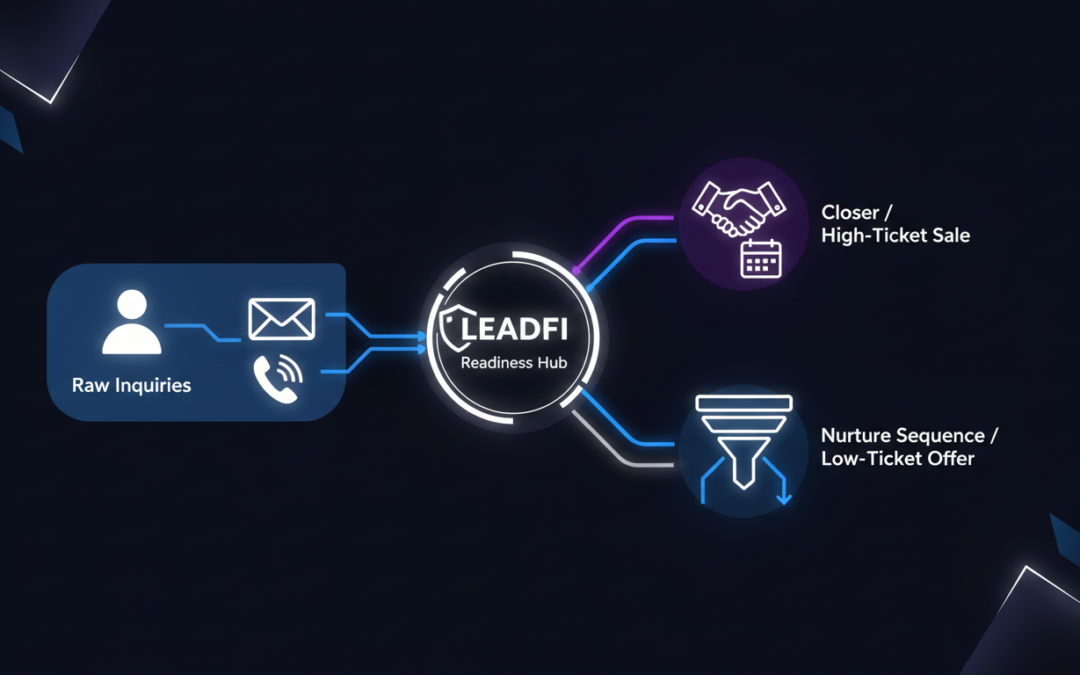
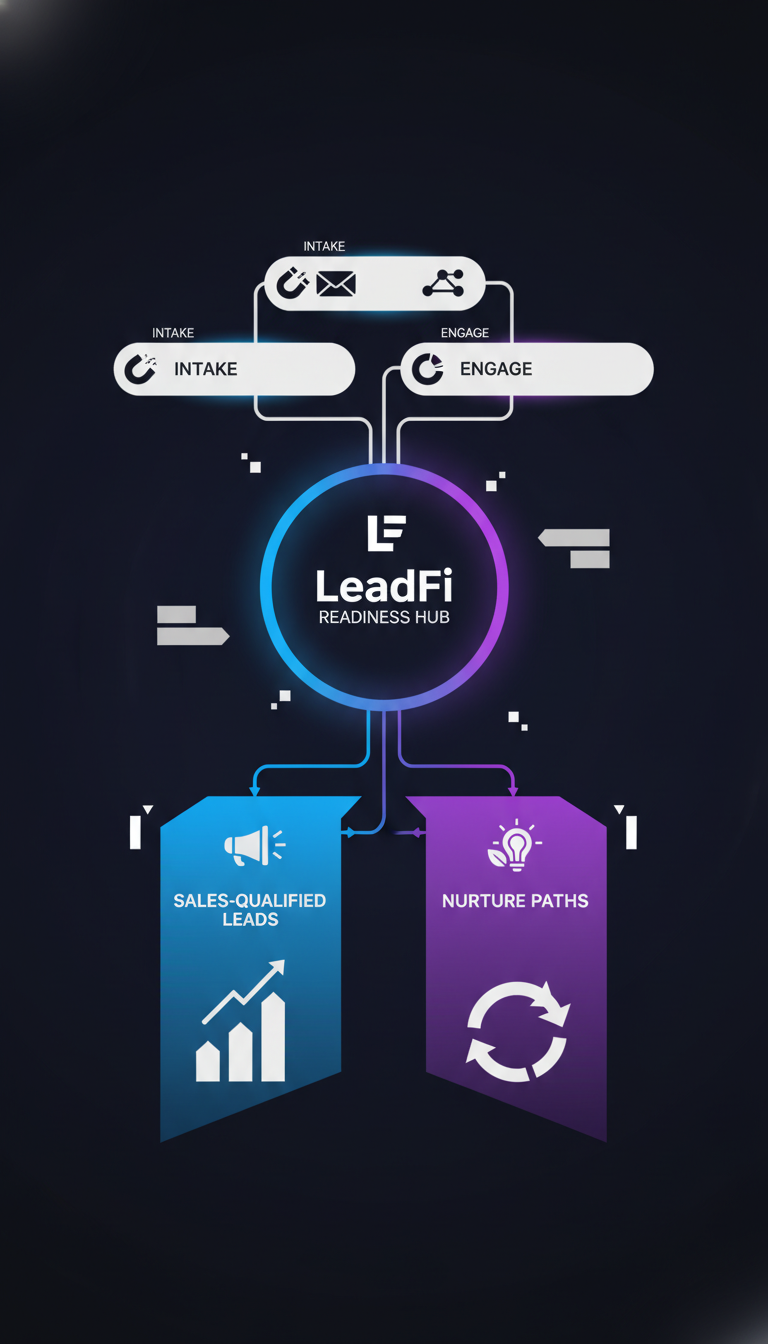
The SQL vs NQL framework is the operational backbone of LeadFi's value proposition for high-ticket sales teams. It transforms raw financial-readiness data into clear routing decisions that help businesses prioritize qualified leads, reduce wasted sales calls, and monetize lower-readiness leads through alternate paths.
What Is an SQL vs NQL?
SQL (Sales-Qualified Lead): A lead whose financial profile indicates strong readiness to afford and pay for the high-ticket offer. High readiness indicators, available credit, income sufficient to support the purchase price, and manageable debt-to-income ratio. SQLs are routed to senior closers, fast-track calendars, or immediate follow-up workflows.
NQL (Not-Yet-Qualified Lead): A lead whose financial profile suggests limited current readiness to afford the high-ticket offer at the present time. Lower readiness indicators, limited available credit, income below threshold, or high debt-to-income ratio. NQLs are routed to low-ticket offers, nurture sequences, or alternate funnels rather than consuming closer capacity on a call that may not convert.
How LeadFi Routes SQLs and NQLs
LeadFi integrates with the business's CRM (GoHighLevel, HubSpot, Close, Pipedrive, Keap, or similar) via webhook, API, Zapier, or Make. When a new lead is captured, LeadFi returns the financial-readiness profile to the CRM in real time. The CRM workflow automation then applies the business's routing rules:
- High readiness indicators + high available credit + sufficient income → Route to senior closer calendar, tag as SQL, prioritize for speed-to-lead
- Mid-range indicators + moderate capacity → Route to setter for triage call, or tag for nurture sequence with financing education
- Lower readiness + limited capacity → Route to low-ticket offer funnel (e.g., $997 self-study course instead of $10k high-ticket offer, a mastermind program, or a long-term nurture list
Why SQL vs NQL Routing Matters
High-ticket sales teams operate on constrained rep capacity. A senior closer handling $10K–$50K deals may have only 8–12 appointment slots per day. If half those calls are with leads who cannot afford the offer, the business is burning rep time, ad spend, and opportunity cost. LeadFi's SQL vs NQL framework ensures that financially qualified leads receive fast, high-touch attention, while lower-readiness leads are routed into alternate paths where they can still generate revenue—just at a different price point or timeline.
This is not about rejecting leads. It's about capturing value from every lead by routing each one to the right offer, rep, and timeline based on their current financial readiness.
Native CRM and Ad Platform Integration
LeadFi integrates directly into the modern high-ticket sales and marketing stack—no heavy developer lift required.
CRM Integration
LeadFi connects to CRMs including GoHighLevel, HubSpot, Close, Pipedrive, and Keap via:
- Webhook (real-time push of financial-readiness data to CRM when lead is captured)
- API (programmatic query for on-demand pulls)
- Zapier (no-code workflow automation for connecting LeadFi to 5,000+ apps)
- Make (formerly Integromat; visual workflow builder for advanced routing logic)
When a new lead enters the CRM, LeadFi returns the readiness indicators, available credit, income, debt-to-income ratio, address, age, and other signals as custom fields or tags. The CRM workflow automation can then apply SQL vs NQL routing rules, assign leads to specific rep calendars, trigger nurture sequences, or update lead scores based on financial readiness.
Ad Platform Signal Feedback
LeadFi can feed qualified-lead signals back into Meta, Google, TikTok, Hyros, and attribution platforms to optimize ad campaigns for buying power—not just lead volume. When an SQL is identified, LeadFi (or the CRM workflow triggered by LeadFi data) can fire a custom conversion event to Meta's Conversions API, signaling that this lead represents a high-value prospect. Over time, Meta's algorithm learns to prioritize audiences with similar financial profiles, improving targeting efficiency and reducing cost per qualified lead.
NQLs can also be added to exclusion audiences to prevent the pixel from spending budget on lookalikes of lower-readiness leads. This creates a compounding advantage: every lead that flows through LeadFi trains the ad platform to find better leads tomorrow.
Why Native Integration Matters
iSoftPull requires developer work to wire API calls into CRMs and does not prominently document native integrations with the platforms high-ticket businesses use most. LeadFi is designed to plug into existing workflows with minimal setup friction, so businesses can launch financial-readiness qualification in days—not weeks or months.
Compliance-Aware Setup: A Value-Add, Not a Blocker
Many high-ticket business owners hesitate to explore financial-readiness qualification because they assume compliance setup will be complicated, expensive, or require months of legal work. LeadFi helps clients set up a compliance-aware qualification workflow before launch—and frames that setup as a value-add, not a blocker.
What LeadFi Helps With
As part of onboarding, LeadFi provides guidance on:
- Privacy policy language appropriate for prescreening and financial-readiness qualification workflows
- Consent language for lead capture forms and application pages
- TCPA-aware practices for phone and SMS follow-up after financial qualification
- Workflow considerations for businesses using financial-readiness data to route and qualify leads
This guidance is not legal advice. LeadFi does not provide legal advice, guarantee compliance, or replace counsel. Clients should review their specific use case with qualified legal counsel before launching financial-readiness workflows.
Why This Matters
Most high-ticket businesses do not have a compliance team or in-house counsel. They need practical help to set up consent flows, privacy disclosures, and CRM workflows that align with regulatory expectations for prescreening. LeadFi helps clients put those pieces in place as part of onboarding, so they can launch with confidence—not spend months paralyzed by uncertainty or hire expensive consultants to draft policies from scratch.
Clients do not need a fully finished compliance program before working with LeadFi. LeadFi helps build the compliance-aware workflow as part of the setup process.
Important Clarifications
- LeadFi supports compliance-aware workflows
- LeadFi does not approve or deny consumers
- LeadFi does not provide legal advice or guarantee compliance
- Clients should review their use case with counsel
- When using financial-readiness data to make routing or prioritization decisions, clients should understand applicable notice and disclosure obligations
- LeadFi's guidance is a starting point; legal review is required before launch
Quick answers
What is an iSoftPull alternative for high-ticket sales?
An iSoftPull alternative for high-ticket sales is a financial-readiness engine that qualifies leads on buying power without requiring address input, integrates natively with high-ticket CRMs like GoHighLevel, includes SQL vs NQL routing frameworks, and feeds qualified-lead signals back into ad platforms. LeadFi is purpose-built for this use case.
Does LeadFi require address input?
No. LeadFi works from name, email, and phone as inputs. It uses identity-matching technology to establish a high-confidence consumer match and surface identity signals such as current address—without requiring the prospect to manually enter an address on the lead capture form.
How does LeadFi compare to iSoftPull?
iSoftPull is built for mortgage brokers, auto dealers, and lenders. It requires name and address, lacks native integrations with GoHighLevel and similar CRMs, and does not include SQL vs NQL routing or ad signal feedback loops. LeadFi is purpose-built for high-ticket coaching, consulting, and agencies. It works from name/email/phone, integrates natively with high-ticket CRMs, and includes a complete financial-readiness routing framework.
What CRMs does LeadFi integrate with?
LeadFi integrates with GoHighLevel, HubSpot, Close, Pipedrive, Keap, and similar CRMs via webhook, API, Zapier, or Make. Financial-readiness data is pushed into the CRM as custom fields or tags, triggering SQL vs NQL routing workflows, rep assignment, nurture sequences, or low-ticket offer funnels.
Examples
- A high-ticket coaching business running paid traffic to a webinar funnel captures name, email, and phone on the registration page. LeadFi returns financial-readiness indicators in real time. Leads with high readiness and available credit are tagged as SQLs and routed to the senior closer's calendar within 5 minutes. Leads with lower readiness are routed to a $497 mini-course offer instead of the $10K mastermind.
- A consulting agency uses LeadFi to qualify inbound leads from a $25K retainer application form. When a lead submits the form, LeadFi returns income estimates, available credit, and debt-to-income ratio to the agency's GoHighLevel CRM. The CRM workflow assigns SQL leads to the founder's calendar and NQL leads to a junior setter for triage and alternate-offer presentation.
- A course creator runs Facebook ads to a free training + application funnel. LeadFi feeds qualified-lead signals back into Meta's Conversions API when an SQL is identified. Over 30 days, Meta's algorithm learns to prioritize audiences with similar financial profiles, reducing cost per qualified lead by 40% and improving sales-call show rates.
Comparison
| Feature | iSoftPull | LeadFi |
|---|---|---|
| Input Requirements | Name + Address | Name + Email + Phone |
| Target ICP | Mortgage, auto dealers, lenders | High-ticket coaching, consulting, agencies |
| CRM Integrations | API only; no native GoHighLevel/HubSpot docs | Native webhook, Zapier, Make for GoHighLevel, HubSpot, Close, Pipedrive, Keap |
| SQL vs NQL Routing | None; manual interpretation required | Built-in framework with CRM workflow automation |
| Ad Signal Feedback | None | Meta, Google, TikTok, Hyros conversion events |
| NQL Monetization | None | Low-ticket offer routing, nurture sequences, alternate funnels |
| Compliance-Aware Setup | Not documented | Included as part of onboarding (guidance, not legal advice) |
| Best For | Lending, mortgage, auto loans | High-ticket coaching, consulting, course creators, agencies |
FAQ
Does LeadFi require address input to run prescreening?
No. LeadFi works from name, email, and phone as inputs. It uses identity-matching technology to establish a high-confidence consumer match and surface identity signals such as current address and age—without requiring the prospect to manually enter an address on the lead capture form. This reduces form friction and improves opt-in conversion for high-ticket online funnels. iSoftPull, by contrast, requires name and address.
How does LeadFi compare to iSoftPull for high-ticket sales?
iSoftPull is built for mortgage brokers, auto dealers, and lenders. It requires name and address, lacks native integrations with GoHighLevel and similar CRMs, and does not include SQL vs NQL routing, ad signal feedback loops, or NQL monetization frameworks. LeadFi is purpose-built for high-ticket coaching, consulting, course creators, and agencies. It works from name/email/phone, integrates natively with the CRMs and ad platforms high-ticket businesses use, and includes a complete financial-readiness routing framework that helps teams prioritize SQLs, monetize NQLs, and optimize ad spend for buying power.
What CRMs does LeadFi integrate with?
LeadFi integrates with GoHighLevel, HubSpot, Close, Pipedrive, Keap, and similar CRMs via webhook, API, Zapier, or Make. Financial-readiness data (income estimates, available credit indicators, debt-to-income ratio, address, age, funding readiness) is pushed into the CRM as custom fields or tags, triggering SQL vs NQL routing workflows, rep assignment, nurture sequences, or low-ticket offer funnels.
Does LeadFi provide legal advice or guarantee compliance?
No. LeadFi does not provide legal advice or guarantee compliance. LeadFi helps clients set up a compliance-aware qualification workflow before launch, including guidance on privacy policy language, consent language, TCPA-aware practices, and workflow considerations. This guidance is a value-add to help clients launch confidently—not a substitute for qualified legal counsel. Clients should review their specific use case with counsel before launching financial-readiness qualification workflows. When using financial-readiness data to make routing or prioritization decisions, clients should understand applicable notice and disclosure obligations.
Can LeadFi optimize ad campaigns for buying power?
Yes. LeadFi can feed qualified-lead signals back into Meta, Google, TikTok, Hyros, and attribution platforms to help optimize ad targeting for buying power—not just lead volume. When an SQL is identified based on readiness indicators, available credit, and income, the CRM workflow (triggered by LeadFi data) can fire a custom conversion event to Meta's Conversions API or Google's Enhanced Conversions. Over time, the ad platform learns to prioritize audiences with similar financial profiles, improving cost per qualified lead and reducing wasted spend on lower-readiness prospects.
Is LeadFi only for coaches and consultants?
LeadFi is designed for high-ticket and credit-adjacent businesses including coaching, consulting, course creators, info products, marketing agencies, sales agencies, business funding, mortgage, lending, real estate, insurance, and auto loans—any business selling offers roughly $1,000 and up. The SQL vs NQL routing framework, CRM integration, and ad signal feedback loops apply across industries where financial readiness is a key qualification variable.
See LeadFi in Action
If you're searching for an iSoftPull alternative for high ticket sales, an iSoftPull alternative for coaching, or an iSoftPull alternative no address, LeadFi is purpose-built for your use case.
LeadFi helps high-ticket businesses:
- Qualify leads based on real buying power—not self-reported application data
- Route SQLs to senior closers and fast-track calendars for speed-to-lead
- Route NQLs to low-ticket offers, nurture sequences, or alternate funnels to capture revenue from every lead
- Integrate natively with GoHighLevel, HubSpot, Close, Pipedrive, Keap, and similar CRMs via webhook, API, Zapier, or Make
- Feed qualified-lead signals back into Meta, Google, TikTok, and Hyros to optimize ad spend for buying power
- Launch with compliance-aware workflow guidance for privacy, consent, TCPA, and other considerations
LeadFi works from name, email, and phone. No address required. No developer lift to integrate. No heavy compliance project before launch—LeadFi helps you set up the compliance-aware workflow as part of onboarding.
This is not generic assessment software. This is a financial-readiness engine that helps you qualify, route, monetize, and optimize leads based on real buying power—so your sales team stops wasting time on unqualified calls and your marketing team starts optimizing for the metrics that actually drive revenue.
Book a demo or start a trial to see LeadFi in action. Experience the difference between a lending-industry tool retrofitted for high-ticket sales and a platform built from the ground up for coaches, consultants, course creators, and agencies who need to know who can pay before the closer says hello.
LeadFi supports compliance-aware workflows. LeadFi does not provide legal advice or guarantee compliance. LeadFi does not approve or deny consumers. Clients should review their use case with counsel.